
How Do Spray Mops Work? A Complete Floor-Cleaning Guide

Quick Answer
A spray mop works by storing floor cleaner or water in an onboard bottle and releasing a controlled mist when you squeeze its trigger. You then move the microfiber pad over the dampened area, where the fibers loosen, absorb, and collect dirt. This low-moisture approach is especially useful on floors that should not be soaked, although you should still follow wood-floor care guidance and your flooring manufacturer’s instructions.
How the cleaning cycle works
- Fill the reservoir: Add an approved ready-to-use cleaner or correctly diluted solution.
- Pull the trigger: The mop sprays a small amount of liquid ahead of the cleaning head.
- Move the pad: Microfiber creates friction that loosens dirt and sticky residue.
- Capture the soil: The pad holds loosened dust, grime, and moisture instead of requiring a bucket.
- Let it dry: A properly used spray mop should leave only a thin film of moisture behind.
Quick tip
- Sweep or vacuum first. Spray mops clean surface residue well, but most cannot collect larger crumbs, hair, or grit effectively.
I use spray mops when I want fast floor cleaning without carrying a bucket through the house. They give me much better moisture control than a soaked string mop.
The basic design is simple, but technique matters. This guide explains how spray mops work, what the microfiber pad does, which floors suit them, and how to prevent streaks or damage.
In This Guide
- What Is a Spray Mop?
- How Do Spray Mops Work?
- How Does a Spray Mop Actually Clean the Floor?
- Spray Mop vs. Other Mops: What’s Different?
- Which Floors Can You Clean With a Spray Mop?
- How Do You Use a Spray Mop Correctly?
- Why Does a Spray Mop Leave Streaks or Stop Spraying?
- Spray Mop FAQs
- Is a Spray Mop Right for Your Floors?
What Is a Spray Mop?
A spray mop is a flat floor mop with an onboard liquid reservoir and a built-in spray system. A hand trigger usually controls how much cleaner reaches the floor.
Unlike a traditional mop, you don’t dip the head into a bucket. The cleaning liquid travels directly from the bottle to one or more spray nozzles.
Definition: A spray mop is a low-moisture floor-cleaning tool that combines a refillable or replaceable cleaner reservoir, controlled spray mechanism, flat mop head, and absorbent cleaning pad.
Most modern versions use microfiber pads. Microfiber means extremely fine synthetic fibers that create many small contact points for collecting dust and moisture.
Some systems use washable pads. Others use disposable pads, proprietary cleaner cartridges, or both.
Brands such as Bona, O-Cedar, Rubbermaid, and Swiffer use variations of this design. Some powered mops add rotating or vibrating pads, but a basic manual spray mop needs no electricity.
How Do Spray Mops Work?
Spray mops work through three actions: controlled liquid delivery, physical agitation, and soil pickup. The spray softens residue, while the pad supplies the wiping action that removes it.
That distinction is important. The liquid does not clean the floor by itself.
1. The reservoir holds the cleaning liquid
The bottle sits on or inside the mop handle. Depending on the design, you may refill it or replace a prefilled cartridge.
Always use a solution approved for both the mop and your flooring. More cleaner does not automatically produce a cleaner floor.
2. The trigger activates the spray mechanism
When you squeeze the handle trigger, a mechanical pump pushes liquid toward the nozzle. The nozzle spreads it across a relatively small area in front of the mop.
This gives you direct control over moisture. One pull may be enough for a lightly dusty section, while dried residue may need another light application.
3. The liquid softens surface soil
Water and cleaner wet dried spills, films, and fine particles. Surfactants in many floor cleaners help separate oily soil from the surface.
The EPA’s Safer Choice product search is useful if you want to research cleaners that meet its ingredient criteria.
Safety note: Always check your floor manufacturer’s care instructions and the cleaner label. Never assume a homemade solution is safe for every finish.
4. The microfiber pad lifts the loosened dirt
The mop head pushes the pad firmly across the surface. This creates enough friction to loosen ordinary footprints, dust films, food residue, and light grime.
The fibers then absorb liquid and hold particles. Once the pad becomes dirty, its cleaning performance drops quickly.
5. The remaining moisture evaporates
A spray mop should leave the floor damp rather than saturated. Good airflow usually helps the thin moisture layer dry faster than a heavily wet-mopped floor.
When I test one on dark laminate or smooth vinyl, I watch the floor behind the mop. If I can see puddles instead of a faint damp trail, I’m using too much liquid.
Section Takeaway: A spray mop does not simply spray cleaner. Its effectiveness comes from controlled moisture, microfiber friction, and a clean pad working together.
How Does a Spray Mop Actually Clean the Floor?
A spray mop is best at removing ordinary surface soil. Think footprints, light kitchen splashes, dust films, and small sticky spots.
It is less effective when loose debris is still scattered across the room. Mop over sand or crumbs and you may simply push them around.
What the spray does
- Wets dried residue: Moisture softens material stuck to the floor.
- Distributes cleaner: A fine spray places solution where you need it.
- Reduces soaking: You control the application rather than flooding the floor.
- Supports spot cleaning: You can treat one dirty area without wetting an entire room.
What the pad does
- Creates friction: The fibers mechanically loosen surface soil.
- Collects particles: Fine debris becomes trapped in the pad.
- Absorbs moisture: The pad removes some liquid as you pass over the floor.
- Reduces redistribution: A clean pad holds soil instead of returning it to the surface.
Cleaning is also different from disinfecting. CDC guidance notes that routine household cleaning is usually enough unless illness or another situation creates a reason to disinfect.
If disinfection is necessary, follow the CDC’s household cleaning and disinfection guidance and the product’s required contact time.
Spray Mop vs. Other Mops: What’s Different?
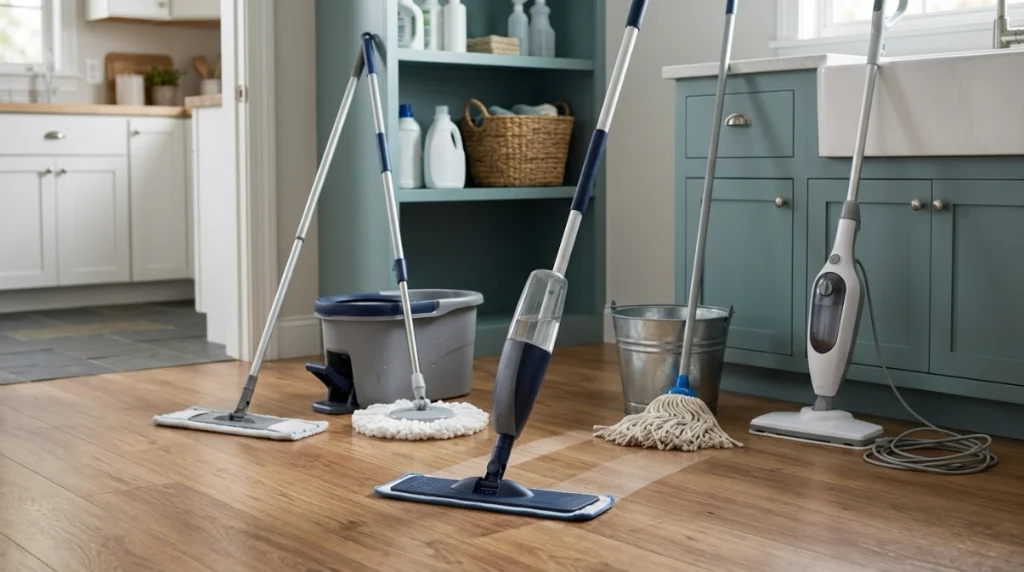
The biggest advantage of a spray mop is moisture control. You carry the cleaner on the mop and release only what the current area needs.
Here’s how common household mop types compare.
| Mop Type | Liquid Delivery | Heat | Moisture Control | Best Fit |
|---|---|---|---|---|
| Spray mop | Trigger-controlled mist | None | High | Quick maintenance and spot cleaning |
| Flat microfiber mop | Pad is pre-dampened or floor is sprayed separately | None | High | Delicate floors and controlled damp cleaning |
| Spin mop | Bucket and wringer | None | Medium | Larger rooms and heavier wet cleaning |
| String mop | Bucket saturation | None | Low to medium | Large durable surfaces |
| Steam mop | Heated water vapor | Yes | Model dependent | Manufacturer-approved heat-resistant floors |
A spray mop is therefore closer to a microfiber flat mop than a steam mop. It relies on cleaner and wiping rather than high-temperature vapor.
For everyday cleaning, I also prefer not carrying dirty bucket water from room to room. Changing a soiled pad is usually faster.
Which Floors Can You Clean With a Spray Mop?
Spray mops can work on many sealed hard floors because you can limit the amount of liquid. Floor compatibility still depends on the cleaner, finish, seams, and manufacturer’s instructions.
As of 2026, I would never use the words “safe for all floors” without checking those details first.
Hardwood and engineered wood
Use minimal moisture and a cleaner specifically approved for the finish. Avoid leaving liquid sitting along plank joints.
Current NWFA technical guidance specifically recognizes high-quality spray mops as a way to control solution on appropriate wood floors. Manufacturer recommendations still take priority.
Laminate
Spray mops can suit laminate when the floor manufacturer permits damp cleaning. The key is preventing liquid from pooling in seams.
Use a fine mist and dry any visibly wet areas. Swollen edges can be difficult or impossible to reverse.
Vinyl, LVT, and LVP
These floors often respond well to low-moisture microfiber cleaning. Use a solution recommended for the specific vinyl product.
Avoid assuming that waterproof flooring means unlimited water exposure. Liquid can still travel between planks or under damaged edges.
Tile
Sealed ceramic and porcelain tile generally tolerate routine damp mopping well. Spray mops are useful for kitchens because you can target food splashes without filling a bucket.
Grout may require separate scrubbing when soil sits below the mop head’s contact surface.
Natural stone
Stone needs more caution. Acidic cleaners such as vinegar can damage acid-sensitive materials, including many marble and limestone surfaces.
Safety note: Check the stone, sealer, flooring manufacturer, and cleaner label before applying any solution.
Manufacturer-specific systems can also matter. Bona, for example, publishes separate spray-mop options for different surfaces in its spray mop floor-care guidance.
Section Takeaway: The spray mechanism helps control water, but it cannot make an unsuitable cleaner or cleaning method safe for a particular floor.
How Do You Use a Spray Mop Correctly?
The best technique uses less liquid than many first-time users expect. Your goal is to loosen the dirt and immediately collect it with microfiber.
- Sweep or vacuum first. Remove hair, sand, crumbs, and grit before adding moisture.
- Check the cleaning solution. Confirm that it suits both your mop system and flooring.
- Install a clean pad. A dirty microfiber pad can create streaks before you even begin.
- Start farthest from the exit. Work toward the doorway so you don’t walk across damp areas.
- Spray lightly. Mist a manageable section instead of covering the entire room at once.
- Mop through the spray. Use overlapping passes so the pad contacts every dampened area.
- Change the pad when dirty. Large rooms may require more than one microfiber pad.
- Check for wet spots. Wipe away excess liquid before leaving the room.
- Wash and dry the pad. Follow its care instructions before storing it.
For a sticky patch, I usually give the cleaner a few seconds to soften the residue. Then I make several passes with the pad rather than spraying repeatedly.
That approach reduces residue. It also keeps unnecessary moisture off the floor.
How much cleaner should you spray?
There is no universal number of trigger pulls because nozzle output varies by mop. Use enough to create a light damp film, not puddles.
If a section stays visibly wet long after you pass over it, reduce the amount. A fresh absorbent pad can also help.
How often should you change the microfiber pad?
Change it whenever it becomes heavily soiled or stops absorbing effectively. Continuing with a gray, saturated pad often spreads dirty solution across the next section.
In a busy kitchen, I sometimes switch pads halfway through even when cleaning only one room. The difference is easy to see on glossy flooring.
Why Does a Spray Mop Leave Streaks or Stop Spraying?
Most spray-mop problems come from too much cleaner, a dirty pad, clogged liquid delivery, or an unsuitable product. Start with the simplest cause.
If the floor looks streaky
- Use less solution: Excess cleaner can dry into a visible film.
- Change the pad: A saturated pad redistributes dirt.
- Check dilution: Concentrated cleaners may leave residue when mixed incorrectly.
- Remove old buildup: Previous products can create haze even after today’s dirt is gone.
If the mop will not spray
- Check the reservoir: Make sure it contains liquid and sits correctly.
- Inspect the nozzle: Dried cleaner can interfere with the spray pattern.
- Prime the trigger: Some systems need several squeezes after refilling.
- Check the bottle valve: A poorly seated cartridge can interrupt flow.
Can you put any cleaner in a spray mop?
No. Some spray mops accept refillable mixtures, while others are designed around a specific cleaner or cartridge.
Never mix cleaning chemicals simply to make them “stronger.” Follow the product label, and test unfamiliar floor cleaners in an inconspicuous area.
Safety note: Avoid combining bleach, ammonia, acids, disinfectants, or other cleaners. Use only products and dilution instructions intended for your floor and mop.
Spray Mop FAQs
Do spray mops actually clean floors?
Yes. Spray mops clean by applying a controlled amount of solution and using a microfiber pad to loosen and collect surface soil. They work best after loose grit, crumbs, and hair have been removed with a broom or vacuum.
Do you need to rinse after using a spray mop?
It depends on the cleaner. Many ready-to-use floor cleaners are designed as no-rinse formulas, while other products require rinsing. Follow the cleaner label because unnecessary rinsing can add excess water to moisture-sensitive floors.
Are spray mops better than regular mops?
Spray mops are often better for quick maintenance and floors needing controlled moisture. Traditional bucket mops can be more practical for large, heavily soiled areas. The best choice depends on the floor material and amount of dirt.
Can you use just water in a spray mop?
Some refillable spray mops can use plain water, but check the manual first. Water can remove light dust and fresh spills, while oily soil and stubborn residue may need an appropriate floor-cleaning solution.
Can spray mops be used on hardwood floors?
They can be suitable for some properly finished wood floors because the spray allows careful moisture control. Use a wood-floor-approved cleaner, keep liquid away from open seams, and follow the flooring or finish manufacturer’s instructions.
Do spray mops disinfect floors?
Not automatically. Cleaning and disinfecting are different processes. A disinfectant must be suitable for the floor and remain wet for its labeled contact time. Routine household floor cleaning usually does not require disinfection unless there is a specific reason.
Why does my floor feel sticky after spray mopping?
Sticky floors commonly result from excess cleaner, incorrect dilution, old product buildup, or a dirty microfiber pad. Reduce the amount of solution, replace the pad, and use a cleaner formulated for your specific flooring.
Is a Spray Mop Right for Your Floors?
For routine floor cleaning, a spray mop is one of the simplest ways to combine controlled moisture with effective microfiber wiping. It is especially convenient for quick kitchen cleanups, small homes, apartments, and spot cleaning.
The biggest mistake is treating the tool as universally safe. The mop may control the liquid, but your cleaner and floor still need to be compatible.
I get my best results by vacuuming first, using less solution than I think I need, and changing the pad early. Those three habits prevent most streaking problems.
If you’re deciding between a spray mop, flat microfiber mop, spin mop, or steam mop, start with the floor manufacturer’s cleaning instructions. Then choose the tool that gives you the safest level of moisture and enough cleaning power for your normal messes.
