
What Is a Spray Mop Used For?

Quick Answer
A spray mop is used for fast, controlled floor cleaning without carrying a bucket. It sprays a small amount of cleaning solution directly in front of a flat mop head, making it useful for everyday dirt, footprints, small spills, pet messes, and quick touch-ups. Spray mops are especially helpful on moisture-sensitive floors when used with the correct cleaner and minimal liquid, which matches the National Wood Flooring Association’s moisture-conscious cleaning guidance.
What a spray mop works best for
- Daily touch-ups: Remove footprints, light dirt, dust films, and small food marks quickly.
- Small spills: Clean localized messes without filling and carrying a mop bucket.
- Low-moisture cleaning: Apply a controlled mist instead of soaking hardwood, laminate, or LVP.
- Kitchen cleanup: Wipe away cooking splashes, crumbs, and light greasy residue after dry debris is removed.
- Pet areas: Handle paw prints and small tracked-in messes between deeper cleaning sessions.
Quick tip
- Sweep or vacuum first, then spray lightly and replace or rinse the microfiber pad when it becomes visibly dirty.
If you want faster floor cleaning without dragging out a bucket, a spray mop is one of the most practical tools to own. I use one most often for the small messes that don’t justify a full wet-mopping routine.
This guide explains exactly what spray mops do, where they work best, and when another mop makes more sense. I’ll also cover floor compatibility, cleaner choice, technique, and common mistakes.
In This Guide
- What Does a Spray Mop Actually Do?
- What Can You Clean With a Spray Mop?
- Which Floor Types Are Best for Spray Mops?
- Spray Mop vs Other Mops: Which Should You Use?
- How Do You Use a Spray Mop Correctly?
- What Cleaning Solution Should You Put in a Spray Mop?
- When Should You Not Use a Spray Mop?
- What Spray Mop Mistakes Cause Streaks or Damage?
- Frequently Asked Questions
What Does a Spray Mop Actually Do?
A spray mop combines a flat mop, cleaning pad, and liquid dispenser in one tool. You press a trigger or button, the mop sprays a light mist, and the pad wipes up loosened soil.
Definition: A spray mop is a floor-cleaning tool with an onboard liquid reservoir and spray mechanism that dispenses cleaner ahead of a reusable or disposable cleaning pad.
The main advantage is control. Instead of wetting an entire floor with a bucket mop, you apply liquid only where you need it.
It handles light and moderate soil
A spray mop works well on surface dirt that has not become deeply embedded. Think shoe marks, kitchen drips, pet paw prints, dust films, and everyday grime.
- Entryways: Tracked-in dust and light footprints.
- Kitchens: Small splashes, food marks, and light grease.
- Dining areas: Drink spots and minor food residue.
- Bathrooms: Light surface dirt on compatible sealed floors.
- Pet zones: Paw marks and localized messes.
It reduces setup time
A bucket mop may require filling, carrying, wringing, rinsing, and emptying a bucket. A ready-to-use spray mop can be grabbed for a two-minute cleanup.
That convenience changes how often people clean. In my own routine, I reach for a spray mop immediately after seeing muddy paw marks instead of leaving them until the next full mopping day.
It helps control moisture
Moisture control is one of the strongest reasons to use a spray mop. A fine mist is easier to manage than a saturated string or sponge mop.
This does not make every spray mop automatically safe for every floor. The floor manufacturer’s care instructions still come first.
What Can You Clean With a Spray Mop?
Spray mops are mainly designed for routine hard-floor cleaning. Their strength is maintenance cleaning, not heavy restoration work.
Everyday dirt and footprints
Microfiber pads are effective at collecting fine debris and wiping away marks after dry dirt has been removed. The flat head also keeps consistent contact with smooth flooring.
Always vacuum or sweep loose grit first. Wetting sand and crumbs can turn them into muddy residue or drag abrasive particles across the finish.
Small spills and sticky spots
A spray mop is useful when juice, coffee, sauce, or another small spill dries on a hard floor. Spray only enough cleaner to soften the mark, then make several controlled passes.
For thick or sugary spills, wipe up most of the material with a cloth first. That keeps the mop pad from becoming overloaded immediately.
Light kitchen grease
Kitchen floors often develop a thin greasy film near cooking areas. A floor-safe cleaner and clean microfiber pad can remove light residue before it builds up.
Heavy grease may require a cleaner specifically approved for the flooring material. Repeatedly spraying more product is not a substitute for using the right formula.
Quick maintenance between deeper cleans
A spray mop does not eliminate the need for occasional detailed cleaning. Corners, grout lines, textured surfaces, and heavily soiled areas may need brushes or other tools.
For routine maintenance, however, the spray mop is efficient. It is particularly useful in apartments and smaller homes where storing a large bucket is inconvenient.
Which Floor Types Are Best for Spray Mops?
Spray mops can work on many sealed hard floors because they dispense relatively little liquid. Compatibility still depends on the cleaner, flooring finish, and manufacturer instructions.
| Floor Type | Spray Mop Suitability | Typical Routine | Main Precaution |
|---|---|---|---|
| Sealed hardwood | Good with minimal moisture | About weekly in busy areas | Never leave pooled liquid |
| Laminate | Good when lightly misted | Every 1–2 weeks as needed | Protect seams from excess water |
| Vinyl/LVP | Very practical | Weekly or when visibly dirty | Avoid cleaner buildup |
| Ceramic/porcelain tile | Good for surface cleaning | About weekly in high traffic | Pads may not scrub deep grout |
| Natural stone | Only with approved cleaner | As needed | Avoid acidic formulas |
| Sealed concrete | Good for light maintenance | Every 1–2 weeks | Textured areas may need scrubbing |
Hardwood and engineered wood
A spray mop can be a strong choice for sealed wood because it limits liquid. The NWFA advises avoiding wet mops and recommends cleaning products made for the floor’s finish.
Keep the pad only lightly damp during use. If you can see puddles or wet trails sitting behind the mop, you are applying too much solution.
Laminate and LVP
Both surfaces benefit from controlled moisture, especially around joints and seams. A microfiber spray mop lets you clean small sections without flooding the floor.
Do not assume waterproof marketing means unlimited water is harmless. Follow the specific flooring brand’s care instructions.
Tile and stone
Spray mops work well across smooth ceramic and porcelain tile. Deep or recessed grout often needs more focused agitation than a flat pad can provide.
Natural stone requires more caution because acidic cleaners can harm some surfaces. Choose a stone-approved, usually pH-neutral product.
Safety note: Always check your flooring manufacturer’s care guide before using a new cleaner, especially on wood, laminate, natural stone, or specialty finishes.
Spray Mop vs Other Mops: Which Should You Use?
A spray mop is best when speed and moisture control matter. Other mop types become more useful as the mess gets larger or more stubborn.
| Mop Type | Best Use | Moisture Control | Main Limitation |
|---|---|---|---|
| Spray mop | Daily touch-ups | High | Limited for heavy grime |
| Flat microfiber mop | Dry or damp cleaning | High | Cleaner applied separately |
| Spin mop | Larger dirty areas | Moderate to high | Requires bucket setup |
| String mop | Large washable surfaces | Low to moderate | Can carry excess water |
| Steam mop | Compatible sealed surfaces | Controlled vapor | Heat is unsuitable for some floors |
For a quick breakfast spill, I would choose a spray mop. For a large muddy kitchen after a busy weekend, I would usually choose a spin mop with a proper wringer.
A steam mop is a different tool entirely. It uses heat and vapor, so you must confirm that the flooring manufacturer allows steam before using one.
How Do You Use a Spray Mop Correctly?
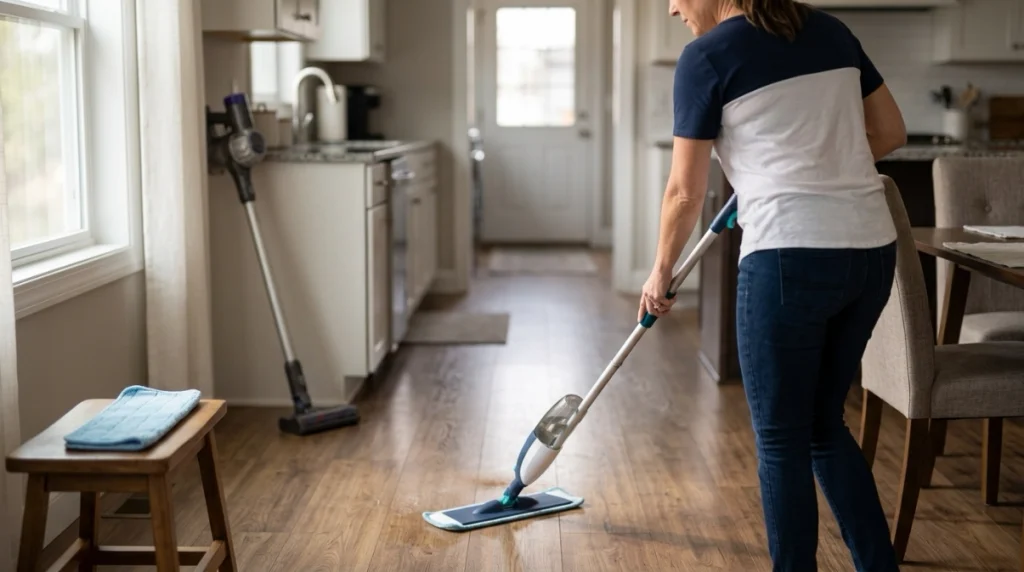
The basic technique is simple: remove dry dirt, apply a light mist, and mop with a clean pad. The details determine whether your floor dries clean or ends up streaky.
- Sweep or vacuum first. Remove grit, hair, crumbs, and loose debris.
- Check the cleaner. Confirm that it is approved for your exact floor type.
- Attach a clean pad. A dirty microfiber pad spreads soil instead of collecting it.
- Start far from the exit. Work toward the doorway so you avoid walking on freshly cleaned areas.
- Spray lightly. Mist a small section rather than repeatedly soaking the same spot.
- Use overlapping passes. Move steadily and keep the mop head flat against the floor.
- Change the pad when dirty. Large floors may require more than one clean pad.
- Let the floor dry. Keep foot traffic away until the surface is no longer damp.
How much solution should you spray?
Use enough to make the pad glide and loosen soil, but not enough to create puddles. On moisture-sensitive flooring, the surface should look lightly damp rather than visibly wet.
If the floor takes a long time to dry, reduce the amount you spray. A clean, dry microfiber pad can also remove extra moisture.
How often should you wash the pad?
Wash a reusable microfiber pad after each substantial cleaning session. Replace it during cleaning if it becomes dark with dirt or stops picking up residue effectively.
A clean pad is one of the easiest ways to prevent streaks. I have seen floors improve dramatically without changing cleaner simply by switching pads halfway through the room.
What Cleaning Solution Should You Put in a Spray Mop?
Use a cleaner approved by both the mop manufacturer and the flooring manufacturer. A pH-neutral floor cleaner is often the safest starting category for many sealed surfaces.
The EPA’s Safer Choice product search can also help consumers identify cleaning products that meet the program’s ingredient and performance requirements.
Do you need disinfectant in a spray mop?
Usually, no. The CDC’s cleaning and disinfecting guidance says routine cleaning is sufficient in many household situations, while disinfection becomes more relevant when illness is present.
A normal spray-mopping routine should focus on removing dirt and residue. Do not add disinfectants unless the product label allows that application on your floor.
Can you put vinegar in a spray mop?
The answer depends on the flooring rather than the mop alone. Vinegar is acidic and is a poor choice for natural stone and some finished surfaces.
Do not treat homemade vinegar mixtures as universally safe. The correct cleaner for sealed wood may be different from the correct cleaner for tile or vinyl.
Can you use dish soap or laundry detergent?
I don’t recommend casually adding either product to a spray mop reservoir. Both can leave excess surfactant residue when used too heavily, which may cause streaks or a sticky feel.
A dedicated floor cleaner is easier to dose correctly. Follow its label rather than guessing dilution ratios.
Safety note: Never mix bleach, ammonia, disinfectants, vinegar, or other cleaning chemicals unless the product label specifically instructs you to do so.
When Should You Not Use a Spray Mop?
A spray mop is not the right tool for every floor or mess. Avoid using it when the surface cannot tolerate liquid or the contamination requires a different cleaning method.
- Unsealed wood: Liquid can absorb into exposed wood fibers.
- Water-sensitive flooring: Follow the manufacturer’s restrictions before damp cleaning.
- Large liquid spills: Absorb the liquid first instead of trying to mop it around.
- Heavy mud: Remove loose soil before wet cleaning.
- Deep grout buildup: A brush may provide better agitation.
- Waxed or specialty finishes: Confirm cleaner compatibility first.
- Unknown flooring: Identify the material before applying cleaner.
A spray mop also should not be treated as a disinfecting machine automatically. Cleaning and disinfecting are different tasks with different product requirements.
What Spray Mop Mistakes Cause Streaks or Damage?
Most spray mop problems come from excessive cleaner, dirty pads, or skipping dry debris removal. These mistakes are easy to correct.
Spraying too much cleaner
More liquid does not necessarily mean more cleaning power. Too much solution can leave residue, increase drying time, and raise moisture exposure.
Mopping without vacuuming first
Loose dust mixes with cleaner and creates a dull film. Grit can also become trapped beneath the pad and scratch delicate finishes.
Using one dirty pad for the whole house
A microfiber pad has a finite dirt-holding capacity. Once loaded, it starts redistributing grime instead of lifting it away.
Using the wrong cleaner
A multi-surface label does not override your floor manufacturer’s care requirements. Hardwood, laminate, vinyl, stone, and tile finishes can react differently to the same formula.
Leaving cleaner in a refillable mop for too long
Some solutions can clog small spray passages or leave residue inside the reservoir. Follow the mop manufacturer’s storage and rinsing instructions.
Section Takeaway: Use less liquid than you think you need, start with a clean floor pad, and match the cleaner to the flooring. Those three habits prevent most spray-mop problems.
Frequently Asked Questions
Is a spray mop good for everyday cleaning?
Yes. A spray mop is especially useful for everyday footprints, light dirt, pet paw marks, food spots, and quick kitchen cleanups. It is faster than setting up a bucket and lets you control how much moisture reaches the floor.
Can a spray mop replace a regular mop?
It can replace a traditional mop for many routine cleaning jobs, especially on smooth hard floors. However, heavy mud, deeply soiled grout, large areas, or stubborn buildup may still require a spin mop, scrub brush, or deeper cleaning method.
Are spray mops safe for hardwood floors?
They can be suitable for sealed hardwood when used with minimal moisture and an approved wood-floor cleaner. Avoid soaking the surface, clean spills promptly, and follow the floor manufacturer’s instructions because finishes and installation methods vary.
Do spray mops clean or just spread dirt around?
A spray mop cleans effectively when you start with a clean microfiber pad and remove dry debris first. If the pad becomes saturated with grime, it can spread residue, so rinse or replace the pad during larger cleaning jobs.
Can you put plain water in a spray mop?
Many refillable spray mops can dispense water, but whether water alone is appropriate depends on the floor and mop instructions. Plain water may handle light dust films, while greasy or sticky soil usually needs a compatible floor-cleaning solution.
Why does my spray mop leave streaks?
Common causes include too much cleaner, dirty microfiber pads, leftover floor-product residue, hard-water minerals, or mopping over loose dirt. Start with less solution and a fresh pad, then check whether your cleaner requires dilution or rinsing.
Is a spray mop better than a steam mop?
Neither is universally better. Spray mops are convenient for quick, low-moisture maintenance, while steam mops use heat to loosen soil on surfaces approved for steam. Spray mops are usually the more cautious choice when heat exposure is a concern.
The main takeaway: A spray mop is designed for fast, controlled maintenance cleaning. It works best when you want to remove everyday dirt without the setup and excess water of a traditional bucket mop.
Keep the pad clean, use only a floor-compatible solution, and spray lightly. Those simple habits will give you cleaner floors with fewer streaks and less risk of moisture damage.