
What Are the Pros and Cons of Spray Mops?

Quick Answer
Spray mops are fast, lightweight, and good at controlling moisture, making them useful for everyday floor cleaning. Their drawbacks include small solution tanks, frequent pad changes, possible cleaner residue, and limited power against heavy grime. They work best when you use a floor-safe cleaner and follow surface-appropriate cleaning guidance.
Main Advantages
- Fast setup: There is no bucket to fill, carry, or empty.
- Moisture control: A trigger releases small amounts of cleaning solution where you need it.
- Easy storage: Most spray mops have a slim, lightweight design.
- Reusable pads: Many models use washable microfiber pads instead of disposable sheets.
Main Drawbacks
- Limited scrubbing: A spray mop may struggle with dried or deeply embedded grime.
- Small reservoir: Large homes may require refilling during cleaning.
- Residue risk: Too much cleaner can leave floors streaky, cloudy, or sticky.
- Not universal: Your cleaning solution still has to be safe for the specific floor.
I use spray mops when I want to clean a floor quickly without dragging out a bucket. They are especially convenient for kitchens, entryways, apartments, and small everyday messes.
However, convenience does not make them perfect for every floor or every cleaning job. Here is where spray mops work well, where they fall short, and how they compare with other mop types in 2026.
In This Guide
- What Is a Spray Mop and How Does It Work?
- What Are the Main Advantages of Spray Mops?
- What Are the Disadvantages of Spray Mops?
- Which Floors Are Spray Mops Best For?
- Spray Mop vs. Steam Mop vs. Spin Mop
- Who Should Buy a Spray Mop?
- How Do You Get the Best Results From a Spray Mop?
- Frequently Asked Questions
- Are Spray Mops Worth It?
What Is a Spray Mop and How Does It Work?
A spray mop is a flat floor mop with an onboard liquid reservoir and spray nozzle. You squeeze a handle trigger to mist cleaning solution directly onto the floor.
The pad then loosens and collects dirt as you move the mop across the damp area. Most models use either washable microfiber pads or replaceable disposable pads.
This design is simpler than a steam mop because it has no heater. It is also different from a cordless electric mop because you provide the scrubbing motion yourself.
Common examples include reusable spray systems from Bona and disposable-pad systems from Swiffer. The basic cleaning principle remains the same.
- Reservoir: Holds water or compatible floor cleaner.
- Trigger: Controls when liquid reaches the floor.
- Nozzle: Spreads a light mist ahead of the mop head.
- Flat pad: Picks up dust, residue, spills, and loosened grime.
The key advantage is control. You can apply less moisture than a traditional wet mop while still cleaning more thoroughly than dry dusting.
What Are the Main Advantages of Spray Mops?
The biggest advantages are speed, moisture control, and convenience. For routine cleaning, those benefits can make a spray mop easier to use consistently.
1. You do not need a mop bucket
A spray mop keeps its solution inside the handle or attached bottle. That removes the usual cycle of filling, carrying, rinsing, and emptying a bucket.
I notice the difference most when cleaning one kitchen or hallway. A small job no longer feels like a full cleaning project.
2. You control how much liquid reaches the floor
The spray trigger lets you add moisture only where needed. That can be useful on floors where excessive water is a concern.
For example, I might use one light spray across a small clean area and slightly more on a dried kitchen mark. The floor should look lightly damp, not soaked.
3. Spray mops work well for quick messes
Footprints, light food residue, dust, and small spills rarely need a full bucket-and-mop routine. A spray mop can handle these jobs within minutes.
- Muddy footprints near an entrance
- Light kitchen grease film
- Water spots around a sink
- Dust on a low-traffic floor
- Small drink spills after wiping up excess liquid
4. Microfiber pads can collect fine dirt effectively
Microfiber consists of extremely fine synthetic fibers that grab small particles and hold them inside the pad. A clean pad also reduces the chance of simply moving dirty water around.
Washable microfiber makes a reusable spray mop especially practical. Keep several pads available so you can change them when they become visibly dirty.
5. They are lightweight and easy to store
Most spray mops have a slim flat head and upright handle. They usually fit easily in a closet, utility corner, or small apartment.
There is also no electrical cord or charging dock. That makes a manual spray mop easier to grab for a two-minute cleanup.
6. Many models work across several hard-floor types
The mop itself may work on hardwood, laminate, vinyl/LVP, tile, and other sealed floors. The bigger limitation is usually the cleaning liquid rather than the mop head.
Safety note: Always check your flooring manufacturer’s care instructions before using any liquid cleaner, especially on wood, laminate, natural stone, or specialty finishes.
Section Takeaway: Spray mops make everyday floor cleaning faster because they combine controlled moisture, a flat microfiber pad, and onboard cleaner in one lightweight tool.
What Are the Disadvantages of Spray Mops?
Spray mops are convenient, but they trade deep-cleaning power for speed. Their weaknesses become more obvious with large areas, heavy soil, and unsuitable cleaning solutions.
1. They are not ideal for heavy grime
A lightweight flat head cannot always scrub dried grease, sticky food, or textured grout effectively. You may need pretreatment or a separate scrub brush.
A spin mop can provide more rinsing ability. A compatible steam mop may also loosen stubborn residue on heat-safe surfaces.
2. The cleaning tank is relatively small
An onboard reservoir works well for quick cleaning but can become annoying across a large house. You may have to stop and refill it.
This is rarely a problem in a studio apartment or single kitchen. It matters more when cleaning several large rooms at once.
3. Too much cleaner can cause streaks and residue
More spray does not mean a cleaner floor. Excess product can dry into a visible film, especially on dark laminate, glossy vinyl, or finished hardwood.
- Streaks: Often appear when too much solution remains on the surface.
- Cloudiness: Can develop when cleaner residue builds over repeated sessions.
- Stickiness: May attract fresh dust and footprints.
- Slipperiness: Can occur when product remains on the floor instead of being removed by the pad.
If the floor looks worse after drying, reduce the amount of cleaner first. Also wash or replace the microfiber pad.
4. Dirty pads require frequent attention
A spray mop does not magically remove dirt once its pad becomes saturated. Continuing with a dirty pad can spread residue across the next room.
I prefer keeping at least two or three clean pads available during a whole-house cleaning session. Changing pads often produces a more consistent finish.
5. Some systems rely on proprietary refills
Certain spray mops use dedicated bottles, pads, or solution cartridges. That may increase ongoing cost and create more waste.
A refillable mop with washable microfiber pads gives you more flexibility. Still, only use cleaners approved for your flooring and compatible with the mop.
6. A spray mop is a cleaning tool, not automatically a disinfecting system
Cleaning removes dirt and many germs from a surface. Disinfecting is a different process that requires an appropriate disinfectant and its specified contact time.
Do not assume a quick mist followed immediately by wiping has disinfected the floor. Follow the disinfectant label when disinfection is genuinely needed.
Safety note: Never mix cleaners or disinfectants. Check both the product label and your flooring manufacturer’s instructions before applying chemicals to a floor.
Section Takeaway: Spray mops struggle most when users expect deep scrubbing, unlimited cleaning capacity, or disinfection from a quick pass.
Which Floors Are Spray Mops Best For?
Spray mops work best on sealed hard floors that tolerate light damp cleaning. The cleaning solution must also match the floor material and finish.
Hardwood and engineered wood
Controlled moisture is one reason spray mops can suit some finished wood floors. The National Wood Flooring Association’s care guidance specifically emphasizes minimal moisture, absorbent pads, and manufacturer-approved cleaning products.
Never treat all wood floors alike. Waxed, oiled, worn, unsealed, or specialty finishes may require different care.
Laminate
A spray mop can be useful on laminate because you can avoid flooding seams. Use a laminate-safe cleaner and only enough mist to dampen the working area.
If liquid pools between planks, stop spraying. Wipe the area dry immediately.
Vinyl and LVP
Spray mops are often practical for vinyl and luxury vinyl plank because they use less water than a soaked string mop. A clean microfiber pad also helps control streaking.
Choose a cleaner approved for your exact vinyl product. Avoid assuming that “waterproof” means every chemical is safe for the wear layer.
Ceramic and porcelain tile
Tile handles damp cleaning well, so a spray mop performs nicely for everyday soil and footprints. However, a flat mop does not reach deeply into recessed or heavily stained grout.
For dirty grout, spot-scrub before mopping the surrounding tile. This gives better results than repeatedly spraying more cleaner.
Natural stone
Stone needs more caution because marble, travertine, limestone, and other materials can react to unsuitable cleaners. A pH-neutral cleaner made for the specific stone is usually the safer starting point.
Safety note: Never assume vinegar, acidic DIY cleaner, or general-purpose floor cleaner is safe for natural stone. Check the stone and sealer manufacturer’s care guidance.
Spray Mop vs. Steam Mop vs. Spin Mop
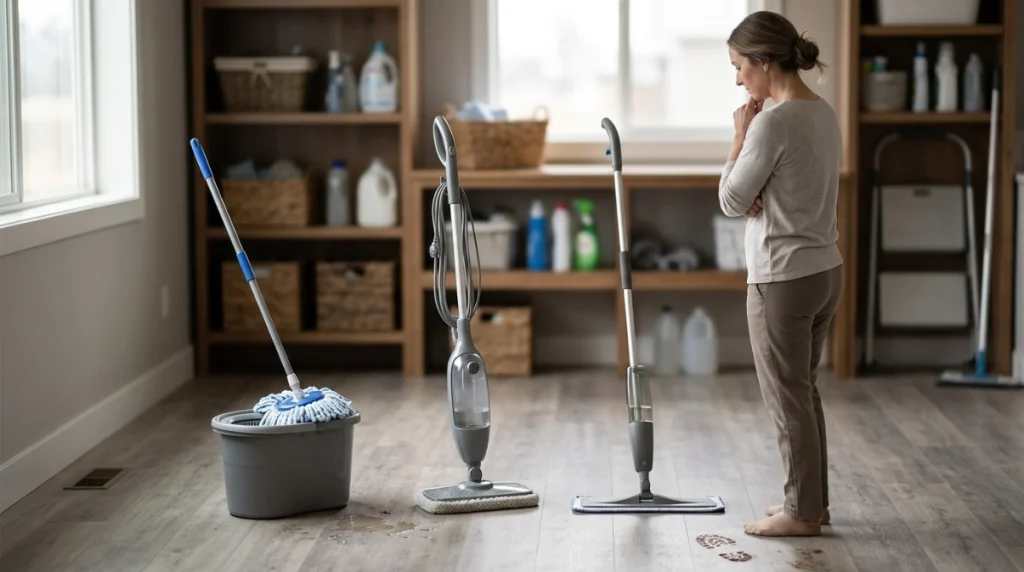
A spray mop is usually best for quick, low-moisture maintenance. Steam and spin mops solve different cleaning problems.
| Feature | Spray Mop | Steam Mop | Spin Mop |
|---|---|---|---|
| Liquid delivery | Trigger-controlled mist | Heated vapor | Wrung wet/damp mop head |
| Bucket needed | No | No | Usually yes |
| Electricity needed | No | Usually yes | No for manual models |
| Best task | Quick routine cleaning | Stuck residue on steam-safe floors | Larger wet-mopping jobs |
| Moisture control | High when used lightly | Steam output varies | Depends on wringing |
| Main limitation | Limited deep scrubbing | Heat-sensitive floors | Bucket and extra water |
A microfiber flat spray mop is my usual choice for small, frequent jobs. I would choose a spin mop when I need more rinsing capacity across a large tile area.
Steam deserves extra caution. Hardwood, laminate, LVP, and specialty surfaces may have manufacturer restrictions against heat or vapor.
Who Should Buy a Spray Mop?
A spray mop makes the most sense for someone who values quick setup and controlled moisture. It is particularly practical for regular maintenance rather than neglected floors.
A spray mop is a strong fit if you:
- Clean kitchens or entryways frequently.
- Live in an apartment or small home.
- Want to avoid carrying a mop bucket.
- Prefer washable microfiber pads.
- Have several sealed hard-floor areas.
- Often clean light footprints, dust, and small spills.
Choose another mop if you:
- Regularly scrub heavy grease or dried grime.
- Have extensive textured tile or dirty grout.
- Need to rinse a large amount of soil from the mop head.
- Want an automated robot mop for unattended maintenance.
- Prefer a powered cordless electric mop for scrubbing assistance.
Homes with several cleaning needs may benefit from more than one tool. A spray mop can handle daily maintenance while a spin mop or scrub brush handles periodic deep cleaning.
How Do You Get the Best Results From a Spray Mop?
The most important rule is to use less liquid than you think you need. A spray mop should leave a controlled damp film, not puddles.
- Remove loose debris first. Vacuum or dry-sweep hair, grit, crumbs, and sand before damp mopping.
- Check floor compatibility. Confirm that both damp mopping and your chosen cleaner are allowed.
- Start with a clean pad. A dirty microfiber pad spreads residue rather than removing it.
- Work in small sections. A roughly 4-by-4-foot area is easy to control before the solution dries.
- Spray lightly. Start with one or two trigger pulls and add more only if needed.
- Mop with overlapping passes. This helps the microfiber contact the entire surface.
- Change dirty pads. Do not use one saturated pad throughout an entire house.
- Let the floor dry completely. Keep people and pets off damp areas to reduce footprints and slip risk.
Use the right amount of cleaner
If your mop is refillable, follow the cleaner’s dilution instructions. Stronger mixtures are not automatically more effective.
The EPA’s Safer Choice product database includes floor-cleaning products that meet its ingredient criteria. Floor compatibility still needs to be checked separately.
Safety note: Never add bleach, disinfectant, essential oils, vinegar, or other chemicals to a mop reservoir unless both the mop maker and flooring manufacturer allow them.
Wash microfiber correctly
Rinse a heavily soiled pad before laundering it. Follow the pad maker’s washing instructions and let it dry fully before storage.
Avoid using a pad that feels oily or coated with old cleaner. Residue inside the fibers can contribute to streaks on the next floor.
Section Takeaway: Pre-clean loose debris, use minimal solution, work in small sections, and change pads before they become saturated.
Frequently Asked Questions
Are spray mops better than regular mops?
Spray mops are better for quick cleaning, small spaces, and controlled moisture. Traditional string or spin mops may be better for large areas and heavier soil because they provide greater rinsing capacity.
Do spray mops actually clean floors?
Yes. A spray mop can remove dust, footprints, light spills, and everyday grime when paired with a clean microfiber pad and suitable cleaner. It is less effective against heavily embedded grime or dirty grout.
Can you use a spray mop every day?
You can use one frequently if your flooring manufacturer allows damp cleaning. Daily dry dusting may be enough for many areas, while wet cleaning is better reserved for visible dirt and spills.
Can spray mops damage hardwood floors?
They can if you use too much liquid or an unsuitable cleaner. On compatible finished hardwood, use minimal moisture, absorbent pads, and only the cleaner recommended by the flooring or finish manufacturer.
Why does my spray mop leave streaks?
Common causes include too much cleaner, a dirty pad, residue buildup, or spraying more solution than the pad can absorb. Reduce the amount of product and switch to a clean microfiber pad.
Can I put homemade cleaner in a spray mop?
Only if the mop manufacturer and flooring manufacturer approve the ingredients. Vinegar, bleach, oils, detergents, and other DIY mixtures can damage some finishes or create residue.
Do spray mops disinfect floors?
Not automatically. A spray mop cleans by removing soil, while disinfection requires a suitable disinfectant used exactly according to its label, including any required wet contact time.
Are Spray Mops Worth It?
Yes, spray mops are worth it for quick, routine cleaning on compatible hard floors. Their strongest advantages are convenience, low water use, simple storage, and precise control over cleaning solution.
The tradeoff is limited deep-cleaning ability. A spray mop also needs clean pads, correct cleaner, and careful moisture control to prevent streaks or floor damage.
- Best for: Regular maintenance, small messes, kitchens, apartments, and quick touch-ups.
- Less suitable for: Heavy grime, neglected grout, large wet-mopping jobs, and surfaces requiring specialty care.
- Best buying feature: A refillable reservoir with durable, washable microfiber pads.
If you already vacuum or sweep regularly, a good spray mop can make the damp-cleaning part of your routine much faster. Treat it as an everyday maintenance tool rather than a replacement for every floor-cleaning method.
