
Are Spray Mops Worth It? An Honest 2026 Guide

Quick Answer
Yes, spray mops are worth it for quick everyday floor cleaning, small homes, and anyone who wants better control over moisture than a traditional mop provides. They work especially well for light dirt, footprints, dust, and small spills, but they are not a complete replacement for deep scrubbing or proper cleaning and disinfecting when that is required.
A spray mop is most worthwhile when:
- Cleaning is frequent: You mop kitchens, entryways, or other busy areas several times each week.
- Moisture matters: You want to mist the floor instead of soaking it with a bucket mop.
- Storage is limited: You want one lightweight tool without a separate bucket.
- Messes are light: Most cleaning involves dust, paw prints, crumbs, or small sticky spots.
- Reusable pads appeal: You prefer washable microfiber pads over constantly buying disposable ones.
Think twice when:
- Your floors regularly need heavy scrubbing, large amounts of dirty water, or specialized cleaning equipment.
I use spray mops most often when a full bucket-and-mop routine feels excessive. For everyday floor cleaning, that convenience can make the difference between cleaning a spill immediately and leaving it until later.
This guide looks beyond convenience. I’ll cover cleaning ability, floor safety, ongoing costs, alternatives, and who gets the best value from a spray mop in 2026.
In This Guide
- What Is a Spray Mop and How Does It Work?
- Are Spray Mops Actually Worth It?
- What Are the Pros and Cons of Spray Mops?
- Which Floors Are Spray Mops Safe For?
- Spray Mop vs Spin Mop vs Steam Mop vs Flat Mop
- How Much Does a Spray Mop Cost to Own?
- How Do You Use a Spray Mop Without Streaks?
- Who Should Buy a Spray Mop?
- Spray Mop FAQs
- Final Verdict: Are Spray Mops Worth the Money?
What Is a Spray Mop and How Does It Work?
A spray mop is a floor-cleaning tool with a built-in liquid reservoir and a trigger-operated spray system. It releases a small amount of cleaner in front of the mop head, then a microfiber or disposable pad wipes the floor.
Definition: A spray mop combines a mop, cleaning-solution bottle, and controlled spray mechanism in one lightweight floor-cleaning tool.
Most manual models need no electricity. You squeeze a trigger on the handle, mist a small area, and move the mop over it.
Reusable vs disposable spray mops
The biggest difference is what happens after cleaning. Some systems use washable microfiber pads and refillable bottles, while others rely on proprietary pads or cleaner refills.
- Reusable systems: Lower ongoing waste and let you wash the pad after use.
- Disposable systems: Convenient when you do not want to wash dirty mop pads.
- Refillable bottles: Let you choose a compatible floor cleaner.
- Sealed cartridges: Reduce measuring but can increase long-term refill costs.
Brands such as Swiffer, Bona, O-Cedar, and Rubbermaid use variations of this basic design. Electric spinning mops from brands such as Bissell and Tineco belong to a different category because powered pads provide extra scrubbing.
Are Spray Mops Actually Worth It?
Spray mops are worth it when convenience makes you clean more consistently. Their main advantage is not raw cleaning power but the ability to start mopping in seconds.
In my experience, kitchens show the benefit best. A few muddy footprints or dried drink drops rarely justify filling a bucket, but they are perfect jobs for a spray mop.
They save setup time
A traditional mop requires water, a bucket, cleaner, wringing, and cleanup afterward. A ready-to-use spray mop removes most of that setup.
This matters when you clean several small messes during the week. You can grab the mop, spray a section, wipe it, and put the tool away.
They give you better moisture control
Each trigger pull releases a limited amount of liquid. That makes it easier to keep the floor damp instead of saturated.
Moisture control is especially valuable around flooring with seams. Hardwood, engineered wood, laminate, and some vinyl floors can react poorly to excessive liquid.
They do not replace every cleaning tool
A spray mop performs best on light and moderate soil. Heavy grease, textured grout, dried mud, and neglected floors may need a stronger cleaning method.
- Use a vacuum or broom for loose grit first.
- Use a spray mop for routine damp cleaning.
- Use targeted scrubbing for stubborn buildup.
- Use a floor-approved disinfectant only when disinfection is needed.
The EPA explains the difference between cleaning, sanitizing, and disinfecting. A quick spray-mop pass should not automatically be treated as disinfection.
What Are the Pros and Cons of Spray Mops?
The best spray-mop benefits are speed, low water use, and easy storage. The weaknesses appear when floors are heavily soiled or the mop relies on expensive proprietary refills.
Advantages
- Fast setup: No bucket needs filling or carrying.
- Controlled spray: You decide exactly where moisture goes.
- Lightweight handling: Most manual models are easier to move than a bucket system.
- Easy spot cleaning: Small kitchen and entryway messes can be cleaned immediately.
- Compact storage: One upright tool needs little closet space.
- Reusable options: Washable microfiber pads can reduce disposable-pad purchases.
Disadvantages
- Limited deep cleaning: Manual pressure may not remove stubborn grime quickly.
- Small reservoirs: Large houses can require refilling during a cleaning session.
- Refill costs: Proprietary cleaner bottles and pads can make a cheap mop expensive over time.
- Spray failures: Nozzles can clog if incompatible solutions leave deposits.
- Dirty-pad buildup: One pad can begin spreading soil if you clean too large an area.
- Not universal: The cleaner inside the bottle still must suit your exact flooring.
A spray mop therefore works best as a maintenance tool. It is less convincing as the only floor-cleaning tool in a home with pets, heavy outdoor traffic, or textured tile.
Which Floors Are Spray Mops Safe For?
Spray mops can work on many sealed floors because they let you control moisture. However, the mop itself does not determine safety; the floor finish and cleaning solution matter just as much.
| Floor Type | Spray Mop Suitability | Best Approach |
|---|---|---|
| Sealed hardwood | Often suitable | Use minimal moisture and a wood-approved cleaner. |
| Engineered wood | Manufacturer-dependent | Mist lightly and avoid leaving liquid around seams. |
| Laminate | Use cautiously | Keep the pad only lightly damp and follow the flooring care guide. |
| Vinyl/LVP | Usually practical | Use a residue-free cleaner approved by the flooring manufacturer. |
| Ceramic/porcelain tile | Good choice | Spray normally, then scrub grout separately when needed. |
| Natural stone | Cleaner-dependent | Use a stone-safe, usually pH-neutral product. |
| Sealed concrete | Often suitable | Confirm the cleaner is compatible with the sealer. |
The National Wood Flooring Association provides industry resources and standards for wood flooring. For wood floors, I always put the flooring maker’s instructions ahead of a generic cleaner label.
Safety note: Check your floor manufacturer’s care guide before using a new cleaner. Avoid leaving standing liquid on seams, damaged finishes, or unsealed flooring.
Spray Mop vs Spin Mop vs Steam Mop vs Flat Mop
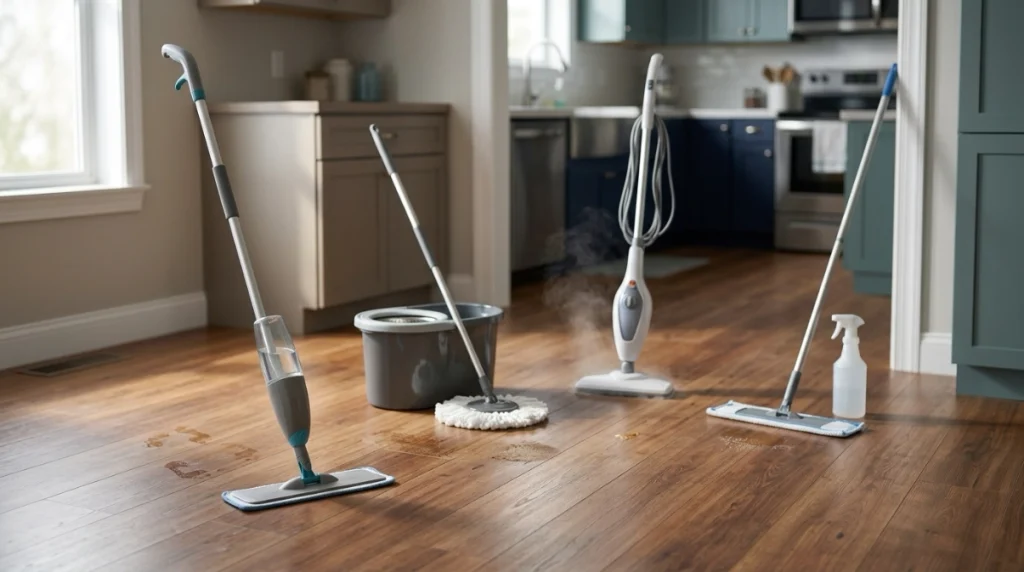
A spray mop is not automatically the best mop. The right choice depends on whether you value speed, scrubbing power, floor compatibility, or moisture control most.
| Mop Type | Setup | Moisture Control | Best For | Main Limitation |
|---|---|---|---|---|
| Spray mop | Under 1 minute | High | Daily cleaning and spot messes | Limited deep scrubbing |
| Spin mop | Several minutes | Medium to high | Larger rooms and dirtier floors | Requires a bucket |
| Steam mop | About 1–5 minutes | Machine-controlled | Sticky grime on steam-approved floors | Heat and moisture restrictions |
| Basic microfiber flat mop | 1–3 minutes | High | Flexible low-moisture cleaning | Cleaner must be applied separately |
I would choose a spray mop over a spin mop for quick weekday cleaning. For a muddy kitchen after a busy weekend, I would usually reach for the spin mop instead.
A microfiber flat mop remains the simplest all-purpose option when you want complete control over the liquid. Steam mops are more specialized because heat is unsuitable for many flooring systems.
How Much Does a Spray Mop Cost to Own?
The purchase price is only part of the cost. Pads, cleaner refills, replacement bottles, and proprietary cartridges can eventually cost more than the mop itself.
Typical costs to consider
- Basic manual spray mop: Often around $20–$50, depending on construction and included accessories.
- Replacement microfiber pads: Commonly sold in multipacks for roughly $10–$25.
- Cleaning solution: Ongoing cost depends heavily on bottle size, formula, and cleaning frequency.
- Disposable pads: Increase cost each time you mop if the system cannot use washable pads.
- Sealed refill cartridges: Can cost more over time than refillable reservoirs.
For value, I prefer a sturdy handle, refillable reservoir, replaceable spray mechanism, and several washable pads. Those features reduce the chance that one unavailable refill turns the entire mop into waste.
If you mop twice each week, owning three or four pads is practical. You can change pads when one becomes dirty without running the washing machine after every cleaning session.
How Do You Use a Spray Mop Without Streaks?
Streaks usually come from too much cleaner, dirty pads, or mopping loose dust into wet solution. A spray mop works best when you use less liquid than you think you need.
- Remove dry debris first. Vacuum, sweep, or dust-mop grit and hair.
- Check the cleaner. Make sure it matches your exact floor type.
- Start with a clean pad. A dirty microfiber pad redistributes old soil.
- Mist a small section. One or two trigger pulls may cover more area than expected.
- Mop with overlapping passes. Keep the pad flat against the floor.
- Change pads when dirty. Do not clean an entire large home with one saturated pad.
- Let the floor dry. Keep foot traffic away until visible moisture disappears.
Do not make the cleaner stronger
Extra cleaner does not automatically mean a cleaner floor. Too much product often leaves residue that catches light and appears as streaks or dull patches.
Follow the product label rather than adding concentrated cleaner by eye. The CDC also advises using cleaning products suitable for the surface and following label directions.
The EPA recommends following product instructions and avoiding unnecessary mixing of household chemicals. Its indoor environment guidance also advises ventilation when using cleaning products.
Safety note: Never mix cleaners unless the labels specifically permit it. Check both the cleaner label and your flooring manufacturer’s care instructions.
Who Should Buy a Spray Mop?
A spray mop gives the best value to people who clean small amounts of dirt often. Convenience becomes more important when the mop is used several times each week.
A spray mop makes sense for:
- Apartment residents: No bucket means less equipment to store.
- Busy households: Quick setup helps with frequent kitchen and entryway messes.
- Pet owners: Paw prints and small dirty spots can be handled quickly after loose hair is vacuumed.
- Parents: Small food and drink messes are easier to address immediately.
- Wood-floor owners: A spray system can provide careful moisture control when the floor manufacturer approves damp cleaning.
- Older users: A lightweight mop may be easier to handle than carrying a full bucket.
You may want something else if:
- Your floors regularly collect heavy mud or grease.
- You need aggressive grout scrubbing.
- You prefer rinsing the mop head repeatedly in clean water.
- Your chosen system requires expensive proprietary refills.
- You need one machine to vacuum and wash simultaneously.
For those situations, a spin mop, electric mop, wet-dry floor cleaner, or separate microfiber system may offer better value. A robot mop such as an iRobot Braava-style cleaner also targets a different goal: automated maintenance rather than quick manual control.
Spray Mop FAQs
Are spray mops better than regular mops?
Spray mops are better for quick maintenance because they need no bucket and give you precise moisture control. Traditional or spin mops are usually better for heavily soiled floors because you can rinse the mop head and work with more cleaning solution.
Are spray mops good for hardwood floors?
They can be good for sealed hardwood when the flooring manufacturer permits damp cleaning. Use a wood-compatible cleaner, mist lightly, and avoid leaving liquid around board edges or damaged areas.
Do spray mops actually clean floors?
Yes. A clean microfiber pad plus a floor-safe cleaning solution can remove routine dirt, footprints, light grease, and small spills effectively. Spray mops are less effective on thick buildup or deeply textured surfaces that require scrubbing.
Can you put any cleaner in a spray mop?
No. Check both the mop instructions and the cleaner label first. Some solutions can damage internal seals, clog nozzles, leave residue, or harm flooring finishes.
Are reusable spray mops cheaper?
They often cost less over time when they use washable pads and a refillable reservoir. The savings depend on cleaning frequency, replacement-pad life, and whether the system requires a proprietary cleaning formula.
How often should you wash a spray-mop pad?
Wash the pad after each substantial cleaning session or sooner when it looks dirty. For larger homes, rotate several clean pads during one session rather than continuing with a pad that is already gray with soil.
Can a spray mop disinfect floors?
Only if the cleaning product is approved for disinfection on that surface and you follow its required contact time. Routine spraying and immediately wiping should not automatically be considered disinfection.
Final Verdict: Are Spray Mops Worth the Money?
Yes, spray mops are worth it for most people who want fast, controlled everyday floor cleaning. They are especially useful in kitchens, apartments, pet homes, entryways, and homes with moisture-sensitive flooring.
The biggest benefit is simple: you are more likely to clean a small mess when the mop takes seconds to start. That convenience adds up over months of regular cleaning.
- Buy one: You clean light messes often and value quick setup.
- Choose reusable: You want lower ongoing pad and refill costs.
- Keep another mop: You sometimes deal with heavy dirt or deep cleaning.
- Check compatibility: Your flooring and cleaning solution must work safely together.
As of 2026, my preferred setup for many homes is a refillable spray mop with several washable microfiber pads. It handles everyday maintenance without turning every footprint or kitchen spill into a full cleaning project.
If your floors regularly need heavy scrubbing, keep a deeper-cleaning tool as well. Use the spray mop for what it does best: fast, controlled, repeatable floor care.