
What Is the Best Spray Mop to Buy?

Quick Answer
For most homes, the best spray mop to buy is a lightweight microfiber spray mop with a refillable bottle, a washable pad, a wide swivel head, and controlled spray. I prefer this style because it uses less water than a traditional bucket mop and makes quick everyday cleaning simple.
What to look for
- Microfiber pad: Choose a washable pad that lifts fine dirt without leaving excessive moisture.
- Refillable bottle: A reusable reservoir gives you better control over cleaner and water.
- Swivel head: A flexible head makes furniture legs, corners, and tight spaces easier to reach.
- Floor compatibility: Make sure the mop and cleaner match your hardwood, laminate, vinyl, tile, or stone floor.
- Easy maintenance: Washable pads and simple bottle cleaning matter more than extra features.
My quick buying tip
- For daily messes: Pick a compact microfiber spray mop with a trigger-controlled mist.
- For hardwood: Choose a model designed for finished wood and use minimal moisture.
- For mixed floors: A reusable spray mop with interchangeable or universal pads offers the most flexibility.
I’ve tested and compared many different approaches to floor cleaning, and spray mops remain one of my favorite choices for everyday messes. They sit between a dry microfiber mop and a traditional bucket system, giving you enough moisture to clean without dragging a heavy bucket around.
In this guide, I’ll explain which spray mop features matter, which floor types need special care, and when another mop style may make more sense.
In This Guide
- What is a spray mop?
- What features matter most when buying one?
- Which floors are spray mops best for?
- How does a spray mop compare with other mops?
- How do you use a spray mop correctly?
- What cleaner should you put in a spray mop?
- What spray mop mistakes should you avoid?
- Which spray mop should you buy?
- Spray mop FAQs
What Is a Spray Mop?
A spray mop is a floor-cleaning tool with a flat mop head, cleaning pad, and built-in liquid reservoir. Instead of carrying a bucket, you squeeze a trigger or press a button to release a small amount of cleaning solution directly in front of the mop.
The controlled spray is the main reason I recommend this mop style for regular maintenance. You can add moisture exactly where you need it, then immediately wipe the area with the microfiber pad.
Why microfiber matters
Microfiber is made from extremely fine synthetic fibers that can trap small particles and absorb liquid. A clean microfiber pad is especially useful when you want to remove everyday dust, footprints, food crumbs, and light grime without soaking the floor.
The pad also makes a spray mop easier to maintain. Instead of repeatedly buying disposable cleaning sheets, you can wash reusable pads and keep several available for larger cleaning sessions.
Who should buy one?
- Busy households: Spray mops are quick to grab for everyday spills and footprints.
- Apartment dwellers: You don’t need storage space for a bucket and wringer.
- Small spaces: The compact design works well around furniture and narrow rooms.
- Hard-floor owners: Controlled moisture is useful when the floor should not be saturated.
Section Takeaway: A spray mop is best viewed as a convenient low-moisture cleaning system, not a replacement for every type of floor-cleaning tool.
What Features Matter Most When Buying a Spray Mop?
The best spray mop isn’t necessarily the one with the most features. I pay more attention to pad quality, spray control, maneuverability, durability, and floor compatibility.
1. Look for controlled spray
A good trigger should release a manageable amount of liquid. Too much spray defeats one of the main advantages of this mop because excess moisture can create streaks, slow drying, or become a problem on moisture-sensitive flooring.
2. Choose a washable microfiber pad
A washable pad lowers ongoing costs and gives you a fresh cleaning surface whenever you need one. I recommend having at least two or three pads so you can change them when one becomes visibly dirty.
3. Check the mop-head size
A wider head covers open rooms faster, while a smaller head is easier to maneuver around toilets, chair legs, cabinets, and other obstacles. For an average home, I prefer a medium-to-wide head with a flexible swivel joint.
4. Don’t overlook the handle
The handle should feel comfortable during repeated passes. A telescoping or adjustable handle is useful because the correct height reduces awkward bending while cleaning.
5. Inspect the bottle design
A removable refillable bottle is convenient because you can rinse it after cleaning. Avoid a system that makes refilling, emptying, or replacing the reservoir unnecessarily difficult.
| Feature | What I Look For | Why It Matters |
|---|---|---|
| Spray control | Fine, controlled mist | Helps prevent excess moisture |
| Mop pad | Washable microfiber | Captures dirt and reduces refill costs |
| Head | Wide and swiveling | Improves coverage and maneuverability |
| Bottle | Removable and refillable | Simplifies filling and cleaning |
| Handle | Comfortable and adjustable | Makes longer cleaning sessions easier |
Which Floors Are Spray Mops Best For?
Spray mops work particularly well on sealed hard floors when you use the correct pad and cleaner. The important point is that the mop itself doesn’t make a floor safe; the floor’s finish and manufacturer care instructions determine what you should use.
Hardwood floors
Finished hardwood generally benefits from a lightly damp cleaning method rather than excessive water. The National Wood Flooring Association recommends a well-wrung, slightly moistened mop for routine damp cleaning.
For hardwood, I favor a spray mop that produces a fine mist and dries quickly. Never assume a wood floor can tolerate a cleaner simply because the bottle says it works on multiple surfaces.
Safety note: Always check your flooring manufacturer’s care guide before using water, vinegar, disinfectants, or another cleaning solution on wood.
Laminate floors
Laminate is another surface where moisture control matters. A spray mop can work well because you can apply a small amount of solution instead of leaving a wet layer across the entire room.
Use a soft microfiber pad and avoid flooding seams or allowing standing liquid to remain on the floor.
Vinyl and LVP
Spray mops are convenient for vinyl and luxury vinyl plank because they can deliver controlled moisture. However, product compatibility still depends on the flooring manufacturer and finish.
I would not automatically use a steam mop simply because a vinyl floor looks waterproof. Heat and moisture requirements vary between flooring products.
Tile and stone
Tile generally gives you more cleaning flexibility, especially when the surface is glazed and sealed. Grout, however, can hold soil and may need more targeted cleaning than a spray mop provides.
Natural stone requires extra caution because acidic or unsuitable cleaners can affect some stone types and finishes. Choose a cleaner specifically approved for your stone.
Safety note: Check the manufacturer’s care guide for natural stone, tile finishes, grout, and sealed surfaces before choosing a cleaner.
How Does a Spray Mop Compare With Other Mops?
I don’t consider one mop type universally better than another. The right choice depends on floor type, room size, mess level, and how often you clean.
| Mop Type | Best For | Main Advantage | Main Limitation |
|---|---|---|---|
| Spray mop | Everyday hard-floor cleaning | Fast and low-moisture | Limited deep scrubbing |
| Spin mop | Larger homes and heavier messes | Excellent wringing control | Requires bucket storage |
| Steam mop | Compatible sealed surfaces | Heat loosens stubborn grime | Not suitable for every floor |
| Flat microfiber mop | Dry or damp maintenance | Simple and versatile | May require a separate spray bottle |
| String mop | Large, washable hard floors | Good coverage | Can retain more water |
Spray mop vs. spin mop
Choose a spray mop when speed and convenience matter most. Choose a spin mop when you regularly clean larger areas or want more control over rinsing and wringing.
Spray mop vs. steam mop
A spray mop is the safer default when you’re unsure about heat compatibility. A steam mop can be useful on manufacturer-approved surfaces, but steam should never be treated as a universal floor-cleaning solution.
Section Takeaway: For routine cleaning, a spray mop wins on convenience. For heavy-duty jobs, another mop type may be more appropriate.
How Do You Use a Spray Mop Correctly?
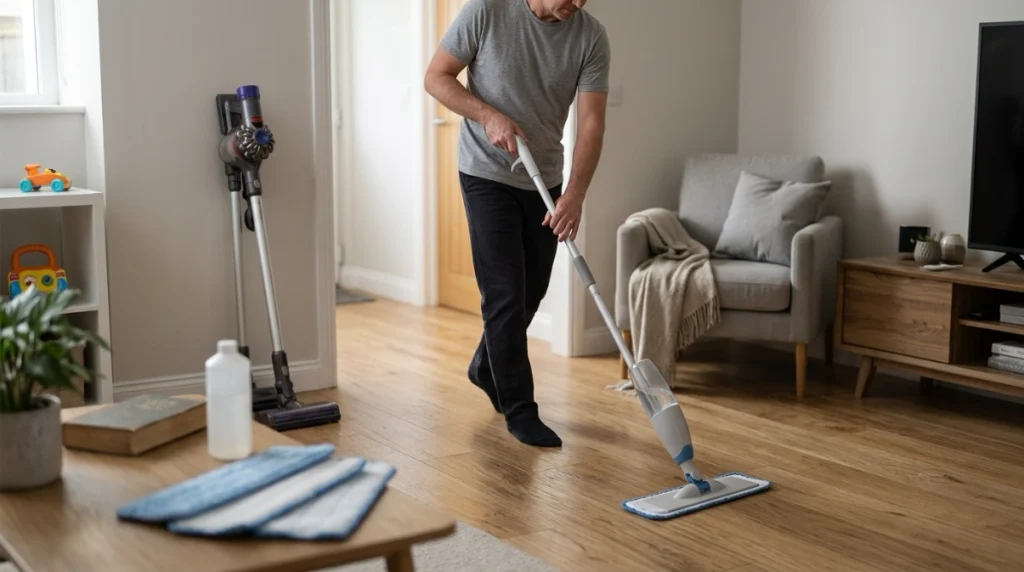
The technique is simple, but a few habits make a noticeable difference. I always remove loose grit before introducing moisture because dirt can turn into a muddy film when it mixes with cleaner.
- Remove loose debris: Vacuum or dry-mop the floor first.
- Prepare the solution: Fill the reservoir according to the mop and cleaner instructions.
- Start at the farthest point: Work toward the exit so you don’t walk repeatedly across cleaned areas.
- Spray lightly: Apply enough solution to loosen surface dirt without flooding the floor.
- Mop in overlapping passes: Keep the microfiber pad moving steadily across the surface.
- Change dirty pads: Replace or rinse the pad when it becomes heavily soiled.
- Let the floor dry: Allow normal airflow to finish the job before heavy foot traffic.
How often should you change the mop pad?
Change the pad whenever it becomes visibly dirty, heavily damp, or starts spreading soil instead of collecting it. For a larger home, keeping several washable pads ready is much easier than trying to clean an entire floor with one overloaded pad.
What Cleaner Should You Put in a Spray Mop?
The safest answer is the cleaner recommended for your specific mop and flooring. A spray bottle is not a chemistry experiment, and adding random household products can create residue or damage the equipment.
For routine cleaning, a floor-safe cleaner used at the labeled dilution is usually the simplest approach. If your mop manufacturer specifies a particular solution, follow that guidance.
Should you use vinegar?
Vinegar is often suggested as a homemade floor cleaner, but it isn’t appropriate for every surface. Natural stone is a particularly important example where acidic cleaners can be unsuitable.
Safety note: Check your floor manufacturer’s instructions and the cleaner label before using vinegar or any homemade solution.
Do you need disinfectant?
Routine floor cleaning and disinfection are not the same thing. CDC guidance says cleaning removes dirt and many germs, while disinfection is a separate step used when circumstances call for it, such as when someone is sick.
If you use a disinfectant, follow its label exactly, including the approved surface, dilution, application method, and required contact time.
Never mix bleach with another cleaner or disinfectant. That can create dangerous vapors.
What Spray Mop Mistakes Should You Avoid?
Most spray mop problems come from using too much cleaner or moisture rather than from the mop itself.
- Over-spraying: More liquid does not automatically mean cleaner floors.
- Skipping vacuuming: Loose grit can become wet residue or contribute to scratching.
- Using a dirty pad: An overloaded microfiber pad can redistribute soil.
- Using the wrong cleaner: A cleaner suitable for tile may not be appropriate for wood or stone.
- Ignoring floor seams: Standing liquid can create problems on moisture-sensitive flooring.
- Never washing the bottle: Cleaner residue can build up inside a reusable reservoir.
- Expecting deep cleaning: A spray mop is excellent for maintenance but isn’t designed to solve every heavy buildup problem.
Why does my spray mop leave streaks?
Streaks usually point to too much cleaning solution, an overloaded pad, unsuitable cleaner, or a floor that has accumulated residue. Start by using less solution and a freshly washed microfiber pad.
If the problem continues, check whether the cleaner is approved for your flooring and whether old product buildup needs to be removed using a floor-safe method.
Safety note: Don’t use aggressive stripping chemicals simply to remove streaks. Check the floor manufacturer’s maintenance instructions first.
Which Spray Mop Should You Buy?
As of 2026, I’d choose a straightforward microfiber spray mop over an overly complicated model for most households. The best everyday design has a refillable reservoir, controlled spray, washable pads, a comfortable handle, and a swiveling head.
Best choice for hardwood
Look for a spray mop specifically designed for finished wood and pair it with a compatible low-moisture cleaner. The Bona Premium Spray Mop, for example, is designed around floor-specific cleaning formulas, including a pH-neutral option for certain finished wood floors.
Best choice for mixed flooring
A versatile microfiber spray mop makes sense if your home contains hardwood, laminate, vinyl, and tile. The important feature isn’t a claim that one cleaner works everywhere; it’s the ability to match the cleaning solution and moisture level to each surface.
Best choice for small apartments
Choose the lightest model that still has a stable head and comfortable handle. A compact spray mop is easy to store behind a door or in a narrow utility closet, which makes it more likely you’ll use it regularly.
Best choice for frequent messes
If you have children, pets, or a busy kitchen, prioritize fast setup and easy pad changes. I would rather have a simple spray mop that takes one minute to grab than a complicated machine that stays in a closet.
My overall verdict: Buy a durable microfiber spray mop with controlled spray and washable pads. Spend more on build quality and floor compatibility rather than unnecessary electronic features.
Spray Mop FAQs
Is a spray mop better than a regular mop?
For everyday hard-floor cleaning, a spray mop is often more convenient because it combines the mop and cleaning reservoir in one tool. A traditional spin or string mop can be better for large areas, heavy messes, or situations where you need more rinsing and wringing control.
Can you use a spray mop on hardwood floors?
You can use a spray mop on many finished hardwood floors when the flooring manufacturer allows damp cleaning. Use minimal moisture and a compatible cleaner. Avoid soaking the surface, and always follow the care instructions for your specific wood flooring.
Can I put any cleaner in a spray mop?
No. Use the solution recommended by the mop manufacturer or a cleaner clearly labeled as suitable for your flooring. Concentrated or incompatible cleaners can leave residue, damage finishes, or affect the mop’s reservoir and spray mechanism.
Are spray mops good for laminate floors?
They can be a good choice because they allow controlled moisture. Laminate should not be flooded with water, so a light spray followed by microfiber cleaning is generally more practical than a dripping mop. Always follow your laminate manufacturer’s care instructions.
How often should you use a spray mop?
There is no single schedule for every home. Clean floors when they become visibly dirty or after spills, while high-traffic areas may need more frequent attention. Regular dry debris removal also reduces how much wet cleaning the floor needs.
Do spray mops actually clean floors?
Yes, when used correctly. The spray loosens surface soil while the microfiber pad physically picks up dirt and moisture. Their strength is routine maintenance rather than removing severe buildup that may require a stronger floor-safe cleaning method.
Should you vacuum before using a spray mop?
Yes. Removing loose grit first helps prevent muddy residue and reduces the chance of dragging abrasive particles across the floor. A quick vacuum or microfiber dust mop can make the wet-cleaning step faster and more effective.
Final Takeaway: The best spray mop to buy is the one that gives you controlled moisture, a good microfiber pad, easy maneuverability, and reliable floor compatibility. For most homes, a simple reusable spray mop is enough for regular cleaning.
Before buying, check your floor type first. Then choose the mop, pad, and cleaning solution as a complete system rather than shopping by mop appearance alone.
If you clean a little and often, a good spray mop can make floor care noticeably easier.
