
How to Choose a Spray Mop: A Practical Buying Guide

Quick Answer
To choose a spray mop, match the mop to your floor type first, then compare spray control, pad quality, maneuverability, and refill options. For moisture-sensitive wood floors, follow your flooring manufacturer’s instructions and general guidance from the National Wood Flooring Association before choosing any wet-cleaning method.
What to look for
- Floor compatibility: Make sure the mop and cleaner are approved for hardwood, laminate, LVP, tile, or your specific surface.
- Fine spray control: A controlled mist helps prevent puddles and excess moisture.
- Microfiber pads: Choose washable pads that lift dirt without aggressive scrubbing.
- Easy maneuvering: A swivel head should reach edges, corners, and areas under furniture.
- Refill flexibility: Check whether the reservoir accepts your preferred floor-safe cleaner.
A good spray mop can make routine floor cleaning faster, but the wrong one can leave streaks, residue, or too much moisture behind.
I look at spray mops differently from ordinary mop-and-bucket systems. The most useful model isn’t always the most expensive one; it’s the mop that gives you good moisture control on the floors you actually own.
In This Guide
- What is a spray mop?
- How do you choose the right spray mop?
- Which spray mop is best for your floor type?
- Which spray mop features actually matter?
- Spray mop vs flat, spin, and steam mop
- What cleaning solution should you use?
- How can you tell if a spray mop is good value?
- Frequently asked questions
- Final takeaway
What Is a Spray Mop?
A spray mop is a floor-cleaning tool with a liquid reservoir and an integrated spray system. You dispense a small amount of cleaner ahead of the mop pad and wipe the area immediately.
Most manual spray mops use a trigger in the handle. This gives you more control over water than a traditional wet string mop.
Why spray mops are useful
The biggest advantage is convenience. You don’t need to carry a bucket through the house or repeatedly wring out a mop head.
- Quick setup: Fill or attach the cleaning bottle, install the pad, and start.
- Controlled moisture: Spray only where cleaner is needed.
- Easy storage: Most models take up little more room than a broom.
- Spot cleaning: They’re convenient for footprints, food splashes, and other small messes.
- Reusable options: Many designs work with washable microfiber pads.
That doesn’t make every spray mop suitable for every floor. The cleaner, pad, spray volume, and floor finish still matter.
How Do You Choose the Right Spray Mop?
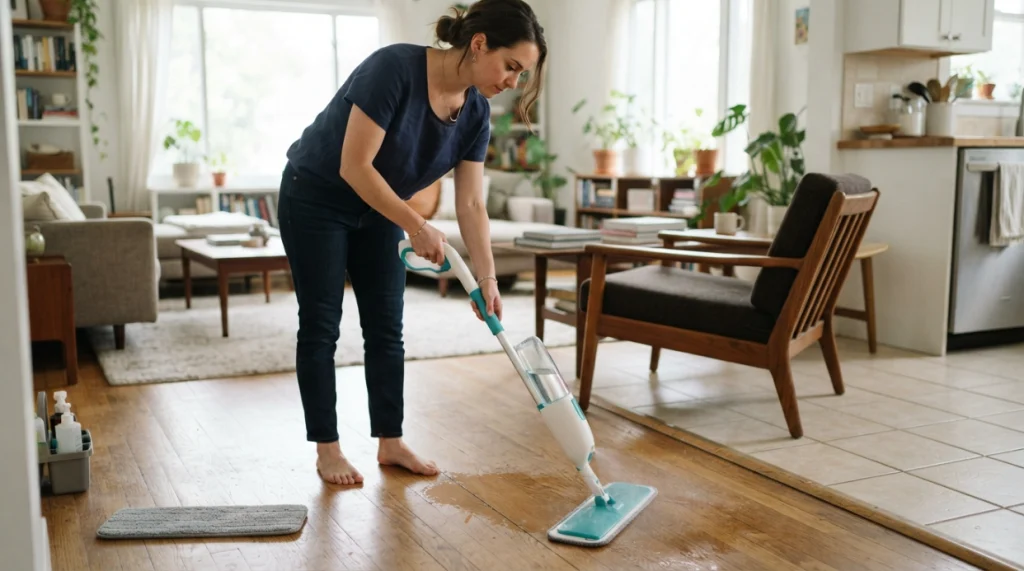
Start with your flooring rather than the brand name. Then evaluate how precisely the mop controls liquid and how easily you can maintain it.
When I evaluate a spray mop, I pay particular attention to the first trigger pull. A fine, even mist is far more useful to me than a strong spray that creates a wet patch.
1. Identify every floor you plan to mop
Make a short list before shopping. A home containing tile and LVP has different requirements from one containing mostly hardwood.
- Solid hardwood
- Engineered wood
- Laminate
- Luxury vinyl plank or sheet vinyl
- Ceramic or porcelain tile
- Natural stone
- Sealed concrete
If you have several surfaces, prioritize the most moisture-sensitive one. This usually prevents you from choosing a system that applies more liquid than necessary.
2. Check how much control the sprayer gives you
Look for a trigger that responds consistently. You should be able to mist a small cleaning area without pumping the handle repeatedly.
Wide uncontrolled spray can reach baseboards, furniture, or adjoining floors. Precise delivery makes everyday cleaning easier.
3. Examine the pad design
Microfiber contains fine synthetic fibers that collect dust and soil from a floor’s surface. A reusable microfiber pad is my preferred starting point for most routine hard-floor cleaning.
Check how securely the pad attaches. Pads that fold, bunch, or slip during turning quickly become frustrating.
4. Look at the reservoir
A refillable bottle gives you more choice over the cleaner you use. A proprietary cartridge can be convenient, but it may lock you into one refill system.
- Check whether the bottle can be removed easily.
- Look for a cap that can be opened without tools.
- Make sure the bottle seats securely after refilling.
- Check the manufacturer’s rules before using third-party cleaner.
5. Test the handle and swivel head
A spray mop should turn without requiring you to twist your wrist aggressively. This matters around chair legs, toilets, cabinets, and narrow kitchen spaces.
Handle length matters too. If you’re bending during normal passes, the mop is too short for comfortable regular use.
Which Spray Mop Is Best for Your Floor Type?
The best spray mop is one that cleans without exceeding your floor’s moisture and chemical limits. Always give the flooring manufacturer’s care instructions priority.
| Floor type | Preferred spray-mop setup | Moisture level | Main concern |
|---|---|---|---|
| Sealed hardwood | Soft microfiber pad | Low | Water sitting on seams |
| Laminate | Fine-mist spray mop | Very low | Moisture entering joints |
| LVP or vinyl | Microfiber spray mop | Low | Residue and seam moisture |
| Ceramic or porcelain tile | Microfiber or mild scrub pad | Low to moderate | Dirty grout lines |
| Natural stone | Soft pad plus stone-approved cleaner | Low | Wrong cleaner or damaged sealer |
Hardwood and engineered wood
For wood, I want a spray mop that gives me excellent control. The goal is a light mist that the microfiber pad picks up during the same pass.
The National Wood Flooring Association is a useful authority for wood-floor care guidance. Your flooring manufacturer’s instructions should still decide which cleaner and method you use.
Laminate
Laminate generally needs cautious moisture control. Look for a fine-mist mop and avoid leaving visible wet areas around plank joints.
A fast-moving microfiber pad is a better fit for routine cleaning than soaking the floor. Dry any accidental puddle promptly.
Vinyl and LVP
Spray mops suit many vinyl-floor routines because they can apply limited moisture. Soft reusable pads also help reduce the need for aggressive scrubbing.
Don’t assume water-resistant flooring means every cleaner is safe. The finish can still become hazy or sticky when too much product remains behind.
Tile
Tile tolerates routine damp cleaning better than many wood-based floors. However, a flat spray mop may glide across low grout lines instead of cleaning embedded grout soil.
For dirty grout, use a separate grout-safe tool when needed. Don’t choose an overly abrasive mop pad just to compensate.
Safety note: Check your flooring manufacturer’s care guide and the cleaner label before introducing any new chemical or cleaning method.
Which Spray Mop Features Actually Matter?
Useful features improve control, cleaning access, or maintenance. Decorative extras matter far less than a good spray pattern and dependable pad attachment.
A fine, consistent spray
This is my first priority. A controlled mist gives you time to wipe the solution before it sits on moisture-sensitive flooring.
Washable microfiber pads
Reusable pads reduce the need to keep disposable refills on hand. Owning two or three pads also lets you swap out a dirty one during larger cleaning sessions.
Wash pads according to their care instructions. Fabric softener can coat some microfiber and reduce how effectively it picks up soil.
A low-profile swivel head
A flat head helps reach under sofas, beds, cabinets, and other furniture. Good rotation also makes it easier to clean around table legs.
A comfortable trigger
The trigger shouldn’t require excessive hand pressure. This matters more than it sounds when you’re cleaning several rooms.
A refillable, easy-to-clean bottle
Check the bottle opening before buying. Narrow openings can make rinsing, refilling, and drying more difficult.
Replacement-part availability
A durable handle isn’t useful if replacement pads disappear from the market. Before choosing a system, check whether pads and bottles are sold separately.
Spray Mop vs Flat, Spin, and Steam Mop: Which Should You Choose?
A spray mop is strongest at quick, controlled maintenance cleaning. Other mop types can perform better when you have different cleaning priorities.
| Mop type | Liquid delivery | Best use | Main limitation |
|---|---|---|---|
| Spray mop | Trigger-controlled mist | Fast routine cleaning | Small reservoir |
| Flat microfiber mop | Pad dampened separately | Low-moisture floor care | No built-in sprayer |
| Spin mop | Bucket and wringer | Larger or dirtier areas | Bucket setup required |
| Steam mop | Heated water vapor | Approved heat-resistant surfaces | Not suitable for many floor finishes |
Choose a spray mop when convenience and controlled application are priorities. It works especially well for kitchens, entryways, apartments, and routine touch-ups.
A spin mop makes more sense when you frequently clean larger dirty areas. A basic microfiber flat mop is excellent when you want simple low-moisture cleaning without an integrated reservoir.
Steam needs separate consideration. Heat and moisture can be unsuitable for some hardwood, laminate, vinyl, adhesive-backed, or specialty floors.
Safety note: Never assume a floor is steam-safe because it is described as sealed or water-resistant. Check the flooring manufacturer’s care guidance first.
What Cleaning Solution Should You Use in a Spray Mop?
Use a cleaner that is compatible with both your mop and your floor. Don’t choose a solution based only on fragrance or its promise of extra shine.
Start with the floor manufacturer’s recommendations
Some floors need a pH-neutral cleaner, meaning a product that is neither strongly acidic nor strongly alkaline. Natural stone, wood finishes, and other specialty surfaces may have stricter requirements.
For general information about household chemical products and environmental safety, the U.S. Environmental Protection Agency provides consumer resources. Product labels remain your primary instructions for dilution and safe use.
Avoid the “more cleaner works better” mistake
Too much solution can leave a sticky or cloudy film. That film attracts soil and can make freshly cleaned floors look streaky.
- Follow the cleaner’s dilution directions.
- Don’t add extra concentrate for routine dirt.
- Wash or replace dirty pads during larger jobs.
- Use only formulas permitted by your spray-mop manufacturer.
Don’t casually mix household cleaners
Combining chemicals can create dangerous reactions. The Centers for Disease Control and Prevention is a useful general public-health resource for safe cleaning practices.
If you’re using a disinfectant rather than a standard floor cleaner, read the entire product label. Cleaning and disinfecting are different jobs, and a disinfectant may require a specific contact time.
Safety note: Never mix cleaning products unless their labels explicitly permit it, and verify that any cleaner is approved for your flooring.
How Can You Tell If a Spray Mop Is Good Value?
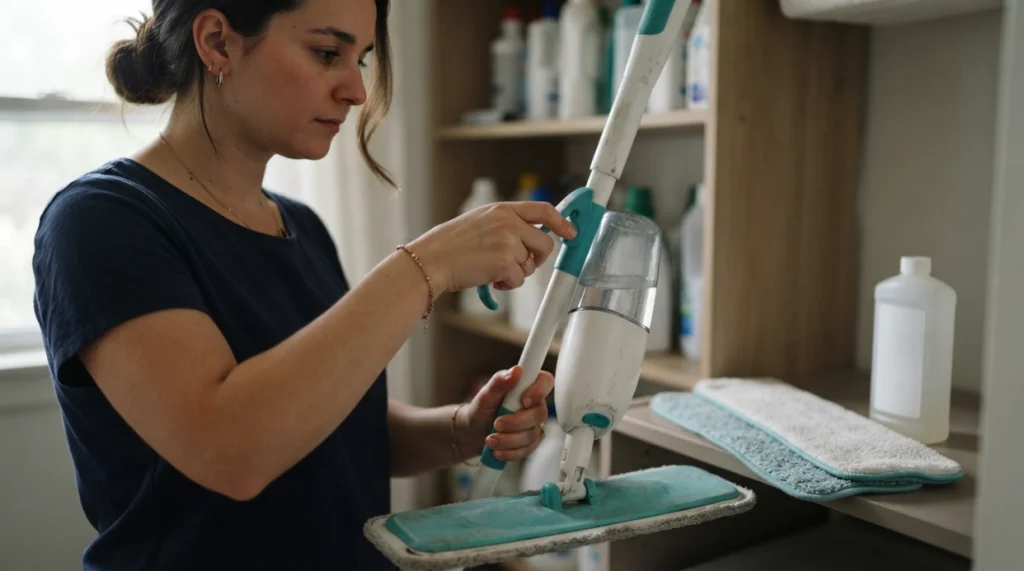
Don’t judge value from the initial price alone. Look at what you’ll need to replace during the next year of routine cleaning.
Check recurring costs
- Pads: Are they washable or disposable?
- Cleaner: Can you use common compatible solutions?
- Cartridges: Does the mop require proprietary bottles?
- Parts: Can you replace the reservoir or mop head?
A cheap mop can become expensive when it depends on frequent disposable refills. A slightly higher-priced reusable system may cost less to operate.
Inspect the high-stress parts
Pay attention to the handle joint, trigger, bottle connection, and swivel mechanism. These areas receive repeated movement during normal use.
I also check how the mop behaves when changing direction quickly. Excessive flex around the lower handle can make scrubbing sticky spots awkward.
Consider the size of your home
A compact spray mop can be ideal for an apartment or small kitchen. Larger homes may benefit from a bigger reservoir and several washable pads.
Don’t automatically choose the biggest bottle. Extra liquid also adds weight to the handle.
Read independent evaluations carefully
Look for testing that discusses handling, cleaning performance, durability, and refill costs instead of concentrating on marketing features. Consumer Reports is one example of an independent consumer-testing resource.
As of 2026, my basic buying rule remains simple: prioritize floor safety, moisture control, and maintainability over unnecessary features.
Frequently Asked Questions About Choosing a Spray Mop
What should I look for when buying a spray mop?
Look for floor compatibility, a consistent fine-mist sprayer, washable microfiber pads, a comfortable handle, good swivel movement, and an easy-to-maintain reservoir. Also check the long-term cost and availability of replacement pads or cartridges.
Is a spray mop good for hardwood floors?
A spray mop can work on some sealed hardwood when the flooring manufacturer permits damp cleaning. Choose a fine-mist model, use an approved wood cleaner, and avoid leaving standing liquid on boards or seams.
Is a spray mop good for laminate floors?
A fine-mist spray mop can suit laminate when the manufacturer allows damp mopping. Use minimal liquid, wipe spills quickly, and prevent cleaner from collecting along seams or edges.
Can I put any cleaner in a spray mop?
No. Check both the mop instructions and your flooring care guide before filling the reservoir. Some cleaners can damage seals, leave residue, clog spray mechanisms, or harm specific flooring finishes.
Are reusable spray mop pads better than disposable pads?
Reusable microfiber pads are useful for regular cleaning because you can wash and reuse them. Disposable pads can be convenient for occasional messes, but they create an ongoing replacement cost.
Is a spray mop better than a regular mop?
A spray mop is usually more convenient for quick maintenance and controlled moisture. A traditional or spin mop may be better when cleaning a large area with heavy soil that requires repeated rinsing.
How many spray mop pads do I need?
Two or three reusable pads are practical for most homes. This lets you replace a dirty pad during cleaning instead of continuing to spread soil across additional rooms.
Final Takeaway: Choose the Mop Around Your Floor
The best way to choose a spray mop is to start with your floor type and moisture limits. After that, compare spray control, microfiber pad quality, reservoir design, maneuverability, and replacement costs.
For most routine floor cleaning, I would rather have a simple spray mop with an excellent mist pattern than a feature-heavy model that’s difficult to refill or control.
Check your flooring manufacturer’s cleaning instructions before buying. Once you know what your floor can tolerate, choosing the right spray mop becomes much easier.