
Why Is My Floor Still Dirty After Steam Mopping?

Quick Answer
Your floor can still look dirty after steam mopping when loose debris was not removed first, the pad became saturated with grime, old cleaner residue remains, or the mop released too much moisture. Steam loosens dirt, but the pad still has to physically lift that dirt away, which is why proper preparation and pad changes matter. The CDC’s household cleaning guidance also recommends using cleaning methods and products appropriate for the surface.
Most common reasons
- Dirty mop pad: A saturated microfiber pad can spread loosened grime instead of collecting it.
- Skipped vacuuming: Hair, grit, dust, and crumbs can turn into muddy residue when steam reaches them.
- Cleaner buildup: Old detergent, polish, or soap can create a dull or sticky film.
- Too much steam: Excess moisture can move dirty water around rather than removing it efficiently.
- Wrong floor method: Some hardwood, laminate, vinyl, and stone floors should not be steam cleaned at all.
Quick fix
- Vacuum first, install a fresh pad, use the lowest suitable steam setting, and change the pad as soon as it becomes visibly dirty.
I know how frustrating this looks. You steam mop expecting a clean shine, then sunlight hits the floor and you still see footprints, gray film, streaks, or dirty patches.
In my floor-cleaning tests, the steam mop itself is rarely the whole problem. Preparation, old residue, water quality, pad condition, floor type, and technique usually explain what went wrong.
In This Guide
- Why does steam mopping sometimes leave floors dirty?
- What are the main causes of dirty floors after steam mopping?
- How do you steam mop without leaving dirt behind?
- Could your floor type be the problem?
- Steam mop vs other mops: which removes dirt better?
- How do you remove old residue before steam mopping again?
- Could your steam mop itself be dirty?
- Frequently asked questions
- What should you do next?
Why Does Steam Mopping Sometimes Leave Floors Dirty?
A steam mop can loosen dirt without removing all of it. The steam softens grime, while the cleaning pad must collect that loosened material.
A steam mop is an electric floor-cleaning tool that heats water and sends hot vapor through or around a cleaning pad. Most basic models do not vacuum dirty water or loose debris back into a separate tank.
- Steam loosens: Heat and moisture soften dried spills, grease, and sticky soil.
- Microfiber collects: Microfiber is a fabric made from extremely fine synthetic fibers that trap moisture and fine dirt.
- The pad has limits: Once loaded with dirt, it has less clean surface available to collect more.
- No suction occurs: A standard steam mop cannot remove dirty liquid like many wet-dry floor washers can.
This explains why a floor may look worse after several rooms. A pad that cleaned the first area can start redistributing grime across the next one.
I see this most often in kitchens. Grease, cooking residue, pet traffic, and fine dust create more soil than one pad can reasonably hold.
What Are the Main Causes of Dirty Floors After Steam Mopping?
The most common cause is not weak steam. It is usually a mismatch between the amount of dirt on the floor and the way the steam mop was used.
1. You did not vacuum or sweep first
Steam mops are not replacements for vacuum cleaners unless your machine specifically includes suction. Loose grit and hair should come off before moisture reaches the floor.
Otherwise, fine dust mixes with moisture. That mixture can leave gray streaks around grout lines, edges, and textured surfaces.
2. Your microfiber pad became too dirty
A clean pad can absorb loosened grime. A blackened or greasy pad has much less ability to collect additional soil.
- Start heavily soiled rooms with a fresh pad.
- Check the pad after the first small section.
- Replace it when the working surface becomes visibly dark.
- Keep two or three pads ready for larger kitchens or open-plan rooms.
For a roughly 10-by-12-foot kitchen with noticeable traffic soil, I often plan on more than one clean pad. That simple change prevents much of the streaking I see during testing.
3. Old cleaning solution is still on the floor
Floor cleaners, soaps, waxes, polishes, and DIY mixtures can leave residue behind. Steam may soften that film without removing all of it.
The result can look cloudy, tacky, or smeared. Shoes may also leave new marks quickly because sticky residue attracts fresh dirt.
Safety note: Check the flooring manufacturer’s care guide before using vinegar, alkaline cleaners, degreasers, or other chemicals. Natural stone and some finished floors can be damaged by unsuitable products.
4. You are using too much steam
More steam does not always mean more cleaning. Heavy steam output may leave extra moisture for the pad to manage.
Start with the lowest setting that handles the soil. Increase steam only when both your machine and flooring instructions allow it.
5. You are moving too quickly
Racing across the floor gives heat little time to loosen stuck residue. However, holding the mop stationary can also expose flooring to unnecessary heat and moisture.
Use slow, continuous passes. For stubborn spots, make another controlled pass rather than parking the hot mop head in one place.
6. Hard-water minerals are affecting the machine
Minerals from hard water can accumulate inside some steam appliances. Buildup may eventually affect steam flow or leave deposits, depending on the machine.
Follow the owner’s manual for water type and descaling. Use distilled or demineralized water only when the manufacturer permits or recommends it.
7. The floor is not suitable for steam
A dirty-looking result may sometimes be finish damage rather than remaining dirt. Cloudiness, whitening, raised seams, or dull patches deserve extra attention.
In 2026, I still treat the flooring manufacturer’s care instructions as the final rule. A label saying a mop works on “hard floors” does not automatically make every hard floor steam-safe.
Section Takeaway: Steam cleaning works best after dry debris is removed, with clean pads and controlled moisture. If the floor remains dull or sticky, investigate old residue and floor compatibility before increasing the steam.
How Do You Steam Mop Without Leaving Dirt Behind?
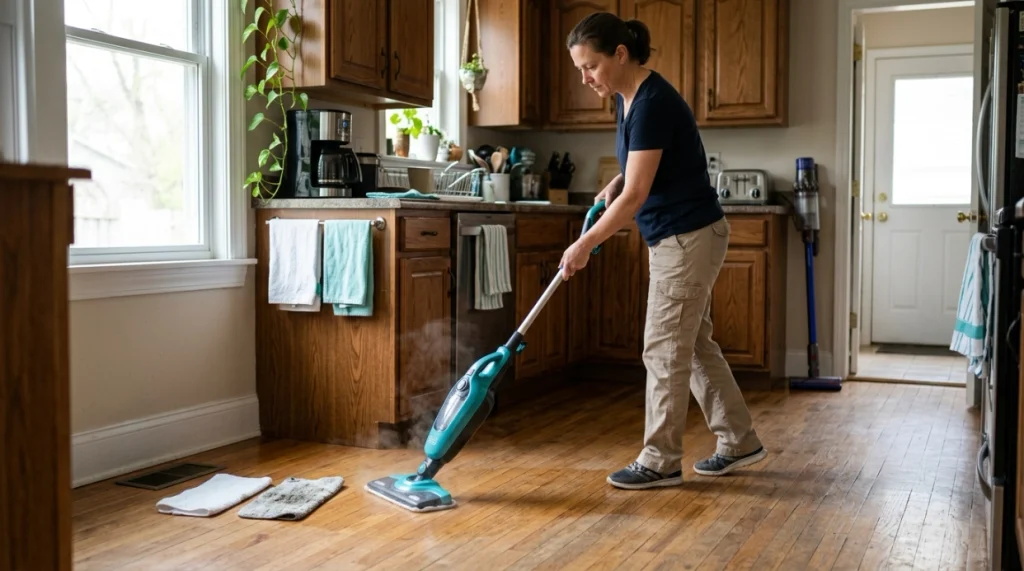
Good results depend on removing dirt in stages. Dry soil should come off first, then steam can tackle compatible stuck-on residue.
- Check floor compatibility. Confirm that the floor manufacturer allows steam cleaning.
- Vacuum thoroughly. Remove dust, crumbs, hair, sand, and grit, including along edges.
- Start with a clean pad. Do not reuse yesterday’s dirty pad just because it looks dry.
- Fill the tank correctly. Use the water type specified in your steam mop manual.
- Choose a suitable steam level. Start low unless the flooring and mop instructions say otherwise.
- Work in small sections. A roughly 3-by-3 to 5-by-5-foot area makes pad condition easier to monitor.
- Use overlapping passes. Slight overlap helps prevent narrow dirty strips between passes.
- Change the pad early. Do not wait until it is completely saturated with gray grime.
- Let the floor dry. Keep people and pets away until the surface is dry and no longer slippery.
I prefer cleaning from the far side of a room toward the exit. That keeps me from walking back over freshly cleaned areas.
Do not pour ordinary floor detergent into the steam mop tank unless the manufacturer specifically allows it. Many machines are designed for water only.
Wet floors also create a slip risk. OSHA’s guidance on wet-floor slip and fall hazards emphasizes keeping walking surfaces clean and dry.
Section Takeaway: Think of steam mopping as the second stage of cleaning, not the first. Vacuum first, use fresh pads, control moisture, and keep traffic off the floor until it dries.
Could Your Floor Type Be the Problem?
Yes. Heat and moisture affect flooring materials differently, so a method that works beautifully on one floor may be unsuitable for another.
| Floor type | Steam-mop approach | Main concern |
|---|---|---|
| Ceramic or porcelain tile | Often suitable when properly installed and sealed as required | Dirty grout, residue, or damaged joints |
| Vinyl / LVP | Use only if the flooring manufacturer expressly allows steam | Heat, seams, adhesive, and moisture |
| Laminate | Usually better handled with tightly controlled damp cleaning unless approved | Moisture entering joints or core material |
| Hardwood / engineered wood | Follow the wood-floor manufacturer’s instructions closely | Finish damage, gaps, moisture, or heat exposure |
| Natural stone | Check stone type, sealer, and installer guidance first | Sealer condition and chemical sensitivity |
| Sealed concrete | May tolerate steam depending on coating and finish | Coating compatibility and surface porosity |
If you see swelling, lifted edges, whitening, finish changes, or persistent cloudiness, stop using steam. Those signs should not be treated as ordinary dirt.
Safety note: Always follow the flooring manufacturer’s care guide before applying steam, chemicals, or prolonged moisture.
Steam Mop vs Other Mops: Which Removes Dirt Better?
No mop wins every cleaning job. The better tool depends on whether you are dealing with loose soil, greasy film, sticky residue, or moisture-sensitive flooring.
| Mop type | Best use | Dirt removal | Moisture control |
|---|---|---|---|
| Steam mop | Sticky grime on compatible heat-safe floors | Good when pads are changed often | Varies by steam setting |
| Microfiber flat mop | Routine cleaning and moisture-sensitive floors | Good for fine dust and light soil | Excellent when pad is properly wrung |
| Spin mop | Larger washable hard-floor areas | Good for heavier general soil | Good with an effective wringer |
| String mop | Large durable surfaces and spills | Can handle substantial liquid and soil | Lower unless thoroughly wrung |
| Vacuum floor washer | Homes needing debris pickup plus wet cleaning | Can separate collected dirty water on supported models | Machine-controlled |
This is why I do not automatically reach for steam on every dirty floor. A microfiber flat mop can be more useful when residue needs to be rinsed away with controlled moisture.
Steam mops remain convenient for compatible surfaces, especially where heat helps soften sticky messes. Consumer Reports also evaluates modern models through its steam mop testing and reviews.
How Do You Remove Old Residue Before Steam Mopping Again?
If the floor feels sticky after drying, old cleaner buildup may be the main problem. Repeated steam passes can keep softening that layer without fully carrying it away.
Try a controlled floor reset
- Stop adding more products. Do not layer one cleaner over another.
- Check the care guide. Identify a cleaner approved for your specific flooring.
- Use fresh microfiber pads. Dirty pads can reapply loosened residue.
- Clean a small test area. Choose a hidden section before treating the entire room.
- Remove the loosened film. Use a clean, slightly damp pad if the floor instructions allow it.
- Repeat with clean pads if needed. One pass may not remove years of buildup.
- Allow full drying. Judge the finish only after remaining moisture disappears.
A pH-neutral cleaner is designed to sit near the middle of the acid-to-alkaline scale. These products are often useful for routine floor care, but approval still depends on your flooring material.
Do not assume vinegar is a universal residue remover. Acidic cleaners can be unsuitable for stone and some floor finishes.
Safety note: Never mix household cleaners or disinfectants unless the product labels specifically direct you to do so. The EPA advises following product labels because incompatible cleaning chemicals can create dangerous exposure.
The EPA’s explanation of cleaning, sanitizing, and disinfecting is also useful here. Cleaning dirt away and disinfecting microorganisms are different jobs.
Could Your Steam Mop Itself Be Dirty?
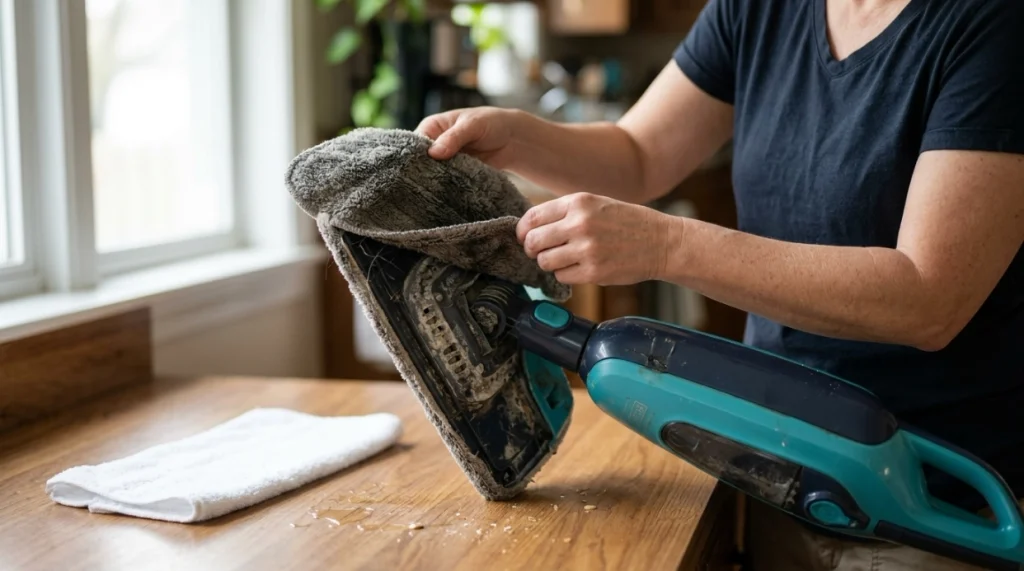
Yes. A steam mop with a contaminated pad, restricted steam path, or poorly maintained tank can deliver disappointing results even when your technique is good.
Check these parts before blaming the floor
- Mop pad: Wash it according to the manufacturer’s directions and replace worn pads.
- Steam outlets: Check for visible mineral deposits or blockages using the approved maintenance method.
- Water tank: Empty and maintain it as directed instead of leaving stale water indefinitely.
- Mop head: Remove hair, grease, and debris trapped around the pad attachment area.
- Steam output: Uneven or weak steam can signal a maintenance problem.
- Power cord or battery: Make sure the appliance receives the power its manual requires.
Wash microfiber pads separately from lint-heavy laundry when practical. Fabric softener can also reduce the absorbent behavior of some microfiber products, so follow the pad-care instructions.
If a Bissell, Shark, Tineco, or another machine suddenly performs differently, start with its manual. Maintenance procedures vary too much to use one descaling method safely across every model.
Frequently Asked Questions
Why does my floor look streaky after steam mopping?
Streaks usually come from a dirty pad, remaining cleaner residue, loose dust, or excess moisture. Vacuum first, use a clean pad, and reduce the steam level if your floor and machine allow it.
Why does my floor feel sticky after steam mopping?
Sticky flooring often points to detergent, polish, grease, or previous cleaner buildup. Steam can soften the residue without removing enough of it, especially when the cleaning pad becomes saturated.
Should I put floor cleaner in my steam mop?
Only if the steam mop manufacturer specifically says that product or solution is approved for the tank. Many traditional steam mops are designed for water only, and adding detergent can damage the machine or leave residue.
Do I need to vacuum before using a steam mop?
Yes, unless your machine specifically vacuums and steams in one operation. Removing grit, dust, crumbs, and hair first prevents loose debris from becoming wet grime under the mop pad.
Does a steam mop disinfect the floor?
Do not assume every steam pass disinfects. Effective sanitizing or disinfecting depends on validated temperature, contact time, surface compatibility, and the manufacturer’s tested instructions.
Why does my steam mop make the floor look dull?
Dullness may come from residue, mineral deposits, a dirty pad, or changes to the floor finish. If a clean test area remains cloudy after drying, stop steaming and check the flooring manufacturer’s care instructions.
How many steam mop pads should I use?
There is no universal number because soil levels and room size vary. I keep at least two clean pads available for a dirty kitchen and change pads whenever the working surface becomes heavily discolored.
What Should You Do Next?
If your floor is still dirty after steam mopping, do not keep adding steam. First determine whether you are dealing with loose soil, a saturated pad, old cleaner residue, maintenance problems, or an incompatible floor.
- Vacuum or sweep thoroughly.
- Confirm that your flooring allows steam.
- Install a fresh microfiber pad.
- Use controlled steam instead of maximum output.
- Change pads before they become overloaded.
- Address old cleaner buildup separately.
- Stop if you notice finish damage or raised seams.
For me, the biggest improvement comes from treating the pad as the part that removes the dirt. Steam loosens the mess, but a clean surface still depends on giving that grime somewhere clean to go.
Fix that part of the routine, and most mysterious post-mopping streaks become much easier to diagnose.
