
What Is a Spin Mop System? Complete Guide for 2026

Quick Answer
A spin mop system is a floor-cleaning setup that combines a reusable mop with a bucket containing a spinning wringer. The spinning action removes excess water from the mop head, so you can control moisture without twisting the mop by hand. Systems such as the O-Cedar EasyWring spin mop system use a foot-operated wringer for hands-free moisture control.
What a spin mop system includes
- Mop head: Usually washable microfiber that collects dust, hair, spills, and everyday soil.
- Spin wringer: A basket rotates rapidly to remove water from the mop head.
- Bucket: Holds cleaning water and supports the spinning mechanism.
- Moisture control: More spinning leaves the mop drier for moisture-sensitive flooring.
- Reusable design: Most systems let you wash and reuse the mop head instead of throwing it away.
Best use
- Spin mops are especially useful when you want the cleaning reach of a string-style mop with better control over how wet the floor becomes.
A spin mop system takes the familiar mop-and-bucket setup and makes wringing much easier. It can also give you better control over floor moisture than a basic string mop.
As of 2026, there are simple single-bucket models, clean-water separation systems, and several variations in mop-head design. Here is how they work, where they make sense, and how to use one without leaving your floors soaked or streaky.
In This Guide
- What is a spin mop system?
- How does a spin mop system work?
- What types of spin mop systems are available?
- How does a spin mop compare with other mops?
- Which floors can you clean with a spin mop?
- What cleaning solution should you use?
- How do you use a spin mop correctly?
- Spin mop system FAQ
- Final takeaway
What is a spin mop system?
A spin mop system is a mop, bucket, and centrifugal wringer designed to remove water from the mop head by spinning it rapidly. Instead of squeezing wet fibers by hand, you place the mop inside the wringer and activate the spinning mechanism.
The mop head is usually made from microfiber, a synthetic material made from extremely fine fibers. Those fibers help collect fine dust and hold moisture while remaining washable.
What parts make up the system?
- Mop handle: Usually telescopic or adjustable for easier storage and comfortable cleaning.
- Mop head: Often circular or triangular, with microfiber strands extending from the base.
- Bucket: Holds water or diluted floor cleaner.
- Wringer basket: Spins the mop head to expel excess moisture.
- Spin mechanism: May use a foot pedal, handle action, or another manual mechanism.
The main advantage is control. A few extra spins can produce a noticeably drier mop than simply lifting a traditional string mop from a bucket.
I consider that moisture control one of the most useful features when comparing mop systems. It matters most on flooring where standing water is undesirable.
Does the mop head itself spin while cleaning?
Usually, the term spin mop refers mainly to the wringing process. The mop head rotates freely for maneuverability, but it is not normally motor-driven while you move it across the floor.
That makes a standard spin mop different from an electric spinning mop. Powered models use rotating cleaning pads to provide scrubbing action during cleaning.
How does a spin mop system work?
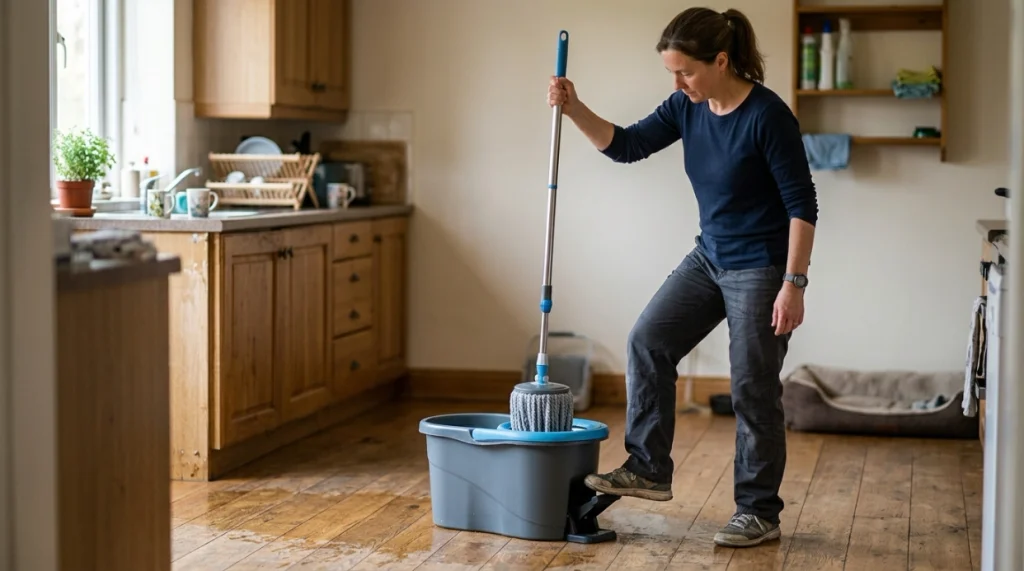
A spin mop works by using centrifugal force to throw water outward from the wet mop fibers. The wringer catches that water and sends it back into the bucket or a separate dirty-water compartment.
The process is simple once the handle and mop head are assembled.
- Fill the bucket: Add the amount of water recommended for your system.
- Add cleaner if needed: Use only a cleaner suitable for your floor surface.
- Wet the mop: Immerse the microfiber head in the cleaning water.
- Move it to the wringer: Keep the mop upright so it can rotate freely.
- Activate the spinner: Use the pedal or handle mechanism until the moisture level feels appropriate.
- Mop the floor: Work across a manageable section before rinsing the head again.
- Repeat: Rinse, spin, and continue until the floor is finished.
For example, O-Cedar’s current RinseClean instructions suggest roughly five to seven pedal pumps when wringing. The exact amount will vary with the system and the dryness you want.
Why does spinning make such a difference?
With a conventional string mop, people often leave too much water in the fibers. That extra water can lengthen drying time and increase the chance of streaking or water sitting in seams.
A spinner gives you a repeatable way to remove more water. You can also adjust the result by simply spinning longer.
- Tile cleaning: Leave slightly more moisture when you need time to loosen stuck-on soil.
- Laminate cleaning: Wring much more thoroughly so the mop feels damp rather than wet.
- Sealed wood cleaning: Use minimal moisture and avoid letting water sit on the surface.
What types of spin mop systems are available?
The biggest difference between spin mop systems is how they handle cleaning water. Basic models use one bucket, while more advanced designs separate cleaner water from dirty rinse water.
Single-bucket spin mop
This is the simplest design. The mop is rinsed and wrung using the same main bucket assembly.
- Usually compact and easy to understand
- Fewer parts to wash after cleaning
- Often easier to store in apartments or small utility areas
- Cleaning water becomes progressively dirtier during use
Dual-tank or clean-water spin mop
A dual-tank system keeps fresh water separate from the water removed during wringing. O-Cedar’s RinseClean is one current example of this approach.
This design reduces how often a dirty mop head goes directly back into the original cleaning water. The tradeoff is a larger bucket with more components to rinse and dry.
Foot-pedal versus handle-activated systems
A foot-pedal system spins when you press a pedal built into the bucket. Your hands stay on the handle, which makes moisture adjustments quick.
Handle-activated models generate the spinning motion through the mop handle itself. They can eliminate a pedal but depend more heavily on the handle’s internal mechanism.
- Foot pedal: Easy to control while standing normally.
- Handle spinner: Useful when you prefer fewer moving parts in the bucket.
- Dual-tank design: Better suited to users who dislike returning the mop to increasingly dirty water.
How does a spin mop compare with other mops?
A spin mop sits between a traditional string mop and a low-moisture microfiber flat mop. It offers the coverage of loose fibers while adding a much easier wringing method.
| Mop type | How moisture is controlled | Main strength | Main limitation | Best fit |
|---|---|---|---|---|
| Spin mop | Centrifugal wringer | Good coverage with adjustable dampness | Bucket takes storage space | Whole-home hard-floor cleaning |
| Traditional string mop | Hand or mechanical wringer | Handles large wet-cleaning jobs | Easy to leave too wet | Tile, utility rooms, heavy messes |
| Flat microfiber mop | Pre-dampened or sprayed pad | Low water use and easy storage | Pad may need frequent changing | Routine wood, laminate, and vinyl care |
| Steam mop | Small heated water tank | Steam helps loosen grime | Not appropriate for every floor | Compatible sealed surfaces |
A spin mop is often the more flexible choice when several rooms need wet cleaning. You can change the moisture level without changing tools.
A flat microfiber mop can still be quicker for small apartments or daily touch-ups. It also avoids carrying a bucket through the home.
Which floors can you clean with a spin mop?
A spin mop can work on many hard floors, but the important question is not simply whether the mop touches the surface. You must also control water and choose a compatible cleaner.
Tile and ceramic floors
Glazed tile is one of the easiest surfaces for a spin mop. The microfiber strands can reach grout lines and collect loose debris across larger areas.
Don’t flood grout or leave puddles around edges. A damp mop usually cleans routine soil without excessive water.
Hardwood and engineered wood
Use a spin mop only when the floor manufacturer permits damp mopping. Wring the head thoroughly and remove spills or standing water promptly.
For finished wood, a purpose-made pH-neutral wood floor cleaner is a safer starting point than experimenting with strong homemade mixtures.
Laminate flooring
Laminate responds best to controlled moisture. Water should not remain around joints or edges where it may reach the core material.
Spin until the mop is only damp, then clean small sections. Dry any visibly wet areas rather than waiting for puddles to evaporate.
Vinyl and LVP
Most water-resistant vinyl floors are straightforward to damp mop. Still, check the flooring maker’s instructions because cleaner restrictions can vary by finish and product line.
Natural stone
Stone requires extra attention to chemistry. The Natural Stone Institute’s care guidance recommends neutral or mild cleaners and warns that acidic products can damage acid-sensitive stone.
That matters for marble, limestone, and travertine. Vinegar is not a universal floor cleaner.
Safety note: Always check your flooring manufacturer’s care guide before introducing a new cleaner, disinfectant, steam process, or unusually wet mopping method.
What cleaning solution should you use in a spin mop?
You don’t automatically need a strong chemical mixture. For ordinary household soil, water or a correctly diluted floor cleaner may be enough.
The CDC’s cleaning and disinfecting guidance says routine cleaning with soap or detergent and water removes dirt and germs from surfaces. Disinfection generally becomes more relevant when illness is present or another situation specifically calls for it.
Match the cleaner to the floor
- Sealed hardwood: Choose a cleaner approved for finished wood and avoid excess liquid.
- Laminate: Use a low-residue product permitted by the flooring manufacturer.
- Vinyl/LVP: Use a compatible neutral cleaner and avoid leaving concentrated product behind.
- Tile: A suitable neutral floor cleaner works for most routine jobs.
- Natural stone: Use stone-safe, non-acidic products when required.
If ingredient choice matters to you, the EPA Safer Choice program provides a way to identify cleaning products that meet its ingredient and performance requirements.
Should you put vinegar in a spin mop?
I would not treat vinegar as a universal spin-mop solution. Its acidity makes it unsuitable for some surfaces, especially calcareous natural stones.
Even on other flooring, the safest approach is to follow the floor manufacturer’s instructions. More cleaner is not automatically better, either.
Over-concentrated detergent can leave residue behind. That residue may make floors look dull, feel tacky, or show footprints soon after drying.
Safety note: Never mix cleaning chemicals unless their labels specifically allow it. Follow dilution, ventilation, contact-time, and surface-compatibility instructions on the product label.
How do you use a spin mop correctly without streaks?

The biggest mistake is starting with a floor covered in loose grit. Mopping wet dust and crumbs can turn them into muddy residue.
Prepare the floor first, then control both cleaner concentration and mop moisture.
- Vacuum or sweep first: Remove hair, sand, crumbs, and grit.
- Prepare the solution correctly: Follow the cleaner label instead of guessing the concentration.
- Saturate the mop head: Wet the microfiber evenly before the first pass.
- Spin out excess water: Aim for dampness that suits the flooring.
- Start at the far side: Work toward the exit so you don’t walk across the freshly cleaned floor.
- Use overlapping passes: A loose figure-eight or S-shaped motion covers edges efficiently.
- Rinse when dirty: Don’t continue spreading visibly dirty water across another room.
- Let the floor dry: Keep foot traffic away until the surface is no longer damp.
How can you prevent a spin mop from smelling?
Don’t store the mop head wet inside the bucket. Trapped moisture can produce unpleasant odors and makes the entire system harder to keep fresh.
- Rinse the mop head after use.
- Wash it according to the manufacturer’s instructions.
- Avoid fabric softener when the mop maker says it can reduce microfiber performance.
- Rinse dirt and cleaner residue from the bucket.
- Allow the bucket and mop head to air-dry fully before storage.
Is a spin mop worth using?
A spin mop makes the most sense when you regularly clean several hard-floor rooms and dislike hand-wringing a traditional mop. It also helps when you want one mop that can move between tile, vinyl, laminate, and compatible sealed floors.
The main drawbacks are storage space and bucket maintenance. A dual-tank system can also feel bulky if you only clean a small area at a time.
- Good fit: Medium or large areas of hard flooring
- Good fit: Homes with several compatible floor types
- Good fit: People who want reusable microfiber heads
- Less convenient: Tiny apartments with little bucket storage
- Less convenient: Quick spot cleaning where a spray mop is faster
Spin mop system FAQ
What is the main purpose of a spin mop?
The main purpose of a spin mop is to make wet floor cleaning easier while giving you better control over mop moisture. Its spinning wringer removes excess water from the mop head, reducing the need to squeeze or twist wet fibers manually.
Do you need a special bucket for a spin mop?
Yes. A standard spin mop depends on the matching bucket and wringer mechanism to create the spinning action. Replacement buckets or handles are not always interchangeable between brands, so check compatibility before replacing one part of the system.
Can you use only water with a spin mop?
Yes, you can use plain water for some routine cleaning jobs when the flooring manufacturer allows damp mopping. A suitable floor cleaner can help with grease, residue, or heavier soil, but always follow both the cleaner label and floor-care instructions.
Can a spin mop be used on hardwood floors?
A spin mop may be suitable for some sealed hardwood floors when used barely damp. Wring the mop thoroughly, avoid puddles, and confirm that damp mopping is permitted by the flooring manufacturer before cleaning the entire room.
Is a spin mop better than a regular mop?
A spin mop offers easier wringing and more repeatable moisture control than a basic string mop. A regular mop may still suit heavy wet-cleaning tasks, while a flat microfiber or spray mop can be more convenient for quick daily cleaning.
How often should you wash a spin mop head?
Wash or thoroughly rinse the mop head whenever it becomes visibly dirty and after significant cleaning jobs. Follow the manufacturer’s washing instructions, because bleach, fabric softener, high heat, or machine drying may be discouraged for some microfiber refills.
Why does my floor look streaky after using a spin mop?
Common causes include too much cleaning solution, a dirty mop head, overly wet mopping, or residue already present on the floor. Try using the correct dilution, rinsing the mop more often, and spinning out more water before each pass.
Final takeaway
A spin mop system combines a reusable mop, bucket, and spinning wringer to make moisture control easier. That simple mechanism is what separates it from an ordinary mop-and-bucket setup.
For most households, the biggest benefits are hands-free wringing, washable mop heads, and flexibility across compatible hard floors. Single-bucket models keep things simple, while dual-tank designs offer better separation between clean and dirty water.
The mop itself is only part of good floor care. Sweep first, choose a cleaner that matches the floor, wring thoroughly, and never assume that one cleaning solution is safe for every surface.
If those basics fit your cleaning routine, a spin mop can be a practical middle ground between a traditional string mop and a low-moisture flat mop.