
Foot Pedal Spin Mop vs Handle Spin Mop: Which Is Better?

Quick Answer
A foot pedal spin mop uses repeated leg presses to power the bucket wringer, while a handle spin mop spins when you push the mop handle downward. Foot-pedal models can feel easier on the wrists and give direct wringing control. Handle-operated models remove the pedal and often use a simpler bucket footprint. Whichever system you choose, good routine household floor cleaning still depends on controlling dirt, moisture, and cleaning solution.
The biggest differences
- Spin activation: Pedal models use your foot, while handle models use downward arm movement.
- Wrist effort: Pedal designs put less of the spinning work through your hands and wrists.
- Balance: Handle systems don’t require you to stand on one leg while pumping a pedal.
- Bucket design: Handle-operated buckets can have fewer exterior parts and a cleaner storage footprint.
- Moisture control: Either system can wring microfiber well if its mechanism is efficient and stable.
My simple rule
- Choose the movement that feels comfortable enough to repeat throughout an entire cleaning session.
Choosing between a foot pedal spin mop and a handle spin mop looks simple until you use the wringer twenty or thirty times. The activation method changes how your legs, hands, wrists, and the bucket itself behave during floor cleaning.
I also pay close attention to moisture control. A convenient spinning system isn’t useful if the mop still leaves hardwood, laminate, or LVP wetter than the floor can safely handle.
In This Guide
- How Do Foot Pedal and Handle Spin Mops Work?
- Foot Pedal Spin Mop vs Handle Spin Mop Comparison
- Which Spin Mop Is Easier to Use?
- Which Spin Mop Is Better for Different Floor Types?
- Which Design Is More Durable and Easier to Maintain?
- How Should You Choose Between Them?
- How Do You Use a Spin Mop Properly?
- Foot Pedal vs Handle Spin Mop FAQ
- Which Spin Mop Should You Choose?
How Do Foot Pedal and Handle Spin Mops Work?
Both designs use fast rotation to push excess water out of a wet mop head. The difference is how you create that rotation.
A spin mop is a floor-cleaning system that uses centrifugal rotation to rinse or wring moisture from a mop head. Most manual models pair a microfiber mop with a bucket-mounted spinning basket.
How a foot pedal spin mop works
A foot pedal spin mop has a pedal near the base of the bucket. Pressing the pedal drives the spinning wringer through an internal mechanical system.
- Step 1: Wet or rinse the microfiber mop head.
- Step 2: Place the head inside the spinning basket.
- Step 3: Hold the handle upright and press the pedal several times.
- Step 4: Stop when the mop reaches the moisture level you want.
The main advantage is separation between wringing and the mop handle. Your leg generates most of the spinning motion.
How a handle-operated spin mop works
A handle spin mop uses the mop shaft itself to activate the spinner. You normally unlock the handle, press downward, and let an internal mechanism rotate the mop head.
- Step 1: Place the wet mop head in the spinning basket.
- Step 2: Position the handle vertically.
- Step 3: Push the handle downward several times.
- Step 4: Lock or steady the handle before mopping again.
There is no floor pedal to pump. That can make the bucket slightly less cluttered around its base.
Foot Pedal Spin Mop vs Handle Spin Mop Comparison
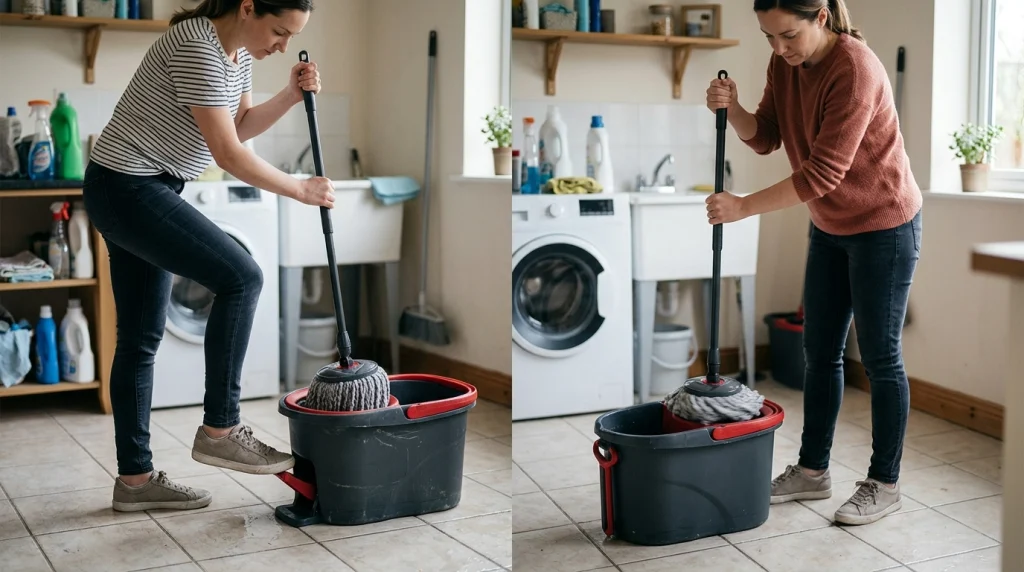
The biggest practical difference is ergonomics rather than cleaning chemistry. Both systems can clean well when paired with good microfiber and sensible moisture control.
| Feature | Foot Pedal Spin Mop | Handle Spin Mop |
|---|---|---|
| Spin activation | Foot pumping | Downward handle pumping |
| Main effort area | Leg and foot | Hands, arms, and shoulders |
| Balance required | More while pumping pedal | Both feet stay planted |
| Bucket footprint | Pedal may protrude | Often cleaner around base |
| Moving mechanism | Pedal and bucket drive | Handle and internal drive |
| Moisture control | Good with repeated pedal spins | Good with repeated handle presses |
| Storage | Pedal adds exterior hardware | Bucket may be simpler externally |
| Good fit for | Users wanting less wrist-driven wringing | Users who dislike pedal operation |
Don’t judge either type only by how fast the basket spins. I would rather have a stable bucket and predictable moisture control than dramatic spin speed.
A second check matters too. After wringing, lift the mop and see whether water drips from the fibers without squeezing them.
If it does, give it another spin before using it on moisture-sensitive flooring.
Which Spin Mop Is Easier to Use?
A foot pedal model often feels easier when you want to keep wringing effort out of your wrists. A handle model can feel easier when balance or repeated foot movement is the bigger concern.
Foot pedal advantages
- Less arm-powered spinning: Your leg provides the wringing force.
- Easy extra spins: Another pedal press quickly removes more moisture.
- Independent handle: The mop shaft isn’t responsible for powering the spinner.
- Clear feedback: You can easily control how many pedal strokes you use.
The tradeoff is stance. You normally keep one foot on the floor and use the other to work the pedal.
That arrangement may feel awkward for someone with balance limitations.
Handle spin mop advantages
- Two feet grounded: You don’t need to repeatedly raise one foot.
- No external pedal: There is one less protruding part around the bucket.
- Fast workflow: Rinsing and spinning happen with the mop already in your hands.
- Simple positioning: You stand over the bucket and push vertically.
The downside is repeated downward pressure. A long cleaning session can make your hands, forearms, or shoulders notice the work.
Comfort also depends on handle height. A handle that forces you to hunch forward can make an otherwise good spin system frustrating.
Section Takeaway: Foot-pedal and handle-operated systems move the physical effort to different parts of your body. Choose based on the motion you can repeat comfortably, not the mechanism that looks more impressive in a product photo.
Which Spin Mop Is Better for Different Floor Types?
Neither activation method automatically makes a mop safer for hardwood, laminate, tile, or vinyl. Moisture control matters far more.
The National Wood Flooring Association recommends keeping moisture limited on wood floors and following the floor or finish manufacturer’s instructions. See the National Wood Flooring Association for broader wood-floor guidance.
Hardwood and engineered wood
Use whichever system can leave the microfiber head slightly damp rather than wet. Finished wood doesn’t benefit from extra water sitting on its surface or entering gaps.
- Remove grit before damp cleaning.
- Spin the mop thoroughly.
- Work in small sections.
- Wipe spills and visible standing moisture promptly.
Laminate
Laminate also rewards aggressive wringing. Water collecting around seams and damaged edges can create avoidable problems.
A pedal or handle system can both work if your flooring manufacturer permits damp mopping.
Vinyl and LVP
Vinyl and luxury vinyl plank generally make moisture control easier than wood-based floors. Still, there is no cleaning benefit in flooding the surface.
Use enough moisture to loosen soil without leaving puddles around joints, edges, cabinets, or transitions.
Ceramic and porcelain tile
Tile can tolerate a more generous damp-mopping routine when the tile, grout, and installation are in good condition. This is where either spin system feels especially practical.
For dirty kitchen tile, I focus more on rinsing the microfiber frequently than on choosing pedal versus handle activation.
Natural stone
Natural stone needs a compatible cleaner. Avoid assuming a household DIY mixture is safe simply because it works on ceramic tile.
Safety note: Check your flooring manufacturer’s care guide before using a new cleaner, vinegar mixture, disinfectant, steam, or moisture-heavy method.
Which Design Is More Durable and Easier to Maintain?
Durability depends on build quality, but the two systems place moving parts in different locations. Pedal models concentrate the drive mechanism around the bucket, while handle models depend more heavily on the mop shaft.
Parts to inspect on a foot pedal mop
- Pedal travel: It should move smoothly without binding.
- Bucket stability: The bucket shouldn’t slide when the pedal is pressed.
- Drive connection: The spinner should engage consistently.
- Pedal housing: Check for trapped hair, grit, or cleaning residue.
Parts to inspect on a handle spin mop
- Handle lock: It should switch reliably between spinning and mopping positions.
- Telescoping joints: Sections shouldn’t loosen during repeated pressing.
- Spin mechanism: Downward movement should feel smooth rather than jerky.
- Mop-head connection: The head should remain secure at full spin speed.
Replacement mop heads matter more than many shoppers expect. A durable bucket isn’t useful if matching microfiber heads disappear from the market.
I also prefer designs that can dry completely after cleaning. Permanently damp microfiber and trapped dirty water quickly make a mop unpleasant to store.
Section Takeaway: Neither pedal nor handle operation guarantees longer life. Favor a stable mechanism, replaceable heads, washable parts, and a design you can rinse and dry easily.
How Should You Choose Between a Foot Pedal and Handle Spin Mop?
Start with your body, floor type, and storage space. Those factors affect daily satisfaction more than an unusually long accessory list.
Choose a foot pedal spin mop when:
- You want to reduce repeated downward pressure through your wrists.
- You like controlling moisture with several quick pedal presses.
- You have enough storage room for a bucket with exterior pedal hardware.
- You feel steady while operating the pedal.
Choose a handle spin mop when:
- You prefer keeping both feet planted while wringing.
- You dislike pedals or want fewer parts around the bucket base.
- You have a narrow storage area.
- Repeated vertical handle pressing feels comfortable.
What features matter on either design?
- Stable base: The bucket shouldn’t walk across smooth tile during spinning.
- Strong wringing: You need enough control to produce a lightly damp head.
- Washable microfiber: Replaceable heads make long-term use easier.
- Secure handle: Look for comfortable height and solid locking joints.
- Easy emptying: A pour spout or drain can simplify cleanup.
- Reasonable capacity: More water reduces refills but makes the bucket heavier.
- Replacement availability: Check mop-head compatibility before buying.
As of 2026, I would treat extras such as wheels, soap dispensers, brushes, and splash guards as secondary. They can be useful, but they shouldn’t distract from wringing control and stability.
How Do You Use a Spin Mop Properly?
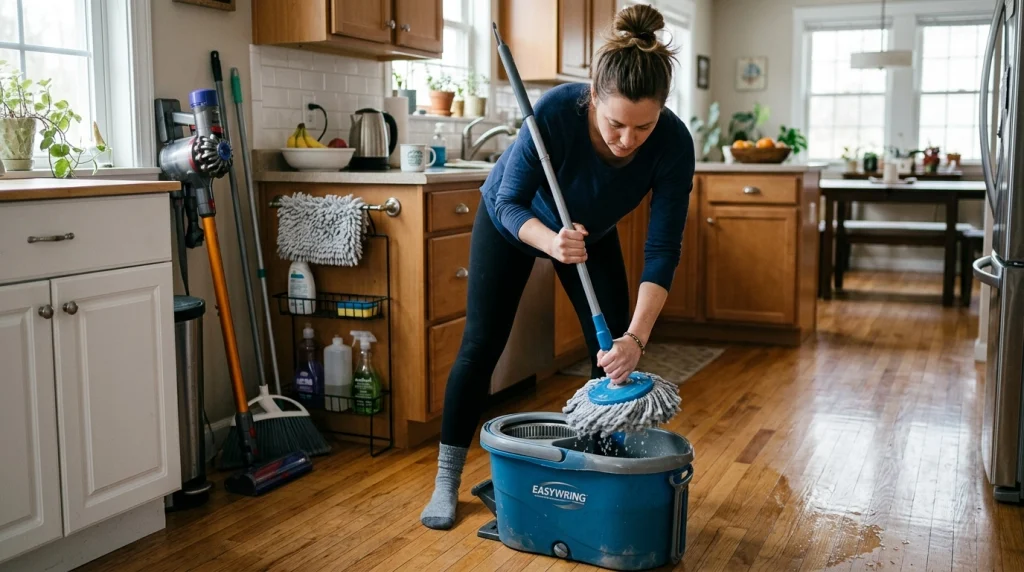
A good mop system can still leave dull or streaky floors if the technique is poor. Start by removing dry debris and keep dirty water under control.
- Sweep or vacuum first. Remove hair, crumbs, grit, and dust before adding moisture.
- Check the floor instructions. Confirm that damp mopping and your cleaner are suitable.
- Fill the bucket conservatively. Follow the cleaner’s label rather than guessing a stronger mixture.
- Wet the microfiber head. Let the fibers absorb cleaning solution.
- Spin thoroughly. Use the pedal or handle until the head reaches the needed dampness.
- Mop a manageable area. Use overlapping passes instead of soaking an entire room.
- Rinse when dirty. Don’t keep pushing visibly loaded microfiber across clean areas.
- Change dirty water. Replace heavily cloudy or contaminated solution.
- Empty the bucket. Rinse residue from the wringer and reservoir.
- Dry everything. Let the mop head and bucket air-dry before storage.
Routine cleaning doesn’t automatically require a disinfectant. CDC household guidance says regular cleaning is sufficient in many situations unless illness or another specific circumstance makes disinfection appropriate.
If you do need a disinfectant, the EPA explains cleaning, sanitizing, and disinfecting and emphasizes following the registered product’s label directions.
Never assume that adding extra chemical produces a cleaner floor. Too much product can leave residue, and incompatible chemicals can create dangerous reactions.
Safety note: Follow product labels for dilution, surface compatibility, ventilation, protective equipment, and contact time. Never mix cleaning chemicals unless their instructions specifically permit it.
Section Takeaway: Spin-mop performance depends on technique as much as bucket design. Remove dry dirt first, wring carefully, refresh dirty water, and let every component dry after use.
Foot Pedal vs Handle Spin Mop FAQ
Is a foot pedal spin mop better than a handle spin mop?
Not automatically. Foot-pedal systems shift the spinning effort toward your leg, while handle-operated systems use downward arm movement. Both can wring microfiber effectively. Comfort, bucket stability, moisture control, and floor compatibility matter more than the activation method alone.
Which spin mop is easier on the wrists?
A foot pedal model can reduce the amount of repeated force needed through the wrists because your leg powers the spinning basket. However, you still need to steer the mop during cleaning, so handle height and grip comfort remain important.
Which spin mop is better for someone with balance problems?
A handle-operated system may feel more stable because both feet can stay on the floor during wringing. Individual needs vary, so test the operating movement when possible and choose a bucket that stays firmly planted during spinning.
Can I use either type of spin mop on hardwood?
Only when your wood-floor or finish manufacturer permits damp mopping. Wring the microfiber until it is only slightly damp, avoid standing water, and clean spills quickly. The activation system matters less than limiting moisture.
Do handle spin mops break more easily?
Not necessarily. Handle-operated models place more mechanical responsibility inside the shaft, while pedal models add moving parts around the bucket. Build quality, cleaning, proper use, and replacement-part availability are more useful durability indicators than mechanism type.
How many times should I spin the mop?
There is no universal number because spinner efficiency varies. Keep spinning until the mop reaches the moisture level appropriate for your floor. For laminate or wood, the head should normally be well wrung and should not drip freely.
Should I put disinfectant in my spin mop bucket?
Routine household floors usually need cleaning rather than constant disinfection. When disinfection is appropriate, use a surface-compatible product and follow its label exactly. Clean dirt from the floor first rather than relying on disinfectant to replace normal cleaning.
Which Spin Mop Should You Choose?
Choose a foot pedal spin mop if you prefer powering the wringer with your leg and want to reduce repeated handle pressing. It can be especially convenient when you often adjust the mop between wetter and nearly dry settings.
Choose a handle spin mop if you prefer keeping both feet planted or want a bucket without an exterior pedal. Make sure the handle spins smoothly and locks securely for normal mopping.
- For wrist comfort: Consider a foot pedal model.
- For two-foot stability: Consider a handle-operated model.
- For hardwood or laminate: Prioritize excellent wringing and moisture control.
- For large tile areas: Prioritize bucket stability, capacity, and easy rinsing.
- For small storage spaces: Compare actual bucket dimensions and external hardware.
The mechanism shouldn’t make the decision by itself. A stable bucket, washable microfiber head, comfortable handle, strong wringer, and easy cleanup will affect your floor-cleaning routine every week.