
Flat Spin Mop vs Round Spin Mop: Which Is Better?

Quick Answer
A flat spin mop is usually better for everyday cleaning, corners, baseboards, and low-moisture floors. A round spin mop is usually better for heavier dirt, tile, larger wet-mopping jobs, and uneven areas. Whichever style you choose, good routine floor cleaning depends more on clean pads, controlled moisture, and the right cleaner than the head shape alone.
Main differences
- Corner cleaning: Flat heads reach edges and straight baseboards more easily.
- Heavy scrubbing: Round microfiber heads often handle dirtier, water-tolerant floors better.
- Moisture control: Flat pads are easier to keep lightly damp for sensitive flooring.
- Furniture access: Thin flat heads usually slide farther beneath cabinets and furniture.
- Rinsing: Traditional round spin systems are convenient when you need repeated bucket rinsing and wringing.
My simple rule
- Choose flat for controlled everyday cleaning. Choose round when the floor is dirtier and can safely handle more moisture.
I’ve used both styles on tile, vinyl, laminate, and finished wood. The difference becomes obvious once you stop comparing bucket features and watch how each mop head contacts the floor.
A flat head gives me precision. A round microfiber head gives me flexibility and more aggressive wet cleaning.
In This Guide
- What Is the Difference Between a Flat and Round Spin Mop?
- Flat Spin Mop vs Round Spin Mop Comparison
- Which Spin Mop Cleans Better?
- Which Mop Is Better for Each Floor Type?
- Which Mop Is Better for Corners and Furniture?
- Which Spin Mop Is Easier to Maintain?
- How Do You Choose Between Flat and Round?
- Frequently Asked Questions
- Final Takeaway
What Is the Difference Between a Flat and Round Spin Mop?
The main difference is the shape and floor contact of the cleaning head. Flat spin mops use a rectangular or elongated pad, while traditional round spin mops use a circular microfiber head.
Both may use a bucket-mounted spinning wringer. However, they feel quite different during actual floor cleaning.
What is a flat spin mop?
A flat spin mop combines a thin flat cleaning plate with a spinning bucket or wringing mechanism. The pad usually attaches across the whole underside of the plate.
- Large contact area: More of the pad touches smooth flooring at once.
- Low profile: The head can often fit under beds, couches, and cabinets.
- Straight edges: These make baseboard and wall cleaning easier.
- Controlled moisture: A thin microfiber pad usually holds less water than a thick string-style head.
What is a round spin mop?
A round spin mop usually has a circular plate surrounded by microfiber strands. Those strands spread and flex as you push the mop across the floor.
- Flexible fibers: The strands move around chair legs and uneven surfaces.
- More liquid capacity: Many round heads absorb more water than thin flat pads.
- Good agitation: The fibers can work into textured tile and shallow grout lines.
- Easy bucket rinsing: Most classic spin buckets are designed around this head shape.
I notice the difference most in kitchens. A flat head feels controlled around cabinets, while a round head feels more forgiving when I’m scrubbing a dirtier tile floor.
Flat Spin Mop vs Round Spin Mop Comparison
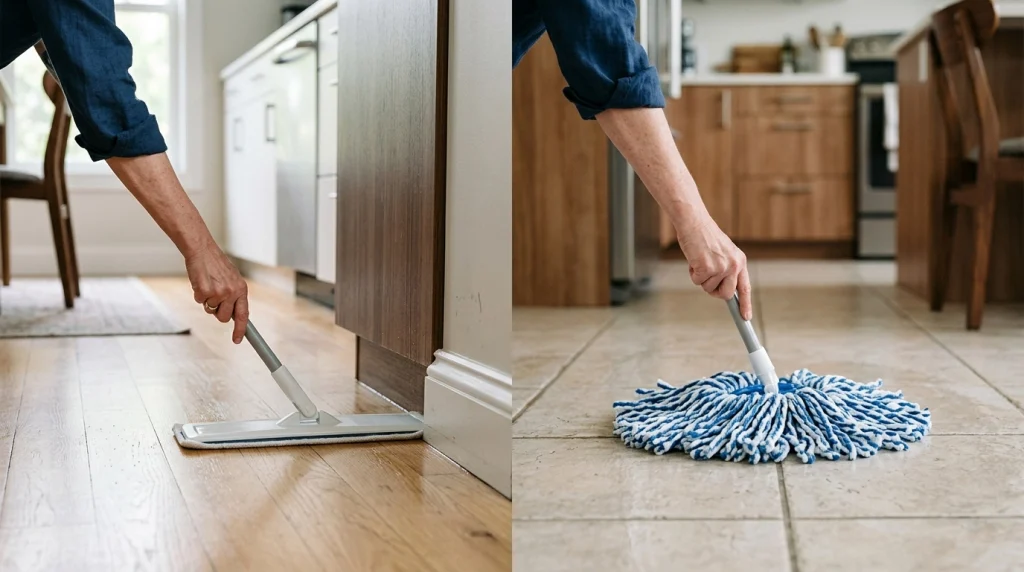
Neither design wins every category. Your flooring and cleaning habits matter more than the shape alone.
| Feature | Flat Spin Mop | Round Spin Mop |
|---|---|---|
| Best use | Routine cleaning | Heavier wet cleaning |
| Corner reach | Excellent | Moderate |
| Under furniture | Usually excellent | Varies by joint design |
| Moisture control | Very good | Good when thoroughly spun |
| Absorbency | Moderate | Usually higher |
| Textured surfaces | Good | Often better |
| Baseboard cleaning | Excellent | Fair to good |
| Large tile areas | Good | Excellent |
| Sensitive flooring | Better moisture control | Requires careful wringing |
The biggest difference for me isn’t spinning speed. It’s how much moisture and cleaning surface I can control.
Which Spin Mop Cleans Better?
For routine dirt on smooth floors, I usually get cleaner and more consistent results from a flat microfiber head. For muddy or heavily soiled water-safe floors, I often prefer a round spin mop.
Flat heads spread pressure evenly
A flat pad places a broad surface against the flooring. That helps with footprints, fine dust, light kitchen film, and everyday dirt.
The wide pad also lets me see when an area has been covered. I can make overlapping passes without repeatedly soaking the same spot.
Round heads handle messy wet cleaning well
Round microfiber strands move independently. That helps them bend into shallow surface texture and around small obstacles.
I particularly notice this on textured ceramic tile. The fibers can disturb dirt that a smooth flat pad sometimes passes over.
The mop head still needs to stay clean
A dirty mop doesn’t become effective because it spins faster. Once the pad turns gray and loaded with soil, rinse it or replace it.
The CDC notes that ordinary cleaning removes dirt and impurities, while disinfecting is a separate process. Routine cleaning is enough in many household situations.
Safety note: If you use a disinfectant rather than an ordinary floor cleaner, follow the product label and confirm that the chemical is approved for your flooring.
Section Takeaway: Flat spin mops excel at controlled maintenance cleaning. Round spin mops become more useful as soil levels and water-safe scrubbing needs increase.
Which Mop Is Better for Each Floor Type?
The best choice changes once flooring enters the equation. I would never treat hardwood, laminate, LVP, and tile as though they tolerate water equally.
Hardwood and engineered wood
I prefer a flat microfiber mop for finished wood because it makes moisture easier to control. I keep the pad lightly damp rather than wet.
The National Wood Flooring Association’s maintenance guidance advises cleaning spills quickly and warns against wet mops and steam mops on wood flooring.
If a flat spin mop cannot wring the pad sufficiently, I would switch to a standard pre-dampened microfiber flat mop instead.
Safety note: Always follow the wood-floor or finish manufacturer’s care instructions before wet cleaning.
Laminate
Flat microfiber also makes sense for laminate. I want enough moisture to loosen grime without leaving liquid sitting along plank joints.
A round spin mop can work only when its head becomes thoroughly wrung. If I can squeeze visible water from the fibers, it’s wetter than I want on laminate.
Vinyl and LVP
Both mop styles can work on compatible vinyl flooring. I still prefer flat microfiber for regular maintenance because it leaves less liquid behind.
- Flat mop: Better for quick weekly cleaning.
- Round mop: Useful for larger dirtier areas when the flooring permits damp mopping.
- Cleaner: Use a product approved for the exact vinyl or LVP floor.
Ceramic and porcelain tile
Round spin mops make the strongest case on tile. The absorbent head works well when you need more rinsing, scrubbing, and water capacity.
A flat spin mop still performs well on smooth tile. I favor it when the floor has only dust, footprints, and light food residue.
Natural stone
I care more about the cleaner than the mop shape on stone. Marble, limestone, travertine, and similar materials can react badly to unsuitable chemicals.
Use a cleaner approved for the specific stone and sealer. Avoid assuming that vinegar or another acidic DIY solution is safe.
Safety note: Check the stone and sealer manufacturer’s instructions before introducing a new cleaner.
Section Takeaway: Flat heads are usually easier to control on moisture-sensitive floors, while round heads make more sense on water-tolerant tile and other durable surfaces.
Which Mop Is Better for Corners and Furniture?
A flat spin mop usually has the advantage around straight walls, cabinets, furniture, and tight spaces. Its shape matches the geometry of most rooms.
Flat heads reach straight edges
The front and side edges can run almost parallel with a baseboard. That gives the microfiber more direct contact along the room perimeter.
On my kitchen floors, this matters around cabinet kickboards. Dirt tends to build along those edges where a circular head leaves a small gap.
Round heads move around legs easily
Round mop heads aren’t bad around obstacles. Their flexible fibers wrap naturally around table and chair legs.
- Baseboards: Flat usually wins.
- Sharp corners: Flat usually wins.
- Chair legs: Round fibers work well.
- Low furniture: Flat usually wins if the handle folds close to the floor.
- Curved fixtures: Round heads can feel more natural.
Don’t judge only by head shape, though. A stiff swivel joint can make an otherwise excellent flat mop frustrating underneath furniture.
Which Spin Mop Is Easier to Maintain?
Both are easy to maintain when their microfiber parts are removable. The bigger issue is how quickly the head rinses, dries, and becomes ready for storage.
Flat pads are simple to inspect
I like being able to peel off a flat microfiber pad and immediately see how dirty it is. Keeping several replacement pads also lets me switch halfway through a large cleaning job.
Flat pads usually take little storage space. They can also dry quickly when hung with good airflow.
Round heads can hold more debris and moisture
Round microfiber strands may trap hair, crumbs, and debris between the fibers. I rinse them carefully after dirty jobs rather than trusting the bucket spin alone.
Never leave either style wet inside a bucket. Wash the head as directed and let it dry completely before storage.
Dirty water matters too
Traditional single-bucket spin systems eventually collect dirty water. Repeatedly dipping the mop into heavily soiled water can redistribute some of that material.
For a large dirty area, I replace the water once it becomes visibly murky. Clean pads or separate clean-water systems can also help.
How Do You Choose Between Flat and Round?
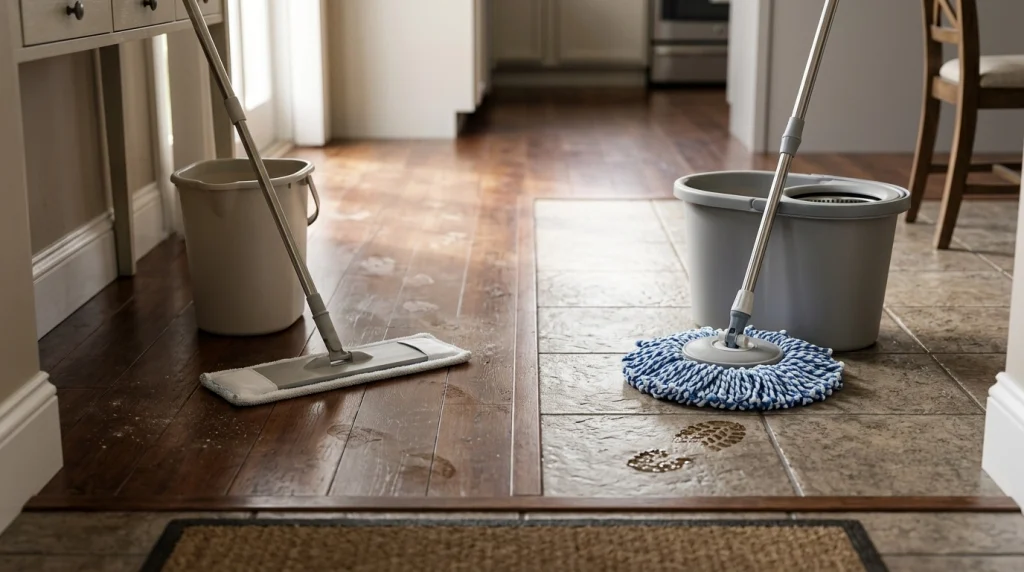
Start with your flooring, then consider your usual mess level. That approach works better than choosing by brand or bucket size first.
Choose a flat spin mop if:
- You clean hardwood-compatible, laminate, vinyl, or other low-moisture floors.
- You want strong edge and corner reach.
- You regularly clean beneath beds or furniture.
- Your home mostly gets dust, footprints, pet hair, and light spills.
- You prefer washable pads that are easy to swap.
- You want precise control over where moisture goes.
Choose a round spin mop if:
- You have large ceramic or porcelain tile areas.
- You often clean muddy or heavily soiled floors.
- You value absorbency for wet messes.
- You want microfiber strands that conform to surface texture.
- You frequently rinse and wring the mop during cleaning.
- Your floors safely tolerate damp mopping.
Think about drying time
More water doesn’t automatically mean cleaner floors. Extra moisture can lengthen drying time and create a temporary slip hazard.
OSHA’s workplace guidance identifies wet floors as a slip hazard and emphasizes keeping walking surfaces clean and dry. The same basic caution is sensible at home.
I finish wet cleaning near the room exit. That keeps me from walking back over the damp surface.
Don’t use disinfectant unless you need it
For routine household cleaning, a suitable floor cleaner is often enough. The CDC says disinfecting at home is generally more relevant when someone is sick or at higher risk.
The EPA explains the difference between cleaning, sanitizing, and disinfecting. EPA-registered disinfectants also need their label directions followed, including contact time.
Safety note: Never mix cleaning or disinfecting chemicals. Follow the product label and your flooring manufacturer’s care instructions.
Section Takeaway: Choose the mop for the floor and mess you deal with most often. Flat favors precision and moisture control; round favors absorbency and heavier wet cleaning.
Frequently Asked Questions
Is a flat spin mop better than a round spin mop?
A flat spin mop is better for many everyday cleaning jobs because it reaches corners, fits beneath furniture, and gives you good moisture control. A round spin mop can be better for larger tile areas, wet messes, and heavier soil.
Which spin mop is better for tile floors?
Both styles work on compatible tile, but I usually prefer a round spin mop for heavily soiled ceramic or porcelain tile. Its flexible microfiber strands provide good absorbency and contact with textured areas. For light routine cleaning, a flat microfiber head is faster and more precise.
Which spin mop is better for hardwood?
A flat microfiber mop is my preference for finished hardwood because controlling moisture is easier. The pad should remain lightly damp rather than wet. Follow the flooring or finish manufacturer’s care instructions, since excessive water can harm wood flooring.
Does a round spin mop clean corners?
It can clean near corners, but the circular plate may not make full contact with a 90-degree corner. Loose microfiber strands help compensate, yet a rectangular flat head generally reaches straight walls and corners more consistently.
Do flat spin mops clean grout?
Flat microfiber pads can remove surface dirt from grout, but they aren’t a replacement for targeted grout scrubbing. Deep or recessed grout may need a suitable brush and cleaner before you mop the surrounding tile.
Which type holds more water?
Traditional round microfiber heads often absorb more liquid because they contain numerous thick strands. That helps with wet messes, but it also means thorough wringing matters. Flat microfiber pads generally favor controlled damp cleaning instead of maximum absorbency.
Can I use the same cleaning solution with both?
The mop shape doesn’t determine cleaner compatibility. Your floor does. Use a cleaner approved for your exact flooring and follow its dilution or application directions rather than assuming one solution is safe on every hard surface.
Final Takeaway
For most routine home cleaning, I find a flat spin mop more precise and versatile. It reaches edges well, slips beneath furniture, and makes moisture easier to control.
A round spin mop becomes more useful for dirty, water-tolerant floors. Its flexible microfiber strands handle tile, larger wet jobs, and messier cleaning sessions particularly well.
As of 2026, I wouldn’t choose either one from head shape alone. Look at the wringing system, pad quality, swivel movement, replacement-head availability, bucket design, and compatibility with your flooring.
Match the mop to your floors first. That decision will matter every time you clean.