
Why Does a Spin Mop Head Rotate? How the Spinning Mechanism Works

Quick Answer
A spin mop head rotates because its handle or spinning mechanism converts an up-and-down pushing motion into rotational movement. In the bucket, this rotation creates centrifugal effects that force water out of the microfiber strands and into the wringer basket. The result is a mop head with less moisture, making it easier to control during floor cleaning.
What makes the mop spin?
- Handle mechanism: A spiral shaft or drive assembly turns straight handle movement into rotation.
- Rotating head: The shaft transfers movement to the mop head and its microfiber strands.
- Wringer basket: A rotating basket supports the mop head during spinning and helps contain expelled water.
- Centrifugal effect: Rotation pushes water outward from the wet fibers.
- One-way clutch: Some designs engage the spinning mechanism on the downward stroke and reset on the return stroke.
Quick tip for better spinning
- Keep the handle upright, seat the mop head correctly in the basket, and use smooth, controlled strokes. Check the manufacturer’s instructions if the head won’t rotate or the handle feels stuck.
A spin mop head rotates because a mechanical drive inside the handle turns your pushing motion into a spinning action. That simple movement makes rinsing and wringing easier without requiring you to twist wet mop strings by hand.
I’ve found that understanding this mechanism also helps explain common problems, from a mop that spins weakly to one that refuses to rotate at all. This guide breaks down the moving parts, the role of centrifugal force, and the best ways to keep your spin mop working smoothly.
In This Guide
- Why does a spin mop head rotate?
- How does the spin mop mechanism work?
- How does spinning remove water?
- What are the different spin mop mechanisms?
- How do you use a spin mop correctly?
- Why is your spin mop head not rotating?
- Does spin speed matter for different floors?
- How do you maintain a spin mop?
- Frequently asked questions
Why Does a Spin Mop Head Rotate?
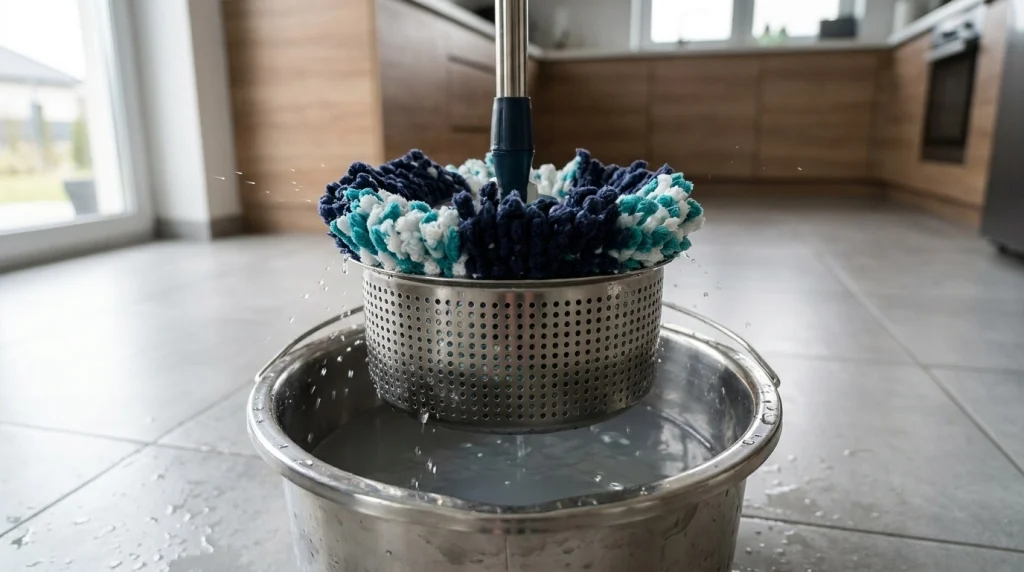
A spin mop head rotates because a built-in mechanical drive transfers movement from the handle to the mop head. Depending on the model, that drive may use a spiral shaft, a sliding rod, gears, or a foot-operated wringer.
The spinning action serves two main purposes: helping rinse the mop and removing excess water before cleaning the floor. It reduces the need for manual wringing.
What is a spin mop?
A spin mop is a floor-cleaning tool with a rotating mop head and a mechanism designed to spin the head during rinsing or wringing. Most household models pair a microfiber string head with a bucket containing a spinning basket.
Microfiber is a synthetic material made from very fine fibers that collect dust, dirt, and moisture. Its absorbency makes it useful for routine cleaning on many sealed hard floors when used correctly.
Why does the head need to spin?
Wet mop strands hold water between their fibers, which can leave a floor too wet if you start mopping immediately after rinsing. Spinning throws some of that excess water outward, so you can control how damp the mop remains.
A properly wrung mop can also make cleaning more manageable because it leaves less standing water behind. That’s especially important on moisture-sensitive surfaces such as laminate and many hardwood floors.
- During rinsing: Rotation helps agitate the strands and release some trapped dirt.
- During wringing: Rotation removes excess moisture from the mop head.
- During floor cleaning: A controlled moisture level helps limit puddles and excessive wetting.
How Does the Spin Mop Mechanism Work?
A manual spin mop converts a straight push or pull into rotational movement through a mechanical assembly in the handle. The rotating head then spins inside a compatible basket, where excess water can escape from the fibers.
Although the details vary by design, most systems follow the same basic principle: apply force, transfer motion, rotate the head, and allow the mechanism to reset.
1. The handle supplies the force
On many manual models, you push the handle downward while the mop head sits securely in the wringer. The handle’s internal rod moves relative to the surrounding tube, activating the drive mechanism.
Some handles contain a spiral-shaped shaft or threaded guide. As the parts slide against each other, the shaft follows a twisting path and turns the connected mop head.
2. The drive transfers motion to the head
The lower handle connects to the mop head through a joint or rotating shaft. When the drive turns, the head follows, carrying the attached microfiber strands around its central axis.
Many manual designs also use a one-way clutch, which allows the drive to engage during one stroke and disengage during the return stroke. This helps the handle reset without simply reversing every rotation.
3. The basket supports spinning
The wringer basket provides a space for the mop head to rotate while containing much of the water expelled from its fibers. Depending on the design, the basket may rotate along with the head or spin independently on its own bearing.
Correct positioning matters. If the head sits crookedly or fails to engage with the wringer, it may wobble, rub against the basket, or refuse to spin.
4. The handle resets for another stroke
After you release upward pressure, a spring or another return arrangement may restore the handle to its starting position. The precise reset action depends on the mop’s design.
You can then repeat the stroke to remove more water. There is no universal number of pushes because handle travel, basket design, fiber density, and the amount of water all affect the result.
Section Takeaway: The handle creates the movement, the drive converts it into rotation, and the basket gives the wet mop head room to spin and release water.
How Does Spinning Remove Water From a Mop Head?
Spinning removes water because rotation causes the water held between mop fibers to move outward. This effect is commonly described as centrifugal force, and it helps separate liquid from the rotating mop strands.
The water then travels through the openings in the wringer basket and collects in the bucket. The mop remains damp, but it should carry less excess water than before spinning.
What centrifugal force means in everyday terms
Think about a wet umbrella that you shake outside. Water flies away as the umbrella moves, and a spin mop uses a related rotational effect to release moisture from its fibers.
In a rotating frame of reference, the outward effect is described as centrifugal force. In a stationary frame, the water’s inertia and the forces acting on it explain why it moves away from the center as the fibers rotate.
Why faster spinning can remove more water
Higher rotational speed can increase the outward acceleration acting on water held by the mop strands. However, the actual drying result also depends on the mop’s construction, the basket, and how much water the fibers retain.
Faster isn’t automatically better. Excessive force, an incorrectly seated mop head, or a mechanism not designed for aggressive operation can cause wobbling, wear, or damage.
Why a spin mop doesn’t become completely dry
Microfiber strands retain some moisture even after wringing because liquid clings to the fibers and remains between them. A spin mop is designed to remove excess water, not to dry the mop head completely.
For everyday cleaning, that remaining moisture can be useful. The goal is a damp head that picks up dirt without leaving the floor soaked.
- Too wet: The head may leave puddles, streaks, or excessive moisture.
- Properly damp: The mop can spread cleaning solution in a controlled layer.
- Too dry: The head may struggle to glide or distribute solution evenly, depending on the floor and cleaning method.
What Are the Different Spin Mop Mechanisms?
Not every spinning mop uses the same drive system. The most important difference is how the user supplies force and how the mop transfers that force to the head or wringer basket.
Knowing your mechanism helps you use the mop correctly and identify the right cause when something stops working.
Manual push-pull spin mop
This common design uses a sliding handle and internal drive to rotate the mop head when you press down. A return mechanism lets you lift the handle and repeat the action.
It is convenient because it does not require a power outlet or batteries. However, the internal shaft, clutch, and joints can wear or jam over time.
Foot-pedal spin mop
A pedal-operated bucket uses your foot to drive the wringer basket through a mechanical linkage. The mop head spins when it sits correctly inside the basket and you operate the pedal.
This arrangement reduces repeated hand pressure on the handle. It still needs a stable bucket, a properly positioned head, and a pedal mechanism that moves freely.
Electric or powered rotating mop
An electric mop uses a motor to rotate cleaning pads or brushes during floor cleaning. Unlike a traditional manual spin mop, its rotation may be intended to scrub the floor rather than wring water from a string head.
Powered models may use batteries, charging systems, and replacement pads. Their maintenance requirements differ from those of a basic bucket-and-mop system.
How do the main mop types compare?
The key difference is the purpose of the rotation. A traditional spin mop mainly uses spinning for rinsing and wringing, while powered rotating mops use motor-driven movement to help clean the floor.
| Mop type | How movement works | Main purpose | Best use case |
|---|---|---|---|
| Manual spin mop | Handle-driven shaft turns the head | Rinsing and wringing | Routine hard-floor cleaning |
| Pedal spin mop | Foot pedal drives the wringer | Hands-free wringing action | Frequent bucket-based cleaning |
| Cordless electric mop | Battery-powered motor rotates pads or brushes | Active floor scrubbing | Routine cleaning with powered assistance |
| Flat microfiber mop | Manual push-and-pull movement | Dust pickup and damp cleaning | Small areas and narrow spaces |
| Steam mop | Heated water produces steam | Steam-assisted cleaning | Compatible, heat-tolerant sealed floors |
These categories are not interchangeable. A steam mop does not wring itself by spinning, and a robot mop generally follows a programmed cleaning path rather than relying on a bucket’s centrifugal wringer.
How Do You Use a Spin Mop Correctly?
Use a spin mop by wetting the head, placing it securely in the appropriate basket, and activating the spinning mechanism according to the manufacturer’s instructions. Then adjust the moisture level before applying the mop to the floor.
A few careful habits improve water control and reduce unnecessary stress on the handle and basket.
Follow these steps for effective spinning
- Prepare the bucket: Add clean water and a compatible floor cleaner if needed, following the product label.
- Wet the mop head: Dip the microfiber strands into the cleaning water until they are evenly damp.
- Position the head: Place the head fully inside the wringer basket and align it with the spinning mechanism.
- Activate the drive: Use controlled downward strokes or the foot pedal, depending on your model.
- Check the moisture: Stop and inspect the strands before returning to the floor.
- Repeat if needed: Spin again if the head remains too wet for the surface you’re cleaning.
How wet should the mop head be?
The right moisture level depends on your floor’s material and finish. Tile and many sealed concrete floors usually tolerate more moisture than laminate, unsealed wood, or other water-sensitive surfaces.
For hardwood and laminate, use a well-wrung head and avoid standing water. Follow the floor manufacturer’s care instructions, because even a small amount of excess water can be a problem for vulnerable seams and finishes.
Should you spin the mop in clean water or dirty water?
Use clean solution for initial wetting and rinse the mop frequently as dirt accumulates. If your bucket has separate clean-water and dirty-water compartments, follow its instructions to keep the two streams separated.
Spinning helps release some trapped liquid and loosened dirt, but it does not automatically disinfect the mop head or make contaminated water clean. Replace dirty water when needed.
Safety note: Check your flooring manufacturer’s care guide and the cleaner’s label before using water, vinegar-based mixtures, disinfectants, or other chemicals on a floor.
Why Is Your Spin Mop Head Not Rotating?
A spin mop usually stops rotating when the handle drive fails to engage, the head is incorrectly seated, or a moving part becomes obstructed. Start with the simplest checks before assuming the mechanism has broken.
Never force a stuck handle. Doing so can damage the internal shaft, clutch, or connecting joint.
Common causes and practical fixes
| Problem | Likely cause | What to do |
|---|---|---|
| Handle moves but head stays still | Drive not engaged or internal parts worn | Check the locking position and operating instructions |
| Head wobbles in basket | Incorrect seating or uneven loading | Reseat the head and check for damage |
| Handle feels stiff | Debris, misalignment, or a jammed drive | Stop, inspect accessible parts, and clean as directed |
| Head spins but barely dries | Low speed, overloaded fibers, or a damaged basket | Check basket movement and use the recommended stroke |
| Pedal doesn’t turn the basket | Obstruction or a damaged pedal linkage | Remove accessible debris and inspect the mechanism |
How to troubleshoot the handle
- Remove the mop head from the bucket and check whether it attaches securely to the handle.
- Look for a lock, collar, or switch that must be released before spinning.
- Check the basket for tangled fibers or visible debris that could block rotation.
- Test the mechanism gently, following the manufacturer’s operating instructions.
- If the shaft slips, grinds, or remains stuck, stop using it and check the warranty or replacement-parts guidance.
A mop head that spins freely outside the bucket but fails inside it may be meeting resistance from the basket or may not be seated correctly. If neither position works, the handle drive or head connection may need attention.
Section Takeaway: Check the head connection, lock, basket, and visible obstructions first. Replace or repair damaged components rather than forcing the mechanism.
Does Spin Speed Matter for Different Floors?
Yes, spin speed matters because it affects how much moisture remains in the mop head. The best setting is the one that leaves enough dampness for effective cleaning without putting excess water on your floor.
Most manual spin mops don’t offer a precise speed setting. You can often adjust moisture by changing how long or how many times you spin, within the manufacturer’s recommendations.
Choosing the right moisture level
- Sealed tile: A moderately damp mop usually works well for routine cleaning, provided you use a compatible cleaner.
- Sealed concrete: Follow the coating or sealer instructions, especially if the surface has a decorative finish.
- Vinyl and LVP: Use a well-wrung mop and a cleaner approved for the flooring’s finish.
- Laminate: Keep moisture low and wipe up spills promptly to protect joints and edges.
- Hardwood and engineered wood: Use minimal moisture and follow the finish manufacturer’s guidance.
- Natural stone: Choose a cleaner suitable for the specific stone; acidic products can damage some surfaces.
These are general guidelines, not a substitute for the flooring manufacturer’s instructions. Unsealed, damaged, waxed, or specially treated surfaces may require different care.
Can too much water cause streaks or damage?
Yes, excess water and leftover cleaning solution can contribute to streaks, residue, or moisture damage. A mop that leaves the floor visibly wet for an extended period may be too saturated for that surface.
If streaks persist, check the cleaner’s dilution instructions, rinse the mop thoroughly, and replace dirty water. Avoid adding extra detergent in the hope of improving cleaning performance.
Safety note: Don’t use vinegar or acidic cleaners on natural stone or any floor whose manufacturer prohibits them. Follow the flooring and cleaning-product labels before treating stains or disinfecting.
How does a spin mop compare with other floor-cleaning tools?
A spin mop offers useful control over moisture, but it isn’t the only option for hard floors. The best tool depends on the floor’s finish, the type of dirt, and how much effort you’re willing to spend rinsing and wringing.
- Microfiber flat mop: Useful for quick dust removal and controlled damp cleaning, especially in smaller rooms.
- String mop: Absorbs liquid and covers broad areas, but manual wringing can be more demanding without a wringer.
- Steam mop: Uses heated water and requires a surface approved for steam cleaning; it isn’t suitable for every wood or laminate floor.
- Robot mop: Automates routine maintenance, although you still need to maintain its pads, water system, and sensors.
For guidance on wood-floor maintenance, consult the National Wood Flooring Association. Its flooring-care resources can help you understand why moisture control and finish-specific cleaning matter.
How Do You Maintain a Spin Mop?
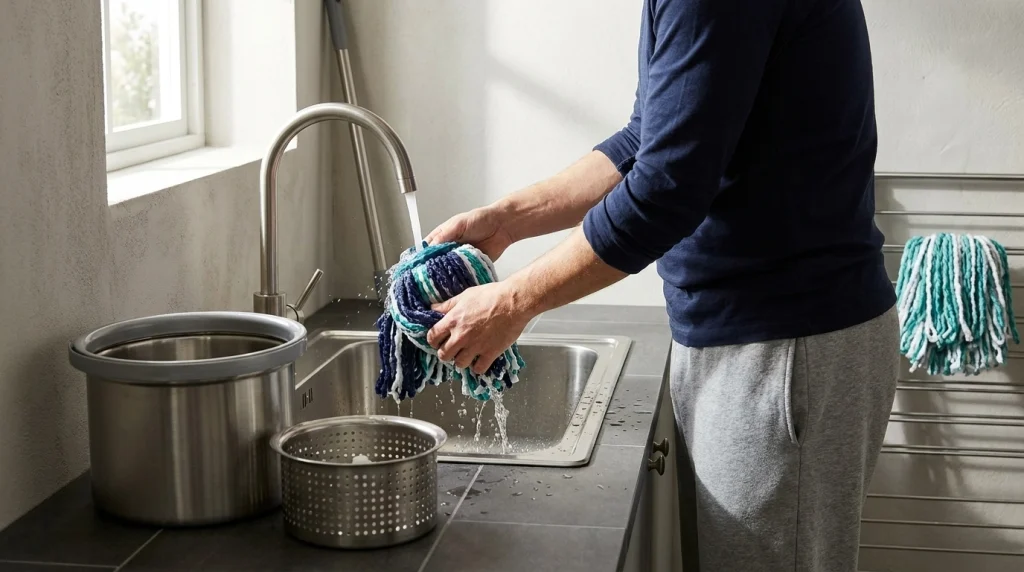
Regular cleaning helps keep the mop head, bucket, and rotating mechanism working as intended. Rinsing away dirt and allowing the components to dry can also reduce lingering odors and residue.
After every cleaning session
- Rinse the mop head until visible dirt and cleaning solution are removed.
- Spin out excess water using the normal operating procedure.
- Empty the bucket and rinse away sediment or detergent residue.
- Allow the mop head and bucket to dry in a well-ventilated area.
- Check the handle, head attachment, and basket for obvious wear.
When should you wash or replace the mop head?
Wash a reusable microfiber head whenever it becomes visibly dirty or develops a persistent odor. Follow its care label, because high heat, fabric softener, and unsuitable detergents can affect some microfiber materials.
Replace the head when the fibers become badly matted, start shedding excessively, or no longer clean effectively after washing. The replacement interval depends on how often you mop and how well you care for the fibers.
Should you lubricate the spinning mechanism?
Only lubricate the mechanism if the manufacturer specifically permits it and identifies a suitable lubricant. Applying oil or grease without guidance can attract dirt, affect plastic components, or interfere with the clutch.
If the handle develops grinding noises or persistent resistance, inspect the parts you can safely access. For sealed or damaged internal components, manufacturer-approved repair or replacement is usually safer than dismantling the drive.
For cleaning-product safety, the U.S. Environmental Protection Agency provides information on using household cleaning products responsibly. Always follow the specific label, particularly when handling concentrated cleaners or disinfectants.
Frequently Asked Questions
1. Why does my spin mop head rotate when I push the handle down?
The handle activates a drive mechanism that converts downward movement into rotation. Depending on the model, a spiral shaft, sliding rod, or clutch transfers that motion to the mop head, allowing it to spin inside the wringer basket.
2. Why does my spin mop rotate in one direction only?
Many manual spin mops use a one-way clutch that engages during the driving stroke and disengages during the return stroke. This lets the handle reset without reversing the mop head on every movement, although the exact behavior depends on the design.
3. Why is my spin mop spinning but not removing enough water?
The head may be spinning too slowly, the basket may be obstructed, or the microfiber strands may retain more water than expected. Check the head’s position, clean the accessible parts, and follow the recommended wringing technique before considering replacement.
4. Can I spin a mop head without using its bucket?
Some mop heads can rotate when their handles are operated outside the bucket, but the bucket provides the intended support and collects expelled water. Follow the manufacturer’s instructions rather than spinning a wet head where water could splash onto people or electrical equipment.
5. Does a faster-spinning mop clean the floor better?
Not necessarily. Faster spinning primarily helps remove moisture, while floor-cleaning performance also depends on the microfiber condition, cleaning solution, technique, and type of dirt. The goal is a suitably damp head, not maximum rotational speed.
6. Why does my spin mop head wobble while rotating?
Wobbling can result from an incorrectly seated head, unevenly distributed strands, a loose attachment, or a damaged basket. Stop the mechanism, reposition the head, and inspect the accessible parts; discontinue use if the wobble persists or the handle feels unstable.
7. Can I use a spin mop on hardwood and laminate floors?
You can often use a spin mop on sealed hardwood and suitable laminate flooring if you wring it thoroughly and keep moisture low. Check the flooring manufacturer’s care guide first, avoid standing water, and use only a compatible cleaning product.
For additional product-label and disinfectant guidance, the Centers for Disease Control and Prevention offers general information about cleaning and disinfecting. Routine floor cleaning and disinfection are not the same, so use a disinfectant only when appropriate and according to its label.
Final Takeaway: Why Does a Spin Mop Head Rotate?
A spin mop head rotates because a mechanical drive transforms the movement of its handle or pedal into spinning action. That rotation helps release excess water through centrifugal effects, making it easier to control the moisture left on the floor.
When your mop stops spinning, check the head connection, locking mechanism, and basket before assuming the drive has failed. Keep the components clean, avoid forcing a jammed handle, and choose a moisture level that suits your floor.
For everyday home cleaning, the biggest benefit is simple: a properly functioning spin mop makes rinsing and wringing more convenient while helping you avoid leaving unnecessary water behind.