
How Much Water Does Spinning Remove From a Mop?

Quick Answer
A spin mop can remove a substantial amount of excess water, but the exact amount depends on the mop head, its initial water content, the spinner design, and how long you spin it. One published test of the O-Cedar EasyWring microfiber spin mop reported that its wringer removed approximately 73% of the water absorbed during testing. That result is a useful example, not a universal figure for every spin mop.
What affects water removal?
- Spinning time: Additional spins generally remove more excess moisture until the head approaches its practical drying limit.
- Mop material: Absorbent microfiber retains water within its fibers, so the head will not become completely dry through ordinary spinning.
- Wringer design: Basket shape, rotation speed, and mechanical condition affect how efficiently water escapes.
- Starting moisture: A freshly soaked mop releases more water than one that has already been wrung out.
- Floor type: Sealed hardwood and laminate need careful moisture control, while many properly installed ceramic tile floors tolerate more water.
The practical rule
- Spin until the mop feels damp rather than dripping for routine floor cleaning, and follow the flooring manufacturer’s care instructions.
When you use a spin mop, the goal isn’t simply to remove as much water as possible. You want enough moisture to loosen dirt and pick up grime without leaving puddles, streaks, or a floor that stays wet too long.
In this guide, I’ll explain how much water spinning can remove, why results vary, and how to judge the right dampness for different floors. I’ll also cover simple ways to improve wringing performance and recognize when a mop head or bucket needs attention.
In This Guide
- How much water does spinning remove from a mop?
- How does a spin mop remove water?
- What affects how much water a spin mop removes?
- How can you measure water removal at home?
- How damp should a mop be for different floors?
- Spin mop vs. other mops: Which removes more water?
- How can you improve spin mop wringing performance?
- Why is your spin mop still too wet?
- Frequently asked questions
How much water does spinning remove from a mop?
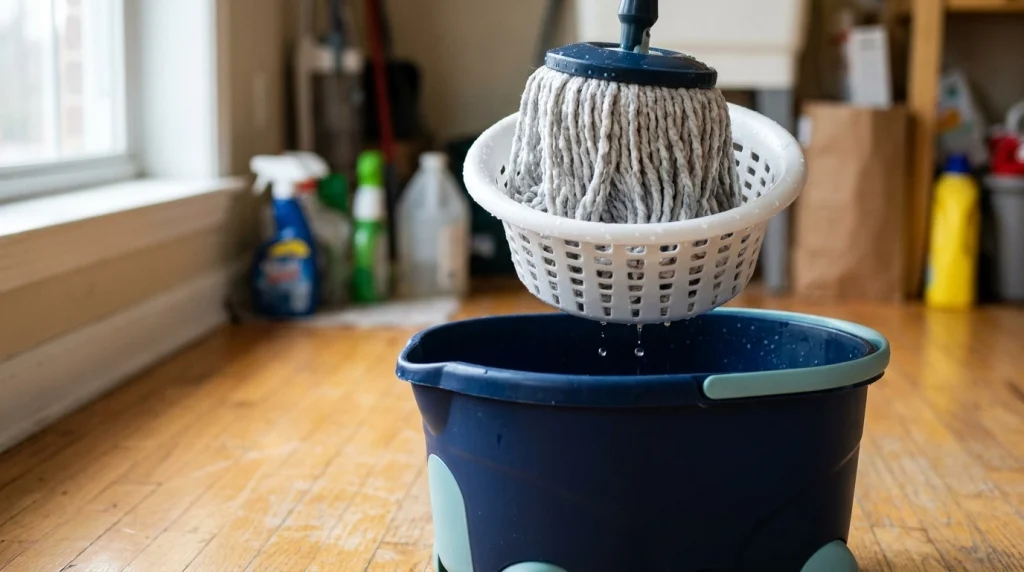
A spin mop removes a variable percentage of the water held in its mop head. There is no single percentage that applies to every model, because microfiber density, wringer design, spinning speed, and starting moisture all influence the result.
What do real-world test results tell us?
A published test by Serious Eats reported that the O-Cedar EasyWring microfiber spin mop’s foot-operated wringer removed about 73% of the water absorbed during its testing. The mop head absorbed 1,285 grams of water in that test.
Using those figures, 73% of 1,285 grams is approximately 938 grams of water removed. Roughly 347 grams would remain if the reported absorption amount and removal percentage are applied to the same starting amount.
These calculations illustrate how a wringer can substantially reduce moisture. They do not establish the performance of other mop heads, nor do they guarantee identical results in everyday cleaning.
Why isn’t there one standard percentage?
Manufacturers use different mop fibers, basket designs, and wringing mechanisms. Some systems use a foot pedal, while others rely on pumping the handle down by hand.
The starting condition also matters. A fully saturated mop has more water available for removal than a head that has already undergone several wringing cycles.
- New mop head: Fiber structure and manufacturing residues may affect its first few uses.
- Well-used mop head: Worn fibers, trapped debris, or detergent buildup can change water retention.
- Different spinning cycles: One brief press and several repeated presses won’t necessarily produce the same dampness.
As of 2026, the most useful approach is to treat published percentages as model-specific test results and evaluate your own mop under consistent conditions.
How does a spin mop remove water?
A spin mop is a floor-cleaning tool with an absorbent mop head and a rotating wringer that removes excess water mechanically. Most traditional models use a basket inside a bucket, activated by a pedal or a pumping handle.
What role does centrifugal force play?
When the mop head spins rapidly, water moves outward from the rotating fibers and escapes through the openings in the wringer basket. This process is commonly described as centrifugal water removal.
The basket catches much of the expelled water, allowing it to drain back into the bucket instead of spreading across the floor. The mop fibers retain some moisture because their structure holds water between and within the fibers.
Spinning therefore reduces the water load rather than eliminating it completely. The remaining moisture helps the mop loosen and collect dirt during the next cleaning pass.
What happens during a wringing cycle?
- Soaking: The mop head absorbs water from the bucket.
- Rinsing: Water movement helps loosen dirt and cleaning residue from the fibers.
- Spinning: The rotating basket expels much of the excess water.
- Floor cleaning: The damp fibers lift and collect dirt while spreading a controlled amount of moisture.
Washing and wringing are related but different jobs. A mop can spin freely without becoming thoroughly clean if dirt remains trapped in the fibers.
Does faster spinning always remove more water?
Higher rotational speed can help expel water, but speed alone doesn’t determine the final result. The wringer’s design, the mop’s balance, and the fibers’ water retention all matter.
Follow the manufacturer’s instructions rather than forcing the mechanism or modifying the bucket. Stop if the mop wobbles, the basket jams, or the handle becomes unusually difficult to operate.
What affects how much water a spin mop removes?
Water removal depends on several interacting factors rather than spinning time alone. Understanding them helps explain why one mop feels nearly dry while another remains noticeably wet.
1. Mop-head material and construction
Microfiber consists of very fine synthetic fibers designed to collect dirt and absorb liquid. Its dense structure makes it useful for floor cleaning, but it also means some moisture remains after wringing.
Thicker or denser heads may hold more water initially. Their final dampness depends on fiber construction, the amount of water absorbed, and how effectively the wringer extracts it.
2. Basket design and rotation speed
A stable basket that allows water to escape efficiently can improve wringing. A clogged basket, worn mechanism, or poorly seated mop head may interfere with the process.
Some foot-pedal models and pump-action systems also differ in how much control they give you over each cycle. Always use the method recommended for your specific model.
3. Spinning duration and repeated presses
Repeated presses generally remove additional moisture, especially during the first few cycles. However, each extra cycle usually offers diminishing returns as the mop becomes less saturated.
For everyday cleaning, judge the result by the mop’s dampness and the floor’s response. Don’t keep spinning simply to achieve the driest possible head.
4. Water temperature and cleaning solution
Water temperature is not usually the main factor determining wringing efficiency. A more important consideration is whether the cleaner creates excessive foam or leaves residue in the fibers.
Too much detergent can make a mop harder to rinse thoroughly and may leave a film on the floor. Use only a cleaning solution approved for your mop and flooring.
Safety note: Check your floor manufacturer’s care guide and the cleaner’s label before use. Never mix cleaning chemicals, and don’t assume vinegar is suitable for every floor finish.
5. Mop condition and maintenance
A mop head clogged with hair, grit, or detergent residue may not behave like a clean one. A damaged or misshapen spinner can also make wringing less effective.
- Remove loose hair and debris before washing.
- Clean the bucket and wringer according to the care instructions.
- Wash removable microfiber heads as directed by the manufacturer.
- Replace a head that has become badly worn or no longer cleans effectively.
Section Takeaway: Mop material, spinner design, starting moisture, and maintenance determine the result. Repeated spinning helps, but it cannot compensate for a damaged mechanism or a dirty, worn-out mop head.
How can you measure water removal at home?
You can estimate your spin mop’s water-removal performance with a kitchen scale and a consistent testing routine. This is more informative than relying on how dry the fibers feel to your hand.
Use a simple before-and-after weighing test
- Clean the mop head and allow it to reach a consistent dry condition.
- Weigh the dry head and record the result in grams.
- Soak the head thoroughly, following the usual rinsing procedure.
- Let excess water drip briefly, using the same interval each time.
- Weigh the wet head to determine its initial water load.
- Spin it using the same number of presses or the same procedure each time.
- Weigh the head again immediately after spinning.
Subtract the dry-head weight from each wet measurement to estimate how much water the fibers hold at each stage. Then compare the initial and final water loads.
Calculate the percentage removed
Use this formula when the mop head’s dry weight stays constant and the wet measurements represent the same head under comparable conditions:
Water removed (%) = (Initial water load − Final water load) ÷ Initial water load × 100
For example, suppose a mop holds 600 grams of water before spinning and 180 grams afterward. It has released 420 grams of water, which represents 70% of its initial water load.
This is a hypothetical example, not a claim about a particular mop model. Water that drips away before the first weighing must be treated consistently to keep comparisons fair.
Compare different spinning cycles
Repeat the test with one, three, and five handle presses, if those cycles are permitted by your model’s instructions. Keep the soaking method and dripping interval consistent.
| Test stage | Water load | What it shows |
|---|---|---|
| Before spinning | 600 g | Starting moisture |
| After spinning | 180 g | Water retained |
| Water expelled | 420 g | 70% removed in this example |
A household scale may struggle with a bulky mop head, so choose one with sufficient capacity and useful precision. Avoid placing dripping equipment directly on an electrical scale unless the setup protects it from water.
Section Takeaway: Weighing the mop before and after spinning provides a repeatable estimate. Consistent testing matters more than comparing results obtained with different soaking and dripping methods.
How damp should a mop be for different floors?
The right amount of water depends on the floor material, its finish, and the manufacturer’s maintenance instructions. A mop that works well on ceramic tile may leave too much moisture on wood or laminate.
Hardwood and engineered wood
Use a well-wrung, barely damp mop when the flooring manufacturer permits damp mopping. Excess moisture can enter joints, damage finishes, and contribute to swelling or warping.
Engineered wood has layered construction, but that doesn’t make every product waterproof. Check the specific manufacturer’s instructions before wet cleaning.
Laminate and vinyl flooring
Laminate flooring often has joints that can be vulnerable to water penetration. Use minimal moisture and avoid leaving standing water along seams or edges.
Many luxury vinyl plank (LVP) floors tolerate damp mopping well, but the recommended cleaner and moisture level depend on the product. Avoid assuming that every vinyl floor has identical care requirements.
Ceramic tile, porcelain, and natural stone
Glazed ceramic and porcelain tile generally tolerate routine damp mopping, although grout, sealants, and installation details still matter. A properly wrung mop can reduce puddles and help keep the floor safer to walk on.
Natural stone requires more care because acidic cleaners can damage some stone surfaces. Use a cleaner approved for the specific stone and finish.
Concrete and sealed floors
Sealed concrete often handles damp mopping, but the sealant determines which cleaning methods are suitable. Unsealed or porous concrete can absorb liquid and may develop marks if dirty water sits on the surface.
Safety note: Follow your flooring manufacturer’s care guide and the cleaning product label. The National Wood Flooring Association provides wood-floor care resources at nwfa.org; avoid excessive moisture on wood floors.
| Floor type | Suggested mop dampness | Main precaution |
|---|---|---|
| Sealed hardwood | Barely damp | Prevent standing water and wet joints. |
| Engineered wood | Barely damp, if permitted | Follow the specific floor warranty and care guide. |
| Laminate | Lightly damp | Keep water out of seams. |
| Vinyl/LVP | Damp | Use compatible cleaner and avoid puddles. |
| Ceramic or porcelain tile | Damp to moderately wet as needed | Avoid excess water and slippery residue. |
| Natural stone | Damp | Use stone-compatible products. |
| Sealed concrete | Damp | Check sealant compatibility and drying. |
These are practical starting points, not universal manufacturer specifications. Your floor’s care instructions take priority.
How can you tell when the mop is damp enough?
After wringing, lift the mop and observe whether water drips from the fibers. If water streams from the head, spin again before cleaning moisture-sensitive floors.
Make a short test pass in an inconspicuous area. If the mop leaves puddles or the floor remains visibly wet, wring it more thoroughly and adjust your technique.
Drying time alone cannot establish whether a floor has received too much water. Room temperature, humidity, ventilation, and the surface material all affect how quickly moisture evaporates.
Spin mop vs. other mops: Which removes more water?
A spin mop offers mechanical wringing, while other mop types use different methods to control moisture. The best choice depends on the floor, the size of the mess, and how much control you need.
Compare common mop types
| Mop type | How moisture is controlled | Best use | Main limitation |
|---|---|---|---|
| Spin mop | Rotating bucket wringer | Routine cleaning and adjustable dampness | Performance varies by model and technique. |
| Flat microfiber mop | Manual wringing or washable pad changes | Small rooms and controlled damp cleaning | Some models lack an integrated wringer. |
| String mop | Bucket wringer or manual pressure | Larger spills and heavy-duty cleaning | Can retain substantial water if poorly wrung. |
| Spray mop | Measured spray from a reservoir | Quick touch-ups and small areas | Limited liquid delivery for large spills. |
| Steam mop | Heated water delivered as steam | Compatible hard floors that permit steam | Unsuitable for many moisture- or heat-sensitive floors. |
| Cordless electric mop | Controlled spray or onboard water system | Convenient routine cleaning | Moisture output depends on the machine design. |
The table compares how each mop controls moisture, not measured water-removal percentages. Reliable, directly comparable test results are needed before ranking different mop types by extraction efficiency.
When is a spin mop the better choice?
A spin mop is useful when you want to rinse a reusable mop head and adjust its dampness without squeezing it by hand. Repeated wringing can help when moving between tile and more moisture-sensitive surfaces.
A flat microfiber mop may be more convenient for small apartments or quick daily touch-ups. A spray mop can also reduce the need to carry a bucket for minor spills.
Does a steam mop remove water from a mop head?
A steam mop is not designed around the same centrifugal wringing process. It heats water and delivers steam through a cleaning pad, so its moisture behavior depends on steam output, pad condition, and the surface being cleaned.
Don’t use steam simply because you want faster drying. Follow the floor manufacturer’s instructions, especially for hardwood, engineered wood, and laminate.
Safety note: Check the flooring manufacturer’s care guide before using steam, acidic cleaners, or disinfectants. Use only products and cleaning methods approved for the surface.
How can you improve spin mop wringing performance?
You can often get a more consistent result by improving the way you soak, rinse, and spin the mop. A few small adjustments may matter more than adding many extra handle presses.
Follow a consistent wringing routine
- Wet the fibers evenly: Allow the mop head to absorb water rather than dipping only part of it.
- Rinse away loose dirt: A dirty head may spread grime even if it spins well.
- Center the mop: Position it correctly in the spinning basket.
- Use controlled presses: Operate the pedal or handle as directed by the manufacturer.
- Check the dampness: Add another cycle if the head drips or leaves excessive water.
During my approach to evaluating mopping routines, I focus on the result on the floor rather than the sound or apparent speed of the spinner. A loud, fast spin doesn’t automatically mean the mop is clean or sufficiently wrung out.
Keep the mop head clean
Wash reusable microfiber heads according to the care label. Avoid fabric softeners if the manufacturer warns against them, because residues may interfere with absorbency and cleaning performance.
Rinse the bucket after use and remove trapped hair or debris from the spinner. Let the mop head dry fully before storing it to reduce lingering odors.
Use the right amount of cleaning solution
More detergent doesn’t necessarily mean cleaner floors. Excess solution can leave a film that attracts dirt or makes a surface feel slippery.
Measure the cleaner according to its label, and choose a product compatible with your floor. For routine household cleaning, ordinary cleaning is often sufficient without a separate disinfectant.
The CDC’s cleaning and disinfecting guidance explains when cleaning is appropriate and when disinfection may be needed.
Safety note: Read the cleaner label and your flooring care guide before mixing or applying any solution. Never combine bleach with vinegar, ammonia, or other cleaning products.
Why is your spin mop still too wet?
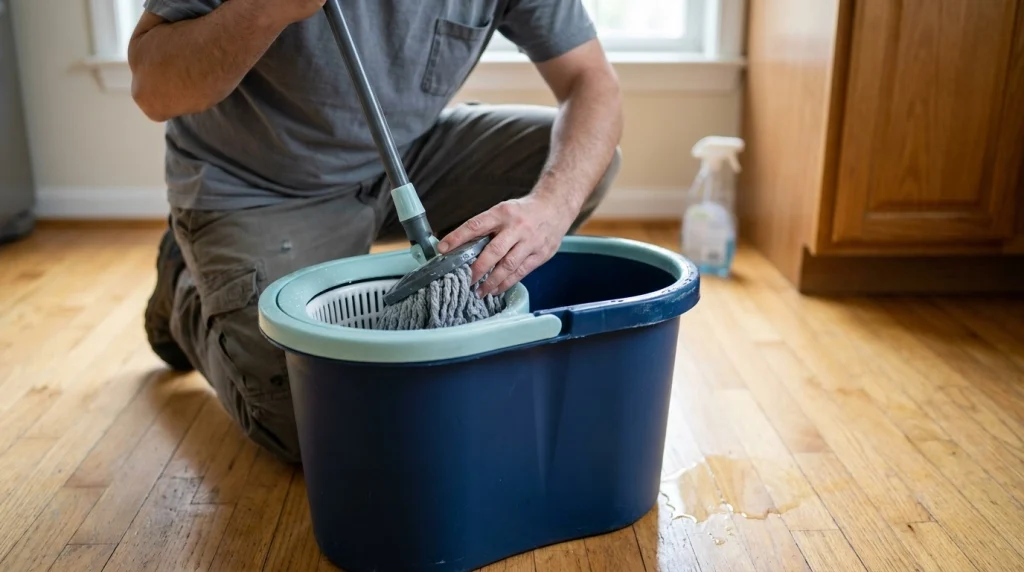
If your mop continues to drip after spinning, the cause may be a saturated head, an incorrect setup, or a wringer that isn’t working properly. Start with simple checks before replacing the entire mop system.
Check these common causes
- Too little spinning: Follow the recommended cycle and add controlled presses if needed.
- Incorrect positioning: Recenter the mop head in the wringer basket.
- Excess water from soaking: Allow a consistent brief drip period before wringing, if your model’s instructions permit it.
- Blocked basket: Remove visible debris and clean the wringer.
- Worn mechanism: Inspect the pedal, handle lock, and moving parts for damage.
- Overloaded fibers: Remove hair and buildup, then wash the mop head as directed.
What if the mop spins but barely releases water?
A spinning mop head that remains saturated may have a mechanical issue or a design that extracts less moisture than expected. Check the manual for the correct locking position and whether the head should spin freely in the basket.
Don’t force the handle or reach into a moving spinner. Stop the mechanism before removing obstructions or inspecting parts.
What if the floor still looks wet after mopping?
First, check whether the mop is leaving puddles or merely a thin damp film. Puddles suggest excess water delivery, while a thin film may be normal for some compatible floor surfaces.
Wring the head again, work in smaller sections, and use a clean microfiber pad if the existing head is saturated with dirty water. Improve ventilation where practical and keep people away from slippery areas until the floor is safe to walk on.
For wood and laminate, don’t wait for puddles to dry on their own if the floor care instructions call for immediate removal of excess moisture. Blot standing water promptly with an appropriate dry cloth.
Section Takeaway: A mop that remains too wet deserves a check of the head, basket, and operating technique. Never force a damaged spinner, and always prioritize floor safety over achieving a particular extraction percentage.
Frequently asked questions
1. What percentage of water does a spin mop remove?
There is no universal percentage for every spin mop. One published O-Cedar EasyWring test reported approximately 73% removal of the absorbed water during testing, but other models and conditions can produce different results.
2. Does spinning a mop make it completely dry?
No. Spinning removes excess water, but absorbent microfiber usually retains some moisture. A properly wrung mop should have the dampness needed for its intended cleaning task without dripping excessively.
3. How many times should I spin my mop?
Use the number of presses or pedal cycles recommended by the mop manufacturer, then check the head’s dampness. Repeat the cycle if it still drips, particularly before cleaning hardwood or laminate that requires minimal moisture.
4. Does a faster spin remove more water?
Faster rotation can help expel water, but the final result also depends on basket design, fiber construction, and how saturated the head is. Use the intended operating method rather than forcing the mechanism to spin faster.
5. Why does my spin mop leave puddles?
Puddles can indicate insufficient wringing, an overly saturated mop head, or excessive liquid applied during cleaning. Spin the head again, inspect the wringer, and make shorter cleaning passes until you can control the moisture.
6. Is a drier mop always better for cleaning?
No. A mop that’s too dry may not loosen certain kinds of dirt effectively, while an overly wet mop can leave residue or damage moisture-sensitive flooring. Aim for a dampness level suited to the surface and cleaning task.
7. Can I use a spin mop on hardwood and laminate?
Many spin mops can clean compatible sealed hardwood and laminate when properly wrung out, but the flooring manufacturer’s instructions take priority. Use minimal moisture, avoid standing water, and choose an approved cleaning solution.
Final takeaway: Remove enough water, not all of it
A spin mop can remove a substantial share of the water held by its fibers, but the exact percentage varies by mop and testing conditions. A published result of approximately 73% for one O-Cedar model offers a useful reference rather than a universal benchmark.
For everyday cleaning, focus on a clean mop head, consistent wringing, and the moisture level your floor can safely tolerate. If your mop drips heavily or leaves puddles, spin it again and check the mechanism before continuing.
For more reliable floor care, always follow the flooring manufacturer’s cleaning instructions and use compatible products. A well-maintained spin mop should leave your floor clean without unnecessary water or residue.
Affiliate disclosure: This article is informational and does not contain product purchase links. Any product-specific test result is identified as such and should not be treated as a guarantee of performance for other mop models.