
Adjustable Handle Spin Mop Types: How to Choose the Right One

Quick Answer
Adjustable handle spin mop types differ mainly in how the handle locks, how the mop head spins, and how the bucket removes excess water. Telescopic twist-lock models suit households that want simple height adjustment, while push-pull spinning handles and pedal-operated bucket systems offer different ways to wring microfiber mop heads. Choose a model with a secure lock, comfortable reach, a compatible bucket, and a mop head that suits your flooring.
Main types to compare
- Telescopic twist-lock: Rotating a collar secures the handle at your preferred length.
- Push-button adjustable: A button or release mechanism allows the pole to extend or retract.
- Handle-operated spin: A pumping or twisting action activates the wringing mechanism on compatible systems.
- Pedal-operated bucket: A foot pedal drives the bucket spinner while the handle mainly guides the mop.
- Interchangeable or modular: Detachable sections or replaceable parts offer flexibility when the design supports them.
Before buying
- Check the lock: The handle should stay at the selected length when you apply normal mopping pressure.
- Match your floor: Use a well-wrung mop and follow the flooring manufacturer’s moisture limits.
- Confirm compatibility: Check whether the handle, mop head, and spinner bucket work together.
An adjustable handle spin mop can make everyday floor cleaning more comfortable, especially when several people share the same cleaning tools. The right design helps you reach beneath furniture without constantly bending, while a working spin mechanism makes it easier to control how much water stays in the mop head.
In this guide, I’ll explain the main adjustable-handle designs, how their wringing systems differ, and which features matter for hardwood, laminate, vinyl, and tile. I’ll also cover common handle problems so you can make a practical choice in 2026.
In This Guide
- What is an adjustable handle spin mop?
- What types of adjustable spin mop handles are available?
- How do spin mop wringing mechanisms differ?
- How do you choose the right handle?
- Which spin mop works for each floor type?
- How do adjustable spin mops compare with other mop types?
- How do you maintain and troubleshoot the handle?
- What should you check before buying?
- Frequently asked questions
What Is an Adjustable Handle Spin Mop?
An adjustable handle spin mop is a floor-cleaning tool with a pole that changes length and a rotating mop head that works with a compatible wringing system. The adjustment helps different users find a comfortable working height without buying separate mops.
The term telescopic handle describes a pole with sections that slide into or out of one another. A locking collar, button, or similar mechanism holds those sections in place during cleaning.
Why does handle adjustment matter?
A handle that fits your height can help you maintain a more natural posture while pushing and pulling the mop. It also makes it easier to clean around furniture, along baseboards, and in open areas without repeatedly changing your grip.
- Comfort: Set the pole to a practical length for your height.
- Shared use: Let family members adjust the same mop to their preferences.
- Storage: Shorten a compatible pole when the mop is not in use.
- Reach: Guide a swivel head into corners and beneath accessible furniture.
Adjustment alone doesn’t guarantee a better mop. A loose lock, heavy bucket, awkward grip, or poorly matched spinner can make the whole system frustrating to use.
What Types of Adjustable Spin Mop Handles Are Available?
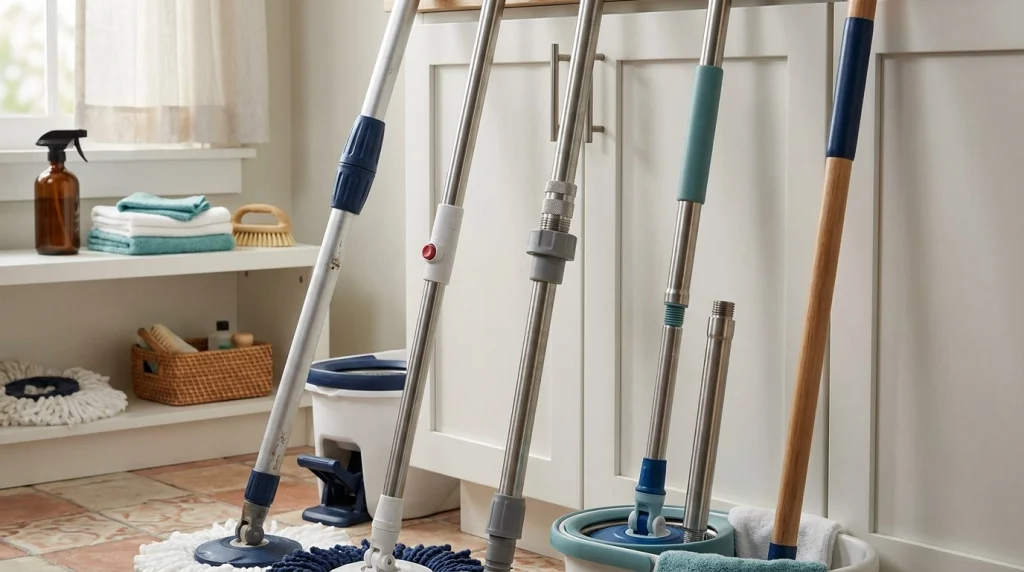
The main handle types differ in how you change their length and secure the pole. These designs may appear in different spin mop products, and not every manufacturer uses the same terminology.
1. Telescopic twist-lock handle
A twist-lock handle uses a rotating collar or joint to release and secure sliding pole sections. You loosen the collar, change the length, and tighten it before mopping.
This design suits households that prefer a straightforward adjustment without relying on a small external button. The locking joint must still hold firmly, and excessive force can damage some plastic fittings.
2. Push-button adjustable handle
A push-button handle uses a release button or similar locking feature to let one section move relative to another. Once the pole reaches the desired position, the mechanism engages again.
Look for a button that moves cleanly and locks securely. Dirt, wear, or damaged internal parts can prevent reliable engagement, so check the mechanism before buying when possible.
3. Threaded or screw-lock handle
Some adjustable poles secure their sections with threaded joints or a screw-style locking collar. These can provide a firm connection when assembled correctly.
The main drawback is that a joint may loosen during repeated use if you don’t secure it properly. Check the manufacturer’s instructions rather than overtightening the connection.
4. Sectional or modular handle
A modular handle uses detachable sections or replaceable components instead of relying solely on a sliding pole. The design can simplify replacement when an individual section becomes damaged.
However, modular parts aren’t automatically interchangeable between brands. Confirm the connection type and the manufacturer’s compatibility information before ordering replacement sections.
5. Fixed-length spin mop handle
A fixed handle doesn’t adjust its length, but it remains a useful comparison when choosing a spin mop. It avoids an adjustable locking joint and may suit users who already know their preferred handle length.
Its limitation is flexibility. A fixed pole may be less convenient when multiple people of different heights share the mop.
| Handle design | Main advantage | Potential drawback |
|---|---|---|
| Twist-lock | Simple length adjustment | Collar may loosen or wear |
| Push-button | Convenient release mechanism | Button may stick or fail to engage |
| Threaded lock | Secure connection when tightened correctly | Can loosen or be overtightened |
| Modular sections | Potentially easier part replacement | Requires compatible components |
| Fixed length | No adjustable locking joint | Limited height flexibility |
Section takeaway: Choose the locking mechanism you find easiest to operate, but prioritize a secure joint over the number of adjustment features.
How Do Spin Mop Wringing Mechanisms Differ?
The handle’s length adjustment and the mop’s wringing action are two separate features. A spin mop can have an adjustable pole and still use a bucket-operated spinner rather than a mechanism built into the handle.
Handle-operated spinning mechanism
In some designs, repeated pumping or twisting of the handle activates the mop head’s spinning action. The mechanism helps remove excess water when used with its compatible wringing setup.
Before buying, check how the handle engages the spinner and whether the instructions require a particular grip or movement. A mechanism that feels awkward may become tiring during longer cleaning sessions.
Foot-pedal spinner bucket
A pedal-operated system uses a foot pedal to drive the bucket’s spinning basket. You place the mop head in the basket and operate the pedal according to the product instructions.
This separates the wringing action from handle-length adjustment. It may suit users who prefer not to pump the pole, although pedal resistance, bucket stability, and the space required for the system still matter.
Manual wringing and squeeze systems
Some spin-style mops use a manual wringer, squeeze mechanism, or other water-removal arrangement. The precise operation depends on the product design.
These options can be simpler than a more elaborate spinner, but you should confirm how much effort the mechanism requires. Don’t assume that every mop marketed as a spin mop uses the same system.
- Check the instructions: Confirm the exact steps needed to wring the head.
- Inspect stability: The bucket should remain stable during normal operation.
- Test water control: Choose a system that lets you avoid a dripping mop.
- Check replacement parts: Find out whether the spinner and mop head can be replaced separately.
*Safety note: Keep hands and loose clothing away from moving spinner parts, and follow the product’s operating instructions. Never reach into a moving basket.
How Do You Choose the Right Adjustable Spin Mop Handle?
The best handle is one that fits your reach, locks securely, and remains comfortable throughout your usual cleaning routine. You don’t need the longest pole or the most complicated mechanism to clean effectively.
Choose a comfortable working length
Stand naturally and hold the mop as you would during everyday cleaning. The pole should let you guide the mop head without repeatedly bending forward or lifting your shoulders unnecessarily.
Check both the minimum and maximum handle lengths. A pole that extends sufficiently may still feel awkward if it doesn’t shorten enough for storage or for a shorter user.
Inspect the locking joint
A secure lock is essential because you push and pull the pole repeatedly during mopping. If the handle slips, the sudden change in length can interrupt your movement and make the tool harder to control.
- Extend the pole and engage its lock according to the instructions.
- Apply gentle pressure to check for unexpected sliding.
- Look for cracks, loose collars, bent sections, or damaged buttons.
- Confirm that the joint stays secure when you move the mop normally.
Consider material and grip
Aluminum and stainless steel are common handle materials, while some designs use plastic components or mixed materials. Material alone doesn’t establish durability; construction quality and joint design also matter.
A comfortable grip can help you maintain control without squeezing the handle too tightly. If you clean for extended periods, pay attention to the overall weight and balance rather than the pole material alone.
Match the handle to your cleaning space
A compact apartment may benefit from a pole that shortens for storage. A larger home may place more importance on comfortable reach and a bucket that is easy to move between rooms.
Consider where you’ll store the bucket, whether you need to carry it up stairs, and how easily the mop head fits beneath your furniture. These practical details can matter more than extra features you rarely use.
Section takeaway: Prioritize comfortable reach, a dependable lock, manageable weight, and a compatible wringing system. Compare the complete mop rather than the handle alone.
Which Spin Mop Works for Each Floor Type?
Most spin mops use absorbent microfiber heads, but the right amount of moisture depends on the flooring material and its finish. Even a well-designed adjustable handle cannot prevent water damage if you leave too much liquid on a sensitive floor.
Hardwood and engineered wood
Use a soft, well-wrung mop and the cleaning method approved by your flooring manufacturer. Excess water can enter joints or damage wood finishes, so avoid soaking the floor.
For care guidance, consult the National Wood Flooring Association and your floor manufacturer’s instructions. A spin bucket is useful only if you can control the mop’s moisture level.
Laminate flooring
Laminate can be sensitive to moisture entering seams and edges. Use a laminate-compatible cleaner and a barely damp mop when the flooring instructions recommend that approach.
Don’t assume that a high-speed spinner makes every mop safe for laminate. Check the mop head, cleaning solution, and drying requirements together.
Vinyl and luxury vinyl plank
Vinyl and luxury vinyl plank often tolerate routine damp mopping, but the finish and manufacturer’s care directions still determine the safest method. A microfiber spin mop can help control moisture and collect ordinary surface dirt.
Avoid abrasive pads and unapproved chemicals that could affect the finish. Test a new cleaning product in an inconspicuous spot when the manufacturer permits it.
Tile and sealed stone
Glazed ceramic and porcelain tile generally accommodate damp mopping, although grout lines can hold residue. A clean microfiber head and the correct cleaner help manage everyday soil.
Natural stone needs more care because certain stones and finishes react to acidic or harsh cleaners. Choose a stone-compatible product and avoid assuming that vinegar is safe for every hard floor.
Concrete and other hard surfaces
Sealed concrete may work well with a compatible mop and cleaner, while unsealed or textured surfaces can require a different approach. Check the surface finish before choosing a cleaning solution.
*Safety note: Follow the floor manufacturer’s care guide and the cleaner’s label. Avoid unapproved acids, abrasives, or excess water, especially on wood, laminate, and natural stone.
How Do Adjustable Spin Mops Compare With Other Mop Types?
An adjustable spin mop combines a height-adjustable handle with a rotating head and a wringing system. Other mop designs may be better for quick touch-ups, steam-based cleaning, or hands-off maintenance.
| Mop type | Best suited to | Main trade-off |
|---|---|---|
| Adjustable spin mop | Routine damp cleaning and controlled wringing | Requires bucket storage and maintenance |
| Flat microfiber mop | Quick cleaning and flat, accessible surfaces | May require a separate rinsing or wringing method |
| Traditional string mop | General wet cleaning on suitable surfaces | Can retain considerable water |
| Steam mop | Compatible sealed floors where steam is permitted | Heat and moisture can damage unsuitable flooring |
| Cordless electric mop | Powered scrubbing or cleaning assistance | Requires charging and equipment maintenance |
| Robot mop | Scheduled maintenance on accessible floors | Needs setup and may miss some edges or obstacles |
When is a spin mop the better choice?
A spin mop is a sensible option when you want a reusable mop head and a dedicated way to remove excess water. The adjustable handle adds flexibility for different users, while the bucket provides a place to rinse and wring the mop.
A flat microfiber mop may be more convenient for a small spill or a quick pass through a compact room. If you want powered cleaning, an electric model may be worth considering, provided its operating method suits your flooring.
Steam cleaning isn’t a universal upgrade. Some wood, laminate, and other flooring manufacturers prohibit steam because heat and moisture may damage the surface or its joints.
For routine household cleaning, the CDC’s cleaning and disinfecting guidance explains why ordinary cleaning is often sufficient and why disinfectants should be used when appropriate rather than automatically applied to every surface.
How Do You Maintain and Troubleshoot an Adjustable Spin Mop?

Regular maintenance helps preserve the handle lock, spinning mechanism, and mop head. Small problems are easier to address when you clean the components after use and inspect them before they become difficult to operate.
The handle keeps slipping
A slipping pole may have a loose twist collar, a worn locking component, or an incorrectly assembled section. Stop mopping, unload pressure from the pole, and follow the manufacturer’s instructions to secure the joint.
If the handle continues to collapse, don’t compensate by gripping it harder or forcing the lock. Replace the damaged component or contact the manufacturer for a compatible repair part.
The handle won’t extend or retract
Dirt, a misaligned section, or a damaged release mechanism can prevent adjustment. Wipe accessible surfaces clean and check whether the parts align correctly.
Never force a stuck pole or dismantle a spring-loaded mechanism unless the manufacturer provides instructions for doing so. Replace a damaged handle when safe adjustment is no longer possible.
The mop head won’t spin properly
A poorly seated head, worn connection, or problem with the wringer can interrupt spinning. Check that the mop head is attached correctly and that the bucket mechanism operates as directed.
Keep fingers away from moving components and disconnect or disable any powered mechanism before cleaning it. If the spinner remains unreliable, check the warranty and replacement-part options.
The floor looks streaky or feels sticky
Streaks can result from excess cleaner, dirty rinse water, a contaminated mop head, or residue left by an unsuitable product. Rinse the mop head, use the recommended cleaner concentration, and change dirty water when necessary.
Use a separate, clean mop head when moving between heavily soiled areas and cleaner rooms. A spin mechanism removes water, but it doesn’t replace washing the microfiber head.
Clean and store the mop correctly
- Rinse the mop head after cleaning and wash it according to its care label.
- Empty and clean the bucket to remove soil and detergent residue.
- Allow the mop head and bucket to dry fully before storage.
- Inspect the handle, locking collar, joints, and spinner for damage.
- Store the pole in a position recommended by the manufacturer.
For disinfecting tasks, follow the product label and clean the surface before applying disinfectant when the directions require it. The EPA’s pesticide registration resources provide information about regulated pesticide products, including disinfectants.
*Safety note: Never mix cleaning chemicals, and never assume that a cleaner suitable for one floor is safe for another. Follow the product label and the floor manufacturer’s care instructions.
What Should You Check Before Buying an Adjustable Spin Mop?
Compare the complete cleaning system rather than choosing by handle design alone. A comfortable pole won’t compensate for a wobbly bucket, difficult spinner, or mop head that is hard to replace.
- Adjustment range: Check the shortest and longest handle positions against your needs.
- Locking security: Look for a mechanism that holds its position during normal cleaning.
- Grip and balance: Consider handle diameter, surface texture, and overall weight.
- Spinner design: Confirm whether the system uses a foot pedal, handle action, or manual wringer.
- Mop head availability: Check the replacement size, attachment method, and washing instructions.
- Bucket practicality: Consider capacity, storage footprint, carrying handles, and stability.
- Floor compatibility: Make sure the microfiber head and recommended cleaning method suit your flooring.
- Warranty and parts: Review the return policy, warranty terms, and availability of compatible components.
What should you avoid?
Be cautious of vague claims such as universal compatibility, maintenance-free operation, or suitability for every floor. These claims need support from specific product documentation.
Also avoid buying a replacement pole based on appearance alone. Different handles may use different thread sizes, connectors, locking joints, and spinner mechanisms.
For a shared household, a secure twist-lock or push-button handle is a practical starting point. For anyone who prefers a simple tool, a fixed-length model may be adequate if its reach feels comfortable.
Section takeaway: Confirm handle dimensions, locking security, spinner compatibility, replacement-head availability, and floor-care requirements before making your final choice.
Frequently Asked Questions
Are all adjustable spin mop handles universal?
No. Handles, mop heads, and spinner buckets can use different connectors and operating mechanisms. Check the product’s compatibility information before purchasing a replacement handle or mixing components from different brands.
Is a twist-lock or push-button spin mop handle better?
Neither design is automatically better for every user. A twist-lock handle suits people who prefer a rotating collar, while a push-button design may offer a more direct release. The best option is the one that adjusts easily and locks securely.
Can an adjustable spin mop be used on hardwood floors?
Yes, if the mop head and cleaning method suit the specific hardwood finish and the flooring manufacturer’s instructions permit damp mopping. Wring the mop thoroughly, avoid standing water, and use an approved cleaner.
Why does my adjustable spin mop handle keep shortening?
The locking collar or internal release mechanism may be loose, worn, damaged, or incorrectly assembled. Stop using the mop until the handle holds securely, then inspect the joint and follow the manufacturer’s repair or replacement guidance.
How often should I wash a spin mop head?
Rinse the head after every cleaning session and wash it according to the care label. Wash it sooner when it becomes heavily soiled or develops an odor, and let it dry completely before storing it.
Can I use vinegar or bleach in a spin mop bucket?
Only use a cleaning solution that is compatible with your floor, mop, and bucket. Vinegar can damage some natural stone and finishes, while bleach can harm certain materials. Never mix bleach with vinegar or other cleaning products.
Does a spin mop disinfect floors?
A spin mop primarily removes dirt and cleaning solution from a surface. Disinfection requires an appropriate product used according to its label, including any required contact time. Ordinary household cleaning is often sufficient unless the situation calls for additional disinfection.
Final Takeaway
Adjustable handle spin mop types offer different ways to customize reach and control the wringing process. Twist-lock, push-button, threaded, and modular designs each have practical advantages, but a secure locking joint and comfortable working position should come first.
Choose a mop with a compatible bucket, replaceable microfiber head, and a cleaning method suited to your floors. With the right setup and routine maintenance, an adjustable spin mop can be a useful tool for everyday floor care.