
Are Steam Mops Better Than Spin Mops? A Practical 2026 Comparison

Quick Answer
Steam mops are better for quick, water-only cleaning on heat-safe sealed floors, especially ceramic and porcelain tile. Spin mops are more versatile because you can control moisture and use a floor-safe cleaner when needed. For routine home cleaning, the CDC’s cleaning guidance also notes that regular cleaning is usually enough in most household situations.
The Main Differences
- Floor safety: A well-wrung spin mop works on more floor types.
- Heat cleaning: Steam mops loosen some sticky grime without adding detergent.
- Moisture control: Spin mops let you wring the head until it is only damp.
- Setup: Steam mops avoid carrying a large cleaning bucket.
- Best overall: I prefer a spin mop when one mop must clean several floor types.
I have used both types when cleaning kitchens, bathrooms, entryways, and larger hard-floor areas. Each can work well, but they solve different cleaning problems.
The important question is not simply which mop is stronger. It is which cleaning method matches your floor, mess, and daily routine.
In This Guide
- Are steam mops better than spin mops?
- How do steam mops and spin mops work?
- Steam mop vs spin mop: which cleans better?
- Which mop is safer for different floor types?
- Which mop is easier for everyday cleaning?
- When should you choose each mop?
- What mistakes should you avoid?
- Frequently asked questions
- My final verdict
Are Steam Mops Better Than Spin Mops?
Steam mops are not automatically better than spin mops. They are better for certain heat-safe floors and specific cleaning jobs.
A spin mop is the more flexible choice for most mixed-floor homes. You control the water level, cleaning solution, and pressure yourself.
I noticed this difference most when moving from kitchen tile into rooms with more moisture-sensitive flooring. The steam mop stopped being my automatic choice as soon as the floor material changed.
- Choose steam when you have compatible sealed tile and want quick cleaning without a bucket.
- Choose a spin mop when your home has several floor types or you need better moisture control.
- Choose neither blindly until you check the flooring manufacturer’s cleaning instructions.
The main advantage of steam is heat. The main advantage of a spin mop is control.
That distinction matters more than advertising claims about one mop being more powerful.
How Do Steam Mops and Spin Mops Work?
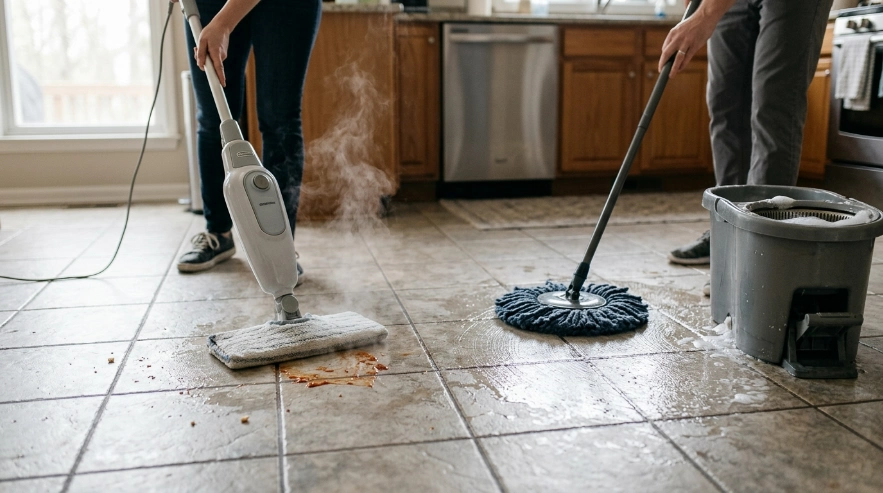
The two tools may look similar while moving across a floor. Their cleaning methods are quite different.
What is a steam mop?
A steam mop is an electric floor cleaner that heats water and releases hot vapor through a cleaning pad. The warm, damp pad then loosens soil as you move it across the floor.
Most models use plain water in their tanks. You should not add household cleaners unless your specific machine allows them.
Steam models from brands such as Shark and Bissell can be convenient because there is no traditional mop bucket. You fill the tank, let the machine heat, and start cleaning.
What is a spin mop?
A spin mop is a manual mop system with a bucket and a spinning wringer. The spinning action removes excess liquid from the mop head.
Many spin mop heads use microfiber. Microfiber can pick up fine dust and grime while remaining gentle on many finished surfaces.
Systems such as O-Cedar-style spin mops also let you decide how wet the mop should be. I find that control useful around seams and other moisture-sensitive areas.
- Spin longer when you need a nearly dry mop head.
- Leave slightly more moisture for durable tile.
- Change the bucket water when it becomes visibly dirty.
- Wash reusable heads after dirty cleaning jobs.
Neither mop replaces sweeping or vacuuming. Loose grit should come off the floor before wet cleaning starts.
Steam Mop vs Spin Mop: Which Cleans Better?
Steam works well on compatible floors with greasy film and some stuck-on grime, while a spin mop gives you more cleaning options. The better performer depends on what is dirty.
| Feature | Steam Mop | Spin Mop |
|---|---|---|
| Cleaning method | Heat, moisture, and microfiber pad | Water or cleaner, microfiber, and manual agitation |
| Electricity needed | Yes | Usually no |
| Bucket needed | No | Yes |
| Moisture control | Depends on steam setting and technique | High control through wringing |
| Cleaner choice | Usually water only | Floor-approved cleaners can be used |
| Sticky kitchen soil | Good on compatible surfaces | Good with the correct cleaning solution |
| Mixed flooring | Limited by heat compatibility | Usually more versatile |
Does steam clean floors better without chemicals?
Steam can loosen grime without putting detergent into the water tank. That is useful when I want to avoid cleaner residue on a compatible surface.
However, heat does not make every floor-cleaning job automatically better. Oily soil, heavy dirt, and old residue may still require a product designed for that surface.
Does a steam mop disinfect the floor?
Be careful with the words clean, sanitize, and disinfect. They do not mean the same thing.
The EPA explains the difference between cleaning, sanitizing, and disinfecting. A steam mop should not be treated as a guaranteed disinfecting system unless its manufacturer provides validated instructions for that use.
Contact time also matters. Moving a mop quickly across a floor may not give a surface the exposure required for a specific sanitizing claim.
For ordinary household floors, my goal is usually simpler. I remove dirt, spills, tracked-in soil, and residue without damaging the finish.
Which Mop Is Safer for Different Floor Types?
A spin mop is generally easier to adapt to different floors because you can control moisture. Steam needs more caution because heat and moisture may affect seams, coatings, adhesives, and finishes.
Hardwood and engineered wood
I would not make a steam mop my default choice for wood flooring. Wood and its finish can react badly to unnecessary heat or moisture.
Bona’s wood floor care guidance recommends keeping water use to a minimum. A lightly damp microfiber method gives you much more control.
With a spin mop, I wring the head several times before touching wood. It should feel damp rather than wet.
Safety note: Check your flooring manufacturer’s care guide before using steam, water, or any cleaning solution on hardwood or engineered wood.
Laminate flooring
Laminate deserves similar caution. Moisture can work into joints and affect the fiber-based core on many products.
Shaw’s laminate floor care instructions specifically warn against steam cleaners and wet mops for its laminate flooring. Other manufacturers may have different requirements for specific product lines.
That last point matters. Some modern laminate products may advertise steam-cleaning compatibility under specific conditions.
Safety note: Never assume that a waterproof or water-resistant label also means unrestricted steam-mop use.
Vinyl and LVP
Spin mops are usually easier to control on vinyl and luxury vinyl plank. I use a well-wrung microfiber head and avoid leaving puddles around seams.
Steam can expose the floor to both high heat and moisture. Those conditions may affect certain vinyl products, adhesives, or installation systems.
Safety note: Follow the exact care guide for your vinyl product, especially before using a steam mop.
Ceramic and porcelain tile
This is where steam mops make the strongest case. Durable sealed ceramic or porcelain tile often tolerates heat and moisture better than wood-based flooring.
I like steam for a quick kitchen or bathroom pass when the tile manufacturer allows it. Heat also helps soften some dried surface grime.
A spin mop still works well here. It may be better when the floor needs detergent or a more thorough rinse.
Natural stone
Do not treat natural stone like ceramic tile. Stone type, sealers, grout, and installation materials can all change the safe cleaning method.
I prefer a damp microfiber approach with a stone-safe, often pH-neutral cleaner unless the manufacturer says otherwise. Steam is not something I would use without checking first.
Safety note: Avoid acidic DIY cleaners on acid-sensitive stone such as marble and confirm cleaner compatibility with the installer or manufacturer.
Concrete
Steam may work on some sealed concrete surfaces. The sealer, coating, paint, or finish still determines what is safe.
A spin mop is easier to adjust when I do not know how a coating will respond to high heat.
Section Takeaway: Spin mops win on versatility. Steam mops make the most sense when the floor manufacturer clearly permits heat and moisture.
Which Mop Is Easier for Everyday Cleaning?
A steam mop is easier to set up for a small compatible area, while a spin mop is easier to adapt throughout a mixed-floor home. Your cleaning routine decides which convenience matters more.
Where steam feels easier
I appreciate steam when I want to clean one tiled room quickly. There is no large bucket to fill, carry, empty, and rinse.
- Fill the reservoir.
- Attach a clean pad.
- Let the mop heat.
- Clean the compatible floor.
- Remove and wash the dirty pad.
The power cord can be the annoying part. You may need to change outlets in a larger home.
Where a spin mop feels easier
A spin mop requires more setup because you need the bucket and water. Once it is ready, I can clean a large area without looking for electrical outlets.
The spinning wringer also saves my hands from twisting a wet mop head. I can quickly make the mop wetter or drier as the floor changes.
- Small tiled bathroom: Steam is convenient.
- Large open floor: Either can work.
- Several floor materials: Spin mop has the advantage.
- No nearby outlet: Spin mop is simpler.
- Need floor cleaner: Spin mop gives more options.
When Should You Choose a Steam Mop or Spin Mop?
Choose based on your floor first and your preferred cleaning style second. A powerful mop is useless if its cleaning method is wrong for the surface.
Choose a steam mop if:
- Your flooring manufacturer allows steam cleaning.
- You mainly clean sealed ceramic or porcelain tile.
- You want to clean mostly with water instead of detergent.
- You dislike filling and carrying mop buckets.
- You often deal with small amounts of sticky surface grime.
- You have convenient electrical outlets near the cleaning area.
Choose a spin mop if:
- You have several different floor types.
- You want direct control over how damp the mop head stays.
- You sometimes need a manufacturer-approved cleaning solution.
- You clean larger areas without convenient outlets.
- You prefer a simple tool without heating elements.
- You want one mop system for most routine floor cleaning.
What would I buy for one-mop household cleaning?
I would choose a quality microfiber spin mop if I could own only one of these two tools. Its wider floor compatibility is the deciding factor.
I would choose steam instead if my home had mostly steam-approved tile. In that situation, the quick setup and water-only cleaning become much more useful.
What Mistakes Should You Avoid With Steam and Spin Mops?

The worst mistake is choosing the cleaning method before checking the floor. A clean floor is not worth a damaged finish or swollen seam.
Steam mop mistakes
- Ignoring floor instructions: A hard surface is not automatically steam-safe.
- Holding steam in one place: Concentrated heat and moisture can increase damage risk.
- Adding random cleaners: Use only liquids approved by the steam mop manufacturer.
- Skipping dry cleaning: Steam does not remove loose grit as efficiently as vacuuming first.
- Using a filthy pad: A saturated dirty pad can spread soil across the room.
Spin mop mistakes
- Leaving the mop soaked: Excess water can enter seams and extend drying time.
- Using too much cleaner: Extra detergent often causes sticky residue or streaks.
- Cleaning with dirty water: Cloudy bucket water can redeposit soil.
- Ignoring the mop head: Wash reusable microfiber heads regularly.
- Using one solution everywhere: Wood, laminate, vinyl, tile, and stone can have different cleaner requirements.
I once assumed that stronger cleaning solution would make a spin mop work faster. Instead, the floor dried with a noticeable film that needed another pass with clean water.
That experience changed my routine. I now start with the smallest amount of product the label calls for and increase cleaning action before increasing chemical concentration.
Safety note: Never mix household cleaning chemicals unless the product labels specifically say the combination is safe.
Frequently Asked Questions
Are steam mops more hygienic than spin mops?
Steam provides heat that a normal spin mop does not, but that does not automatically make every steam-mopped floor disinfected. Results depend on the machine, surface, temperature, contact time, and manufacturer instructions.
Do steam mops clean better than regular mops?
Steam mops can clean some heat-safe hard floors efficiently, especially when grime responds well to heat. A normal or spin mop may work better when you need a surface-specific cleaner, more scrubbing control, or lower moisture exposure.
Can I use a steam mop on hardwood floors?
I would avoid steam unless the exact hardwood manufacturer approves it. Heat and moisture may affect wood, joints, adhesives, or finishes, so a lightly damp microfiber mop is usually the more cautious option.
Can a spin mop clean tile as well as a steam mop?
Yes. A microfiber spin mop can clean tile well, especially when used with the correct tile-safe cleaner. Steam may make some sticky grime easier to loosen, but it is not required for routine tile cleaning.
Which mop leaves less water on the floor?
Both can leave relatively little moisture when used correctly. A spin mop gives you direct control because you can keep spinning the head until it reaches the dampness level you want.
Which mop is better for pet owners?
A spin mop is more versatile for homes with mixed flooring and pet messes because you can use an appropriate floor-safe cleaner when needed. Remove pet hair and loose debris with a vacuum before mopping either way.
Do I need both a steam mop and a spin mop?
No. Most homes can manage with one well-chosen mop. Owning both makes more sense when you have steam-safe tile plus other floors that require a gentler damp-mopping method.
My Final Verdict: Steam Mop or Spin Mop?
For most homes, I would choose a spin mop over a steam mop. Its biggest advantage is not stronger cleaning but better control across different floors.
You can wring the microfiber head until it is lightly damp. You can also choose a cleaner that matches the floor manufacturer’s instructions.
A steam mop still has a clear place. It is convenient for compatible sealed tile when you want heat-assisted cleaning without carrying a bucket.
As of 2026, I would not buy either mop based only on promises about deeper cleaning. I would first check every floor type in the home and see what its manufacturer permits.
If several rooms need different cleaning methods, the spin mop is the safer all-round choice. If most of your flooring is steam-approved tile, the steam mop becomes much more appealing.
