
Are Steam Mops Good for Marble Floors?

Quick Answer
Steam mops are usually not good for marble floors because marble is porous, heat-sensitive, and easy to dull with the wrong cleaning method. A steam mop can push heat and moisture into stone pores, grout lines, tiny cracks, or weak sealers, so a damp microfiber mop with a pH-neutral stone cleaner is the safer choice. For natural-stone care basics, the Natural Stone Institute’s stone care guidance is a better starting point than steam-mop marketing claims.
Best Marble Floor Cleaning Choice
- Skip steam: Use it only if your marble installer or sealer manufacturer clearly approves it.
- Use microfiber: A soft flat mop lifts dust without scratching polished marble.
- Choose pH-neutral: Acidic cleaners can etch marble and leave dull marks.
- Control moisture: Marble should be damp-mopped, not soaked.
- Dry fast: Buffing dry helps reduce streaks, water spots, and slip risk.
Quick Rule
- If you would hesitate to use heat, acid, or standing water on your marble countertop, do not use it on your marble floor either.
Marble floors can look beautiful for decades, but they do not forgive harsh cleaning habits.
I’ve tested plenty of mop routines on tile, vinyl, laminate, hardwood, and stone-style surfaces, and marble always needs the gentler path.
As of 2026, my practical advice is simple: treat marble as natural stone first, not as a “hard floor” that can handle every mop.
This guide explains when steam is risky, what to use instead, and how to clean marble without dulling the finish.
In This Guide
- Are Steam Mops Safe for Marble Floors?
- Why Can Steam Damage Marble?
- What Is the Best Mop for Marble Floors?
- How Do You Clean Marble Floors Safely?
- Steam Mop vs Marble-Safe Cleaning Methods
- Does Sealed, Polished, or Honed Marble Change the Answer?
- What Marble Floor Cleaning Mistakes Should You Avoid?
- When Should You Call a Stone Professional?
- FAQ About Steam Mops and Marble Floors
- Final Takeaway
Are Steam Mops Safe for Marble Floors?
No, steam mops are not the safest choice for most marble floors.
They may clean surface dust, but the heat and moisture can create bigger problems than they solve.
A steam mop is an electric mop that heats water into vapor and releases it through a pad.
That steam can loosen grime on some sealed ceramic or porcelain tile, but marble is a different material.
Marble is a natural stone, and most marble floors have one or more vulnerable areas:
- Stone pores: Tiny openings can absorb moisture if the sealer is weak.
- Grout joints: Steam can push water into grout lines and edges.
- Hairline cracks: Heat and moisture can reach places a normal mop would not soak.
- Surface finish: Polished marble can show dullness, haze, or marks quickly.
- Sealer layer: Repeated heat can stress some protective coatings.
That does not mean one short steam pass will ruin every marble floor.
It means the risk is high enough that I would not use steam as a routine method.
Most homeowners asking this question are trying to solve a practical problem.
They want cleaner marble without streaks, sticky residue, dull spots, or dirty grout.
The answer is not hotter cleaning.
The answer is gentler cleaning with less water, softer mop pads, and the right cleaner.
Safety note: Always check your marble installer’s care guide, stone sealer instructions, or floor manufacturer guidance before using heat, disinfectants, vinegar, bleach, or specialty cleaners.
Section Takeaway: Steam mops are risky for marble because they combine heat, pressure, and moisture. A lightly damp microfiber mop is usually safer.
Why Can Steam Damage Marble?
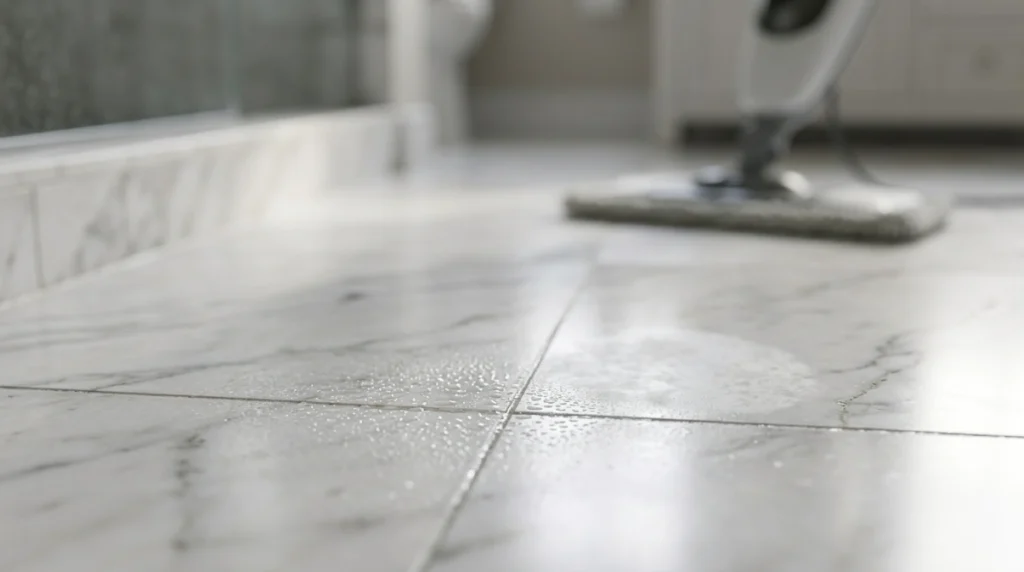
Steam can damage marble because marble reacts poorly to moisture, heat stress, and the wrong chemistry.
The biggest concern is not just visible water on the surface.
Marble Is Porous
Porous means a material has tiny spaces that can absorb liquid.
Marble is denser than many soft stones, but it still needs careful moisture control.
When steam hits the floor, it can condense back into water.
That water may settle into grout, seams, edges, or worn sealer.
Heat Can Stress Sealers
Many marble floors rely on a penetrating sealer to slow down staining.
That sealer does not make marble waterproof.
A good sealer buys you cleanup time.
It does not turn natural stone into porcelain tile.
Repeated heat can also wear on some sealers faster than a room-temperature damp mop.
That matters in kitchens, bathrooms, entries, and other areas that already see spills.
Marble Etches Easily
Etching is a dull mark caused by a chemical reaction on calcium-based stone.
It often looks like a cloudy spot, water mark, or pale ring.
Steam itself is not acidic.
The problem is that steam mopping can spread residue from old cleaners, acidic spills, or dirty mop pads across the surface.
Acidic products are the bigger danger.
The Natural Stone Institute warns against vinegar on calcareous stones such as marble, limestone, and travertine.
Moisture Can Affect Grout
Grout often becomes the weak point on a marble floor.
Steam may loosen surface dirt, but it can also drive moisture into grout lines.
Old, cracked, or unsealed grout is especially vulnerable.
Once grime and moisture settle there, the floor can look dirty again fast.
Safety note: Do not use vinegar, lemon juice, ammonia, abrasive powder, or acidic bathroom cleaner on marble unless your stone professional specifically approves it.
Section Takeaway: Steam is not the only issue. Marble damage often comes from heat, excess moisture, weak sealer, acidic residue, and vulnerable grout working together.
What Is the Best Mop for Marble Floors?
The best mop for marble floors is a soft microfiber flat mop used lightly damp.
A microfiber mop cleans with fine synthetic fibers that grab dust and grit without needing much liquid.
That matters because grit can scratch marble.
Too much water can leave spots, streaks, or moisture along edges.
Best Marble Floor Mop Types
- Flat microfiber mop: Best everyday choice for polished and honed marble.
- Microfiber dust mop: Best for dry dusting before wet cleaning.
- Spray mop: Useful if it releases a fine mist and does not flood the floor.
- Spin mop: Acceptable only if you wring it almost dry.
- String mop: Usually too wet and harder to control.
- Steam mop: Best avoided unless written care guidance allows it.
Best Cleaner for Marble Floors
Use a pH-neutral stone cleaner made for marble or natural stone.
pH-neutral means the cleaner is not strongly acidic or strongly alkaline.
That matters because acidic cleaners can etch marble.
Harsh alkaline cleaners can also leave residue or stress the finish.
For disinfecting questions, remember that cleaning and disinfecting are not the same task.
The CDC explains that cleaning removes dirt and many germs, while disinfecting uses chemicals to kill germs on surfaces.
Most marble floors need routine cleaning more often than disinfecting.
If you do disinfect, use a product that clearly says it is safe for natural stone.
Safety note: EPA-registered disinfectants should be used according to the label, but the label must also match your floor surface. A disinfectant can be effective and still be wrong for marble.
Section Takeaway: The safest marble routine uses dry dust removal, a lightly damp microfiber mop, and a pH-neutral stone cleaner.
How Do You Clean Marble Floors Safely?
Clean marble floors by removing grit first, damp-mopping with a stone-safe cleaner, and drying the surface right away.
Think low moisture from start to finish.
Step-by-Step Marble Floor Cleaning Routine
- Dust first: Use a dry microfiber dust mop or vacuum with a hard-floor setting.
- Remove grit: Check corners, entryways, and under chairs where sand collects.
- Mix cleaner correctly: Follow the pH-neutral stone cleaner label.
- Dampen the mop: The pad should feel damp, not dripping.
- Work in sections: Clean about a 4-by-4-foot area at a time.
- Rinse if needed: Use clean water only if the cleaner label calls for it.
- Dry immediately: Buff with a clean microfiber towel or dry mop pad.
I like to test the mop pad by pressing it with my hand before it touches marble.
If water beads between my fingers, the pad is too wet.
How Often Should You Mop Marble?
Most marble floors do not need wet mopping every day.
They need frequent dry dusting and occasional damp cleaning.
| Area | Dry Dusting | Damp Mopping | Notes |
|---|---|---|---|
| Entryway | Daily or every other day | 1–2 times weekly | Use mats to catch grit. |
| Kitchen | Daily | Weekly or after spills | Wipe acidic spills fast. |
| Bathroom | 2–4 times weekly | Weekly | Dry water spots quickly. |
| Low-traffic room | Weekly | Every 2–4 weeks | Avoid over-washing. |
How Long Should Marble Take to Dry?
A lightly damp marble floor should dry in about 5 to 15 minutes.
If it stays wet longer, your mop is probably too wet.
Drying matters for appearance and safety.
Wet polished marble can become slippery, especially near bathrooms and entries.
Safety note: Place warning signs or block foot traffic while marble dries. Slips can happen even when the floor looks only slightly damp.
Section Takeaway: Safe marble cleaning is mostly about control. Remove grit first, use little liquid, and dry the floor before water can settle.
Steam Mop vs Marble-Safe Cleaning Methods
A steam mop is stronger than marble usually needs.
Marble-safe methods clean with softer pads, cooler water, and less moisture.
| Method | Good for Marble? | Main Benefit | Main Risk |
|---|---|---|---|
| Steam mop | Usually no | Loosens surface grime | Heat, moisture, sealer stress |
| Flat microfiber mop | Yes | Low water control | Dirty pads can scratch |
| Spray mop | Sometimes | Light misting | Wrong cleaner cartridge |
| Spin mop | Carefully | Good wringing control | Can still leave too much water |
| String mop | Usually no | Covers large areas | Hard to keep barely damp |
Steam Mop vs Microfiber Mop
A steam mop uses heat to loosen soil.
A microfiber mop uses fiber texture and mild cleaner to lift soil.
For marble, the microfiber method wins because it gives you more control.
You can adjust moisture, switch pads, and dry the floor quickly.
Steam Mop vs Spin Mop
A spin mop can work if you wring it until it is almost dry.
It should never splash, drip, or leave puddles near grout lines.
Steam mops give you less control because the machine keeps generating vapor.
That makes them less forgiving on natural stone.
Section Takeaway: Marble does not need aggressive cleaning. The safest method is the one that removes grit while leaving the least moisture behind.
Does Sealed, Polished, or Honed Marble Change the Answer?
Sealed, polished, and honed marble still need gentle cleaning.
The finish changes the risk level, but it does not make steam mopping automatically safe.
Can You Steam Mop Sealed Marble?
I would still avoid it unless the sealer manufacturer says steam is safe.
Sealer slows absorption, but it does not make marble waterproof.
You can do a simple water-drop check in a hidden spot.
If water darkens the stone quickly, the marble may need resealing.
This test does not prove steam is safe.
It only shows whether water is absorbing too easily.
Can You Steam Mop Polished Marble?
Polished marble shows dull spots more easily than many other floors.
That glossy surface can reveal haze, streaks, etching, and fine scratches.
Because of that, I am extra cautious with polished marble.
A soft dry dust mop and a pH-neutral cleaner usually give better results.
Can You Steam Mop Honed Marble?
Honed marble has a softer matte look.
It may hide tiny marks better, but it can still absorb moisture and stain.
Do not treat honed marble as rough utility tile.
It is still natural stone.
What About Marble Tile Grout?
Grout can collect soil even when the marble itself looks clean.
Use a soft brush and stone-safe cleaner for small grout areas.
Avoid stiff wire brushes, acidic grout cleaners, and aggressive scrubbing.
Those methods can scratch marble edges or damage grout.
Safety note: If your marble floor has darkened edges, loose tiles, crumbling grout, or cloudy patches, pause wet cleaning and ask a stone professional before using more moisture.
Section Takeaway: Sealer and finish matter, but they do not remove the core risk. Marble still needs low-moisture, stone-safe cleaning.
What Marble Floor Cleaning Mistakes Should You Avoid?
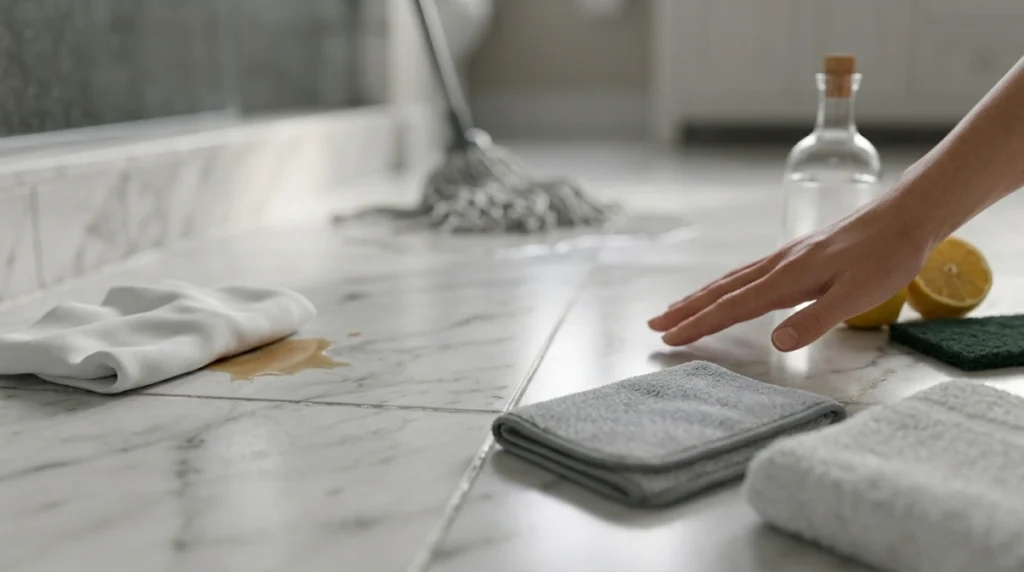
The biggest marble cleaning mistakes are using too much water, acidic products, abrasive pads, and all-purpose cleaners made for tougher surfaces.
Most damage happens slowly, then seems sudden.
Common Mistakes That Dull Marble
- Using vinegar: Vinegar is acidic and can etch marble.
- Using lemon cleaner: Citrus-based cleaners can damage calcium-based stone.
- Using bleach casually: It may discolor, stress sealers, or leave harsh residue.
- Using too much water: Moisture can settle into grout and stone pores.
- Skipping dry dusting: Sand and grit can scratch during mopping.
- Scrubbing with rough pads: Abrasive pads can leave visible swirl marks.
- Letting spills sit: Coffee, wine, juice, and tomato sauce can stain or etch.
What If the Floor Feels Sticky?
A sticky marble floor usually means cleaner residue is still on the surface.
It can also happen when dirty mop water gets spread around.
Use a clean microfiber pad and a stone-safe cleaner diluted exactly as directed.
Then buff the floor dry with a separate clean pad.
What If the Floor Looks Cloudy?
Cloudiness can come from residue, hard-water film, etching, or worn sealer.
Try a careful clean-and-dry routine first.
If the dull mark does not improve, it may be etching rather than dirt.
Etched marble often needs polishing by a stone-care professional.
Safety note: Do not try to “fix” etched marble with stronger cleaners. Stronger chemistry often makes the dull area worse.
Section Takeaway: Marble cleaning is mostly about avoiding damage. Gentle products, soft pads, and quick drying protect the finish better than force.
When Should You Call a Stone Professional?
Call a stone professional when marble has stains, etching, cracks, loose grout, or a finish problem that normal cleaning does not solve.
More cleaning will not fix every marble issue.
Signs You Need Professional Help
- Etched spots: Dull marks remain after cleaning and drying.
- Deep stains: Dark marks appear below the surface.
- Loose grout: Moisture may be reaching tile edges.
- Cracked tiles: Steam or wet mopping can make hidden moisture worse.
- Uneven shine: The floor may need polishing, not more cleaner.
- Unknown sealer: You do not know what was applied or when.
Should Marble Floors Be Resealed?
Some marble floors need resealing over time, especially in kitchens, bathrooms, and entryways.
The schedule depends on the stone, sealer, traffic, and cleaning habits.
A stone professional can test absorption and recommend the right sealer.
That is safer than guessing with a hardware-store product.
Can Professionals Use Steam?
Some professionals use specialized tools, but that does not mean a home steam mop is safe.
Professional stone care involves training, surface testing, extraction, and controlled methods.
A consumer steam mop lacks that control.
That is why I separate professional restoration from routine home mopping.
Section Takeaway: If marble looks stained, etched, cracked, or uneven, stop experimenting. Professional stone care is cheaper than making damage worse.
FAQ About Steam Mops and Marble Floors
Can I use a Shark or Bissell steam mop on marble floors?
I would not use any brand of steam mop on marble unless your marble installer, sealer maker, or floor care guide clearly allows it.
The issue is not the brand name. The issue is heat, moisture, grout exposure, and natural-stone sensitivity.
What happens if I already used a steam mop on marble?
Dry the floor fully and check for dull spots, darkened grout, cloudy marks, or slippery residue.
If the floor looks normal, avoid repeating the method. If you see dull patches that do not clean away, ask a stone professional about etching or sealer damage.
Can steam mops disinfect marble floors?
Steam may reduce some surface germs under the right conditions, but marble safety comes first.
For home floors, routine cleaning is often enough unless someone is sick or a specific contamination happened. Use only marble-safe disinfecting products when disinfection is truly needed.
Is hot water safe on marble floors?
Warm water is usually safer than steam, but it should still be used sparingly.
Do not flood marble with hot water. Use a damp microfiber mop, clean in small sections, and dry the floor quickly.
Can I use vinegar and water on marble floors?
No, vinegar is not safe for marble floors.
Vinegar is acidic and can etch calcium-based natural stone. Use a pH-neutral stone cleaner instead, and avoid lemon, acidic bathroom spray, or harsh DIY mixtures.
How do I make marble floors shine again?
Start by removing residue with a pH-neutral stone cleaner and a clean microfiber mop.
If the marble still looks dull, the problem may be etching or worn polish. In that case, cleaning will not restore the shine, but professional polishing may help.
Are steam mops safe for marble-look porcelain tile?
Marble-look porcelain tile is not the same as real marble.
Porcelain is usually less porous and more heat-tolerant, but you still need to check the tile and grout care guide. Do not assume a marble-look floor is natural marble.
Final Takeaway
Steam mops are usually not good for marble floors.
They bring heat and moisture to a surface that needs gentle, controlled cleaning.
For everyday care, use a dry microfiber dust mop first.
Then damp-mop with a pH-neutral stone cleaner and dry the floor right away.
That simple routine protects polished marble, honed marble, grout lines, and sealers better than steam.
When in doubt, test less, not more.
Your marble floor will usually reward patience, soft pads, and low moisture.
