
Are Steam Mops Safe for Engineered Hardwood Floors?

Quick Answer
Steam mops are generally not safe for engineered hardwood floors. Heat and moisture can reach seams, weaken the finish, swell wood layers, and contribute to warping or delamination over time, so the safest approach follows wood-floor maintenance guidance from the NWFA and your flooring manufacturer’s instructions.
What You Need to Know
- Steam adds moisture: Vapor can reach tiny gaps between engineered wood planks.
- Heat adds stress: Repeated heating and cooling can affect finishes, adhesives, and wood layers.
- Sealed isn’t waterproof: A surface coating doesn’t guarantee that every seam or edge blocks moisture.
- Damage can be gradual: Cupping, cloudy finish, swelling, or separation may appear after repeated cleaning.
- Safer tools exist: A barely damp microfiber mop and approved wood-floor cleaner provide much better moisture control.
The Safe Rule
- Don’t steam engineered hardwood unless the care guide for your exact flooring product specifically says steam cleaning is allowed.
Engineered hardwood looks tough, and its layered construction is more dimensionally stable than many solid wood floors. That doesn’t make it a good match for a steam mop.
I prefer a simple rule when cleaning engineered wood: control the moisture first. This guide explains why steam creates problems, what flooring manufacturers recommend, and what to use instead.
In This Guide
- What Is Engineered Hardwood, and Why Does Steam Matter?
- Why Can Steam Damage Engineered Hardwood Floors?
- Can You Steam Mop Sealed or Waterproof Engineered Hardwood?
- What Do Flooring Manufacturers Say About Steam Mops?
- Steam Mop vs Microfiber Mop for Engineered Hardwood
- How Should You Clean Engineered Hardwood Safely?
- What Should You Do If You Already Used a Steam Mop?
- Frequently Asked Questions
- Final Takeaway
What Is Engineered Hardwood, and Why Does Steam Matter?
Engineered hardwood is real wood flooring made from multiple bonded layers. A genuine wood veneer forms the visible surface, while plywood or another stable wood-based core sits underneath.
Definition: Engineered hardwood is layered wood flooring with a real hardwood wear layer attached to a more dimensionally stable core.
That layered construction helps engineered wood handle normal humidity changes better than many solid wood products. It doesn’t make the flooring waterproof.
Why the seams matter
The finished surface may resist small spills well. The joints between boards remain the weak points.
- Board seams can admit moisture.
- Scratches may expose less-protected material.
- Worn finish can reduce surface resistance.
- Cut edges near walls and transitions may be vulnerable.
- Damaged joints can hold moisture below the surface.
Steam is especially troublesome because water begins as vapor and can enter small openings. It then cools and condenses back into liquid moisture.
This is why I don’t judge steam safety by whether a floor looks sealed from across the room. The care instructions for the exact flooring product matter more.
Safety note: Check your flooring manufacturer’s current care guide and warranty before introducing heat, steam, or significant moisture.
Why Can Steam Damage Engineered Hardwood Floors?

Steam can damage engineered hardwood because it combines two things wood-floor care normally tries to limit: heat and moisture. Repeated exposure can affect the finish, wood veneer, joints, and bonded layers.
Moisture can enter plank joints
A steam mop doesn’t simply wipe the surface with a damp pad. It continuously creates hot water vapor while you clean.
That moisture can work into seams or damaged areas. Once below the surface, drying becomes slower and less predictable.
Wood changes with moisture
Wood naturally responds to its surrounding moisture conditions. As moisture content increases, wood components can swell.
Uneven moisture exposure creates a bigger concern. One area may change while surrounding sections remain stable.
Possible symptoms include:
- Cupped or raised board edges
- Swollen seams
- New gaps after drying
- Uneven or wavy areas
- Discoloration near joints
Heat may stress the finish and bonded layers
Engineered hardwood depends on more than the visible wood veneer. Manufacturers bond its structural layers together during production.
Repeated exposure to unwanted heat and moisture isn’t part of normal dry or damp maintenance. That’s one reason flooring companies often exclude steam from their recommended cleaning routines.
Damage doesn’t always appear immediately
A floor can survive one steam-cleaning session without obvious changes. That isn’t proof the method is safe for repeated use.
Moisture-related problems can develop gradually around seams, damaged finish, doorways, or heavily cleaned areas. By the time swelling becomes visible, simply changing mops may not reverse it.
Safety note: Stop using steam if you notice raised edges, cloudy finish, soft areas, separation, or unusual movement between planks.
Can You Steam Mop Sealed or Waterproof Engineered Hardwood?
A sealed finish doesn’t automatically make engineered hardwood safe for steam. Surface sealing and complete waterproof construction are different things.
Sealed hardwood still has joints
Polyurethane and other factory finishes can help resist everyday spills. They don’t guarantee that steam cannot enter every seam, scratch, bevel, or damaged area.
The steam mop also moves across hundreds of plank joints during one cleaning session. That creates repeated exposure in the areas most likely to admit moisture.
What about floors advertised as water-resistant?
Water resistance describes performance under specific conditions set by the manufacturer. It shouldn’t be interpreted as blanket approval for high-temperature steam cleaning.
Some laminate and luxury vinyl collections specifically advertise steam-mop compatibility. That approval does not transfer to engineered hardwood just because the surfaces look similar.
When would I consider steam?
I would only consider it when the manufacturer of the exact flooring model clearly approves steam cleaning in its current maintenance instructions. The instructions should also explain any required steam level, mop movement, or frequency limits.
If you cannot identify your floor or locate its care guide, skip steam. A controlled-moisture microfiber method is the safer default.
What Do Flooring Manufacturers Say About Steam Mops?
Major hardwood-care sources are remarkably consistent on this point. Their standard advice favors dry cleaning and carefully controlled damp cleaning instead of steam.
Bruce Flooring
Bruce’s engineered hardwood cleaning guidance says steam cleaning engineered hardwood isn’t advisable because excess moisture can cause warping and damage.
Shaw Floors
Shaw’s hardwood care guidance lists wet mops and steam mops among the cleaning methods homeowners shouldn’t use on hardwood.
Mannington
Mannington’s hardwood maintenance guidance likewise tells owners not to use a steam mop on hardwood floors.
This consistency matters more than generic claims printed on a steam-mop box. Your flooring manufacturer knows the construction, coating, adhesives, and warranty requirements of the floor beneath the mop.
As of 2026, my practical rule remains simple: floor-care instructions outrank mop marketing claims. When the two disagree, protect the floor.
Steam Mop vs Microfiber Mop for Engineered Hardwood
A flat microfiber mop is usually the better tool for engineered hardwood. It gives you much tighter control over how much liquid touches the surface.
| Cleaning Method | Moisture Level | Engineered Hardwood Suitability | Main Concern |
|---|---|---|---|
| Steam mop | Hot vapor | Generally avoid | Heat and moisture entering seams |
| Flat microfiber mop | Low and controllable | Usually preferred | Avoid oversaturating the pad |
| Microfiber spray mop | Low | Good when cleaner is approved | Don’t overspray seams |
| Traditional wet string mop | High | Poor choice | Too much standing water |
| Dry microfiber dust mop | None | Excellent for routine care | Won’t remove every sticky spill |
Microfiber is useful because the fine synthetic fibers pick up dust and soil while requiring little liquid. A washable flat pad also makes it easy to replace a dirty pad instead of spreading grime.
For everyday dust, I start dry. I only introduce a lightly damp pad or approved cleaner when the floor needs more than vacuuming or dust mopping.
How Should You Clean Engineered Hardwood Safely?
The safest routine uses the least moisture needed to remove the soil. Start dry, spot-clean problems, and damp mop only when necessary.
1. Remove grit before mopping
Vacuum with a hard-floor attachment or use a soft microfiber dust mop. Removing grit first reduces the chance of dragging abrasive particles across the finish.
2. Check the floor’s care instructions
Identify the flooring brand and product if possible. Use the manufacturer-recommended cleaner rather than assuming a general-purpose product is compatible.
3. Use a clean microfiber pad
The pad should be clean before it touches the floor. Replace it when it becomes visibly dirty instead of continuing through the whole house.
4. Apply very little cleaner
Mist an approved wood-floor cleaner according to its label. Avoid pouring cleaner or water directly onto plank joints.
5. Mop in manageable sections
Work in small areas and move with the direction of the boards. This makes it easier to see excess moisture before it sits too long.
6. Don’t leave puddles behind
The surface should look lightly damp rather than wet. If you can see pooling water, you’re using too much liquid.
7. Dry remaining moisture
Use a clean, dry microfiber pad or soft towel where necessary. Good airflow from a fan can also help the surface dry promptly.
Safety note: Never mix cleaners, use unapproved disinfectants, or substitute vinegar, bleach, ammonia, or strong detergents without confirming compatibility with your floor’s finish.
A simple weekly routine
- Regularly: Sweep, dust mop, or vacuum loose debris.
- As needed: Blot spills promptly with a dry or slightly damp cloth.
- For deeper cleaning: Use an approved cleaner with a low-moisture microfiber pad.
- Afterward: Check seams and high-traffic areas for remaining moisture.
You don’t need to make engineered hardwood visibly wet for it to look clean. Controlled moisture is the goal.
What Should You Do If You Already Used a Steam Mop?
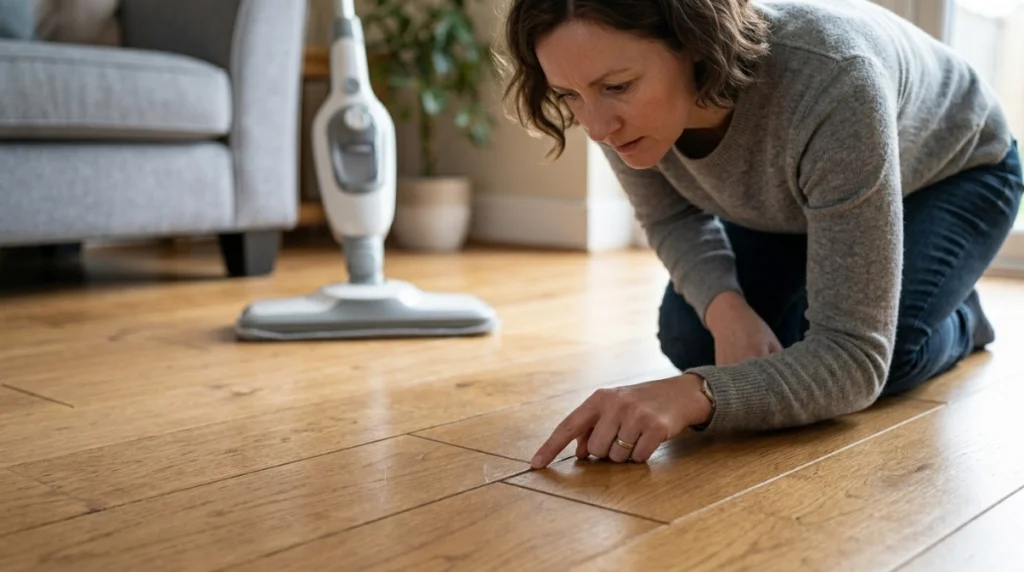
Don’t panic if you’ve steam mopped the floor once and it still looks normal. Stop using the steam mop and inspect the floor carefully before your next cleaning.
Watch for warning signs
- Raised or curled plank edges
- Swelling around seams
- Cloudy or whitish finish
- New gaps between boards
- Bubbling or peeling surface layers
- Soft areas underfoot
- Boards that suddenly move or sound different
If the floor still looks normal
Switch to dry cleaning and low-moisture microfiber cleaning. Avoid trying another steam session just to see whether damage develops.
Keep an eye on the areas you cleaned most slowly. Doorways, kitchens, worn traffic paths, and damaged seams deserve extra attention.
If you notice swelling or distortion
Stop adding moisture and check the flooring manufacturer’s warranty or care documentation. Significant buckling, delamination, or widespread movement deserves an assessment from a qualified flooring professional.
Don’t try to flatten swollen boards with more heat. That can make an existing moisture problem harder to diagnose.
Safety note: Moisture trapped beneath flooring can involve the subfloor as well as the visible planks, so widespread or persistent damage shouldn’t be treated as a surface-cleaning problem.
Frequently Asked Questions
Can I use a steam mop on engineered hardwood once a month?
It’s better to avoid routine steam mopping unless your exact flooring manufacturer specifically approves it. Even monthly exposure introduces heat and moisture that can reach seams and damaged areas, while a damp microfiber mop provides safer moisture control.
Can you steam mop sealed engineered hardwood floors?
A sealed surface isn’t automatic permission to steam mop. Seams, scratches, worn finish, and plank edges can still admit moisture, so check the manufacturer’s care guide rather than relying only on the word “sealed.”
What is the best mop for engineered hardwood floors?
A flat microfiber mop or microfiber spray mop is usually the safest practical choice. Use it dry for dust or barely damp with a manufacturer-approved wood-floor cleaner when deeper cleaning is necessary.
Can a Shark or Bissell steam mop be used on engineered hardwood?
The steam mop brand doesn’t determine whether your floor can tolerate steam. Follow the engineered hardwood manufacturer’s care instructions first, even if the mop itself lists sealed hard floors among its possible uses.
Will steam ruin engineered hardwood immediately?
Not necessarily. Some damage can develop gradually after repeated exposure, especially around seams, worn finishes, scratches, and areas where the mop pauses and applies more heat or moisture.
What should I use instead of a steam mop?
Start with a vacuum or dry microfiber mop, then use a barely damp microfiber pad and an approved hardwood cleaner when needed. Wipe spills promptly and avoid leaving standing water on the floor.
Is engineered hardwood more water-resistant than solid hardwood?
Its layered construction can provide better dimensional stability under normal environmental changes, but engineered hardwood is still a wood product. Better stability doesn’t mean unlimited water resistance or automatic compatibility with steam cleaning.
Final Takeaway
Steam mops are generally not a safe choice for engineered hardwood floors. The combination of heat and moisture creates an unnecessary risk when gentler cleaning methods work well.
Use a dry or barely damp microfiber mop, choose a cleaner approved for your floor, and keep liquid away from seams. Most importantly, follow the care instructions for your exact engineered hardwood product.
If the manual doesn’t specifically approve steam, I would skip it. Protecting the finish and layered construction is more valuable than saving a few minutes during cleaning.
