
Are Steam Mops Safe for Hardwood Floors?

Quick Answer
In most cases, steam mops are not safe for hardwood floors. Hot vapor and moisture can reach seams, small finish gaps, and exposed wood, increasing the risk of swelling, cupping, finish damage, or discoloration over time. The National Wood Flooring Association’s wood-floor maintenance guidance recommends avoiding both wet mops and steam mops.
What matters most
- Solid hardwood: Avoid steam because heat and moisture can affect both the finish and wood.
- Engineered hardwood: Don’t assume its layered construction makes steam safe.
- Sealed floors: A surface finish doesn’t guarantee every seam and joint is moisture-proof.
- Unknown flooring: Skip steam until you identify the floor and read its care instructions.
- Safer option: Use a clean microfiber mop with a manufacturer-approved wood-floor cleaner.
My practical rule
- If the flooring manufacturer doesn’t clearly approve steam cleaning, I treat that as a reason not to use it.
If you’re wondering whether steam mops are safe for hardwood floors, you’re probably trying to get a deeper clean without damaging an expensive surface.
I’ve tested enough floor-cleaning routines to know that hardwood rewards restraint. In this guide, I’ll explain why steam creates risk, which wood floors are most vulnerable, and what I use instead.
In This Guide
- Are Steam Mops Safe for Hardwood Floors?
- Why Can Steam Damage Hardwood Floors?
- Can You Steam Mop Sealed Hardwood Floors?
- Which Hardwood Floors Are Most at Risk?
- What If a Steam Mop Says It Is Safe for Hardwood?
- What Is the Safest Way to Mop Hardwood Floors?
- Steam Mop vs Microfiber Mop for Hardwood
- What Should You Do If You Already Steam Mopped Hardwood?
- Frequently Asked Questions
Are Steam Mops Safe for Hardwood Floors?
For most hardwood floors, no. A steam mop combines heat with moisture, while wood flooring generally performs best when you keep moisture exposure controlled.
A steam mop is a powered floor cleaner that heats water and releases vapor through a cleaning pad. That vapor helps loosen grime on surfaces that tolerate heat and water well.
Hardwood is different. The visible finish may resist small spills, but the entire floor isn’t a single waterproof sheet.
Why the top finish isn’t the whole story
Wood floors contain seams between boards. They may also have tiny scratches, worn finish areas, perimeter gaps, or joints where moisture can move below the surface.
Steam can reach those vulnerable areas more easily than a carefully controlled damp microfiber pad.
- Surface finish: Repeated heat and moisture can stress some coatings.
- Board seams: Vapor can move into spaces where liquid would normally be avoided.
- Exposed wood: Scratches and worn spots provide less protection.
- Wood movement: Moisture absorption can make wood fibers expand.
The Consumer Reports guidance on steam mops and wood flooring also recommends avoiding this method because moisture and temperature changes can damage wood.
Safety note: Always check the flooring manufacturer’s care guide before applying heat, water, cleaner, polish, or any powered cleaning method.
Why Can Steam Damage Hardwood Floors?
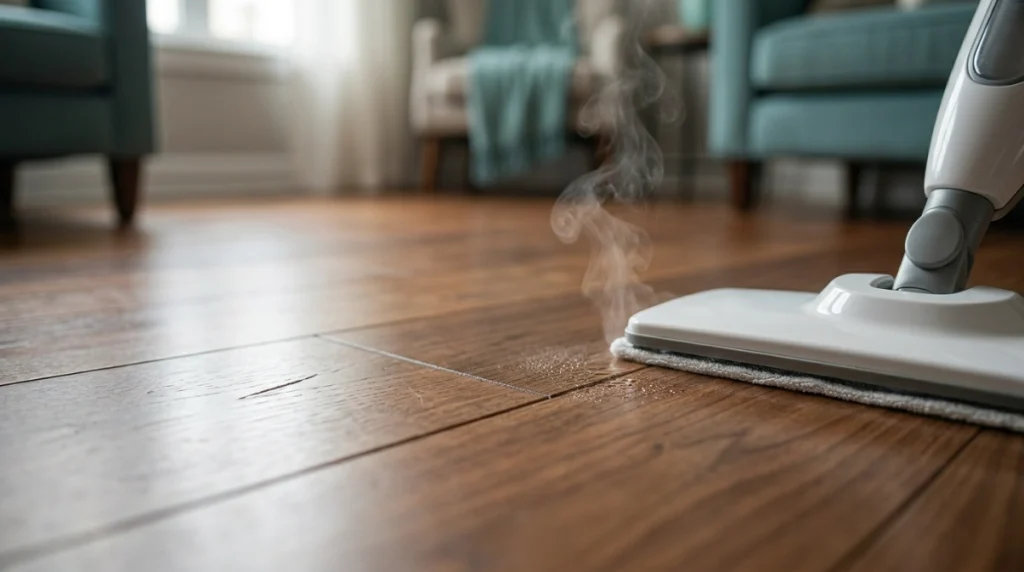
Steam presents two problems at once: heat and moisture. The combination is harder to control than the light moisture applied by a spray or microfiber mop.
The risk also builds over time. A floor may look perfectly normal after one cleaning yet develop problems after repeated exposure.
Moisture can enter seams and scratches
Finished hardwood resists ordinary surface moisture, but resistance isn’t the same as being completely waterproof.
Water vapor can reach joints, scratches, damaged finish areas, and exposed board edges. Once wood absorbs moisture, it can change dimension.
- Cupping: Board edges may become higher than their centers.
- Swelling: Moisture can make boards or wood fibers expand.
- Gaps after drying: Repeated expansion and contraction can affect board spacing.
- Finish changes: Some floors may become dull, cloudy, or discolored.
Heat adds another variable
A regular microfiber mop doesn’t intentionally heat the flooring. Steam cleaning does.
That difference matters because the floor’s finish, adhesive system, wood layers, and joints may not have been designed for repeated steam exposure.
The damage may not show immediately
This is one reason people receive conflicting advice. Someone may steam mop a floor several times and see no obvious problem.
That doesn’t prove the cleaning method is harmless. Flooring guidance usually focuses on protecting the floor across years of routine cleaning.
I’ve found that this distinction matters when testing cleaning routines. The safest method isn’t simply the one that leaves the floor looking clean today; it’s the one that removes soil while exposing the floor to the least unnecessary moisture.
Section Takeaway: Steam can expose hardwood to heat and moisture at seams, scratches, and worn areas. Repeated exposure is the bigger concern, even when one cleaning appears harmless.
Can You Steam Mop Sealed Hardwood Floors?
I still wouldn’t use a steam mop simply because the hardwood is sealed. A sealed surface doesn’t mean every part of the installed floor is sealed against hot vapor.
Most modern finished hardwood has a protective coating. That coating helps resist spills, stains, and ordinary cleaning moisture.
Sealed does not mean waterproof
The finish mainly protects the exposed face of each board. Seams, board edges, damaged areas, and scratches may have much less protection.
Even a strong finish can become worn in doorways, kitchens, hallways, and other high-traffic areas.
Prefinished hardwood still has joints
Factory-finished boards can have durable surface coatings. However, each installed plank still meets another plank at a joint.
Those joints are exactly where I want the least moisture possible during routine cleaning.
Bona’s hardwood floor care guidance advises avoiding steam cleaners and recommends floor-specific cleaning methods instead.
Safety note: Never assume that “sealed,” “finished,” or “prefinished” automatically means steam-safe. Follow the care instructions for your exact flooring product.
Which Hardwood Floors Are Most at Risk?
Unsealed, damaged, older, and engineered wood floors deserve especially cautious cleaning. I wouldn’t use steam on any of them unless the flooring manufacturer explicitly instructs otherwise.
Unsealed or unfinished hardwood
Unsealed wood lacks the protective surface coating found on finished flooring. Moisture can enter the wood much more easily.
For this floor type, steam cleaning is an unnecessary risk.
Older hardwood floors
An older floor may have worn finish, open joints, repairs, scratches, or small gaps that aren’t obvious until you’re close to the surface.
These imperfections give moisture more ways to reach the wood.
Engineered hardwood
Engineered hardwood uses a real-wood surface layer over a layered core. That construction improves dimensional stability, but it doesn’t automatically make the floor steam-safe.
Bruce recommends a microfiber mop and pH-balanced hardwood cleaner for engineered wood while advising against steam cleaners in its engineered hardwood cleaning guidance.
Floors with scratches or failing finish
A scratch that reaches through the protective coating creates a weak point. Peeling, flaking, cloudy, or worn finish areas deserve the same caution.
Use minimal moisture until you know whether the floor needs professional repair or recoating.
What If a Steam Mop Says It Is Safe for Hardwood?
The flooring manufacturer’s instructions matter more than a mop’s broad surface claim. Compatibility involves both products, not only the cleaning machine.
A steam-mop package may refer to “sealed hard floors” or similar surfaces. Your particular hardwood manufacturer may still prohibit steam.
Check both manuals before cleaning
I use a simple order when deciding whether an unfamiliar cleaning method belongs on a floor:
- Identify the exact flooring. Confirm whether it’s solid hardwood, engineered hardwood, laminate, LVP, or something else.
- Read the flooring warranty. Search specifically for steam, wet mopping, excess moisture, and approved cleaners.
- Check the mop instructions. See which floor types the machine actually supports.
- Follow the stricter rule. If the two instructions conflict, protect the flooring.
Shaw’s hardwood floor care guidance, for example, specifically says not to use wet or steam mops.
This check is worth doing before experimenting. Flooring costs far more to repair than a cleaning tool costs to replace.
What Is the Safest Way to Mop Hardwood Floors?
Use a microfiber mop with tightly controlled moisture and a cleaner approved for your floor. You usually don’t need steam to keep hardwood clean.
My preferred routine starts dry and adds only enough liquid to remove soil that dry cleaning couldn’t pick up.
Step 1: Remove loose grit first
Dust and tiny particles can scratch the finish when dragged underneath a wet mop pad.
- Use a microfiber dust mop.
- Use a soft-bristle broom.
- Or vacuum with a bare-floor setting recommended for wood.
Step 2: Use a clean microfiber pad
Microfiber gives you much better moisture control than a saturated string mop. It also lets you replace a dirty pad instead of pushing the same grime around the room.
If the pad becomes loaded with dirt, switch to a clean one.
Step 3: Apply cleaner sparingly
Use a product designed for your floor’s finish. Spray a manageable area rather than flooding the entire room.
The floor should look lightly damp during cleaning, not covered with puddles.
Step 4: Wipe spills promptly
Don’t let liquid sit at seams or along board edges. A clean absorbent cloth works well for isolated spills.
Step 5: Let the floor dry before heavy traffic
Keep people and pets off damp sections when practical. This reduces footprints and keeps new soil from sticking to the surface.
If you’re choosing a cleaning product, the EPA’s Safer Choice product database can also help you identify cleaners that meet its ingredient-safety criteria.
Safety note: A cleaner can be appropriate from an ingredient perspective but still be wrong for a specific floor finish. Your flooring manufacturer’s approved-product guidance comes first.
Section Takeaway: Dry-clean first, then use a lightly damp microfiber mop and an approved wood-floor cleaner. Good moisture control matters more than aggressive scrubbing.
Steam Mop vs Microfiber Mop for Hardwood
For hardwood, I choose a microfiber mop. It gives you direct control over how much moisture reaches the floor and doesn’t intentionally expose the surface to steam.
| Cleaning Method | Heat Applied | Moisture Control | Main Hardwood Concern | My Choice for Hardwood |
|---|---|---|---|---|
| Steam mop | Yes | Machine releases vapor continuously while operating | Heat and moisture reaching seams or exposed wood | Avoid |
| Microfiber spray mop | No | High; cleaner can be applied in small amounts | Over-spraying or using the wrong cleaner | Preferred |
| Damp flat microfiber mop | No | High when the pad is wrung nearly dry | Using a pad that’s too wet | Good option |
| Traditional wet/string mop | No | Lower; head can retain substantial water | Excess surface water | Usually avoid |
That doesn’t mean steam mops are bad cleaning tools. They’re simply better matched to surfaces whose manufacturers allow steam cleaning.
Hardwood needs a different strategy: less water, less heat, and more control.
What Should You Do If You Already Steam Mopped Hardwood?

Don’t panic after one use. Stop using the steam mop, let the floor dry naturally, and inspect it carefully.
One cleaning doesn’t guarantee damage occurred. The next step is observation rather than adding more water or attempting a DIY repair immediately.
Check for these warning signs
- Raised board edges: Look across the floor from a low angle.
- New gaps: Compare joints with areas that weren’t steam cleaned.
- Cloudiness: Check whether the finish changed after drying.
- Discoloration: Look around seams and previously scratched areas.
- Loose or lifted boards: Pay attention to movement underfoot.
If the floor looks normal
Switch to the manufacturer-approved cleaning method going forward. Avoid repeating steam cleaning just because no immediate problem appeared.
If you see visible changes
Don’t sand, polish, soak, or apply a strong cleaner as an automatic fix. Those steps can make diagnosis harder.
Document the affected area with photos and contact the flooring manufacturer, installer, or a qualified wood-floor professional.
Safety note: If boards have lifted or created an uneven walking surface, keep the area clear until the flooring can be inspected.
Frequently Asked Questions
Can I use a steam mop on hardwood if I use the lowest steam setting?
A lower setting may reduce steam output, but it doesn’t remove the basic heat-and-moisture concern. Unless your exact flooring manufacturer approves steam cleaning, a damp microfiber mop remains the safer choice.
Can you steam mop polyurethane-sealed hardwood floors?
A polyurethane finish protects the surface but doesn’t make board seams, scratches, and worn areas completely waterproof. Because moisture can still reach vulnerable areas, major wood-floor care guidance generally recommends avoiding steam.
Are steam mops safe for engineered hardwood?
Don’t assume they are. Engineered hardwood has a layered construction, and both moisture and heat may affect the finish, joints, or core. Follow the care guide for your exact product rather than relying on a general steam-mop claim.
What mop is best for hardwood floors?
A flat microfiber or microfiber spray mop is usually the safest practical choice. It gives you good dirt pickup while letting you limit liquid to a light mist or slightly damp pad.
Can steam mops make hardwood floors cloudy?
They can contribute to finish problems on susceptible floors, although cloudiness may also come from cleaner residue, wax, polish buildup, wear, or moisture beneath the finish. Stop experimenting with products until you identify the cause.
How do I know whether my hardwood is sealed?
Check installation records, product documentation, or the flooring manufacturer’s information first. Don’t rely on a water test in a visible area because deliberately exposing an unknown wood finish to moisture can create unnecessary risk.
What floors are better suited to a steam mop?
Some ceramic and porcelain tile surfaces can tolerate steam better than wood, but suitability still depends on the flooring, grout, adhesives, and steam-mop instructions. Always verify the care guidance for the exact surface before cleaning.
The Bottom Line
So, are steam mops safe for hardwood floors? For most hardwood flooring, the safest answer is no.
The potential cleaning benefit isn’t worth adding unnecessary heat and moisture when a microfiber mop can handle routine hardwood cleaning with much tighter control.
As of 2026, my rule remains simple: dry-clean first, use minimal moisture, choose a wood-floor-approved cleaner, and follow the flooring manufacturer’s care instructions.
If your manual doesn’t clearly say steam is allowed, keep the steam mop for a surface that’s designed to handle it.
