
Are Steam Mops Safe for Laminate Floors? What You Need to Know

Quick Answer
Steam mops are not safe for most laminate floors. Heat and moisture can enter the plank joints and damage the fiberboard core, edges, finish, or locking system. Some newer waterproof laminate products specifically allow steam cleaning, but you should use steam only when your exact flooring manufacturer says it is permitted in the laminate care instructions.
What to remember
- Default answer: Avoid steam unless the flooring manufacturer specifically approves it.
- Biggest risk: Steam can force heat and moisture into laminate seams and edges.
- Waterproof exception: Some waterproof laminate collections are designed and warranted for steam mopping.
- Safer choice: Use a microfiber flat mop that is damp rather than wet.
- Check first: Read the care guide and warranty for your exact laminate product.
Simple rule
- If the manual does not clearly say “steam mop safe,” keep the steam mop off the floor.
Laminate can look tough enough for almost any cleaning method. Its biggest weakness, however, is often moisture getting through the joints.
My rule for laminate floor cleaning is simple: use the least moisture that gets the floor clean. That usually means a vacuum or dry microfiber mop followed by a lightly damp microfiber pad.
In This Guide
- Why Can Steam Mops Damage Laminate Flooring?
- Are Any Laminate Floors Safe for Steam Mops?
- How Do You Know If Your Laminate Can Be Steam Cleaned?
- What Type of Mop Is Safest for Laminate Floors?
- How Should You Clean Laminate Floors Without Steam?
- What Should You Do If You Already Used a Steam Mop?
- How Can You Sanitize Laminate Without a Steam Mop?
- What Other Cleaning Mistakes Damage Laminate?
- Frequently Asked Questions
Why Can Steam Mops Damage Laminate Flooring?
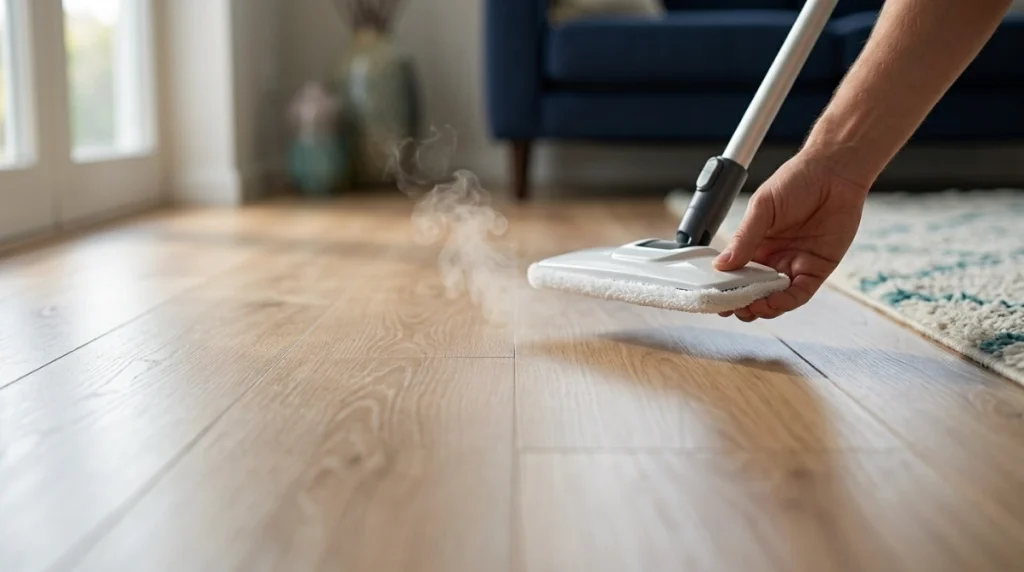
Steam mops combine two things laminate flooring may dislike: high heat and concentrated moisture. The steam can reach tiny gaps where an ordinary damp microfiber pad usually cannot.
Definition: A steam mop is an electric floor-cleaning tool that heats water and sends hot vapor through a cleaning pad.
Laminate has a moisture-sensitive core
Most laminate is built from several bonded layers. Beneath the wear and decorative layers is commonly a wood-fiber-based core.
If enough moisture reaches that core, the edges can swell. The damage may remain even after the floor dries.
- Edge swelling: Plank edges may become raised or uneven.
- Joint damage: Repeated moisture can affect click-lock connections.
- Peaking: Adjacent boards can push upward around their seams.
- Surface changes: Excess heat may affect some finishes or protective layers.
- Delamination: Severe moisture exposure can contribute to layers separating.
Steam can reach the seams quickly
The visible surface may appear dry soon after steaming. That does not tell you how much moisture reached a joint or damaged edge.
This is why the risk is different from wiping a spill with a damp cloth.
Consumer Reports’ steam-mop guidance also recommends avoiding steam on laminate because heat can damage its materials.
Safety note: Always check the care and warranty instructions for your exact laminate before introducing steam, water, or a new cleaning chemical.
Are Any Laminate Floors Safe for Steam Mops?
Yes. A limited number of modern laminate products are specifically designed and warranted for steam mopping.
That exception is important because it means “never steam laminate” is slightly too broad. The manufacturer’s written instructions should decide the issue.
Waterproof does not automatically mean steam-safe
A waterproof claim tells you how a flooring system handles water under stated conditions. It does not automatically approve high-temperature steam.
Look for language that specifically mentions steam cleaning or steam mopping.
For example, Mohawk currently identifies steam-mopping compatibility on certain RevWood products. Its broader floor cleaning and care guidance also shows why checking the individual product matters.
- Good evidence: Your product care guide says steam mopping is allowed.
- Good evidence: Your warranty explicitly covers approved steam cleaning.
- Not enough: The package says only “water-resistant.”
- Not enough: The steam mop says it works on sealed hard floors.
- Not enough: A different laminate product from the same brand allows steam.
A steam mop maker cannot override the care requirements for your floor. When the two instructions differ, protect the flooring warranty first.
Safety note: Never assume that waterproof, water-resistant, or sealed laminate is steam-safe without written manufacturer approval.
How Do You Know If Your Laminate Can Be Steam Cleaned?
Find the manufacturer and exact flooring collection before using steam. This is more reliable than judging the floor by appearance.
Check these five places
- Flooring care guide: Look for “steam mop,” “steam cleaner,” or “wet cleaning.”
- Warranty: Search for exclusions involving water, excessive moisture, or steam.
- Product page: Confirm that your exact collection has steam-cleaning approval.
- Installation paperwork: Some manufacturers include maintenance limits with installation instructions.
- Manufacturer support: Ask the company when the written instructions remain unclear.
What if you do not know the flooring brand?
Treat unidentified laminate as not steam-safe. A microfiber mop is much less risky while you identify the product.
Check leftover flooring boxes, renovation receipts, installer paperwork, or information from the previous homeowner.
Do not rely on the fact that the floor has survived steam before. Moisture damage may build after repeated cleaning.
Safety note: Test any approved cleaning method in an inconspicuous area before using it across the entire floor.
What Type of Mop Is Safest for Laminate Floors?
A microfiber flat mop is usually the safest everyday choice. It cleans with less water than a traditional string mop and gives you better moisture control.
| Mop Type | Moisture Level | Laminate Suitability | Main Concern |
|---|---|---|---|
| Dry microfiber mop | None | Excellent for dust | Won’t remove sticky soil alone |
| Damp microfiber flat mop | Low | Best general choice | Pad must not be soaking wet |
| Spray mop | Low to moderate | Depends on floor guidance | Easy to overspray seams |
| Spin mop | Adjustable | Use only well wrung | Can leave too much water |
| String mop | High | Usually poor choice | Difficult moisture control |
| Steam mop | Hot vapor | Only if explicitly approved | Heat and moisture at seams |
Why microfiber works so well
Microfiber uses fine synthetic fibers to collect dust and lift light soil. You can clean effectively without flooding the surface.
Replace or rinse the pad when it becomes dirty. A loaded pad can spread grime and leave streaks.
How Should You Clean Laminate Floors Without Steam?
The safest routine uses dry soil removal first and minimal liquid second. You should never need puddles of water.
Use this simple cleaning routine
- Vacuum or sweep first. Remove grit that could scratch the wear layer.
- Prepare the cleaner. Use a laminate-approved or manufacturer-recommended product.
- Dampen the microfiber pad. It should feel damp, not drip when squeezed.
- Mop small sections. Avoid leaving liquid sitting along plank joints.
- Deal with spots separately. Wipe sticky marks with a soft cloth rather than soaking the whole area.
- Let the floor dry. Improve airflow if moisture remains visible after cleaning.
How much water should you use?
There is no universal water quantity because mop pads and flooring systems differ. The useful rule is to keep the floor lightly damp and free of standing water.
If you can see beads, puddles, or wet seams, reduce the amount of liquid.
Should you use vinegar?
Don’t assume homemade vinegar mixtures are safe for every laminate finish. Acidity and dilution requirements vary by manufacturer.
A pH-neutral floor cleaner approved for your flooring is easier to control. Follow its label rather than making the mixture stronger.
Safety note: Never mix household cleaning chemicals. Check both the flooring care guide and cleaner label before applying any solution.
What Should You Do If You Already Used a Steam Mop?
One steam-cleaning session does not guarantee that your laminate is ruined. Stop using steam and inspect the floor before cleaning it again.
Look for these warning signs
- Raised edges: Seams feel higher than the center of each plank.
- Peaking: Two adjoining planks push upward where they meet.
- Gaps: Previously tight joints begin separating.
- Bubbling: The visible surface develops small raised areas.
- Color change: Edges become darker or show moisture-related staining.
- Soft areas: A plank feels different or unstable underfoot.
If the floor still looks normal, allow it to dry fully and switch to the manufacturer’s recommended cleaning method. Keep watching seams over the following days.
Do not try to dry it with more heat
A hair dryer, space heater, or concentrated hot air can create another heat problem. Normal room ventilation is safer.
For obvious swelling or widespread changes, contact the flooring manufacturer or a qualified flooring professional. Severe core swelling usually cannot be reversed by surface cleaning.
Safety note: Photograph visible damage before attempting repairs, especially when the flooring may still have warranty coverage.
How Can You Sanitize Laminate Without a Steam Mop?
Routine household floors usually need proper cleaning more often than aggressive disinfection. Steam is not automatically required to keep laminate hygienic.
The CDC’s home-cleaning guidance notes that routine cleaning is enough in many situations. When disinfection is necessary, the product must also be suitable for the surface.
Use a floor-compatible product
Start with the cleaner recommended by your laminate manufacturer. If you need a different household cleaner, check whether its label lists your flooring type.
The EPA maintains a searchable list of Safer Choice-certified cleaning products, including floor-care products.
- Clean first: Remove dust, food, grease, and visible soil.
- Read the label: Confirm the product can be used on laminate.
- Use little liquid: Avoid saturating plank joints.
- Follow contact directions: If disinfecting, use the product exactly as labeled.
- Ventilate: Follow any ventilation instructions on the cleaning product.
Do not add disinfectant, vinegar, bleach, essential oils, or detergent to a steam mop unless its manufacturer specifically permits that product.
Safety note: A disinfectant can be effective against germs yet still be unsuitable for your flooring. Surface compatibility and label directions both matter.
What Other Cleaning Mistakes Damage Laminate?
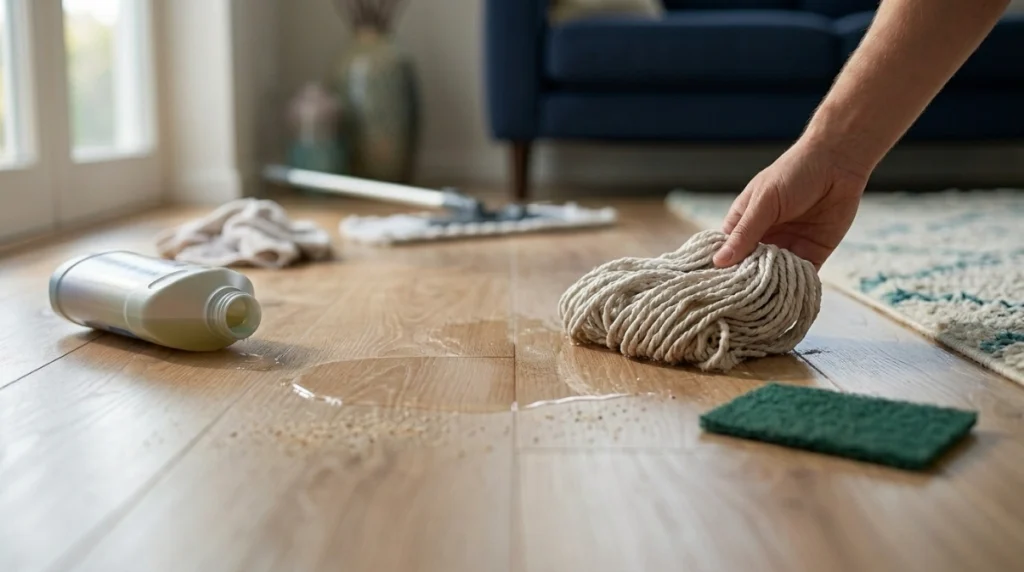
Steam is only one possible source of damage. Excess water and abrasive cleaning habits can create similar problems.
Avoid these common mistakes
- Wet mopping: A saturated mop can push water between plank joints.
- Leaving spills: Wipe liquid promptly instead of allowing it to soak into seams.
- Using abrasive pads: Rough scrubbers can dull or scratch the wear layer.
- Applying too much cleaner: Excess product can leave sticky residue and streaks.
- Pouring cleaner on the floor: Apply it according to the care instructions instead.
- Using unknown chemicals: Strong acids, alkalis, waxes, or polishes may affect the finish.
- Ignoring grit: Sand and small stones can scratch when dragged under a mop pad.
More cleaning power is not always better
Laminate usually responds better to frequent light cleaning than occasional aggressive washing. Remove grit regularly and spot-clean spills before they dry.
This approach reduces the amount of water and cleaner needed during each mopping session.
Safety note: Flooring finishes differ. Follow your manufacturer’s approved cleaner list before using concentrated, homemade, or specialty products.
Frequently Asked Questions
Can I use a steam mop on waterproof laminate flooring?
Only if the manufacturer specifically says that your exact waterproof laminate is steam-mop safe. Waterproof labeling alone does not prove that the floor can tolerate steam, heat, or repeated vapor around the joints.
Can I use a Shark steam mop on laminate floors?
Check the laminate manufacturer’s instructions before the steam mop’s general floor list. If the flooring company prohibits steam, do not use a Shark or any other steam-mop brand on that floor.
Can I use a Bissell steam mop on laminate floors?
The same rule applies to Bissell steam mops. Use one only when the care guide for your exact laminate product explicitly permits steam cleaning.
What is the best mop for laminate floors?
A microfiber flat mop is usually the safest all-purpose option. Use it dry for dust or lightly damp with a manufacturer-approved cleaner when the floor needs deeper cleaning.
Will one use of a steam mop ruin laminate?
Not necessarily. Damage depends on the flooring construction, joint condition, steam exposure, and whether that particular laminate was designed for steam cleaning.
Stop steaming and inspect the joints for swelling, gaps, peaking, or bubbling.
How often should laminate floors be mopped?
Mop when visible soil or sticky residue requires it rather than soaking the floor on a rigid schedule. Vacuuming, sweeping, and dry microfiber cleaning between damp mopping sessions can reduce moisture exposure.
Is a spray mop safe for laminate flooring?
A spray mop can be suitable when your manufacturer permits damp cleaning and you use very little solution. Spray lightly onto the cleaning pad or as directed, and avoid saturating plank seams.
Bottom line: For most laminate floors, a steam mop creates more moisture and heat than you need. A lightly damp microfiber mop gives you much better control.
Before changing your cleaning routine, find the care guide for your exact floor. If that guide does not clearly approve steam mopping, choose the safer non-steam method.
