
Are Steam Mops Safe for LVP Flooring? What You Need to Know

Quick Answer
Steam mops are usually not safe for LVP flooring because concentrated heat and moisture can reach seams, edges, adhesives, and layers below the wear surface. The safest rule is to avoid steam unless your exact flooring manufacturer specifically approves it in the care instructions, a position reflected in COREtec’s LVP cleaning guidance.
What to do instead
- Check the care guide: Look up your exact LVP brand, collection, and product before using steam.
- Use microfiber: A flat microfiber or spray mop gives you better moisture control.
- Keep it damp: Clean with a lightly damp pad instead of soaking the floor.
- Choose pH-neutral cleaner: Use a product approved for vinyl flooring when water alone is not enough.
- Clean spills quickly: Blot liquid before it can sit around plank edges or seams.
The key rule
- Being labeled waterproof does not automatically mean an LVP floor is approved for repeated steam cleaning.
If you’re wondering, are steam mops safe for LVP flooring, you’re asking the right question before starting your floor cleaning routine. Luxury vinyl plank is durable, but the wrong mop can expose it to more heat and moisture than its care instructions allow.
I’ve found that LVP usually responds best to simple cleaning. In this guide, I’ll explain the steam risk, the exceptions, safer mop choices, and the routine I prefer for keeping vinyl clean without flooding it.
In This Guide
- What Is LVP Flooring?
- Are Steam Mops Safe for LVP Flooring?
- How Can Steam Damage LVP?
- Does Waterproof LVP Mean It Is Steam-Proof?
- Are Any LVP Floors Safe for Steam Mops?
- What Mop Should You Use on LVP Instead?
- How Should You Clean LVP Flooring Safely?
- How Can You Tell If Steam Damaged Your LVP?
- Frequently Asked Questions
- Final Takeaway
What Is LVP Flooring?
LVP, or luxury vinyl plank, is a resilient floor covering made to resemble individual wood planks. Depending on the product, its construction can include a protective wear layer, printed design layer, vinyl layers, and a rigid or flexible core.
You may also see terms such as SPC and WPC. SPC generally refers to a rigid solid-polymer or stone-composite style core, while WPC refers to a thicker foamed composite core.
Why LVP needs a different cleaning approach
The visible surface can handle normal household spills well, but cleaning involves more than the top surface. Plank joints, perimeter gaps, attached layers, and glue-down installations can react differently to moisture and heat.
That is why a cleaner being safe for ceramic tile does not make it safe for vinyl plank. The flooring material and installation method both matter.
- Click-lock LVP: Water and vapor can reach plank joints if cleaning is too wet.
- Glue-down LVP: Heat and excessive moisture may affect the adhesive system.
- Rigid-core LVP: A waterproof core still does not automatically make every component steam-safe.
- Attached-pad products: Care requirements can vary by manufacturer and collection.
The manufacturer’s care guide should always take priority over a general cleaning tip.
Are Steam Mops Safe for LVP Flooring?
Usually, no. Unless your flooring documentation specifically says steam cleaning is allowed, I would keep a steam mop off LVP.
A steam mop produces hot vapor at the floor surface. That combination differs from wiping the same floor with a lightly damp microfiber pad.
Why I use a conservative rule with vinyl plank
When I’m choosing a method for a moisture-sensitive floor, I look at what happens at the seams rather than only the center of a plank. That’s where aggressive wet cleaning can become harder to control.
Steam can move into tiny joints and around edges. Repeating that process can create unnecessary risk when a damp microfiber mop already handles normal soil well.
- Heat: Vinyl layers, finishes, and installation materials may have temperature limits.
- Vapor: Steam can enter small openings that a lightly damp pad may not reach.
- Repeated exposure: A method that appears harmless once may still conflict with long-term care requirements.
- Warranty conditions: Using an unapproved cleaning method can complicate a future flooring claim.
Shaw’s vinyl floor care guidance recommends suitable vinyl-cleaning methods and warns against excessive moisture and incompatible products.
Safety note: Before using heat, chemicals, disinfectants, or a new cleaning machine, check the care guide and warranty for your exact flooring product.
Section Takeaway: Treat steam as an exception that requires explicit manufacturer approval, not as a standard LVP cleaning method.
How Can Steam Damage LVP?

Steam-related problems can involve more than visible discoloration. The concern is how heat and moisture interact with plank edges, joints, layers, and installation materials.
Heat can affect vulnerable materials
LVP is designed for daily household use, but that does not mean every product is designed for repeated steam exposure. Concentrated heat can stress components that perform normally at ordinary room temperatures.
Glue-down floors deserve particular caution. The adhesive is part of the flooring system, so care instructions for that installation matter.
Moisture can enter seams
Steam starts as vapor and then condenses back into water as it cools. That moisture may collect around plank joints, edges, transitions, or damaged areas.
One pass will not guarantee damage. The problem is that unnecessary exposure adds risk without giving most households a cleaning benefit they cannot get another way.
Damage may not appear immediately
Some problems appear gradually. That makes it easy to assume a cleaning method is safe because nothing happened during the first few uses.
- Edges may begin lifting or curling.
- Planks may develop movement around joints.
- Glue-down areas may start releasing.
- The surface may become dull or uneven.
- Moisture may remain where you cannot see it.
A low-moisture routine removes this variable from normal floor care.
Does Waterproof LVP Mean It Is Steam-Proof?
No. Waterproof and steam-approved describe different things. A waterproof LVP product can resist normal water exposure while still carrying restrictions on steam cleaning.
This distinction causes a lot of confusion because marketing often highlights waterproof construction. That feature is useful, but it does not override the care guide.
Think about the whole flooring system
The plank itself is only one part of the installation. Seams, edges, transitions, underlayment, adhesives, and the subfloor can also affect how a finished floor responds to moisture.
Even highly water-resistant flooring should still be cleaned according to its manufacturer instructions.
| Cleaning Method | Moisture Level | Typical LVP Use | Main Concern |
|---|---|---|---|
| Steam mop | Hot vapor | Only when specifically manufacturer-approved | Heat and vapor at seams or layers |
| Microfiber spray mop | Low | Excellent for routine cleaning | Avoid over-spraying cleaner |
| Well-wrung spin mop | Low to moderate | Usable when kept only damp | Easy to use too much water |
| Traditional wet string mop | High | Usually not my first choice | Oversaturation and dirty water |
Are Any LVP Floors Safe for Steam Mops?
Yes, a limited number of flooring products are specifically approved for steam cleaning. This is why checking the exact collection matters more than following a blanket rule.
For example, COREtec identifies specific Scratchless styles as steam-mop approved while stating that styles from other collections are not covered by that approval.
How to check your own floor
- Find the manufacturer name. Check purchase records, leftover boxes, or installation paperwork.
- Identify the collection and style. Do not rely only on the broad brand name.
- Open the current care guide. Search for “steam,” “steam mop,” or “steam cleaner.”
- Read the warranty language. Care restrictions may appear there even when marketing pages are vague.
- Follow any stated limits. An approved floor may still have instructions about settings or cleaning technique.
If you cannot identify the product, I would default to a microfiber mop. It is the lower-risk choice.
What Mop Should You Use on LVP Instead?
A microfiber flat mop or spray mop is usually the most practical LVP choice. It cleans with controlled moisture and gives you direct control over where the cleaner goes.
Bona’s LVP cleaning guidance also recommends microfiber or spray-mop cleaning for routine vinyl care.
Microfiber flat mop
- Picks up fine dust and hair.
- Uses little water.
- Reaches under furniture easily.
- Lets you swap dirty pads quickly.
- Works well for both dry and damp cleaning.
Spray mop
- Applies a small amount of liquid at a time.
- Helps avoid soaking plank joints.
- Works well for kitchens and high-traffic areas.
- Makes quick spot cleaning easier.
Spin mop
A spin mop can work when you wring it thoroughly. The head should feel damp rather than dripping when it touches LVP.
I prefer microfiber for routine cleaning because controlling water is simpler.
How Should You Clean LVP Flooring Safely?
Start dry, use minimal liquid, and remove residue rather than flooding the floor. This routine works for ordinary dust, footprints, kitchen soil, and most everyday messes.
1. Remove loose dirt first
Vacuum with a hard-floor setting, sweep gently, or use a dry microfiber pad. Removing grit first prevents your wet mop from dragging abrasive particles across the wear layer.
2. Check for sticky spots
Look for dried food, pet marks, and spills before mopping the whole room. Spot cleaning keeps you from using extra solution everywhere.
3. Choose a suitable cleaner
Use a cleaner approved for your flooring or a manufacturer-recommended pH-neutral product. A pH-neutral cleaner is formulated close to neutral rather than strongly acidic or alkaline.
If you prefer products screened for ingredient safety characteristics, the EPA maintains its Safer Choice program. Floor compatibility still needs to be checked separately.
Safety note: Never assume vinegar, bleach, ammonia, detergent, disinfectant, essential oil, or another homemade mixture is safe for your specific LVP. Check the flooring guide and cleaner label first, and never mix cleaning chemicals.
4. Apply as little liquid as you need
- Lightly mist a small section if using a spray mop.
- Keep a bucket mop thoroughly wrung out.
- Avoid visible puddles.
- Do not pour cleaner directly across the floor.
- Pay extra attention around joints and perimeter edges.
5. Mop in manageable sections
Work across one small area before moving forward. If the pad becomes visibly dirty, rinse it or replace it instead of spreading the soil.
This is one of the easiest ways to prevent dull film.
6. Let the floor dry
A correctly damp-mopped LVP floor should not be left covered in standing water. Improve airflow if necessary and keep people off wet areas to reduce slips and footprints.
For general household hygiene, the CDC says routine cleaning is enough in many home situations and recommends using cleaning products appropriate for each surface. Its home cleaning and disinfecting guidance also distinguishes normal cleaning from sanitizing and disinfecting.
Section Takeaway: Clean LVP with the least aggressive method that removes the soil—dry debris removal first, then controlled damp mopping with a compatible cleaner.
How Can You Tell If Steam Damaged Your LVP?
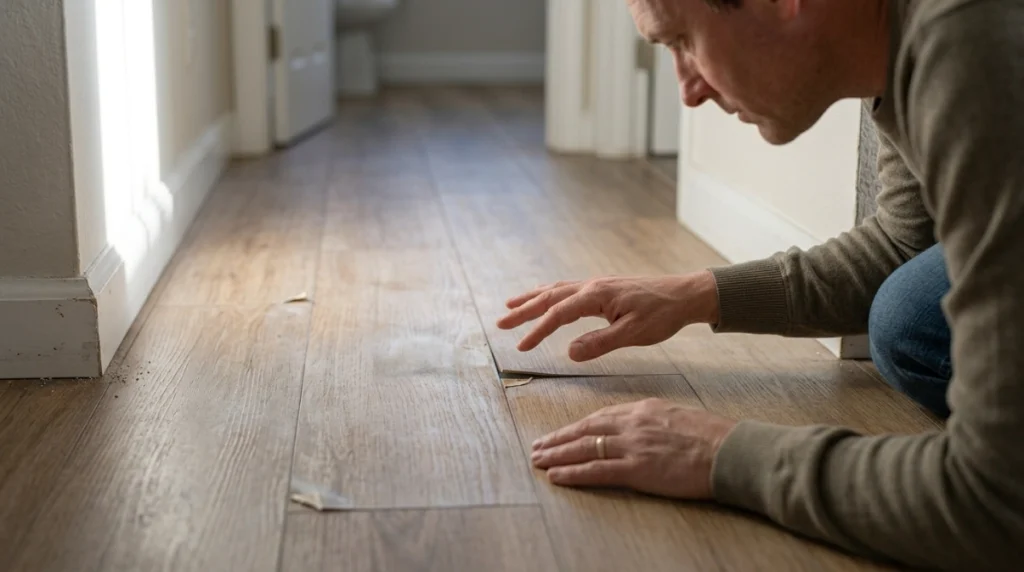
Look for physical changes that remain after the floor is fully clean and dry. Steam damage can resemble ordinary residue at first, so do not assume every cloudy area means permanent damage.
Possible warning signs
- Curling edges: Plank edges no longer sit flat.
- Joint movement: Gaps or raised seams appear where planks meet.
- Loose sections: Glue-down flooring begins lifting or shifting.
- Persistent discoloration: A cloudy or uneven area does not improve after safe cleaning.
- Surface changes: The finish looks permanently dulled, distorted, or different from surrounding planks.
What should you do next?
Stop using the steam mop while you investigate. Take photographs and identify your flooring brand before trying another aggressive cleaner or repair method.
If the floor is under warranty, contact the retailer, installer, or manufacturer before attempting a repair. They may need to inspect the flooring in its current condition.
For isolated residue, a manufacturer-approved cleaner may solve the problem. For lifting, curling, or widespread movement, a flooring professional is the better next step.
Frequently Asked Questions
Can I use a steam mop on waterproof LVP?
Do not assume you can. Waterproof construction does not automatically mean the flooring is approved for steam cleaning. Check the care instructions for your exact brand, collection, and style before exposing the floor to steam.
What happens if I use a steam mop on LVP once?
One use does not guarantee visible damage. However, if steam is prohibited by the manufacturer, stop using it and switch to a damp microfiber method rather than repeating the exposure.
What is the safest mop for luxury vinyl plank?
A microfiber flat mop or spray mop is a strong choice because it gives you excellent moisture control. Pair it with a compatible pH-neutral vinyl cleaner when plain damp cleaning is not enough.
Can I use hot water to mop LVP?
You generally do not need hot water to clean LVP. Use the water temperature and cleaner method specified by the floor or cleaning-product manufacturer, while keeping the mop lightly damp instead of saturated.
Can I use vinegar on LVP flooring?
Do not assume vinegar is safe. Some flooring manufacturers specifically advise against acidic cleaners, including vinegar. Follow the cleaning instructions for your exact LVP rather than relying on a universal homemade recipe.
Do I need to disinfect LVP floors?
Routine cleaning is enough for many normal household situations. If disinfection is needed because of illness or another specific concern, use a disinfectant that is both label-approved for the task and compatible with your flooring.
Is a spin mop safe for LVP?
A spin mop can be suitable if you wring the head until it is only damp. Avoid leaving puddles or repeatedly flooding seams, and follow your flooring manufacturer’s care instructions.
Final Takeaway: Should You Steam Mop LVP?
For most homes, the safest answer is no—do not steam mop LVP unless the manufacturer specifically approves steam for your exact flooring style. Waterproof flooring is not automatically steam-proof.
A microfiber mop, controlled moisture, and an approved pH-neutral cleaner can handle routine LVP floor cleaning without adding unnecessary heat and vapor.
- Dry mop or vacuum loose grit first.
- Use a microfiber flat or spray mop.
- Keep the pad damp, not dripping.
- Clean spills promptly.
- Avoid unapproved chemicals and homemade mixtures.
- Check the manufacturer’s care guide before trying steam.
If you’re unsure what type of LVP you own, choose the gentler method until you can identify it. Protecting the floor is easier than trying to repair lifted seams or damaged planks later.“`
