
Are Steam Mops Worth It? An Honest 2026 Guide

Quick Answer
Steam mops are worth it for homes with mostly sealed ceramic or porcelain tile. They loosen greasy residue, dry quickly, and clean with water instead of bottled floor cleaner. However, a steam mop offers poor value if you have hardwood, laminate, LVP, natural stone, or several sensitive floor types. In that case, use this guide to choosing the right mop before buying.
When a steam mop is worth buying
- Compatible floors: Most of your cleaning area is sealed ceramic or porcelain tile.
- Frequent sticky messes: You regularly clean dried food, muddy marks, or greasy kitchen residue.
- Low-chemical cleaning: You prefer using plain water for routine floor cleaning.
- Quick drying: You want less standing water than a wet string mop usually leaves.
- Regular use: You will use the machine often enough to justify its cost and storage space.
Skip it when
- Sensitive flooring dominates: A microfiber flat mop is safer and more versatile for wood, laminate, and vinyl planks.
I have tested steam mops beside microfiber, spin, and electric mops on common household messes. Steam feels impressive, but its value depends far more on your flooring than the amount of visible vapor.
This guide explains where steam mops excel, where they create risks, and whether the cost makes sense for your home in 2026.
In This Guide
- What Is a Steam Mop and How Does It Work?
- Are Steam Mops Worth Buying?
- Which Floors Can You Safely Steam Mop?
- Steam Mop vs Regular Mop: Which Is Better?
- Do Steam Mops Clean Better?
- What Are the Costs and Drawbacks?
- What Should You Look for Before Buying?
- How Do You Use a Steam Mop Safely?
- Frequently Asked Questions
- Final Verdict: Is a Steam Mop Worth It?
What Is a Steam Mop and How Does It Work?
A steam mop is an electric floor-cleaning tool that heats water and sends vapor through a washable pad. The heat softens stuck-on grime while the pad lifts it from the floor.
Most models include a water tank, heater, steam outlets, mop head, and reusable microfiber pad. Microfiber is a fine synthetic material that traps moisture and small dirt particles.
What steam actually does
Steam can loosen dried spills without requiring as much scrubbing. It also leaves less pooled water than an overloaded string mop when the machine works correctly.
The pad still performs the removal. Steam alone does not make dirt disappear.
- Heat softens residue: Dried food and light grease become easier to wipe away.
- Moisture releases dirt: Vapor dampens grime without flooding the surface.
- The pad collects debris: Microfiber holds the loosened material until you wash or replace the pad.
- Evaporation speeds drying: A light pass may dry within several minutes on suitable tile.
Vacuum or sweep first. Otherwise, the wet pad pushes hair, crumbs, and grit around the room.
A steam mop is also different from a canister steam cleaner. A canister model usually has more attachments, pressure, capacity, and cleaning uses.
Are Steam Mops Worth Buying?
Steam mops are worth buying when compatible tile covers a large part of your home. They are less worthwhile when one machine cannot safely clean most of your floors.
Reasons people like them
- Minimal cleaner use: Most machines are designed to operate with water alone.
- Effective grime removal: Heat helps release dried splashes and sticky kitchen soil.
- Reusable pads: Washable pads reduce dependence on disposable mop sheets.
- Fast setup: Many models require only water, a clean pad, and a short heating period.
- Controlled moisture: A properly moving mop usually leaves less water than traditional wet mopping.
- Quick touch-ups: Lightweight models work well for bathroom and kitchen tile.
Reasons they disappoint
- Limited compatibility: Heat and vapor can damage seams, coatings, adhesives, and moisture-sensitive cores.
- They do not vacuum: You normally need a separate broom or vacuum before steaming.
- Pads get dirty quickly: One pad may spread grime across a large room.
- Cords can interfere: Corded models require outlet changes and careful cord management.
- Storage is required: A full-size machine occupies more space than a flat mop.
- Claims have conditions: Cleaning performance depends on contact time, temperature, surface, and technique.
In my kitchen tile test, steam loosened a dried sauce mark with fewer passes than a cool damp mop. On ordinary dust, however, a microfiber mop was quicker because it needed no heating.
The important question is not whether steam works. Ask whether it solves enough of your recurring messes to earn space in your closet.
Section Takeaway: A steam mop earns its cost on compatible tile with frequent sticky messes. For light dust or mixed sensitive flooring, a simpler mop usually provides better value.
Which Floors Can You Safely Steam Mop?
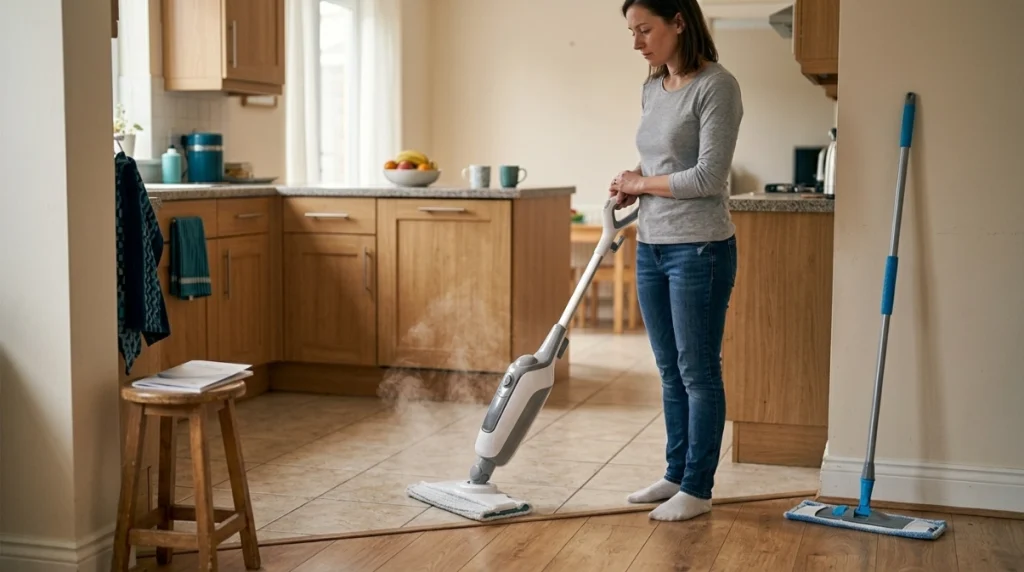
Steam mops are safest on intact, sealed ceramic and porcelain tile when the flooring manufacturer permits steam. Never assume “sealed” means every floor is steam-safe.
| Floor type | General steam-mop suitability | Main concern | Safer routine option |
|---|---|---|---|
| Sealed ceramic or porcelain tile | Usually suitable with manufacturer approval | Damaged grout, cracked tile, or weakened sealant | Steam mop or damp microfiber mop |
| Hardwood or engineered wood | Generally avoid | Moisture entering joints and affecting wood or finish | Barely damp microfiber mop |
| Laminate | Generally avoid | Swollen core, lifted seams, or delamination | Lightly damp flat mop |
| Vinyl or LVP | Avoid unless explicitly approved | Heat, seam penetration, adhesive, or wear-layer damage | Microfiber mop and approved cleaner |
| Natural stone | Check stone and sealer guidance | Porosity, sealant damage, or discoloration | pH-neutral stone cleaner |
| Sealed concrete | Sometimes suitable | Unknown coating or damaged sealer | Damp mop approved for the coating |
Why wood and laminate are risky
Steam can enter tiny gaps between boards even when the visible surface looks sealed. Moisture may then affect the wood, fiber core, finish, or adhesive.
The National Wood Flooring Association is a useful starting point for wood-floor care information. Your specific flooring manufacturer’s instructions should make the final decision.
For a closer look at this risk, read whether a steam mop is suitable for wood floors.
What about waterproof vinyl?
“Waterproof” does not automatically mean heatproof or steam-approved. Water resistance usually describes spills from above, not hot vapor driven toward seams.
Check the warranty before using steam on vinyl. This detailed guide explains the concerns surrounding steam mops and LVP flooring.
Safety note: Always follow the flooring manufacturer’s care guide. Test any approved method in a hidden area before cleaning the entire floor.
Section Takeaway: Floor compatibility decides whether a steam mop is useful or risky. Manufacturer approval matters more than claims printed on the mop’s packaging.
Steam Mop vs Regular Mop: Which Is Better?
A steam mop is better for heat-tolerant tile and stuck-on residue. A regular microfiber or spin mop is better for versatility, lower cost, and sensitive flooring.
| Feature | Steam mop | Microfiber flat mop | Spin mop |
|---|---|---|---|
| Typical upfront cost | About $50–$200+ | About $15–$50 | About $30–$70 |
| Electricity needed | Yes | No | Usually no |
| Floor versatility | Limited | High | Medium to high |
| Sticky-mess performance | Strong on compatible floors | Requires cleaner or scrubbing | Good with controlled solution |
| Storage | Moderate | Minimal | More space due to bucket |
| Best match | Tile-heavy homes | Mixed or sensitive floors | Large washable areas |
A cordless electric mop offers another option. Its rotating pads scrub floors without exposing them to steam, but you must still use a compatible solution.
Robot mops such as the iRobot Braava prioritize convenience. They suit maintenance cleaning better than heavy, dried-on messes.
Do Steam Mops Clean Better?
Steam mops can clean sticky soil better than a cool, water-only mop. They do not automatically outperform correct detergent, agitation, and microfiber removal on every mess.
Cleaning is not the same as disinfecting
Cleaning removes dirt and many germs from a surface. Disinfecting uses an appropriate product or validated process to kill specified germs under stated conditions.
The CDC’s home cleaning guidance says regular cleaning is often enough in many household situations. Disinfection may be appropriate when someone is ill or at higher risk.
A steam mop may have sanitizing claims, but those claims depend on the model’s directions. Required contact time, movement speed, temperature, and surface compatibility can differ.
- Read the manual: Look for the tested procedure behind any sanitizing claim.
- Respect contact time: A fast pass may not match the required treatment.
- Start with a clean pad: A loaded pad can spread loosened soil.
- Do not improvise additives: Use only liquids allowed by the manufacturer.
Where steam performs best
Steam is useful around sealed tile near stoves, sinks, toilets, and pet feeding areas. These locations often collect greasy films or dried splashes.
For bathroom tile, pair correct technique with this guide to cleaning bathroom tile effectively.
Steam is less impressive against loose grit, heavy grease, wax, or mineral buildup. Those problems may require vacuuming, a compatible cleaner, or targeted treatment.
Safety note: Never mix disinfectants, bleach, vinegar, essential oils, or detergent inside a steam-mop tank unless the manual explicitly permits that product.
What Are the Costs and Drawbacks?
A basic steam mop may cost around $50, while premium or multi-function machines can exceed $200. Also budget for replacement pads, distilled water if recommended, and eventual descaling supplies.
Ongoing costs
- Replacement pads: Several pads are helpful because dirty pads need frequent changes.
- Water treatment: Hard water can leave mineral deposits inside some machines.
- Electricity: Each session uses power, although short household cleaning sessions rarely create a large bill.
- Maintenance: Mineral scale can reduce steam output and shorten service life.
- Floor repairs: Incorrect use can create a much larger cost than the mop itself.
Practical drawbacks
You must wait for the machine to heat and cool. You also need to manage a hot pad, a cord on many models, and leftover tank water.
Steam can cause burns. Keep hands away from vapor outlets, and never change a hot pad while the machine remains plugged in.
A steam mop also cannot replace every cleaning tool. You still need a vacuum, spot-cleaning cloth, and possibly another mop for sensitive floors.
If a $25 microfiber system handles 90% of your flooring safely, buying a $150 steam mop for one bathroom is difficult to justify. A tile-heavy home changes that calculation.
Section Takeaway: Consider the complete system, not just the purchase price. Pads, maintenance, storage, floor compatibility, and the need for a second mop determine the real value.
What Should You Look for Before Buying?
Choose a steam mop by matching it to your floors, room size, and common messes. Extra attachments matter only when you will use them.
- Adjustable steam: Multiple settings offer better control for approved surfaces and different soil levels.
- Fast heat-up: A shorter delay makes quick kitchen cleanups more practical.
- Tank capacity: A larger tank covers more floor but adds weight.
- Swivel head: Good movement helps around toilets, cabinets, and furniture legs.
- Long cord: A useful cord reduces outlet changes in open rooms.
- Washable pads: Check the price and availability of replacements before buying.
- Easy pad removal: Hands-free or low-contact removal helps when the pad is hot and dirty.
- Standing stability: A stable mop is safer during short pauses.
- Warranty terms: Read water, descaling, and approved-surface requirements.
Bissell and Shark sell many widely available steam models. Brand recognition does not remove the need to compare weight, pad cost, tank size, and warranty terms.
For a small apartment with one tiled bathroom, prioritize compact storage and quick heating. For extensive tile, prioritize capacity, cord reach, and several pads.
How Do You Use a Steam Mop Safely?
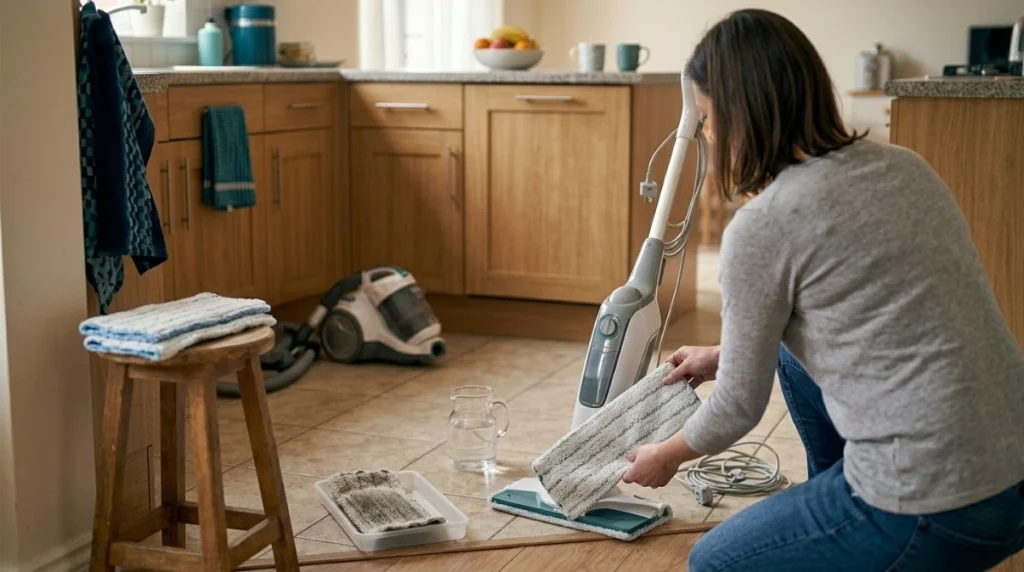
Start with manufacturer-approved flooring, a swept surface, and a clean pad. Keep the mop moving so heat and moisture do not concentrate in one spot.
- Check the floor guide. Confirm that the flooring manufacturer allows steam cleaning.
- Inspect the surface. Avoid loose tiles, open seams, cracked grout, and damaged sealant.
- Remove dry debris. Vacuum or sweep grit, hair, and crumbs before adding moisture.
- Attach a clean pad. Install it before filling, heating, or operating the mop.
- Fill as directed. Use the water type and fill level stated in the manual.
- Test a hidden area. Check for dulling, discoloration, or coating changes.
- Move steadily. Do not park an active steam mop on the floor.
- Change dirty pads. Use several pads for a large or heavily soiled room.
- Unplug before servicing. Let the machine cool before removing the pad or emptying it.
- Dry and store it. Follow the manual’s tank-emptying and descaling instructions.
Keep children and pets outside the work area until the floor is cool and dry. Route the cord away from walkways and wet areas.
Do not put fragrance oil in the tank. Read why essential oils can damage a steam mop before trying scented additives.
Safety note: Steam can burn skin and damage incompatible surfaces. Follow both the appliance manual and the floor manufacturer’s care instructions.
Frequently Asked Questions
Are steam mops worth it for tile floors?
Yes, a steam mop can be worthwhile for large areas of sealed ceramic or porcelain tile. It loosens sticky residue and usually dries quickly. Confirm that the tile, grout, sealant, and flooring manufacturer all permit steam cleaning.
Do steam mops replace regular mopping?
A steam mop can replace wet mopping on approved surfaces, but it cannot handle every floor. Homes with hardwood, laminate, vinyl planks, or natural stone may still need a damp microfiber mop and manufacturer-approved cleaner.
Can I use floor cleaner in a steam mop?
Use only liquids specifically approved in the machine’s manual. Many steam mops are designed for water alone. Detergent, vinegar, disinfectant, or essential oil may clog components, create fumes, leave residue, or void the warranty.
Do I need to vacuum before steam mopping?
Yes. Vacuuming or sweeping removes grit, pet hair, and crumbs that a steam mop cannot collect efficiently. Removing dry debris also reduces scratching and prevents the damp pad from pushing dirty clumps around the room.
Are steam mops good for homes with pets?
They can help clean dried paw marks and feeding-area residue from approved tile. Steam mops do not remove loose fur, so vacuum first. Keep pets away until the floor has cooled and dried completely.
How often should you use a steam mop?
Use it when compatible floors need damp cleaning rather than automatically using it every day. High-traffic tile may need weekly cleaning, while low-traffic rooms may need it less often. Sweep or vacuum between sessions.
Can steam mops leave floors streaky or sticky?
Yes. Common causes include a dirty pad, old cleaner residue, hard-water minerals, or moving too slowly. Start with clean pads and approved water, then change the pad as soon as it becomes visibly soiled.
Final Verdict: Is a Steam Mop Worth It?
A steam mop is worth it when you have plenty of approved tile and regularly face sticky residue. It provides convenient water-based cleaning, reusable pads, and fast drying.
It is not the best universal mop. Hardwood, laminate, LVP, natural stone, and unknown coatings can make steam an unnecessary risk.
Before buying, calculate how much compatible floor you can clean and how often you will use the machine. If the answer is “most rooms, every week,” a steam mop can earn its place.
If the answer is “one small bathroom, occasionally,” choose a quality microfiber mop instead. The simpler tool will cost less, store easily, and clean more floor types safely.
