
Are Vacuum Steam Mops Worth It? An Honest 2026 Guide

Quick Answer
Vacuum steam mops are worth it for homes with lots of compatible hard flooring and frequent crumbs, pet hair, footprints, or sticky spills. They can vacuum loose debris and steam-clean in one routine, which saves a separate sweeping step. They are less useful for carpet-heavy homes or moisture-sensitive flooring, especially wood floors covered by National Wood Flooring Association guidance.
A vacuum steam mop is most worthwhile when:
- Mostly hard floors: Your home has sealed tile or other flooring specifically approved for steam.
- Frequent cleaning: You vacuum and mop several times each week.
- Daily debris: Pets, children, cooking, or outdoor traffic constantly create crumbs and dirt.
- Limited storage: You would rather store one combination machine than two floor cleaners.
- Convenience matters: Saving a cleaning step matters more than buying the cheapest possible setup.
Skip one when:
- Most of your home is carpet, hardwood, laminate, or another floor that does not allow steam.
I’ve found that the appeal of a vacuum steam mop becomes obvious when a kitchen floor has both crumbs and dried-on messes. Instead of vacuuming first and returning with another mop, one machine can handle both jobs on an approved surface.
In This Guide
- What Is a Vacuum Steam Mop?
- Are Vacuum Steam Mops Actually Worth It?
- Which Floors Can You Use a Vacuum Steam Mop On?
- What Are the Pros and Cons?
- Vacuum Steam Mop vs Other Mops
- How Do You Use a Vacuum Steam Mop Correctly?
- What Should You Look for Before Buying?
- Are Vacuum Steam Mops Expensive to Maintain?
- Vacuum Steam Mop FAQs
- Final Verdict: Should You Buy One?
What Is a Vacuum Steam Mop?

A vacuum steam mop is an electric floor cleaner that combines dry-debris suction with heated steam cleaning. Unlike a standard steam mop, it can collect crumbs and hair before or while the pad cleans the floor.
Definition: A vacuum steam mop is a combination floor-cleaning appliance designed to vacuum loose debris and steam-clean compatible hard floors with one machine.
How is it different from a regular steam mop?
A regular steam mop does not usually provide meaningful vacuum suction. You normally sweep or vacuum before using it.
A combination model removes that separate preparation step. Some machines also let you select vacuum-only, steam-only, or combined cleaning modes.
For example, the BISSELL Symphony All-in-One Vacuum and Steam Mop is designed to vacuum and steam at the same time. Its listed specifications include a 25-foot power cord, 12.8-ounce clean-water tank, and 10.1-pound machine weight.
Does it replace every floor-cleaning machine?
No. Think of it as a hard-floor convenience tool rather than a complete whole-home cleaning system.
- Loose debris: The vacuum function handles crumbs, dust, hair, and light dry dirt.
- Stuck-on soil: Steam helps soften dried residue on compatible surfaces.
- Carpet: A dedicated vacuum remains more useful for substantial carpet and stairs.
- Delicate floors: A microfiber flat mop gives you better moisture control.
Are Vacuum Steam Mops Actually Worth It?
Yes, they can be worth it when they replace two chores you perform regularly. Their strongest benefit is convenience, not magical cleaning power.
They are worth it for frequent hard-floor cleaning
A busy kitchen is where I notice the advantage most. Dry cereal, pet hair, footprints, and a dried sauce spot can appear together.
Using a separate vacuum and mop means covering the room twice. A good combination machine can shorten that routine.
- Homes with children dropping crumbs
- Homes with shedding pets
- Kitchens cleaned several times weekly
- Entry areas with regular tracked-in dirt
- Small homes with limited equipment storage
They are not automatically worth the extra complexity
If you mop once every few weeks, a combination machine may solve a problem you barely have. A basic vacuum plus microfiber mop may be simpler.
The same applies when most rooms have carpet. You may still need your regular vacuum, so the combo does not eliminate another machine.
Section Takeaway: Vacuum steam mops earn their value through repeated time savings. The more often you clean compatible hard floors, the easier the purchase is to justify.
Which Floors Can You Use a Vacuum Steam Mop On?
Floor compatibility matters more than the machine’s feature list. Steam introduces both heat and moisture, so “hard floor” does not automatically mean “steam-safe.”
| Floor Type | Steam Suitability | Safer Approach |
|---|---|---|
| Sealed ceramic tile | Often suitable | Confirm manufacturer guidance and start with lower steam |
| Porcelain tile | Often suitable | Keep the pad moving and avoid damaged grout |
| Sealed concrete | Depends on sealer | Check the sealer maker’s instructions |
| Natural stone | Varies | Follow stone and sealer care guidance |
| Hardwood | Avoid | Use a lightly damp microfiber mop |
| Laminate | Usually risky | Use steam only if the flooring maker explicitly approves it |
| Vinyl/LVP | Manufacturer-dependent | Choose a damp microfiber mop when steam approval is unclear |
Why is hardwood especially risky?
The NWFA advises against steam cleaners on wood flooring. Vapor can enter wood fibers and contribute to finish or flooring damage.
A floor can look sealed while still having tiny gaps at joints or worn areas. Those openings make repeated steam exposure a poor gamble.
Safety note: Check your flooring manufacturer’s current care guide and warranty before using heat, steam, or excessive moisture.
What Are the Pros and Cons of Vacuum Steam Mops?
The advantages are meaningful, but so are the tradeoffs. Knowing both prevents an expensive convenience purchase from becoming a storage-room ornament.
Main advantages
- One-pass convenience: You can collect dry debris and tackle stuck-on soil in one routine.
- Less equipment switching: There is no need to put away a vacuum before grabbing a separate mop.
- No mop bucket: Most steam systems use an onboard water tank.
- Reusable pads: Washable microfiber pads can reduce disposable cleaning-pad waste.
- Useful on sticky messes: Heat can help loosen residue on compatible sealed floors.
- Smaller storage footprint: One combination cleaner may replace two hard-floor tools.
Main disadvantages
- Heavier body: A combined motor, tank, vacuum path, and steam system add weight.
- More maintenance: Filters, pads, tanks, and suction channels all need care.
- Limited floor compatibility: Steam narrows the number of surfaces you can safely clean.
- Not a carpet specialist: Most people with extensive carpeting still need a dedicated vacuum.
- Higher complexity: More components mean more parts that can clog, wear, or need replacement.
One hidden drawback is cleanup after cleaning. A slim microfiber mop can be rinsed and hung in seconds, while a combination machine may need several parts emptied or dried.
Vacuum Steam Mop vs Other Mops: Which Is Better?
No mop type wins every category. The best choice depends on your floor, debris level, storage space, and cleaning frequency.
| Cleaning Tool | Dry Debris Pickup | Wet Cleaning | Best Fit |
|---|---|---|---|
| Vacuum steam mop | Yes | Steam | Frequent cleaning on compatible hard floors |
| Standard steam mop | No | Steam | Sticky soil after vacuuming |
| Microfiber flat mop | Light dust only | Controlled damp cleaning | Moisture-sensitive floors |
| Spin mop | No | Yes | Larger areas needing adjustable moisture |
| Robot mop | Model-dependent | Yes | Routine maintenance with minimal effort |
| String mop | No | High water capacity | Durable tile or utility areas |
What if you already own a good vacuum?
A separate steam mop can make more sense. You keep the stronger vacuum while adding steam only when needed.
A microfiber flat mop is even simpler for hardwood, laminate, and other moisture-sensitive floors. It also gives you precise control over how wet the pad becomes.
How Do You Use a Vacuum Steam Mop Correctly?
Good technique matters because suction and steam solve different problems. The vacuum handles loose material, while the heated pad works on attached soil.
- Check the floor first. Confirm that its manufacturer allows steam cleaning.
- Inspect the machine. Make sure the filter, pad, tanks, and suction path are correctly installed.
- Fill only as directed. Use the water type and quantity listed in the appliance manual.
- Start with loose debris. Use vacuum mode first when the floor contains lots of crumbs or pet hair.
- Select appropriate steam. Begin with the lowest effective setting on an approved surface.
- Keep moving. Do not leave a steaming pad resting on one floor area.
- Change dirty pads. A saturated pad can spread soil instead of collecting it.
- Let the floor dry. Keep people and pets away while the surface remains damp or slippery.
Do you still need to clean before disinfecting?
Steam cleaning should not be treated as an automatic disinfection guarantee. Effective germ reduction depends on temperature, exposure time, surface contact, and the appliance’s validated instructions.
The CDC’s household cleaning guidance notes that ordinary cleaning removes dirt and many germs. Disinfection is generally more relevant when illness or elevated risk makes it necessary.
Safety note: Never add bleach, disinfectant, vinegar, essential oils, or floor cleaner to a steam tank unless the appliance manufacturer specifically permits it.
What Should You Look for Before Buying a Vacuum Steam Mop?
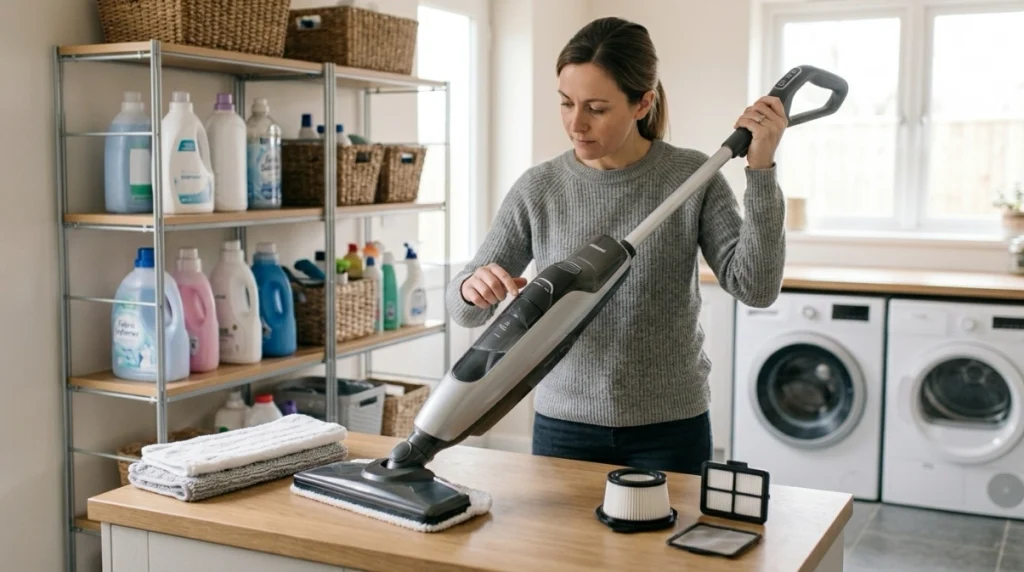
Start with your floors, not the feature list. A powerful combination cleaner has little value if most rooms cannot safely use its steam function.
1. Floor compatibility
List every major floor surface in your home. Check the flooring maker’s care instructions before shopping.
Mixed homes deserve extra caution. A machine that works beautifully on kitchen tile may be inappropriate for the wood floor beside it.
2. Separate cleaning modes
I prefer controls that let you vacuum and steam independently. Separate modes make the machine more flexible for everyday debris.
- Vacuum-only mode for dry crumbs
- Steam-only mode after debris removal
- Combined mode for compatible everyday hard-floor messes
3. Weight and maneuverability
Combination cleaners tend to carry more hardware than plain mops. Check the full machine weight if you have stairs or limited lifting ability.
Also inspect swivel movement and floor-head height. A bulky head can struggle around toilets, table legs, and low furniture.
4. Tank and filter access
A good machine should be easy to empty without touching collected dirt. Filters should also be accessible without disassembling half the cleaner.
Small water tanks reduce weight but require more refilling. Larger tanks increase runtime while making the appliance heavier.
5. Replacement parts
Check whether pads, filters, tanks, and other wear parts remain available. A convenient machine becomes wasteful when a simple filter cannot be replaced.
6. Corded vs cordless design
Corded models offer continuous power but require outlet switching. Cordless electric mops are easier to move, though runtime and battery aging matter.
Section Takeaway: Buy for floor compatibility, cleaning modes, serviceability, and handling first. Extra features matter only after those basics fit your home.
Are Vacuum Steam Mops Expensive to Maintain?
They usually require more maintenance than a simple steam mop. You are maintaining both a vacuum system and a wet-cleaning system.
What needs regular cleaning?
- Microfiber pads: Wash them before soil and grease become embedded.
- Vacuum filters: Clean or replace them according to the manual.
- Dirt container: Empty it before airflow becomes restricted.
- Steam outlets: Watch for mineral buildup if your water is hard.
- Floor head: Remove wrapped hair and trapped debris.
- Water tank: Empty and dry it when the manufacturer recommends doing so.
Replacement parts create an ongoing ownership cost. Pads and filters are small expenses, but they matter if you clean several times each week.
For comparison, current replacement parts for one BISSELL Symphony model include filters and microfiber pads sold separately. That is worth checking before choosing any brand.
Can you reduce cleaner costs?
Steam models often rely mainly on water during steam operation. That may reduce your need for bottled floor cleaner on compatible surfaces.
When you do need a conventional cleaner, look for one approved for your floor type. The EPA Safer Choice program can also help identify cleaning products made with ingredients meeting its criteria.
Safety note: Follow both the flooring care guide and the cleaning-product label. Never mix cleaning chemicals.
Vacuum Steam Mop FAQs
Can a vacuum steam mop replace a normal vacuum?
Usually not throughout the whole home. A vacuum steam mop can handle everyday dry debris on hard flooring, but a dedicated vacuum is generally better for carpets, upholstery, stairs, edges, and larger amounts of dry dirt.
Can you vacuum and steam at the same time?
Some models allow simultaneous vacuuming and steaming, while others separate the functions. Check the product manual because the cleaning sequence and controls differ between machines.
Are vacuum steam mops good for pet hair?
They can be useful for pet hair on hard floors because suction collects loose hair before the mop pad becomes covered. Homes with carpet, sofas, or carpeted stairs will still benefit from a dedicated pet-hair vacuum.
Are vacuum steam mops safe for hardwood floors?
Do not assume they are. NWFA guidance advises against steam cleaners on wood flooring, so a lightly damp microfiber mop and wood-floor-approved cleaner are safer choices unless your specific flooring manufacturer states otherwise.
Do steam mops disinfect floors?
Steam can reduce microorganisms when the required temperature and contact conditions are achieved. However, you should not assume every quick mop pass disinfects a floor unless the appliance has a specific validated claim and you follow its directions.
Is a vacuum steam mop better than a spin mop?
It is more convenient for collecting dry debris and cleaning compatible hard floors in one routine. A spin mop is cheaper, simpler, and lets you control moisture more easily across a broader range of surfaces.
Is a vacuum steam mop worth it for a small apartment?
It can be, especially when most flooring is compatible tile and storage space is limited. If the apartment has laminate, hardwood, or lots of carpet, a compact vacuum and microfiber spray mop may be more useful.
Final Verdict: Should You Buy One?
As of 2026, I think vacuum steam mops make the most sense for people who clean mostly compatible hard floors several times a week. Their biggest advantage is turning the vacuum-then-mop routine into a faster, simpler job.
They make less sense when your home contains large carpeted areas or steam-sensitive flooring. In those homes, separate tools usually provide better flexibility.
- Buy one: Mostly approved hard flooring, frequent messes, pets or children, and high value placed on convenience.
- Consider one: Mixed flooring where you can use separate vacuum and steam modes safely.
- Skip one: Mostly carpet, hardwood, laminate, uncertain flooring warranties, or infrequent mopping.
Before spending money, answer one question: how many rooms could you safely clean with both functions? If the answer is most of your home, a vacuum steam mop can be genuinely worthwhile.
If the answer is one small tiled room, keep your existing vacuum. A simple microfiber mop will probably serve you better.
