
What Are the Benefits of Steam Mops?

Quick Answer
Steam mops loosen grease, sticky residue, and dried spills with heated water vapor. They also reduce the need for chemical cleaners and leave compatible hard floors relatively dry. However, as Consumer Reports’ steam mop guidance explains, heat and moisture can damage wood and laminate flooring.
Main steam mop benefits
- Less scrubbing: Heat softens sticky food, grease, and dried dirt.
- Fewer chemicals: Most models clean with plain water rather than bottled floor solution.
- Low water use: A small tank can clean several rooms without a mop bucket.
- Fast drying: Compatible sealed floors often dry faster than floors cleaned with a wet string mop.
- Reusable pads: Washable microfiber pads reduce dependence on disposable wipes.
- Better soil removal: Steam and microfiber work together to lift grime from textured tile.
Before you start
- Use steam only when both the flooring manufacturer and steam mop manual approve it.
I’ve tested steam mops on kitchen tile, sealed concrete, and bathroom floors with dried soap residue. Their biggest advantage is simple: heat handles stubborn grime without turning routine mopping into a hard scrubbing job.
Steam is not safe for every surface. This guide explains where it helps, where it creates risk, and whether it suits your cleaning routine.
In This Guide
- How Do Steam Mops Work?
- What Are the Main Benefits of a Steam Mop?
- Which Floors Can Benefit From Steam Mopping?
- Is a Steam Mop Better Than a Regular Mop?
- Do Steam Mops Sanitize Floors?
- What Are the Disadvantages of Steam Mops?
- How Do You Get the Best Results From a Steam Mop?
- Frequently Asked Questions
- Is a Steam Mop Worth Buying?
How Do Steam Mops Work?
A steam mop is an electric floor cleaner that heats water and releases vapor through a washable pad. The damp microfiber pad collects the soil loosened by the heat.
Most models need between 20 seconds and one minute to heat. The exact time depends on tank size, heater power, and the selected steam level.
Heat loosens stubborn residue
Warm moisture softens dried food, muddy footprints, and light grease. This lets the pad collect residue that might resist a cool, damp mop.
I notice the difference most around a stove. Several slow passes usually lift thin grease spots without requiring hard pressure.
The pad collects the loosened dirt
Steam does not make dirt disappear. The microfiber pad must physically remove it from the floor.
A saturated or dirty pad starts spreading grime. Keep two or three clean pads nearby when cleaning a large kitchen or several rooms.
Steam output controls moisture
Some models provide low, medium, and high steam settings. Low steam suits lighter cleaning, while higher output helps with textured tile and dried residue.
- Low steam: Light footprints and routine maintenance.
- Medium steam: Kitchen spills and bathroom residue.
- High steam: Stubborn grime on manufacturer-approved tile or sealed concrete.
Safety note: Check your flooring care guide and steam mop manual before use. Never assume a “sealed floor” label automatically means steam-safe.
What Are the Main Benefits of a Steam Mop?
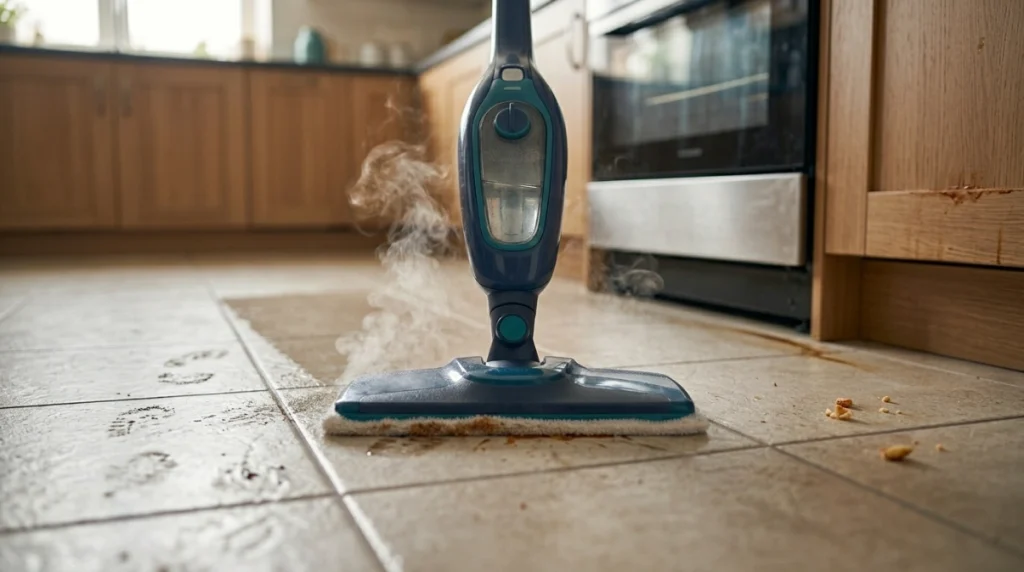
Steam mops provide convenient deep cleaning on compatible hard surfaces. The strongest benefits are reduced scrubbing, limited chemical use, and relatively fast drying.
1. Steam loosens sticky messes
Heat helps soften dried sauce, sugary drink spots, muddy marks, and light cooking grease. You can usually remove these messes with several controlled passes.
This can be easier on your arms than scrubbing with a flat mop. You should still spot-treat thick deposits before cleaning the entire floor.
2. Most models use plain water
A steam mop normally needs only water in its tank. That reduces your exposure to fragrance and avoids cleaner residue when the machine is used correctly.
This feature can appeal to households sensitive to strong cleaning scents. It also prevents the slippery film caused by using too much detergent.
Do not add vinegar, bleach, essential oils, or standard floor cleaner unless the manual expressly allows it. These products can damage internal parts or create unsafe vapors.
3. You do not need a bucket
Steam mops store water in a compact onboard tank. You avoid carrying a heavy bucket and repeatedly dipping a mop into dirty water.
A removable tank also makes refilling easier. Tank capacity commonly determines whether you can clean one room or several rooms per fill.
4. Floors can dry quickly
A properly moving steam mop applies less standing water than a soaked string mop. On compatible tile, the remaining moisture may evaporate within several minutes.
Drying time still depends on steam output, ventilation, room humidity, and cleaning speed. Puddles indicate excessive steam, slow movement, or a saturated pad.
5. Washable pads reduce disposable waste
Most steam mops use reusable microfiber pads. You can wash and rotate them instead of buying a disposable wipe for every cleaning session.
- Let used pads cool before removal.
- Wash them according to the manufacturer’s label.
- Avoid fabric softener because it can coat microfiber.
- Air-dry or use the approved dryer setting.
- Replace pads that stay rough, stained, or misshapen.
6. They clean textured surfaces well
Steam can reach shallow grout lines and textured tile where a smooth pad struggles. A flexible microfiber pad then collects the loosened surface dirt.
Deeply stained grout may still need a suitable brush and cleaner. A floor steam mop is not a complete substitute for grout restoration.
Section Takeaway: Steam mops make compatible hard-floor cleaning faster and less chemical-dependent. Their value comes from combining controlled heat with a clean microfiber pad.
Which Floors Can Benefit From Steam Mopping?
Glazed ceramic and porcelain tile are usually the best candidates. Sealed concrete may also tolerate steam when its coating manufacturer approves the method.
| Floor type | General suitability | Main concern | Safer approach |
|---|---|---|---|
| Glazed ceramic or porcelain tile | Often suitable | Damaged grout or loose tiles | Inspect joints and keep the mop moving |
| Sealed concrete | Sometimes suitable | Heat-sensitive coating | Confirm compatibility with the sealer maker |
| Sheet vinyl or LVP | Usually avoid unless approved | Weakened adhesive or damaged seams | Use a damp microfiber mop |
| Laminate | Generally unsuitable | Swollen core and lifted edges | Use minimal moisture and approved cleaner |
| Hardwood or engineered wood | Generally unsuitable | Finish damage, gaps, and warping | Follow the flooring maker’s damp-mop method |
| Natural stone | Depends on stone and sealer | Porosity or sealer deterioration | Ask the installer or stone-care professional |
| Cork or waxed flooring | Unsuitable | Swelling or melted finish | Use an approved dry or damp method |
Why wood and laminate need caution
Wood finishes do not seal every seam between boards. Pressurized moisture can enter small gaps and reach the wood underneath.
Laminate has a moisture-sensitive core beneath its surface layer. Steam entering the joints may cause raised edges, swelling, or separation.
The National Wood Flooring Association recommends following the flooring manufacturer’s maintenance instructions. That guidance should take priority over broad claims printed on a mop box.
Why vinyl and stone are not automatic yeses
Heat can soften some vinyl adhesives or affect plank joints. Natural stone varies in porosity, finish, and sealer condition.
Check the original care guide. If you cannot identify the product, use a pH-neutral cleaner and a well-wrung microfiber mop instead.
Safety note: Test any approved method in an inconspicuous area. Stop if you notice cloudiness, softened adhesive, raised seams, or discoloration.
Is a Steam Mop Better Than a Regular Mop?
A steam mop is better for sticky grime on compatible tile. A regular microfiber or spin mop remains more versatile across moisture-sensitive floors.
| Feature | Steam mop | Spin mop | Flat microfiber mop |
|---|---|---|---|
| Sticky residue | Strong on approved surfaces | Good with suitable cleaner | Good for light spots |
| Floor versatility | Limited | Good when well wrung | Excellent |
| Chemical cleaner needed | Usually no | Usually yes | Optional |
| Power required | Yes | No | No |
| Typical setup | Fill, heat, and plug in | Fill bucket and mix cleaner | Attach pad and spray |
A steam mop is not a vacuum. You still need to remove hair, sand, crumbs, and other loose debris first.
A flat microfiber mop works better for quick daily cleaning. A spin mop offers stronger agitation and precise moisture control without requiring electricity.
In my mixed-floor testing, no single mop handled every room safely. Steam worked well on bathroom tile, while a damp microfiber pad was the safer choice for wood-look planks.
Do Steam Mops Sanitize Floors?
Some steam mops can reduce microorganisms when used under their tested conditions. However, you should not assume every machine disinfects every floor during a quick pass.
Temperature, surface contact time, pad condition, and cleaning speed affect the result. Manufacturer germ-kill claims may require holding the mop over an area for a stated period.
Cleaning and disinfecting are different
Cleaning removes dirt and many germs from a surface. Disinfecting uses a validated process or registered chemical to kill specified microorganisms.
The CDC’s cleaning guidance says routine cleaning with an appropriate product is enough in many everyday situations. Floors generally need targeted disinfection after contamination or during specific health concerns.
Do not replace label directions with assumptions
Check whether your steam mop makes a tested sanitizing claim. Follow the required warm-up, movement, and contact instructions exactly.
If true disinfection is necessary, use a floor-compatible product from the EPA’s registered disinfectant resources. Follow its dilution, contact-time, ventilation, and rinsing directions.
Safety note: Never place disinfectant, bleach, ammonia, or another chemical inside a steam mop unless its manual explicitly permits that exact product.
What Are the Disadvantages of Steam Mops?
The main disadvantage is limited floor compatibility. A steam mop may permanently damage materials that cannot tolerate concentrated heat and moisture.
- Floor damage risk: Steam can enter seams, weaken adhesive, or affect protective finishes.
- Electricity required: Corded models need a nearby outlet and cord management.
- Burn risk: The steam head, vapor, and pad become hot during operation.
- Pre-cleaning required: Loose grit must be swept or vacuumed before mopping.
- Pad changes: A dirty pad spreads soil and can leave streaks.
- Mineral buildup: Hard water can leave deposits inside some machines.
- Higher purchase cost: Steam models usually cost more than basic flat mops.
Steam does not remove every stain
Old grout discoloration, paint, rust, and deeply absorbed stains may remain. These problems often need a material-specific cleaner or professional repair.
Heat can set some soils
Steam is not ideal for every substance. Heat may make protein-based messes, such as egg or certain bodily fluids, harder to remove.
Lift those spills with cool water and an appropriate cleaner first. Then use any approved sanitizing process required for the surface.
Some machines feel heavy
The mop becomes heavier after you fill its tank. A large tank provides longer runtime but may increase wrist and shoulder strain.
Consider handle adjustment, head movement, cord length, and filled weight before buying. These details matter more than an oversized accessory package.
How Do You Get the Best Results From a Steam Mop?
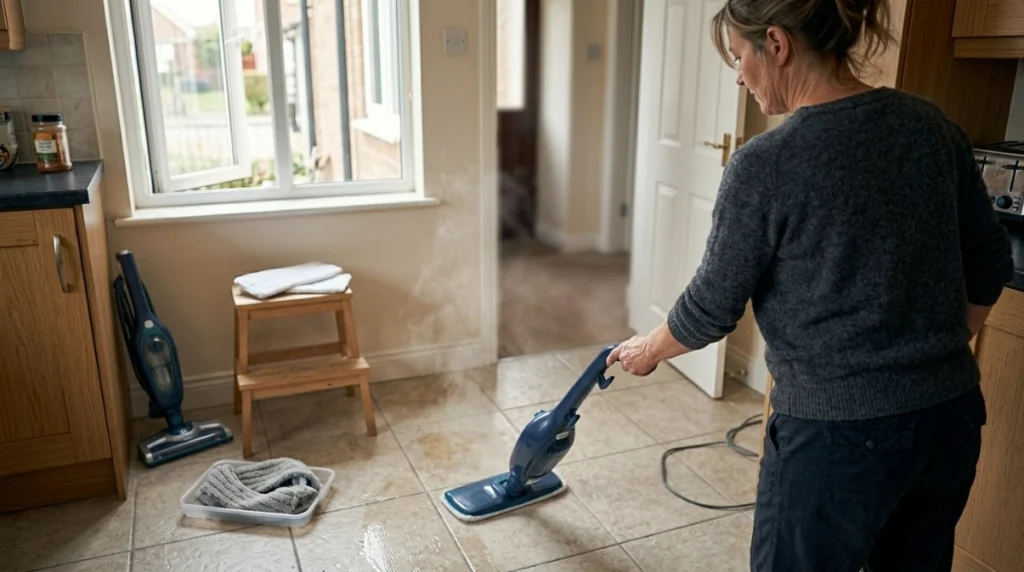
Start with a compatible floor and a freshly washed pad. Remove loose debris, use the lowest effective steam setting, and keep the mop moving.
- Read both manuals. Confirm that the flooring and machine instructions allow steam cleaning.
- Vacuum or sweep. Remove sand, pet hair, crumbs, and other loose debris.
- Attach a clean pad. Secure it before filling, heating, or operating the machine.
- Fill with approved water. Follow the manual’s advice about tap, filtered, or distilled water.
- Allow full warm-up. Wait for the ready light or stated heating time.
- Test a hidden area. Check the surface after it has completely cooled and dried.
- Use slow, overlapping passes. Do not hold the active mop motionless on the floor.
- Replace dirty pads. Switch pads when they become gray, saturated, or streaky.
- Ventilate the room. Open a door or use a fan to support drying.
- Cool and empty the mop. Follow the manual before removing the pad or storing the unit.
How often should you steam mop?
There is no universal schedule. Traffic, pets, cooking activity, and floor compatibility should determine frequency.
- Busy tile kitchen: About once weekly, with spot cleaning between sessions.
- Low-traffic tile room: Every two to four weeks may be enough.
- Entryway during wet weather: Clean when visible soil appears.
- After greasy spills: Remove excess residue before steam cleaning.
Daily steam mopping is rarely necessary in an average home. Frequent heat and moisture add wear without providing much benefit to a floor that is already clean.
How do you prevent streaks?
- Vacuum thoroughly before starting.
- Use a clean, residue-free microfiber pad.
- Avoid adding soap or fragrance to the tank.
- Change pads before they become overloaded.
- Work toward the exit to avoid walking on damp areas.
- Remove old cleaner residue with the floor-approved method.
Section Takeaway: Good results depend more on preparation and pad changes than maximum steam output. Use controlled moisture and never pause an active mop on one spot.
Frequently Asked Questions
Can I use a steam mop every day?
Daily use is usually unnecessary and may expose flooring to repeated heat and moisture. Sweep, vacuum, or spot-clean routine dirt instead. Steam mop compatible tile only when visible grime or your cleaning schedule justifies it.
Do steam mops leave floors wet?
A steam mop should leave a thin layer of moisture rather than puddles. Excess water can indicate high steam output, slow movement, a soaked pad, or a maintenance problem. Stop if water collects around seams.
Can I put floor cleaner in a steam mop?
Use only substances approved in your model’s manual. Most steam mops are designed for water alone. Floor cleaner, vinegar, bleach, or essential oils may damage the tank, seals, heater, or floor.
Do I need to vacuum before steam mopping?
Yes. Vacuuming removes grit, hair, and crumbs that the steam mop cannot collect efficiently. It also reduces scratching and prevents loose debris from turning into muddy streaks under the damp pad.
Will a steam mop remove grout stains?
Steam can loosen surface grime in shallow grout lines. It may not remove deep discoloration, mildew staining, or damaged sealer. Persistent stains require a grout-safe product, brush, or professional assessment.
Can steam mops kill dust mites?
Heat may reduce dust mites when the required temperature reaches them for long enough. A floor mop should not be treated as a complete allergen-control method. Regular vacuuming, laundering, and moisture control remain important.
Are steam mops safe around pets and children?
Steam mops can reduce cleaner residue because they often use plain water. However, hot vapor and heated pads can cause burns. Keep children and pets outside the area until the floor and machine have cooled.
Is a Steam Mop Worth Buying?
A steam mop is worth considering if most of your home has manufacturer-approved tile or sealed concrete. It can loosen stubborn grime, reduce chemical use, and simplify cleaning without a bucket.
It is less useful in homes dominated by hardwood, laminate, cork, or other moisture-sensitive flooring. A high-quality microfiber flat mop offers more flexibility in those spaces.
Before buying, confirm floor compatibility and compare filled weight, cord length, tank size, steam controls, and replacement pad cost. The best choice is the mop that cleans your floor safely—not the model producing the most steam.
