
What Is the Best Floor Cleaner for a Spray Mop?

Quick Answer
The best floor cleaner for a spray mop is usually a low-residue, pH-neutral cleaner that is approved for your specific floor. It should spray evenly, dry without a sticky film, and work with a microfiber pad without needing a heavy rinse. For safer ingredient choices, the EPA Safer Choice program is a useful place to check cleaning products.
What I look for in a spray-mop cleaner
- Floor compatibility: The label should specifically allow use on your hardwood, laminate, vinyl, tile, or stone.
- Low residue: A good formula dries clean instead of leaving haze, stickiness, or visible mop marks.
- Controlled moisture: Spray mops work best with light applications rather than soaking the floor.
- Correct concentration: Ready-to-use cleaner is convenient, while concentrates must be diluted exactly as directed.
- No unnecessary polish: Routine cleaning usually does not require wax, shine enhancers, or heavy coating products.
My safest starting point
- Choose a manufacturer-approved pH-neutral cleaner, use a clean microfiber pad, and spray only enough solution to lightly damp the cleaning path.
I use spray mops when I want fast floor cleaning without carrying a bucket through the house. The mop matters, but the cleaning solution often determines whether the floor finishes clean or ends up streaky and sticky.
The right choice depends on your floor material. In this guide, I’ll explain which cleaners work best, what to avoid, and how I use a spray mop without leaving residue.
In This Guide
- What cleaner works best in a spray mop?
- Which spray-mop cleaner is best for each floor type?
- Ready-to-use vs concentrate vs homemade cleaner
- What should you not put in a spray mop?
- Why does a spray mop leave streaks or sticky floors?
- How much cleaner should you spray?
- Do you need disinfectant in a spray mop?
- Frequently asked questions
- Final takeaway
What cleaner works best in a spray mop?
For most routine floor cleaning, I recommend a low-residue, pH-neutral floor cleaner that your flooring manufacturer approves. This combination gives a spray mop enough cleaning power without flooding the floor or coating it with soap.
A pH-neutral cleaner is formulated close to the middle of the pH scale. That makes it a practical starting point for many finished floor surfaces, although it does not automatically make every product safe for every floor.
Why low-residue formulas matter
A spray mop applies less liquid than a traditional string mop. That is useful, but it also means excess detergent can remain on the surface instead of being rinsed away.
- Too much surfactant: May leave a cloudy or sticky film after drying.
- Added polish: Can create buildup after repeated cleaning.
- Heavy fragrance oils: May contribute to residue in some formulations.
- Wrong dilution: Concentrated cleaner used too strongly often streaks.
I usually prefer a cleaner that dries without a separate rinse. It makes more sense for a spray mop’s low-moisture cleaning style.
What about branded cleaners?
Products from Bona, Swiffer, O-Cedar, Bissell, Shark, and other floor-care brands can work well when the formula matches the floor. I pay more attention to the compatibility label than the logo.
For example, a cleaner labeled for sealed hardwood is a better hardwood choice than a generic multi-surface product with unclear instructions. The same principle applies to laminate and luxury vinyl plank.
Safety note: Always check your flooring manufacturer’s care guide and the cleaner label before using a new chemical product.
Which spray-mop cleaner is best for each floor type?
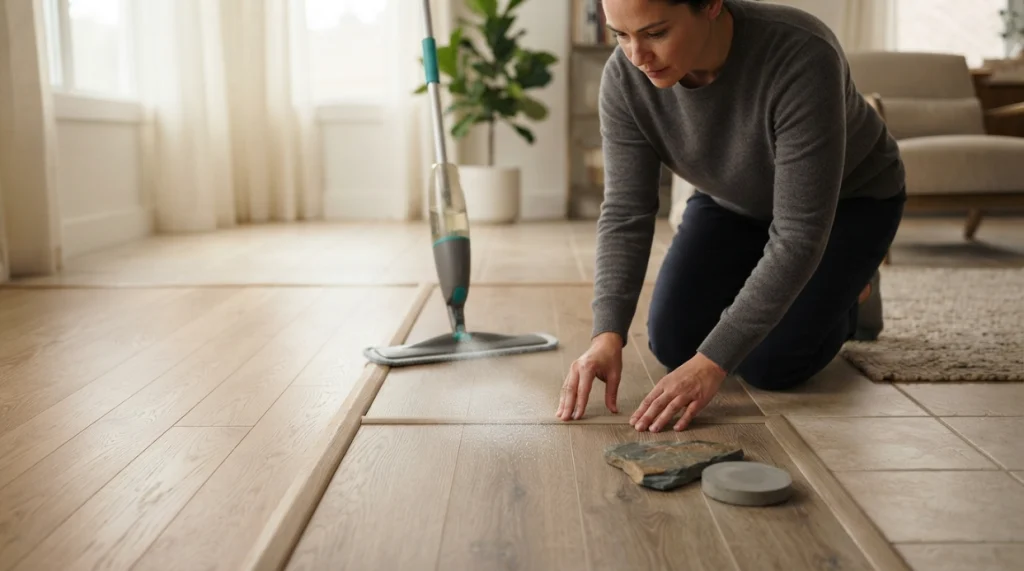
The best solution changes with the floor. Hardwood and laminate need tighter moisture control than ceramic tile, while natural stone requires careful attention to cleaner chemistry.
| Floor type | Best starting cleaner | Moisture level | Main concern |
|---|---|---|---|
| Sealed hardwood | Wood-safe, pH-neutral cleaner | Very light | Standing moisture and residue |
| Laminate | Laminate-approved low-residue cleaner | Very light | Moisture entering seams |
| Vinyl/LVP | Vinyl-safe pH-neutral cleaner | Light | Film and dullness |
| Ceramic/porcelain tile | Neutral multi-surface or tile cleaner | Light to moderate | Soap residue and grout buildup |
| Natural stone | Stone-specific pH-neutral cleaner | Light | Acid etching and sealer damage |
| Sealed concrete | Neutral floor cleaner | Moderate | Compatibility with coatings or sealers |
Hardwood and engineered wood
Use a cleaner specifically approved for your finish and keep the spray light. I never treat wood flooring like tile because water can enter joints, worn finish, or damaged areas.
The National Wood Flooring Association provides technical and homeowner resources for wood flooring. Your flooring manufacturer’s instructions should still be the final word for your installation.
Laminate
Laminate responds best to minimal liquid. I spray a small area, mop it immediately, and avoid leaving wet patches around plank edges.
Vinyl and LVP
Vinyl is often easier to maintain, but excess cleaner can make it look cloudy. A lightly damp microfiber pad and low-residue formula usually give the cleanest finish.
Tile and natural stone
Glazed ceramic and porcelain tile tolerate more routine moisture than wood. Natural stone needs a stone-approved formula because acidic cleaners can harm acid-sensitive materials such as marble and limestone.
Section Takeaway: Match the cleaner to the floor first, then control how much liquid the spray mop releases. There is no single homemade or commercial formula that is ideal for every flooring material.
Ready-to-use vs concentrate vs homemade cleaner
All three approaches can clean floors, but they are not equally convenient or predictable. For spray mops, I usually favor ready-to-use products because concentration errors are less likely.
Ready-to-use cleaner
- Best for: Convenience and consistent results.
- Advantage: No measuring or dilution is required.
- Watch for: Products that contain polish or are incompatible with your floor.
Ready-to-use formulas work especially well in refillable spray mops. You can fill the reservoir and clean without carrying a separate mixing container.
Concentrated floor cleaner
- Best for: Larger homes and economical refills.
- Advantage: One bottle can make many batches.
- Watch for: Using more concentrate than the label requires.
Measure concentrates instead of estimating by eye. A little extra detergent often makes floors harder to clean because the remaining film attracts dirt.
Homemade cleaner
DIY mixtures look attractive because they are inexpensive. The problem is that common ingredients such as vinegar are not suitable for every floor.
I would not use one universal vinegar-and-water recipe throughout a mixed-floor home. Acid-sensitive stone, certain finishes, and manufacturer warranty requirements make that approach risky.
Safety note: Never mix household cleaning chemicals unless the product directions explicitly permit it. Check the floor-care guide and chemical labels before making any DIY solution.
What should you not put in a spray mop?
Avoid anything that can damage the floor, clog the spray system, or leave a difficult coating. More cleaning power is not automatically better.
- Undiluted concentrate: It can leave residue and may exceed the product’s intended strength.
- Wax or polish products: These may create layers of buildup during routine cleaning.
- Dish soap in large amounts: Too many suds can leave a sticky film.
- Vinegar on sensitive surfaces: Acidic mixtures may harm natural stone or incompatible finishes.
- Bleach without approval: It can discolor or damage some floor materials and finishes.
- Mixed cleaning chemicals: Combining products can create dangerous reactions.
- Essential-oil-heavy mixtures: Oils may leave residue and can make a floor slippery.
The reservoir also matters. Some spray-mop manufacturers restrict what liquids can be used because thicker formulas can clog tubing or damage seals.
Check both sets of instructions. Your floor and your mop need to tolerate the same cleaner.
Safety note: Follow the spray-mop manual, floor manufacturer’s care instructions, and cleaning-product label rather than relying on a universal recipe.
Why does a spray mop leave streaks or sticky floors?
Most spray-mop streaking comes from excess cleaner, dirty pads, or residue that was already on the floor. The mop may simply spread that residue into thinner lines.
1. You are spraying too much solution
A spray mop needs surprisingly little liquid. I start with one or two trigger pulls across a manageable section, then add more only if the pad stops gliding comfortably.
2. The microfiber pad is overloaded
Once the pad fills with grease, dust, and cleaner, it stops lifting soil efficiently. It begins moving dirty solution from one area to another.
- Change pads when they look visibly soiled.
- Use several pads for a large floor.
- Wash reusable pads according to their care instructions.
- Avoid fabric treatments that reduce microfiber absorbency.
3. Too much cleaner has built up
If a floor becomes stickier each time you mop, suspect cleaner buildup. Adding another heavy application usually makes the problem worse.
A manufacturer-approved low-residue cleaning method may be needed to remove the film. Avoid aggressive stripping methods unless they are safe for the specific surface.
4. You skipped dry cleaning first
Vacuuming, sweeping, or dry microfiber cleaning should come first. Wetting loose dust creates muddy residue that is harder for a spray mop to collect.
Section Takeaway: When a spray mop starts leaving streaks, reduce the cleaner before changing to a stronger product. Clean pads and light applications solve many residue problems.
How much cleaner should you spray?
Use enough cleaner to lightly damp the cleaning path, not enough to leave visible puddles. The pad should glide smoothly while the floor dries relatively quickly.
I use this simple routine for ordinary maintenance cleaning:
- Remove dry debris first. Vacuum, sweep, or use a dry microfiber pad.
- Attach a clean pad. Starting with a dirty pad defeats the purpose.
- Spray a small section. Work in an area you can mop immediately.
- Mop with overlapping passes. This prevents missed strips between strokes.
- Check the surface. Reduce the spray if liquid remains behind.
- Change the pad when dirty. Large or greasy rooms may require several pads.
My kitchen test
In kitchens, I often see people spray extra cleaner around the stove because grease feels harder to remove. I get cleaner results by slowing down and making a second light pass instead.
The first pass loosens the soil. A fresh pad on the second pass removes more residue without coating the entire floor in extra detergent.
How fast should the floor dry?
There is no universal drying time because humidity, ventilation, temperature, floor type, and spray volume all change it. The practical goal is to avoid standing moisture, especially on wood and laminate.
If obvious wet patches sit behind your mop, use less liquid. Open airflow can also help the floor dry without repeated foot traffic crossing the area.
Do you need disinfectant in a spray mop?
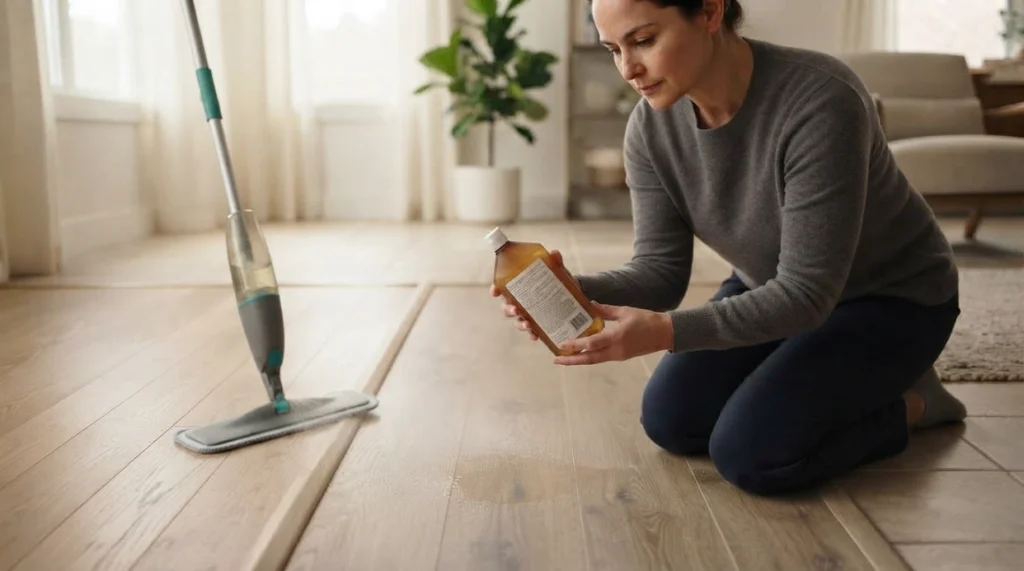
Not for normal everyday floor cleaning in most homes. The CDC explains that regular cleaning removes dirt and many germs, while routine disinfection is usually unnecessary unless someone is sick or at increased risk.
The CDC also recommends choosing products that are suitable for the surface and following their labels. You can review its home cleaning and disinfecting guidance.
Cleaning and disinfecting are different jobs
- Cleaning: Removes dirt, impurities, and many germs from a surface.
- Sanitizing: Reduces germs to specified levels.
- Disinfecting: Uses an appropriate disinfectant to kill many remaining germs.
If disinfection is genuinely needed, the product must be suitable for both the floor and the intended disinfecting task. Follow the required contact time instead of spraying and immediately wiping it dry.
Never mix disinfectants or cleaning chemicals. The CDC specifically warns against mixing products and recommends following label directions.
Safety note: A disinfectant that is effective against germs can still be unsuitable for your flooring. Check both the disinfectant label and the flooring manufacturer’s instructions before use.
Frequently asked questions
Can I use any floor cleaner in a refillable spray mop?
No. Use a cleaner that is compatible with both the mop and your floor. Some concentrated, oily, waxy, or thick products can leave residue, damage flooring, or interfere with the mop’s spray mechanism.
Is pH-neutral cleaner best for a spray mop?
A pH-neutral cleaner is a strong general starting point because many floor materials tolerate neutral formulas well. You still need to confirm that the specific product is approved for your floor finish or material.
Can I put vinegar in a spray mop?
You can only use vinegar where the flooring and mop manufacturers allow it. I avoid treating vinegar as a universal floor cleaner because acidic solutions can damage natural stone and may be unsuitable for certain finishes.
Can I put dish soap in a spray mop?
A small amount may be permitted for some washable surfaces, but dish soap can produce residue if used too strongly. A dedicated low-residue floor cleaner is generally easier to control for routine spray-mop cleaning.
What is the best spray-mop cleaner for laminate floors?
Choose a laminate-approved, low-residue cleaner and use it sparingly. Laminate seams are sensitive to excess moisture, so the goal is a lightly damp microfiber pad rather than a visibly wet floor.
What is the best spray-mop cleaner for vinyl plank flooring?
A vinyl or LVP-approved pH-neutral cleaner is a good starting choice. Avoid heavy polish, abrasive products, and excessive cleaner because residue can make vinyl look dull, cloudy, or sticky.
Why is my floor sticky after using a spray mop?
The most likely causes are too much cleaner, incorrect concentrate dilution, a dirty microfiber pad, or old product buildup. Reduce the amount of solution and use a clean pad before switching to a stronger chemical.
What is the best choice overall?
For most spray-mop cleaning, my first choice is a floor-specific, low-residue, pH-neutral cleaner. It gives you controlled cleaning without requiring a bucket or leaving a heavy layer of detergent behind.
Keep the method simple. Dry-clean first, spray lightly, use clean microfiber pads, and follow the care instructions for the floor beneath your feet.
That combination matters more than chasing the strongest cleaner. A gentle product used correctly usually produces a better-looking floor than an aggressive formula used too often.