
What Is the Best Spray Mop for Kitchen Floors?

Quick Answer
The best spray mop for kitchen floors is a lightweight model with a washable microfiber pad, controlled spray trigger, refillable solution tank, and low-profile swivel head. It should remove crumbs, grease, and everyday spills without soaking the floor. Choose a cleaner approved for your flooring, and remember that routine cleaning is usually enough for household floors according to CDC cleaning guidance.
What I look for in a kitchen spray mop
- Washable microfiber: It grabs fine crumbs, dust, grease, and sticky residue without requiring disposable pads.
- Controlled spray: A trigger lets you apply moisture only where you need it.
- Refillable bottle: You can use the cleaner recommended for your particular kitchen floor.
- Swivel head: A maneuverable head reaches around cabinets, islands, tables, and appliance edges.
- Low moisture: This matters especially on hardwood, engineered wood, laminate, and floors with vulnerable seams.
Best overall approach
- Sweep or vacuum crumbs first, lightly spray a small section, mop with microfiber, and let the floor dry before walking on it.
I’ve cleaned enough kitchen floors to know that the fanciest mop isn’t always the most useful one. Kitchens need something quick, controllable, and easy to grab after cooking.
A good spray mop fits that job well. In this guide, I’ll explain what separates a useful kitchen spray mop from a frustrating one and how to match it to your floor.
In This Guide
- What type of spray mop is best for a kitchen?
- Which spray mop features matter most?
- Which spray mop works for each kitchen floor type?
- Is a spray mop better than a steam, spin, or flat mop?
- What cleaning solution should you put in a spray mop?
- Can a spray mop handle grease and sticky kitchen spills?
- How do you use a spray mop without streaks?
- Frequently asked questions
- Final takeaway
What Type of Spray Mop Is Best for a Kitchen?
For most kitchens, I prefer a refillable microfiber spray mop with a manual trigger. It offers the best balance of moisture control, cleaning power, convenience, and floor compatibility.
A spray mop is a floor-cleaning tool with an onboard liquid reservoir. Pulling its trigger releases a small amount of cleaning solution ahead of the mop pad.
Why microfiber works so well
Microfiber is made from extremely fine synthetic fibers that help collect dust and grime. A quality pad also provides enough gentle friction to loosen dried footprints and light food residue.
I favor washable pads over single-use sheets. I can change pads when one becomes greasy instead of continuing to spread residue across the kitchen.
- Fine debris: Microfiber catches dust and small crumbs after sweeping.
- Greasy film: The fibers provide useful agitation without an aggressive scrubber.
- Footprints: Light moisture usually removes everyday traffic marks quickly.
- Reusable cleaning: Washable pads reduce dependence on disposable refills.
Why a manual spray trigger helps
A manual trigger gives you more control than a mop that continuously dispenses liquid. One or two sprays can cover a small dirty area without flooding nearby seams.
This is especially useful around refrigerators and dishwashers. Those areas already see more moisture than most kitchen flooring.
Why refillable systems are more flexible
Refillable bottles let you match the solution to the flooring instead of accepting one universal cleaner. That flexibility matters when your kitchen contains hardwood, laminate, LVP, stone, or specialty tile.
A sealed proprietary bottle can still clean well. However, you may have fewer choices if the supplied formula doesn’t suit your floor.
Section Takeaway: For most kitchens, choose a refillable manual-trigger spray mop with washable microfiber. Prioritize moisture control over extra gadgets.
Which Spray Mop Features Matter Most?
The best kitchen mop isn’t the one with the longest feature list. The important features make cleaning faster while reducing residue and excess water.
Look for these seven features
- Washable pads: Ideally, keep two or three so you can swap a dirty pad during a larger cleaning session.
- Fine spray pattern: A mist is easier to control than a concentrated stream.
- Refillable reservoir: This lets you choose a floor-compatible cleaner.
- Swivel steering: Kitchens have chair legs, islands, toe kicks, and narrow appliance gaps.
- Low-profile head: A flatter head reaches farther beneath cabinets and furniture.
- Comfortable trigger: A stiff trigger becomes annoying during frequent spot cleaning.
- Replaceable components: Available replacement pads and bottles can extend the mop’s useful life.
Do you need a built-in scrubber?
A small non-scratch scrub section can help with dried sauce or footprints. I wouldn’t make it my first priority, though.
For stubborn food, I usually soften the spot first. Scrubbing aggressively on an unknown finish creates more risk than benefit.
How heavy should the mop be?
A kitchen mop should feel easy to lift with one hand. You’re more likely to use a light mop for a two-minute cleanup after dinner.
Large tanks increase runtime but also increase weight. For a typical residential kitchen, a moderate reservoir is usually more practical.
Which Spray Mop Works for Each Kitchen Floor Type?
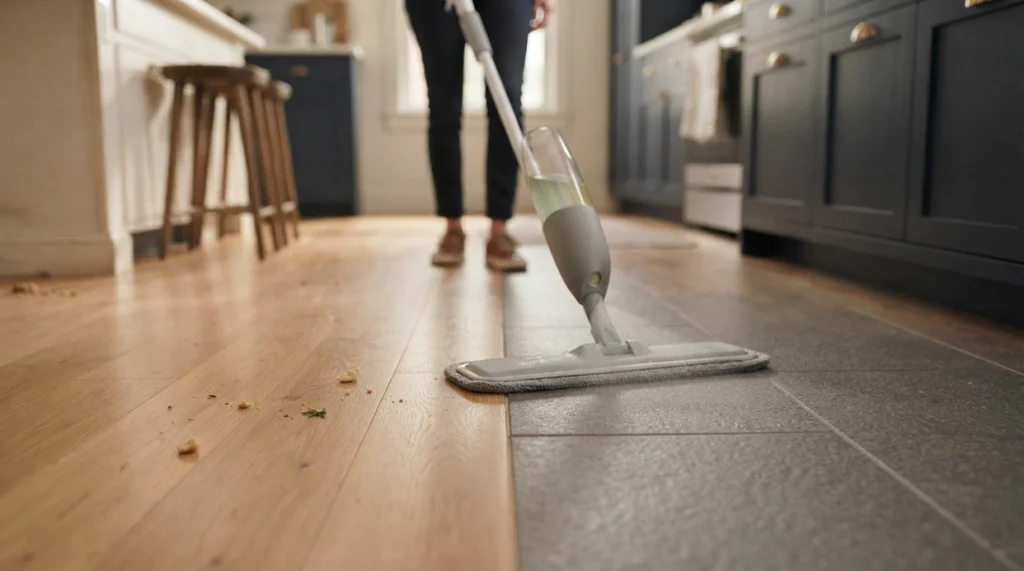
A spray mop can work on many sealed hard floors, but the cleaning solution and moisture level must match the surface. The same liquid shouldn’t automatically go on every floor.
| Kitchen Floor | Spray Mop? | Best Approach | Main Caution |
|---|---|---|---|
| Sealed hardwood | Yes, cautiously | Minimal mist and wood-approved cleaner | Standing water and excess moisture |
| Engineered wood | Usually | Light damp cleaning | Moisture entering seams |
| Laminate | Usually | Fine mist and microfiber | Overwetting edges and joints |
| Vinyl/LVP | Yes | Damp microfiber and mild cleaner | Harsh chemicals or excessive liquid |
| Ceramic/porcelain tile | Yes | Regular spray cleaning | Dirty grout may need separate scrubbing |
| Natural stone | Yes, with care | Stone-safe pH-neutral cleaner | Acidic or unsuitable cleaners |
Hardwood needs the most moisture control
Wood and excessive water are a poor combination. The National Wood Flooring Association maintenance guidance recommends dry or slightly damp cleaning and advises against wet and steam mopping.
On sealed hardwood, spray lightly rather than coating an entire section. The pad should feel damp, not dripping wet.
Safety note: Always check your flooring manufacturer’s care instructions before using water, cleaner, polish, or another chemical product.
Laminate and LVP benefit from controlled spray
Both floors are popular in busy kitchens because everyday cleanup is simple. Their seams still deserve attention.
Spray only enough cleaner to loosen soil. Don’t leave visible puddles sitting while you clean another room.
Tile tolerates more cleaning, but grout changes the job
Ceramic and porcelain tile pair well with spray mops for routine maintenance. A flat microfiber pad can quickly remove cooking film and footprints.
Deep grout discoloration is different. You’ll often need a grout brush or another targeted method rather than more spray.
Section Takeaway: The mop can stay the same while the cleaner and moisture level change. Always match your routine to the floor material.
Is a Spray Mop Better Than a Steam, Spin, or Flat Mop?
For quick kitchen maintenance, I usually reach for a spray mop first. Other mop types become more useful when the mess or floor surface changes.
| Mop Type | Best Kitchen Use | Main Advantage | Main Limitation |
|---|---|---|---|
| Spray mop | Daily maintenance and spot cleaning | Fast and controlled | Limited deep scrubbing |
| Spin mop | Larger or dirtier areas | Adjustable mop moisture | Bucket setup takes longer |
| Steam mop | Compatible sealed surfaces only | Heat-assisted cleaning | Not suitable for many moisture- or heat-sensitive floors |
| Traditional flat mop | Flexible general cleaning | Simple and lightweight | Cleaner is stored separately |
Spray mop vs spin mop
A spin mop makes sense for a large tile kitchen or a mess requiring repeated rinsing. The bucket also lets you control how wet the mop head remains.
The spray mop wins for convenience. There’s no bucket to fill, carry, empty, or clean afterward.
Spray mop vs steam mop
Steam and spray mops solve different problems. A spray mop relies on cleaner, microfiber, and agitation, while a steam mop uses heated vapor.
I consider the spray mop more versatile across mixed residential flooring. Steam should only be used when the flooring manufacturer explicitly permits it.
What Cleaning Solution Should You Put in a Spray Mop?
Use a solution that is both compatible with the mop and approved for the floor. A pH-neutral floor cleaner is often a practical starting point for many sealed surfaces.
pH-neutral means the solution is neither strongly acidic nor strongly alkaline. That doesn’t automatically make every neutral cleaner safe for every floor, so read both labels.
More cleaner does not mean a cleaner floor
Overusing concentrated cleaner can leave residue. That residue may make a kitchen floor look cloudy, feel tacky, or show footprints faster.
Follow the dilution instructions if the product requires dilution. Never estimate a stronger mixture because the floor looks dirty.
Do you need disinfectant in a kitchen spray mop?
Usually, routine floor cleaning and disinfection are different jobs. The EPA distinguishes cleaning from sanitizing and disinfecting, with disinfectants requiring products designed and labeled for that purpose.
For normal household floor maintenance, focus first on removing dirt and residue. If disinfection is needed, follow the disinfectant label for compatible surfaces and required contact time.
Safety note: Never mix cleaning chemicals or add bleach, disinfectant, vinegar, or another ingredient to a mop reservoir unless the product and mop instructions specifically allow it.
Can a Spray Mop Handle Grease and Sticky Kitchen Spills?
Yes, a spray mop handles light grease, footprints, drips, and many sticky spills well. Heavy grease or dried food usually needs spot treatment first.
For a fresh spill
- Pick up solid food with a paper towel or cloth.
- Blot excess liquid rather than spreading it.
- Apply a small amount of compatible cleaner.
- Mop the area with a clean microfiber pad.
- Dry the spot if visible moisture remains.
For dried sticky residue
Give the cleaner a brief chance to soften the spot according to its label. Then make several controlled passes instead of forcing the mop downward.
If the pad becomes greasy, change it. A saturated pad can simply redistribute cooking residue.
For heavy kitchen grease
A spray mop is a maintenance tool, not a substitute for every deep-cleaning method. Heavy grease near a stove may require targeted cleaning with a floor-safe degreasing product.
I’ve found this especially noticeable beside ranges. Using one clean pad around the cooking zone and another for the rest of the room often produces a cleaner finish.
Safety note: Test unfamiliar cleaners in an inconspicuous area and follow the floor manufacturer’s guidance before treating grease or stubborn residue.
How Do You Use a Spray Mop Without Streaks?
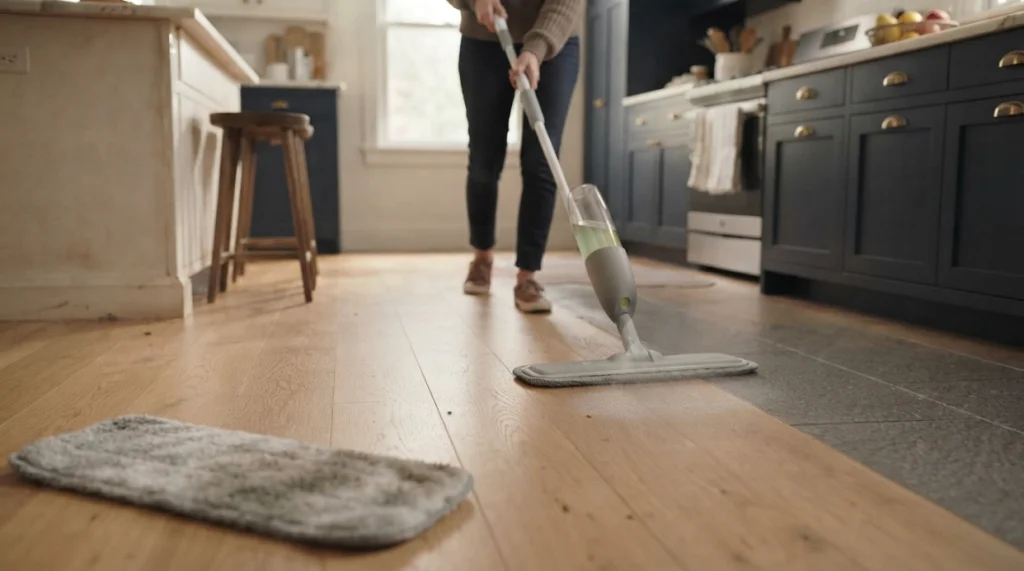
The key is using less liquid and keeping the pad clean. Most streaking problems I see come from excess cleaner, dirty pads, or mopping over loose debris.
My seven-step kitchen routine
- Remove chairs and small obstacles. This reduces repeated passes over wet areas.
- Sweep or vacuum first. Pick up crumbs, grit, pet hair, and loose soil.
- Start with a clean pad. A greasy pad cannot leave a clean finish.
- Work in small sections. Spray only the area you can mop immediately.
- Use overlapping passes. Guide soil toward yourself rather than randomly moving it around.
- Change dirty pads. Don’t finish the entire floor with one saturated pad if it becomes visibly soiled.
- Allow the floor to dry. Keep children and pets away until it is no longer damp or slippery.
How often should you spray-mop a kitchen?
There isn’t one schedule for every household. Mop when the floor is visibly dirty, sticky, or developing traffic marks.
A busy kitchen may need light spot cleaning several times each week. A full damp mopping can usually wait until the floor actually needs it.
Why pre-cleaning matters
A spray mop isn’t designed to collect a pile of cereal, sand, or pet food. Dragging hard debris underneath the pad may also increase scratching risk on sensitive finishes.
Spend one minute sweeping first. That small step makes the wet-cleaning stage much more effective.
Section Takeaway: Use a clean pad, a light mist, and small working sections. More water and more cleaner usually make streaking worse rather than better.
Frequently Asked Questions
What is the best spray mop for kitchen tile floors?
Choose a refillable spray mop with washable microfiber, a sturdy swivel head, and good trigger control. Ceramic and porcelain tile are well suited to routine spray mopping, although heavily soiled grout may need separate brushing.
What is the best spray mop for hardwood kitchen floors?
Look for precise spray control and a soft microfiber pad. Use minimal moisture and only a cleaner approved for your wood finish. Never leave puddles or a soaking-wet pad sitting on hardwood.
Can I use a spray mop on laminate flooring?
A spray mop can work well on many laminate floors because it provides controlled moisture. Use a fine mist, avoid soaking seams, and follow the laminate manufacturer’s care instructions.
Can I put vinegar in a spray mop?
Only if both the mop manufacturer and flooring manufacturer permit it. Acidic homemade solutions aren’t suitable for every finish or natural stone. A manufacturer-approved floor cleaner is the safer choice when you’re uncertain.
Are reusable spray mop pads better than disposable pads?
Reusable microfiber pads are my preference for routine kitchen cleaning because you can wash and rotate them. Disposable systems can still be convenient for occasional messes or households where washing heavily soiled pads is impractical.
Should I disinfect my kitchen floor every day?
Usually not. Routine cleaning removes dirt and much of the contamination found on household surfaces. Disinfection becomes more relevant in specific situations, such as illness, and should always follow the disinfectant product’s label.
Is a spray mop worth buying if I already own a regular mop?
It can be. A spray mop is especially useful for quick spills and small kitchen cleanups because there’s no bucket setup. Keep your traditional mop if you regularly tackle larger or heavily soiled floors.
Final Takeaway: The Best Kitchen Spray Mop Is the One You’ll Use Correctly
As of 2026, I still think simplicity wins for this job. A refillable spray mop with washable microfiber, reliable trigger control, swivel steering, and a lightweight body covers what most kitchens need.
Pay even more attention to the floor beneath it. Hardwood, laminate, vinyl, tile, and natural stone don’t all tolerate the same cleaners or moisture levels.
- For everyday spills: Use a light spray and clean microfiber.
- For greasy areas: Change pads before residue spreads.
- For sensitive flooring: Minimize moisture and check the manufacturer’s instructions.
- For deep cleaning: Use a separate floor-appropriate method when the spray mop isn’t enough.
If you want one mop that can stay ready in the kitchen for fast everyday floor cleaning, a well-designed microfiber spray mop is one of the most practical choices.