
What Are the Best Spray Mops for Wooden Floors?

Quick Answer
The best spray mops for wooden floors use a washable microfiber pad, release a controlled fine mist, and work with a wood-safe cleaner. My top overall choice is the Bona Premium Spray Mop for Hardwood Floors, while the O-Cedar ProMist MAX is a strong refillable alternative. Whatever you choose, follow the National Wood Flooring Association’s wood-floor maintenance guidance and avoid soaking the floor.
What I look for in a wood-floor spray mop
- Fine mist: The sprayer should dampen the surface without creating puddles between boards.
- Microfiber pad: Soft microfiber lifts dust and grime without aggressive scrubbing.
- Wood-safe cleaner: Use a cleaner recommended for your floor’s finish rather than a generic detergent.
- Washable pads: Reusable pads make regular cleaning cheaper and reduce disposable waste.
- Good control: A manual trigger helps you decide exactly how much liquid reaches the floor.
Best quick picks
- Best overall: Bona Premium Spray Mop for Hardwood Floors.
- Best refillable option: O-Cedar ProMist MAX.
- Best disposable-pad system: Swiffer PowerMop Wood.
When people ask me about the best spray mops for wooden floors, I care more about moisture control than scrubbing power. Wood is different from tile because excess liquid can work into seams and damage the finish or boards.
I also prefer a spray mop over a traditional wet mop for routine floor cleaning. You can apply cleaner exactly where you need it, then immediately pick it up with microfiber.
In This Guide
- Which spray mops are best for wooden floors?
- Why are spray mops a good choice for wood floors?
- How do you choose a spray mop for wooden floors?
- What cleaner should you put in a spray mop?
- How should you use a spray mop on wood?
- Is a spray mop better than a steam mop for wood?
- What spray-mopping mistakes damage wooden floors?
- Frequently asked questions
Which Spray Mops Are Best for Wooden Floors?
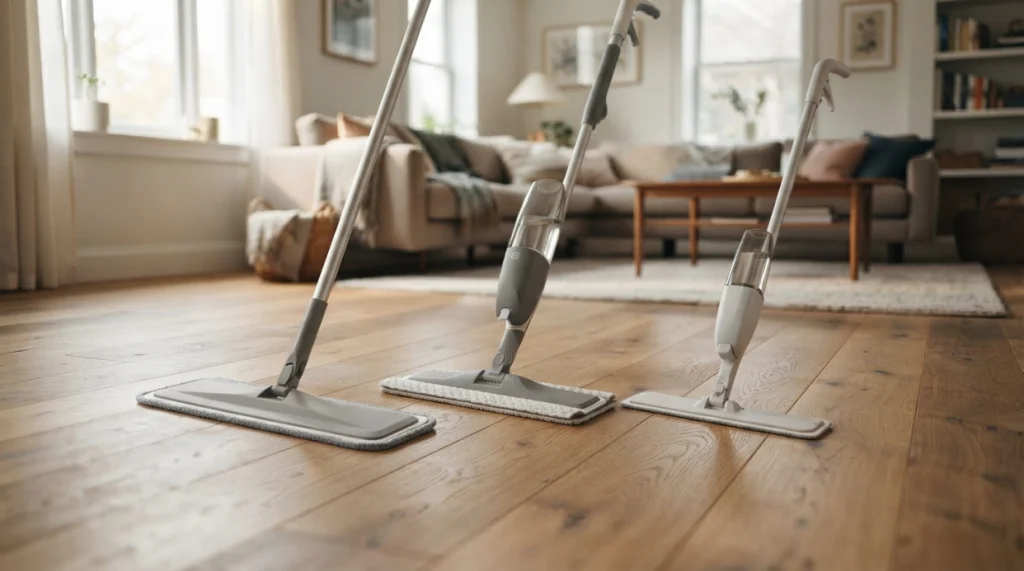
For most finished wooden floors, I favor spray mops that combine a soft microfiber head with tight liquid control. As of 2026, these are the options I would put at the top of a practical shortlist.
1. Bona Premium Spray Mop for Hardwood Floors — Best Overall
Bona is my first choice when the home has mostly finished hardwood. The system pairs a refillable cartridge with a wide microfiber head and a wood-floor-specific cleaner.
The spray is fine enough that I can clean a small section without making the boards visibly wet. That’s exactly what I want on hardwood.
- Best for: Regular cleaning of unwaxed, polyurethane-finished wood floors.
- Pad: Washable microfiber.
- Cleaner: Refillable Bona hardwood-floor cleaner cartridge.
- Main advantage: The mop, pad, and cleaning formula are designed as one wood-floor system.
- Watch for: Use the cleaner appropriate for your exact floor finish.
2. O-Cedar ProMist MAX — Best Refillable Multipurpose Pick
The O-Cedar ProMist MAX is a good fit if you want more control over what goes into the bottle. Its trigger is manual, so there are no batteries to manage.
I especially like its double-sided microfiber head. You can clean with one side, flip the pad, and continue before stopping to wash it.
- Best for: Homes with several compatible hard-floor types.
- Pad: Reusable, double-sided microfiber.
- Bottle: Refillable.
- Main advantage: Flexible cleaner choice and controlled manual spray.
- Watch for: A refillable bottle doesn’t mean every homemade cleaner is safe for wood.
3. Swiffer PowerMop Wood — Best for Disposable Convenience
Swiffer PowerMop Wood suits people who value fast setup and don’t want to wash reusable pads. Its wood version uses pads designed for hardwood and a premixed cleaning system.
The tradeoff is ongoing refill cost. You’re buying replacement pads and solution instead of washing a reusable microfiber pad.
- Best for: Quick cleanup and convenience.
- Pad: Disposable wood-floor pad.
- Cleaner: Premixed proprietary solution.
- Main advantage: Minimal cleanup after mopping.
- Watch for: Higher long-term consumable costs than washable-pad systems.
| Spray Mop | Best For | Pad Type | Refillable | Moisture Control |
|---|---|---|---|---|
| Bona Premium Spray Mop | Dedicated hardwood care | Washable microfiber | Yes | Excellent |
| O-Cedar ProMist MAX | Flexible everyday cleaning | Double-sided microfiber | Yes | Very good |
| Swiffer PowerMop Wood | Fast disposable-pad cleaning | Disposable | Uses system refills | Good |
Section Takeaway: For dedicated hardwood cleaning, Bona is my strongest all-around choice. O-Cedar makes more sense when you want reusable pads and greater control over the cleaning solution.
Why Are Spray Mops a Good Choice for Wood Floors?
A spray mop is a flat mop with an onboard bottle that releases cleaning liquid ahead of its pad. Unlike a bucket mop, it lets you apply a small amount of moisture exactly where you need it.
That distinction matters on real wood. The National Wood Flooring Association recommends avoiding wet mops and emphasizes using only a dry or slightly damp approach.
You control the amount of liquid
A bucket mop can hold far more water than a wooden floor needs. Even after wringing, it can leave a wet trail or push liquid into plank joints.
A good spray mop gives you short bursts instead. I normally spray only enough to make the microfiber glide smoothly across a small working area.
Microfiber handles routine soil well
Microfiber contains very fine synthetic fibers that trap dust and pick up moisture. It works well for footprints, light kitchen residue, pet tracks, and ordinary surface dirt.
You still need to vacuum grit first. Dragging sand or hard particles under any mop pad can scratch a wood finish.
There is no dirty mop bucket
Traditional mopping often means repeatedly putting a mop back into increasingly dirty water. A spray mop avoids that cycle.
I prefer keeping two clean microfiber pads nearby. Once the first pad becomes visibly dirty, I switch instead of spreading the collected soil into the next room.
Section Takeaway: Spray mops suit wood because they combine controlled moisture with soft microfiber. The advantage disappears if you overspray or use an unsuitable cleaner.
How Do You Choose a Spray Mop for Wooden Floors?
Start with your floor finish, not the mop brand. A product marked “hard-floor safe” isn’t automatically suitable for every solid or engineered wood floor.
Look for a controlled spray pattern
A fine, even mist is better than a heavy jet. You want coverage without droplets collecting along plank edges.
Test the trigger on a small area first. One or two pulls should normally cover a workable section without leaving standing moisture.
Choose soft, removable microfiber
The pad should lie flat against the floor and stay secure while turning. Loose edges can fold underneath and trap debris.
Washable pads are useful if you clean several rooms. Keep at least two so you don’t continue mopping with a heavily soiled pad.
Check head size and maneuverability
A wide head moves faster through open rooms. A smaller swivel head can be easier around table legs, toilets, furniture, and narrow hallways.
- Large open rooms: Favor a wider cleaning head.
- Furniture-heavy rooms: Favor a strong swivel joint.
- Stairs: Choose a light mop that’s easy to lift.
- Small apartments: Consider storage height and hanging options.
Consider refill cost before buying
A cheap starter kit can become expensive if it requires proprietary disposable pads. Calculate the cleaner and pad cost over a full year.
Reusable microfiber usually costs more upfront but less per cleaning. Disposable systems can still make sense when convenience is your priority.
What Cleaner Should You Put in a Spray Mop?
Use a cleaning product approved for your wooden floor’s finish. For routine wood-floor cleaning, I prefer a fast-drying, residue-free formula designed specifically for finished wood.
The EPA Safer Choice product search is also useful when you want to identify cleaning products that meet the program’s ingredient and performance criteria.
Why pH-neutral cleaners are common choices
A pH-neutral cleaner is neither strongly acidic nor strongly alkaline. Wood-floor formulations commonly use this approach because aggressive chemistry can harm some finishes or leave them dull.
The exact product still matters. Follow both the flooring manufacturer’s guidance and the cleaning-product label.
Should you use vinegar?
I don’t recommend making vinegar the default cleaner for finished hardwood. Acidic DIY formulas may conflict with the finish manufacturer’s care instructions.
A wood-specific product removes the guesswork. It also makes it easier to control concentration and residue.
Do you need disinfectant on a wooden floor?
Usually, routine cleaning is enough for ordinary household floors. The CDC’s cleaning and disinfecting guidance notes that regular cleaning removes dirt and many germs, while disinfection is more relevant in situations such as illness.
Don’t pour bleach or another disinfectant into a spray-mop reservoir unless both the mop maker and flooring manufacturer allow it.
Safety note: Always check your floor manufacturer’s care guide and the cleaner label before using vinegar, bleach, disinfectant, concentrated detergent, or another chemical on wood.
How Should You Use a Spray Mop on Wood?
The safest technique is simple: remove grit first, use minimal cleaner, and never leave moisture sitting on the boards. I work in small sections instead of spraying an entire room at once.
- Vacuum or dry-mop first. Remove sand, crumbs, pet hair, and other loose debris.
- Inspect the floor. Don’t wet-mop boards with exposed raw wood, open seams, or obvious water damage.
- Attach a clean pad. A dirty microfiber pad can smear residue instead of removing it.
- Spray lightly. Apply a fine mist over a small section rather than saturating the floor.
- Mop with the grain. Long passes following the board direction make residue easier to collect.
- Change dirty pads. Swap pads when microfiber becomes loaded with soil.
- Check for wet spots. Wipe any excess moisture immediately with clean, dry microfiber.
How often should wooden floors be spray-mopped?
There’s no single schedule for every home. High-traffic kitchens and entryways may need light cleaning several times a week, while quieter rooms may need much less.
Don’t wet-clean just because the calendar says so. Vacuuming or dry microfiber dusting is often enough between deeper cleans.
Is a Spray Mop Better Than a Steam Mop for Wood?
For most wooden floors, yes. A spray mop offers much tighter moisture and temperature control because it applies room-temperature cleaner rather than hot vapor.
NWFA maintenance guidance specifically advises against wet mops and steam mops on wood floors. Heat and moisture can damage the finish and wood over repeated use.
| Feature | Spray Mop | Steam Mop |
|---|---|---|
| Moisture | Fine, user-controlled mist | Hot vapor |
| Heat exposure | None required | High |
| Wood-floor suitability | Good when floor and cleaner are compatible | Generally discouraged by NWFA |
| Cleaning control | High | Depends on steam output |
I wouldn’t use steam just because the floor is described as “sealed.” Seams, worn finish, scratches, and manufacturer restrictions still matter.
Safety note: Never assume sealed hardwood or engineered wood is steam-safe. Check the flooring warranty and care instructions first.
What Spray-Mopping Mistakes Damage Wooden Floors?
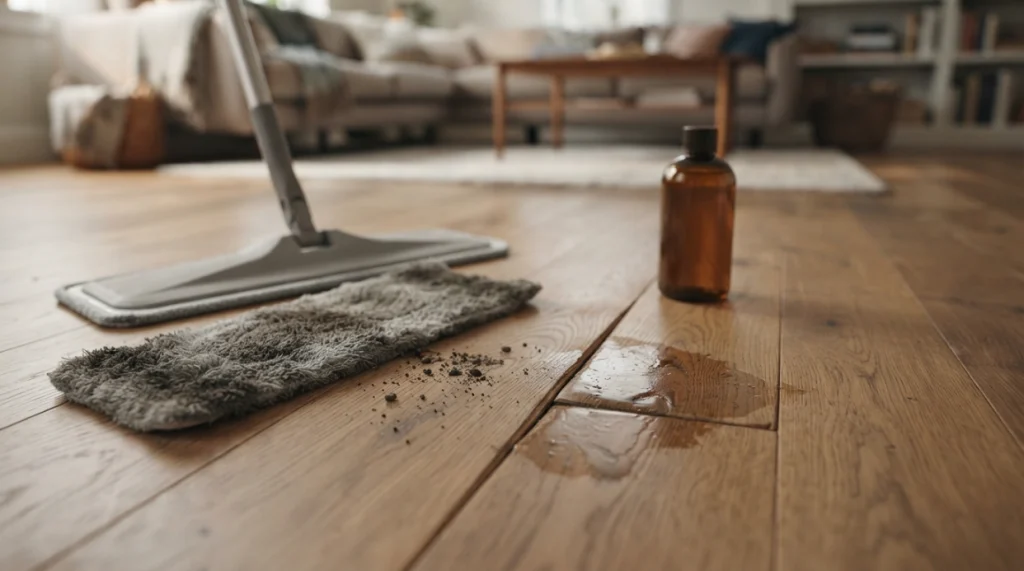
Most spray-mop problems aren’t caused by the mop itself. They come from excessive liquid, dirty pads, or incompatible cleaning products.
- Overspraying: More cleaner doesn’t mean a cleaner floor. Excess liquid can collect in plank joints.
- Skipping vacuuming: Hard grit trapped under microfiber can create fine scratches.
- Using one pad everywhere: A saturated, dirty pad spreads soil and leaves streaks.
- Adding random detergent: Dish soap and concentrated cleaners can leave a sticky film.
- Using polish repeatedly: Some shine-restoring products create buildup rather than cleaning the finish.
- Ignoring damaged boards: Moisture reaches wood faster where finishes are worn or seams have opened.
- Leaving spills: A spray mop isn’t a substitute for immediately blotting standing liquid.
What if the floor looks cloudy after mopping?
Cloudiness often points to cleaner residue, too much product, or a contaminated mop pad. Stop adding more cleaner until you identify the source.
Use the floor manufacturer’s approved method to remove residue. Avoid experimenting with aggressive solvents or acidic DIY mixtures.
What if the floor stays wet?
A correctly damp-cleaned wood floor shouldn’t be covered with puddles. If you can see pooled liquid, pick it up immediately with dry microfiber.
Reduce the number of trigger pulls during the next section. Your goal is a light cleaning film, not a visibly soaked surface.
Section Takeaway: The best spray mop can still damage wood when you oversaturate the floor. Cleaner compatibility and moisture control matter more than aggressive scrubbing.
Frequently Asked Questions
Are spray mops safe for hardwood floors?
Yes, a spray mop can be suitable for many finished hardwood floors when it releases minimal liquid and uses an approved wood-floor cleaner. Check your flooring manufacturer’s care instructions first, especially if the finish is worn, waxed, oiled, or unknown.
What is the best spray mop for hardwood floors?
For most homes, I would start with the Bona Premium Spray Mop for Hardwood Floors. It combines a fine spray, washable microfiber pad, refillable cleaner cartridge, and a cleaning formula designed specifically for finished wood.
Can I put water in a spray mop for hardwood?
That depends on the mop system and your floor. Plain water may work for light damp cleaning on some finishes, but too much water can still damage wood. Always use the smallest practical amount and follow the flooring manufacturer’s directions.
Can I use a spray mop on engineered wood?
Possibly, but engineered wood isn’t automatically moisture-safe. The upper layer is still real wood on many products, while seams and the underlying core can be sensitive to moisture. Follow the specific flooring manufacturer’s cleaning instructions.
Is Bona or O-Cedar better for wooden floors?
Bona is my preference for a dedicated hardwood system because its mop and cleaner are designed together for wood-floor care. O-Cedar ProMist MAX is more flexible if you want a refillable bottle, reusable double-sided microfiber, and one mop for several hard-floor types.
Can I put vinegar in a refillable spray mop?
You physically can with some refillable bottles, but that doesn’t mean you should use vinegar on your wooden floor. Acids may conflict with certain finishes or warranties. A manufacturer-approved wood-floor cleaner is the safer default.
Should I disinfect my wooden floor every time I mop?
No. Routine household floor care normally focuses on removing dirt and residue. CDC guidance says regular cleaning is sufficient in many home situations, while disinfection becomes more relevant when illness or another specific contamination concern is present.
Which Spray Mop Should You Buy?
If you want one straightforward recommendation, I’d choose the Bona Premium Spray Mop for Hardwood Floors for a home dominated by finished wood. Its controlled spray and wood-specific cleaning system address the biggest concern I have with hardwood: excess moisture.
Choose the O-Cedar ProMist MAX when refillability, reusable microfiber, and multi-floor flexibility matter more. Swiffer PowerMop Wood makes sense when disposable convenience is your priority.
Whatever mop you buy, the technique matters most. Vacuum first, spray lightly, use clean microfiber, and never leave water standing between wooden boards.