
Can You Put Anything Other Than Water in a Steam Mop?

Quick Answer
Usually, no. Most steam mops are designed for plain water only, and adding vinegar, bleach, essential oils, detergent, disinfectant, or regular floor cleaner can damage the heating system or leave unwanted residue. For example, BISSELL’s steam-mop guidance specifically says not to put chemicals in the water tank.
What should stay out of the tank?
- Vinegar: Its acidity may affect seals, hoses, heating parts, and some floor finishes.
- Essential oils: Oils do not mix properly with water and may coat or clog internal components.
- Bleach: Never improvise with bleach inside a heated steam appliance.
- Floor cleaner: Regular detergents can foam, leave residue, or damage a water-only system.
- Disinfectants: A product being floor-safe does not mean it is steam-mop-tank-safe.
The exception
- Use something besides plain water only when your exact steam-mop manual specifically approves it, such as a manufacturer-approved demineralized water or a separate solution system.
I understand why people want to add something extra to a steam mop. A little vinegar, cleaner, or fragrance seems like it should make floor cleaning more effective.
In practice, steam mops work differently from spin mops and traditional mop buckets. This guide explains what belongs in the tank, what doesn’t, and safer ways to get cleaner or better-smelling floors.
In This Guide
- What Can You Put in a Steam Mop Besides Water?
- Why Do Most Steam Mops Say to Use Water Only?
- What Should You Never Put in a Steam Mop?
- Should You Use Distilled Water or Tap Water?
- Does the Type of Floor Change What You Should Use?
- How Can You Get Better Results Without Adding Cleaner?
- What Mop Should You Use If You Want Cleaning Solution?
- What Should You Do If You Already Put Cleaner in the Tank?
- Frequently Asked Questions
- Final Takeaway
What Can You Put in a Steam Mop Besides Water?
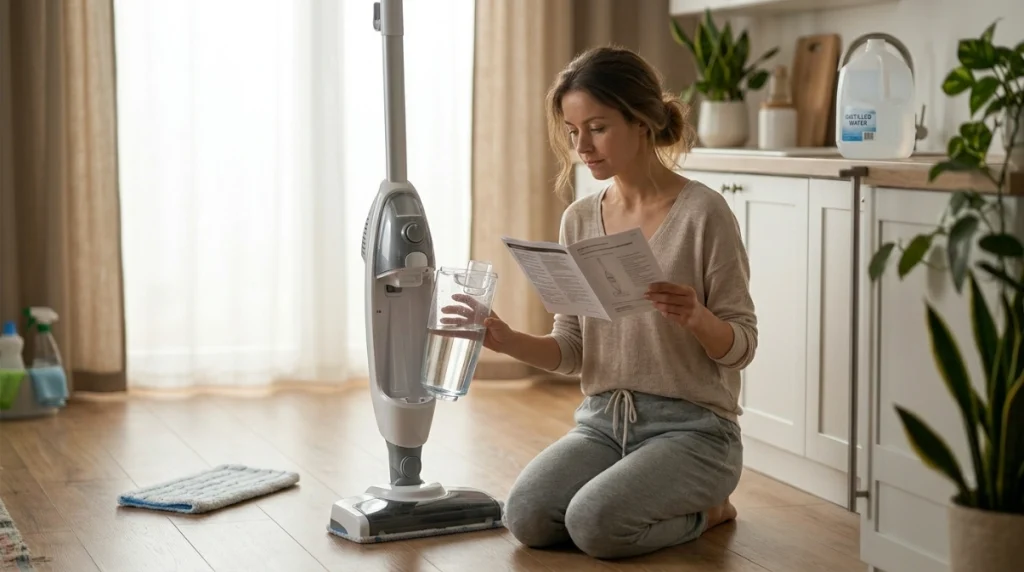
For most steam mops, **plain water is the only safe tank choice**. Anything else should be treated as unsuitable unless the manufacturer explicitly approves it for your exact model.
Definition: A steam mop is an electric floor-cleaning appliance that heats water inside the machine and sends hot vapor through a cleaning pad. Unlike a conventional mop, its tank, pump, tubing, and heater are designed around water rather than ordinary detergent mixtures.
As of 2026, manufacturer instructions remain the best authority because designs vary. Some BISSELL models, for example, recommend distilled or demineralized water.
A manufacturer may also sell scented demineralized water made specifically for compatible steam machines. That is different from pouring fragrance oil or household cleaner into the reservoir yourself.
Check these three things before adding anything
- Your steam-mop manual: Look under filling the tank, water requirements, warnings, or approved solutions.
- The cleaner label: A cleaner labeled for floors is not automatically approved for heated appliances.
- Your flooring care guide: Even a steam-mop-safe liquid may be unsuitable for your particular floor.
Safety note: Never assume two individually safe cleaning products are safe when heated or mixed. Follow the appliance manual, product label, and flooring manufacturer’s care instructions.
Section Takeaway: Unless your exact manual says otherwise, treat a steam mop as a water-only appliance.
Why Do Most Steam Mops Say to Use Water Only?
Steam mops rely on narrow water pathways, pumps, valves, and heating chambers. Household cleaning mixtures may behave differently when heated or concentrated inside those parts.
The issue isn’t simply whether a liquid can make steam. The appliance must also move that liquid safely without deposits, foam, oil, corrosion, or residue.
Cleaners can leave deposits inside the machine
A floor detergent contains ingredients designed to stay on a surface long enough to loosen soil. Those same ingredients can collect inside a steam mop’s small internal passages.
That buildup can eventually reduce steam output. In severe cases, you may get sputtering, dripping, uneven heating, or a clogged nozzle.
Oils behave differently from water
Essential oils don’t dissolve evenly in plain water. They may cling to tank walls, seals, tubing, or other components instead.
I find a clean microfiber pad makes a bigger practical difference than adding fragrance. Once a pad becomes loaded with grime, steam alone cannot make that dirty pad clean efficiently.
Heat changes the situation
A cleaner that works perfectly in a spray bottle isn’t necessarily designed for a heated reservoir. This is why the appliance manufacturer’s directions matter more than a generic DIY floor-cleaning recipe.
Safety note: Do not experiment with chemical mixtures inside a heated appliance. If the manual says water only, follow that instruction.
What Should You Never Put in a Steam Mop?
Vinegar, bleach, essential oils, detergent, and ordinary floor cleaner should normally stay out of a steam-mop water tank. Their risks differ, but none should be added without clear manufacturer approval.
| Liquid or Additive | Put in Steam-Mop Tank? | Main Concern |
|---|---|---|
| Distilled water | Usually yes | Low mineral content helps reduce scale. |
| Tap water | Model dependent | Hard water can leave mineral deposits. |
| White vinegar | Usually no | May affect internal parts and sensitive flooring. |
| Essential oils | No unless approved | Oil can coat or clog water pathways. |
| Bleach | No | Not appropriate for improvised use in a heated water-only appliance. |
| Dish soap or detergent | No | Foam and residue can interfere with the system. |
| Regular floor cleaner | No unless approved | Floor-safe does not mean steam-appliance-safe. |
| Manufacturer-approved steam liquid | Only as directed | Compatibility can be specific to certain models. |
Can you put vinegar in a steam mop?
Don’t add vinegar unless the manual explicitly directs you to use it. This includes using vinegar as a routine cleaner or improvising a descaling mixture.
Vinegar is acidic, and it can also harm certain stone surfaces and finishes. A DIY recipe that works for one cleaning tool may be wrong for another.
Can you put essential oils in a steam mop?
Keep essential oils out of the reservoir unless your manufacturer specifically approves them. Water and oil don’t create a uniform mixture.
If you want fragrance, look for an appliance-approved fragrance system or pad accessory. Don’t assume putting oil directly on a pad is permitted either.
Can you put bleach or disinfectant in a steam mop?
Do not improvise by adding bleach or another disinfectant to the tank. The CDC’s cleaning and disinfecting guidance emphasizes following product-label directions when disinfectants are needed.
The EPA also distinguishes routine cleaning from disinfecting. In many ordinary home situations, removing dirt through regular cleaning is the first priority.
Safety note: Never mix bleach with other household cleaners. Use disinfectants only according to their labels and only on compatible surfaces.
Section Takeaway: If a bottle wasn’t specifically approved for your steam-mop model, don’t pour it into the tank.
Should You Use Distilled Water or Tap Water?
Distilled or demineralized water is often the safest choice for a steam mop, especially in hard-water areas. However, your manual should make the final decision.
Distilled water contains far fewer dissolved minerals than ordinary tap water. That means less calcium and mineral scale can accumulate as water repeatedly heats and evaporates.
When tap water may be acceptable
Some steam-mop manufacturers permit ordinary tap water. If your manual does, using tap water won’t automatically damage the appliance.
Hard water can still create deposits faster. If you notice white scale around the nozzle or declining steam performance, mineral buildup may be contributing.
Don’t confuse softened water with distilled water
Distillation removes dissolved minerals through evaporation and condensation. Household water softeners usually exchange certain minerals rather than creating mineral-free water.
- Distilled water: Often preferred for reducing scale.
- Demineralized water: Also commonly recommended by steam-appliance manufacturers.
- Tap water: Fine only when your manual permits it.
- DIY scented water: Avoid unless your manufacturer specifically approves the ingredients.
Does the Type of Floor Change What You Should Use?
Yes, but there are two separate questions: what your steam mop can handle and what your flooring can handle. Both need a yes before you clean.
A machine may be designed for steam cleaning while the floor beneath it is not. This distinction matters most with wood, laminate, vinyl, and natural stone.
Hardwood and engineered wood
The National Wood Flooring Association’s maintenance guidance advises against wet mops and steam mops on wood floors. Moisture and steam can damage the finish and wood over time.
A lightly damp microfiber flat mop with a manufacturer-recommended hardwood floor cleaner is usually the safer approach. Use as little moisture as practical.
Laminate and vinyl or LVP
Many laminate and vinyl manufacturers restrict steam because heat and moisture can reach seams or edges. Water-resistant flooring isn’t automatically steam-safe.
For these surfaces, a microfiber mop and a compatible pH-neutral cleaner often give more control. A pH-neutral cleaner is formulated to be neither strongly acidic nor strongly alkaline.
Tile and stone
Sealed ceramic and porcelain tile commonly tolerate moisture better, but grout condition still matters. Natural stone needs more caution because acidic products such as vinegar can etch certain materials.
Safety note: Check your floor manufacturer’s care guide before using steam, vinegar, disinfectant, or any new cleaner. Warranty requirements can differ by product.
How Can You Get Better Results Without Adding Cleaner?
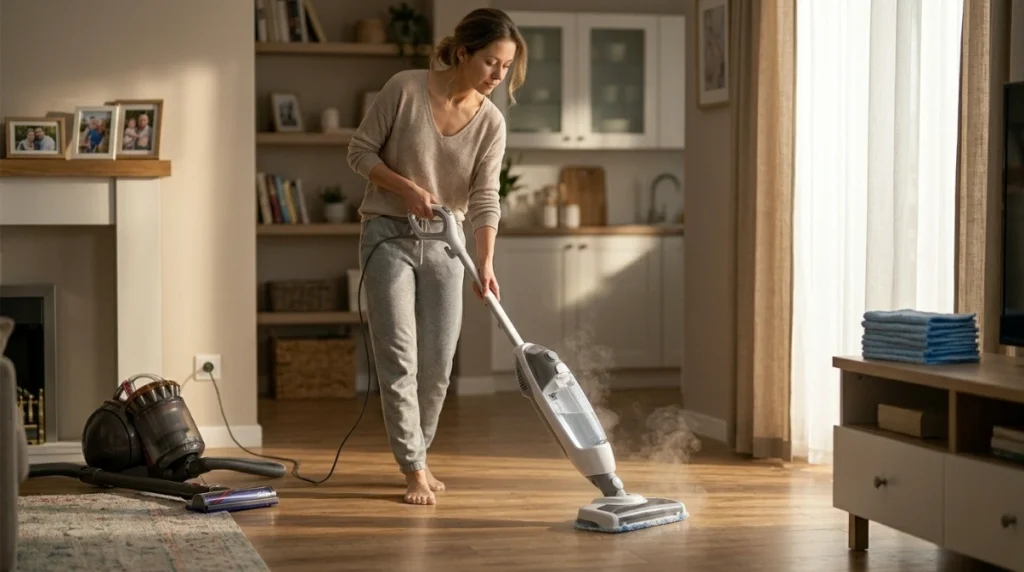
If water-only steam isn’t giving you the finish you expect, don’t immediately reach for detergent. Preparation and pad condition usually matter more.
1. Remove loose debris first
Vacuum, sweep, or dry-mop before steaming. Steam loosens stuck soil, but it isn’t designed to collect piles of hair, crumbs, grit, and dust.
2. Start with a clean microfiber pad
A microfiber pad contains fine synthetic fibers that trap loosened soil. Once those fibers become loaded, the pad can begin moving dirt around instead.
For a large kitchen or several rooms, I prefer keeping a second clean pad nearby. Swapping halfway through often improves the finish more than using extra cleaning chemicals.
3. Don’t hold the mop still
Use smooth passes and keep the head moving unless your manual gives different instructions. Concentrated heat and moisture aren’t helpful on sensitive flooring.
4. Treat greasy or sticky spots separately
Some spills need a floor-safe cleaner rather than more steam. Spot-clean the mess using a product approved for the floor, then use the steam mop only if the surface itself allows steam.
5. Wash reusable pads properly
Dirty pads can contribute to streaks and odors. Wash them according to the manufacturer’s instructions and let them dry fully before storage.
Section Takeaway: Better prep, cleaner pads, and the correct technique usually improve steam-mop performance without modifying the water tank.
What Mop Should You Use If You Want Cleaning Solution?
If your goal is to use detergent, enzyme cleaner, or another floor-specific product, a different mop may be more suitable. Steam isn’t the only effective floor-cleaning method.
| Mop Type | Cleaner Use | Best Fit |
|---|---|---|
| Steam mop | Usually water only | Steam-safe sealed hard surfaces |
| Microfiber flat mop | Floor-compatible spray cleaner | Hardwood, laminate, vinyl and quick cleaning |
| Spin mop | Diluted cleaner in bucket when approved | Tile and larger washable hard-floor areas |
| String mop | Bucket solution | Durable tile or utility floors |
| Cordless/electric wet mop | Usually brand-approved formula | Frequent wet cleaning |
| Robot mop | Only manufacturer-approved liquid | Automated maintenance cleaning |
Brands such as O-Cedar, Swiffer, Bona, Tineco, and iRobot make tools built around different cleaning systems. Match the tool to the floor and cleaner rather than forcing a detergent into a steam appliance.
If you’re using an enzyme cleaner for pet-related messes, follow its label closely. Many enzyme products need specific contact conditions that aren’t compatible with high-temperature steam.
The same principle applies to disinfectants. The EPA explains the difference between cleaning, sanitizing, and disinfecting, so don’t assume stronger chemicals are necessary for routine floor care.
Safety note: Keep cleaning chemicals in their intended application system. Never combine products unless the labels explicitly say that combination is safe.
What Should You Do If You Already Put Cleaner in the Tank?
Stop using the steam mop and unplug it if you accidentally added an unapproved liquid. Don’t keep steaming in an attempt to “use it up.”
- Let the appliance cool completely. Don’t open or handle a hot pressurized system.
- Empty the removable tank. Follow the manual’s normal draining instructions.
- Check the manufacturer’s cleaning procedure. Some models allow a water rinse, while others require different servicing.
- Do not add a second chemical. Trying to neutralize one cleaner with another can create additional problems.
- Contact manufacturer support if needed. This is especially important after bleach, concentrated detergent, or an oily product.
If the mop later produces little steam, leaks, smells unusual, or spits liquid, stop using it until you’ve checked the troubleshooting instructions. Residue or a blockage may remain inside.
Don’t automatically use vinegar to “flush” the system. Descaling procedures are model-specific, and an improvised acid rinse may cause further damage.
Safety note: If an accidental chemical mixture creates strong fumes, leave the area and ventilate it rather than continuing to operate the appliance.
Frequently Asked Questions
Can I put floor cleaner in my steam mop?
Usually not. Most steam mops have a water-only reservoir, and ordinary floor cleaner may foam, leave deposits, or damage internal parts. Use cleaning solution only when the manual for your exact model says it is approved.
Can I put vinegar and water in a steam mop?
Don’t use a vinegar-and-water mixture unless your steam-mop manufacturer specifically recommends it. Vinegar may affect appliance components, and acidic cleaners can also damage natural stone and some floor finishes.
Can I add essential oils to make my floors smell good?
Essential oils should generally stay out of the water tank because they don’t dissolve evenly in water. Use only a manufacturer-approved fragrance method, and check whether fragrances are compatible with your floor and household.
Can you put Pine-Sol or Fabuloso in a steam mop?
Don’t put a household floor cleaner such as Pine-Sol or Fabuloso into a steam-mop tank unless the machine manufacturer explicitly permits that exact type of solution. A cleaner being suitable for mopping doesn’t make it suitable for a heated steam system.
Can I use bottled water instead of distilled water?
You can use it only if your manual allows it, but ordinary bottled drinking water isn’t the same as distilled water. Bottled water may still contain minerals that can contribute to scale inside the heater.
Does steam disinfect floors without cleaner?
Steam can reduce microorganisms when the correct temperature, surface, contact time, and technique are achieved, but don’t assume every quick pass provides complete disinfection. Follow your steam mop’s tested sanitizing instructions when that is your goal.
Why does my steam mop leave streaks when I use only water?
Streaks can come from a dirty microfiber pad, old cleaner residue already on the floor, too much moisture, or soil that wasn’t removed first. Vacuum beforehand and change pads as they become dirty before blaming the lack of detergent.
Final Takeaway
When you’re wondering whether you can put anything other than water in a steam mop, the safest default is simple: **don’t add it unless your manual specifically says you can**.
Distilled or demineralized water is often the best choice. Vinegar, essential oils, bleach, dish soap, disinfectant, and ordinary floor cleaner usually belong somewhere other than the steam-mop reservoir.
If you need chemical cleaning, switch tools instead. A microfiber flat mop, spin mop, cordless wet cleaner, or compatible robot mop lets you use appropriate floor-cleaning products without turning your steam mop into an experiment.
Protect the machine and the floor at the same time. Check both care guides before you start, then use the simplest cleaning method that gets the job done.
