
Can You Put Essential Oils in Steam Mops? Safe Ways to Add Scent

Quick Answer
No, you generally should not put essential oils in a steam mop water tank. Oils do not mix properly with water and may leave residue inside the steam system, while some manufacturers require water or only their approved additives. For fragrance, use only accessories or liquids specifically approved for your model, such as the manufacturer-designed scent options available for some steam mops.
What to do instead
- Keep oils out: Do not pour essential oils directly into the water reservoir unless your manual specifically permits them.
- Check the manual: Use plain, distilled, or demineralized water according to your model’s instructions.
- Use approved fragrance: Some models accept fragrance discs or manufacturer-formulated scented water.
- Protect the floor: Avoid homemade oily sprays that can leave slippery residue or damage finishes.
- Clean for dirt first: Fragrance does not make a floor cleaner or properly disinfected.
If you enjoy a fresh-smelling home, adding essential oils to your steam mop can sound like an easy upgrade. I understand the appeal, but floor cleaning equipment needs a little more care than a regular mop bucket.
I’ve found that steam mops work most predictably when you follow the water and fragrance instructions for the exact machine. This guide explains the risks, safer scent options, floor compatibility, and what to do if oil has already entered the tank.
In This Guide
- Can You Put Essential Oils in a Steam Mop?
- Why Are Essential Oils Risky in a Steam Mop?
- What Can You Put in a Steam Mop Tank?
- How Can You Make Floors Smell Good Without Adding Oils?
- Which Floors Are Safe for Steam Mopping?
- How Do You Use a Steam Mop Safely?
- What Should You Do If You Already Added Essential Oil?
- Do Essential Oils Make Steam Mopping More Effective?
- Frequently Asked Questions
- Final Takeaway
Can You Put Essential Oils in a Steam Mop?
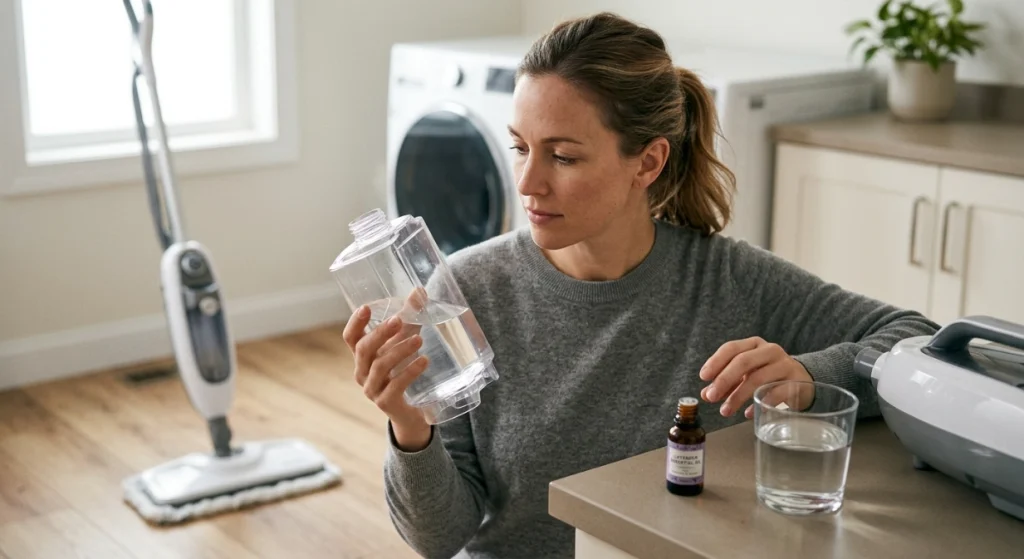
For most steam mops, the safest answer is no. Unless your owner’s manual specifically approves essential oils, keep them out of the water tank.
Definition: A steam mop is an electric floor-cleaning tool that heats water and sends hot vapor through a cleaning head or microfiber pad to loosen soil from compatible surfaces.
A normal microfiber flat mop carries cleaning liquid mainly on the pad. A steam mop sends water through a heater, tubes, valves, and small steam openings first.
Why water-only instructions matter
Those internal parts are built around liquids the manufacturer has tested. Essential oil is a concentrated hydrophobic liquid, meaning it does not dissolve evenly in water.
Instead, droplets can float, coat surfaces, and travel through parts that were designed for water. Heat does not magically turn that oil into a water-based cleaner.
- Water: Moves through the heating system as intended.
- Essential oil: Can separate from water and leave oily material behind.
- Approved scented products: May be formulated specifically for certain compatible machines.
- Homemade mixtures: Have not been tested for your mop’s seals, heater, tubing, or warranty.
As of 2026, some BISSELL steam mops offer purpose-designed fragrance discs or scented demineralized water. That does not mean ordinary essential oil is interchangeable with those products.
Safety note: Always follow both your steam mop manual and your flooring manufacturer’s care instructions before using heat, steam, fragrance, or cleaning additives.
Why Are Essential Oils Risky in a Steam Mop?
Essential oils create two separate concerns: the machine may not tolerate them, and the floor may not tolerate the oily residue. Neither problem improves cleaning performance.
Oil can leave residue inside the steam path
Essential oils do not behave like distilled water. Repeated use may coat small passages, valves, seals, or steam outlets with residue.
When I troubleshoot a steam mop with weak or uneven output, the simplest routine is always best. Extra ingredients make it harder to tell whether the problem is mineral scale, a dirty outlet, or product residue.
Your warranty may depend on using approved liquids
Manufacturer rules vary by model. Some machines specify water only, while others accept a particular demineralized or scented product.
Using an unapproved liquid can put warranty coverage at risk if it contributes to a failure. Check the manual instead of assuming advice for one Bissell, Shark, Tineco, or other machine applies to another.
Oil can create a film on flooring
Even a small amount of oily residue can change how a smooth floor feels. Too much may cause streaks, dull patches, or slipperiness.
This matters most on glossy tile, finished wood, laminate, and vinyl/LVP. A microfiber flat mop with the correct floor cleaner is usually easier to control when residue is the concern.
Safety note: Stop using any mixture that leaves the floor slick, hazy, tacky, or uneven in appearance. Check your floor care guide before trying another product.
What Can You Put in a Steam Mop Tank?
The default choice is the water specified by your manufacturer. If the manual says distilled or demineralized water, use that rather than adding cleaners for extra power.
| Liquid or Additive | Default Tank Advice | Main Concern |
|---|---|---|
| Distilled or demineralized water | Usually the safest choice when approved | Follow your model’s manual |
| Tap water | Use only if the manufacturer allows it | Hard water can contribute to mineral buildup |
| Manufacturer-approved scented water | Only for compatible models | Not universal across brands |
| Essential oils | Avoid unless explicitly approved | Oil separation and residue |
| Vinegar | Do not add unless the manual directs you | Possible component or floor-finish damage |
| Floor cleaner or detergent | Keep out unless specifically approved | Foam, residue, deposits, or component damage |
What about vinegar?
Vinegar is useful in some traditional mop-and-bucket routines, but that does not make it suitable for every steam mop. Never use a homemade vinegar mix as a steam-mop descaler unless your manufacturer’s maintenance instructions call for it.
Can you add regular floor cleaner?
Regular hardwood floor cleaner, laminate-safe cleaner, disinfectant, dish soap, or enzyme cleaner should not automatically go into a steam tank. Apply these products only in the way their labels and your floor manufacturer specify.
Safety note: Never mix household cleaning chemicals together inside a steam mop. Heated or combined products can create hazards that plain water does not.
How Can You Make Floors Smell Good Without Adding Oils?
The safest approach is to separate fragrance from the machine unless the mop has a manufacturer-approved scent system. You can still make a room smell fresh without sending homemade oil through a heater.
1. Use the mop’s approved scent accessory
Some steam mops use fragrance discs placed in a dedicated tray or pad area. These systems are designed for specific machines and should be used exactly as directed.
2. Use approved scented or demineralized water
Certain manufacturers sell scented water formulated for compatible steam mops. Check the model number before buying because compatibility matters more than the fragrance name.
3. Freshen the room separately
If you simply want a pleasant smell, fragrance the room rather than the floor. A separate room-fragrance method keeps oils away from the mop’s heater and the walking surface.
4. Remove the source of odor
A stronger scent will not fix dirty grout, pet residue, a sour mop pad, or trapped moisture. Wash reusable microfiber pads after use and dry them fully before storage.
- Vacuum or sweep loose debris first.
- Wash a dirty microfiber pad instead of reusing it.
- Clean pet accidents with a floor-compatible product.
- Dry damp areas promptly.
- Address mildew or persistent moisture rather than masking the smell.
If you use a spin mop, string mop, or cordless electric mop instead, scent still should not replace correct cleaner dilution. Too much product often creates residue rather than a fresher floor.
Which Floors Are Safe for Steam Mopping?
Whether you can use a steam mop depends more on the floor than on the scent question. Steam introduces both heat and moisture, which some surfaces handle better than others.
- Ceramic or porcelain tile: Often suitable when grout, sealers, and manufacturer instructions permit steam.
- Natural stone: Check the stone and sealer instructions first because heat and cleaning methods can affect finishes.
- Hardwood: Use steam only when the flooring manufacturer explicitly approves it.
- Engineered wood: Treat it like wood and follow the exact care guide.
- Laminate: Many products restrict steam because moisture can enter joints and affect the core.
- Vinyl and LVP: Many manufacturers discourage steam due to heat, seams, wear layers, or adhesives.
- Concrete: Sealed concrete may tolerate steam, but coatings and sealers can have their own restrictions.
The National Wood Flooring Association provides technical resources for wood flooring, but your specific flooring warranty remains the final reference. Never assume that a floor is steam-safe simply because the surface looks sealed.
A lightly damp microfiber mop is the lower-risk alternative for many moisture-sensitive floors. Pair it with a manufacturer-approved pH-neutral cleaner when required.
Safety note: Test any new floor-cleaning method in a hidden area first and stop if you notice whitening, dullness, swelling, lifted seams, or finish changes.
How Do You Use a Steam Mop Safely?

Good steam-mopping technique uses as little complexity as possible. Start with the correct floor, clean water, a clean pad, and continuous movement.
- Check the floor warranty. Confirm that steam cleaning is allowed on the exact flooring product.
- Read the steam mop manual. Confirm the required water type and approved accessories.
- Vacuum or sweep first. Dry debris can scratch floors or turn into muddy streaks.
- Fill the reservoir correctly. Do not exceed the fill line or add unapproved oils and cleaners.
- Attach a clean microfiber pad. Replace a heavily soiled pad instead of spreading dirt.
- Choose the lowest suitable steam level. More steam is not automatically better.
- Keep the mop moving. Avoid holding hot steam over one area for an extended period.
- Let the surface dry. Keep people and pets away while the floor remains damp or slippery.
In my own floor-cleaning routine, changing the microfiber pad halfway through a dirty kitchen often improves the finish more than increasing steam. Once the pad turns gray, it starts redistributing soil.
For routine household hygiene, the CDC advises using cleaning products appropriate for the surface. It also notes that routine cleaning is often enough in typical homes unless extra disinfection is needed.
What Should You Do If You Already Added Essential Oil?
Do not panic if you added a few drops once. Stop using the mixture and check the manufacturer’s cleaning instructions before attempting to flush or descale the machine.
If the mop has not been heated yet
- Unplug the steam mop.
- Allow it to cool completely if it was connected to power.
- Empty the water tank according to the manual.
- Rinse a removable tank with approved water if the instructions permit rinsing.
- Refill only with the recommended water.
If you already ran the oil through the mop
Do not pour vinegar, detergent, alcohol, or another chemical into the machine to “cancel out” the oil. That may create a second problem.
Instead, follow the manufacturer’s maintenance process. Contact support if steam becomes weak, irregular, unusually odorous, or stops altogether.
Watch the floor too
If the floor feels oily, stop walking on it until the residue is removed. Use the cleaning method approved for that flooring rather than adding more steam.
On tile, that might mean a clean microfiber mop and a properly diluted compatible cleaner. Wood, laminate, and LVP often need much tighter moisture control.
Safety note: Unplug and cool the appliance before emptying, inspecting, or cleaning it. Never disassemble a powered steam mop unless the manufacturer specifically instructs you to do so.
Do Essential Oils Make Steam Mopping More Effective?
No. Adding essential oil for fragrance does not automatically improve cleaning, sanitizing, or disinfecting performance.
Cleaning, sanitizing, and disinfecting are different jobs. The EPA distinguishes these terms and regulates antimicrobial products that make sanitizing or disinfecting claims.
- Cleaning: Removes soil, grime, and organic material from a surface.
- Sanitizing: Reduces certain microorganisms to specified levels.
- Disinfecting: Uses a registered product or validated process to address specified microorganisms.
- Fragrancing: Changes how a room or surface smells.
An essential oil that smells like lemon, eucalyptus, peppermint, or tea tree should not be treated as a proven floor disinfectant. A pleasant smell is not evidence that pathogens were removed or killed.
Some steam-mop manufacturers make sanitizing claims for particular models under specific test conditions and use directions. Follow those directions rather than assuming every steam pass gives the same result.
Safety note: If you need true disinfection because someone is ill, use a method appropriate for the surface and follow the disinfectant label. Do not mix a disinfectant into a steam mop unless both product and appliance instructions expressly allow it.
Frequently Asked Questions
Can I put lavender oil in my steam mop?
Not unless the manufacturer specifically says lavender essential oil can go into the tank. The safer approach is plain approved water and any fragrance accessory designed for your exact steam-mop model.
Can I put eucalyptus oil in a steam mop?
Do not confuse eucalyptus essential oil with manufacturer-formulated eucalyptus-scented steam-mop water. They are different products, and only the product approved for your machine should be used.
Can I put lemon essential oil in my steam mop?
Homemade lemon essential-oil mixtures should stay out of a water-only steam tank. If you want a citrus scent, check whether the manufacturer offers an approved fragrance disc or compatible scented water.
Can I put essential oil directly on a steam mop pad?
Do not assume the pad is automatically safe for essential oil. Some models use purpose-designed scent discs near or inside the pad, so follow that system rather than dripping concentrated oil onto an ordinary microfiber pad.
Is distilled water better for a steam mop?
Distilled or demineralized water can reduce mineral deposits in machines whose manufacturers recommend it. Always check the manual because water requirements can vary between models and local water conditions.
Can I use essential oils to disinfect my floor?
Do not rely on fragrance oils as a substitute for an EPA-registered disinfectant when disinfection is required. Use a product approved for your floor and follow its label, including any required contact time.
What is the safest way to make floors smell fresh after mopping?
First remove the odor source, wash dirty mop pads, and let the floor dry completely. If you still want fragrance, use a manufacturer-approved scent system or fragrance the room separately instead of adding homemade oils to the machine.
Final Takeaway
If you’re wondering, “Can you put essential oils in steam mops?” my recommendation is simple: keep homemade essential oils out of the tank unless the manufacturer explicitly approves them.
Use the correct water, a clean microfiber pad, and a steam setting suitable for your floor. When you want fragrance, choose an approved scent disc, approved scented water, or a separate room-fragrance method.
Your steam mop does not need to smell stronger to clean better. A simple routine protects the machine, reduces floor residue, and makes troubleshooting much easier.
