
Can You Use Steam Mops on Hybrid Floors?

Quick Answer
In most cases, you should not use a steam mop on hybrid floors unless your flooring manufacturer specifically says it is safe. Heat and concentrated moisture can affect joints, surface layers, or other components, even when the flooring is sold as waterproof. There are exceptions: for example, Quick-Step permits steam cleaning on its Pulse Hybrid flooring under specific conditions.
What to do before steam cleaning
- Check the care guide: Look up the instructions for your exact flooring range, not hybrid flooring in general.
- Check your warranty: Steam cleaning may be excluded even when the floor is described as waterproof.
- Never assume waterproof means steam-safe: Steam adds heat as well as moisture.
- Use a safer default: A damp microfiber mop is suitable for many hybrid floors.
- Avoid excess water: Remove standing moisture instead of leaving the surface wet.
My default rule
- If the manufacturer does not clearly approve steam, clean the floor without steam.
Hybrid flooring is designed to handle everyday household moisture better than many traditional floor coverings. That does not automatically make it safe for the heat and concentrated moisture produced by a steam mop.
As of 2026, manufacturer instructions still vary between products. This guide explains when steam is risky, when an exception may apply, and how to clean hybrid flooring safely without guessing.
In This Guide
- Can You Steam Mop Hybrid Flooring?
- What Is Hybrid Flooring?
- Why Can Steam Damage Hybrid Floors?
- Are Any Hybrid Floors Safe for Steam Mopping?
- What Should You Use Instead of a Steam Mop?
- How Do You Clean Hybrid Floors Safely?
- Which Mop Is Best for Hybrid Flooring?
- What If You Already Used a Steam Mop?
- Frequently Asked Questions
- Final Takeaway
Can You Steam Mop Hybrid Flooring?
Usually, no. The safest approach is to avoid steam unless the care instructions for your exact hybrid floor specifically approve it.
This matters because “hybrid flooring” describes a broad category rather than one universal construction. Different brands can use different cores, surface layers, locking systems, and installation methods.
Some manufacturers directly advise against steam. Karndean, for example, recommends a soft broom, damp mop, and suitable pH-neutral cleaner for its resilient flooring and states that it does not recommend steam mops or steam cleaners.
You can review its current floor cleaning guidance before choosing a cleaning method for similar resilient surfaces.
- Manufacturer says “no steam”: Do not use a steam mop.
- Manufacturer says nothing about steam: Treat that as a reason to use a safer damp-mop method.
- Manufacturer explicitly approves steam: Follow its temperature, power, pad, and movement instructions exactly.
- You do not know the flooring brand: Avoid steam until you identify the product.
A waterproof label should not be your only test. Waterproof performance usually concerns liquid spills and normal cleaning conditions, not unlimited exposure to heat.
Safety note: Always follow the care and warranty instructions supplied with your exact floor before introducing steam, cleaning chemicals, or excess water.
What Is Hybrid Flooring?
A hybrid floor is a resilient plank flooring system that combines a rigid or strong core with protective surface layers and typically uses a floating click-lock installation. Designs vary significantly between manufacturers.
Quick-Step describes its hybrid vinyl as combining a strong core with a protective surface and watertight click technology. You can see the manufacturer’s overview of hybrid vinyl flooring for an example of this construction.
Why is hybrid flooring called waterproof?
Many hybrid floors are designed so routine spills remain on the surface rather than immediately damaging the plank. Tight locking systems can also reduce water entry through the joints.
That makes hybrid flooring practical for kitchens, dining areas, and other busy spaces. It does not mean every cleaning appliance is compatible.
Waterproof is not the same as heat-proof
A spilled glass of water and a steam mop create different conditions. A steam mop introduces heat and moisture together at the floor surface.
The effect also depends on how long the mop stays in one spot. Joints and edges deserve particular attention because they connect individual planks.
This distinction explains why two waterproof hybrid floors can have different steam-cleaning rules. The product manual matters more than the marketing term alone.
Why Can Steam Damage Hybrid Floors?

Steam can be unsuitable because it combines heat, moisture, and concentrated contact. Those three factors may affect flooring differently from an ordinary damp microfiber mop.
Heat can affect sensitive floor components
Flooring materials and installation systems respond differently to heat. Some resilient-floor manufacturers therefore exclude steam cleaning from their recommended maintenance.
EVORICH, for example, advises against steam mops on its High End Resilient Flooring because of heat-related concerns involving the wear layer and seams. Its floor-maintenance guidance recommends a damp mop with gentle cleaner instead.
Moisture can concentrate around joints
Steam cools and condenses into water. If repeated passes leave moisture around plank edges, that creates a different exposure pattern from light damp mopping.
A well-wrung microfiber pad gives you more control. You can clean dirt without intentionally forcing hot moisture across every seam.
Standing in one place increases exposure
Holding a steam mop stationary creates more concentrated heating. This is why even manufacturers that permit steam may tell users to keep the machine moving.
- Do not assume a low steam setting is universally safe.
- Do not park a hot steam head on the floor.
- Do not repeatedly target plank seams unless approved.
- Do not use steam to loosen a stain without checking the floor instructions.
Safety note: Damage may not appear immediately. Follow the flooring manufacturer’s care instructions even when a short steam test seems harmless.
Are Any Hybrid Floors Safe for Steam Mopping?
Yes, some products can be steam-mopped when the manufacturer expressly allows it. That exception is why a blanket statement that every hybrid floor can never be steam-cleaned would also be inaccurate.
Quick-Step Australia currently says its Pulse Hybrid flooring can be steam-cleaned under strict conditions. Its instructions depend on the steam device, heat distribution, steam quality, and how the machine is used.
What do manufacturer-approved steam instructions look like?
For an approved product, the instructions may include several restrictions. These are product-specific rather than universal recommendations.
- Use the correct cloth: A suitable pad helps distribute heat and steam rather than applying it directly.
- Keep moving: Avoid holding the machine over one location.
- Use low power: Follow the permitted steam setting rather than maximizing output.
- Protect the joints: Minimize prolonged exposure at plank connections.
- Follow plank direction: Some manufacturers specify how the mop should travel across the floor.
The important phrase is your exact product. Permission for one Quick-Step range does not automatically apply to another brand or even another range from the same manufacturer.
My practical rule is simple: I want to see a clear “steam allowed” statement in the current care instructions before treating any hybrid floor as steam-safe.
What Should You Use Instead of a Steam Mop?
A microfiber flat mop or spray mop is the safest general-purpose choice for many hybrid floors. It gives you direct control over how much moisture reaches the surface.
Microfiber flat mop
Microfiber uses fine synthetic fibers that pick up dust and light soil efficiently. A flat mop also lets you wring or dampen the pad before it touches the floor.
Use it slightly damp rather than dripping wet. Replace or rinse the pad when it becomes dirty instead of spreading residue across the room.
Spray mop
A spray mop can work well because it releases a small amount of cleaner exactly where you need it. This makes moisture easier to control than with a saturated string mop.
Choose a cleaner approved by your flooring manufacturer. Karndean’s cleaning guidance, for example, recommends a damp mop with a suitable pH-neutral cleaner for its vinyl flooring.
Vacuum or soft broom before mopping
Dry soil should come off first. Sand and grit can act like abrasives when dragged under a wet mop pad.
- Vacuum using a hard-floor setting.
- Use a soft-bristle broom if you prefer sweeping.
- Pay attention to corners and plank grooves.
- Remove visible grit before wet cleaning.
A robot mop can also be useful for light maintenance if its moisture output suits your flooring. Check both the robot manufacturer’s instructions and your flooring care guide.
How Do You Clean Hybrid Floors Safely?
Start dry, use minimal moisture, and finish with a clean surface that can dry quickly. You usually do not need steam for routine dirt, footprints, or small spills.
Step 1: Remove loose debris
Vacuum or sweep the entire area before introducing moisture. Look carefully around entrances, kitchen zones, and furniture where grit collects.
Step 2: Check the cleaner
Use the product named in your floor’s care guide or a cleaner that meets the manufacturer’s specifications. A pH-neutral floor cleaner is commonly recommended for resilient vinyl-type surfaces.
Safety note: Never mix cleaning products, and always follow the cleaner label and flooring manufacturer’s care instructions.
Step 3: Dampen the mop
Wet the microfiber pad and wring it thoroughly. It should feel damp but should not release puddles when pressed against the floor.
Step 4: Work in manageable sections
Mop a small area at a time using light pressure. This makes it easier to see streaks, excess moisture, and dirty sections of the mop pad.
- Start at the farthest point from the exit.
- Work along the direction of the planks where practical.
- Rinse or replace a dirty microfiber pad.
- Remove excess solution instead of adding more.
- Keep people and pets off the surface while it remains wet.
Step 5: Deal with spills promptly
Wipe liquid spills rather than leaving them for the next scheduled cleaning. Quick-Step likewise recommends removing spilled liquids promptly when maintaining its vinyl floors.
For sticky marks, place a lightly damp cloth over the area briefly and wipe it gently. Avoid abrasive scrubbers unless your care guide approves them.
Step 6: Let the floor dry
Normal damp mopping should leave only a thin film of moisture. Increase ventilation if the floor remains noticeably wet.
If you can see puddles around joints, your mop is too wet. Dry those areas with a clean microfiber cloth.
Section Takeaway: For routine hybrid-floor cleaning, controlling moisture matters more than generating heat. A clean, slightly damp microfiber pad is the safest default when steam approval is unclear.
Which Mop Is Best for Hybrid Flooring?
A microfiber flat mop is the easiest default because it combines good dirt pickup with precise moisture control. Steam mops belong in a separate category because compatibility depends on the exact flooring product.
| Mop Type | Moisture Control | Hybrid Floor Suitability | Best Use |
|---|---|---|---|
| Microfiber flat mop | High | Good general choice when used damp | Routine cleaning |
| Spray mop | High | Often suitable with approved cleaner | Quick cleanups and footprints |
| String mop | Moderate to low | Use only when thoroughly wrung | Larger areas |
| Steam mop | Varies by machine | Only when exact flooring instructions approve steam | Manufacturer-approved floors only |
| Robot mop | Model-dependent | Potentially suitable with controlled water output | Frequent light maintenance |
If I had an unidentified hybrid floor and needed to clean it today, I would choose a microfiber flat mop. It requires fewer assumptions about the floor’s tolerance for heat.
What If You Already Used a Steam Mop on Hybrid Flooring?
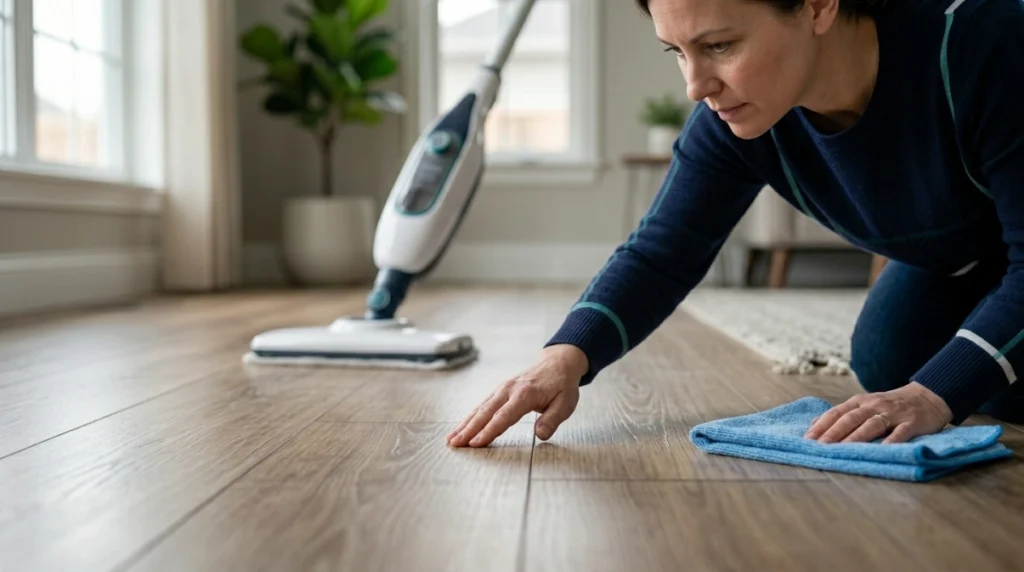
Do not panic after a single use. Stop steam cleaning until you identify the floor and read its maintenance instructions.
A steam mop does not guarantee immediate visible damage. The sensible next step is inspection rather than repeatedly testing the floor.
Check the floor after it dries
- Look for raised or uneven plank edges.
- Check whether joints appear wider than before.
- Look for surface changes, haziness, or distortion.
- Walk across the area and notice unusual movement.
- Check for moisture that remains around edges.
If the floor looks normal, switch to the manufacturer’s recommended cleaning method. Keep the product information or warranty documentation available for future reference.
If you notice significant lifting, joint movement, or surface damage, contact the flooring retailer, installer, or manufacturer. Avoid trying to repair a click-lock floor with adhesive unless the manufacturer specifically recommends that repair.
Safety note: Do not continue steam cleaning a questionable area to see whether the problem gets worse. Repeated exposure may complicate both the damage and any warranty discussion.
Frequently Asked Questions
Can you steam mop waterproof hybrid flooring?
Not automatically. Waterproof performance does not prove that a floor can tolerate steam heat. Check the manufacturer’s care guide for your exact product and use steam only when the instructions specifically allow it.
Will a steam mop make hybrid flooring swell?
The outcome depends on the flooring construction and installation. Some manufacturers warn against steam because heat and moisture can affect floor components, joints, or surface layers, so avoiding steam is safer when approval is unclear.
What is the best mop for hybrid flooring?
A microfiber flat mop is a strong general choice because you can control moisture easily. Use it damp rather than saturated and pair it with a cleaning product approved by your flooring manufacturer.
Can I use vinegar on hybrid floors?
Do not assume vinegar is safe simply because it is a common DIY cleaner. Flooring finishes and manufacturer recommendations vary, so use the cleaner specified in your care guide rather than experimenting with acidic homemade solutions.
How often should I mop hybrid floors?
Mop when visible soil, footprints, or sticky residue require it rather than soaking the floor on a fixed daily schedule. Busy kitchens and entryways may need more frequent cleaning than bedrooms or low-traffic areas.
Can you use a Shark or Bissell steam mop on hybrid flooring?
The steam mop brand does not determine floor compatibility. Your hybrid flooring manufacturer must approve steam cleaning first, after which you should also follow the steam mop manufacturer’s operating instructions.
Does Quick-Step hybrid flooring allow steam mops?
Quick-Step Australia currently states that Pulse Hybrid can be steam-cleaned under strict conditions, including using an appropriate cloth and avoiding prolonged exposure. That permission should not be applied automatically to other Quick-Step products or other hybrid flooring brands.
Final Takeaway: Should You Steam Mop Hybrid Floors?
For most households, the safest answer to “can you use steam mops on hybrid floors?” is not unless the manufacturer clearly says you can. Waterproof flooring and steam-safe flooring are not interchangeable terms.
Some products are genuine exceptions. Quick-Step Pulse Hybrid is one example where the manufacturer provides specific steam-cleaning instructions.
When your floor’s instructions are unclear, use a damp microfiber mop, remove grit first, limit excess water, and choose an approved cleaner. That routine handles normal floor cleaning without introducing unnecessary heat.
Before your next clean, find the brand and product name on your flooring paperwork and check its current care guide. That one step can protect both your floor and its warranty.
