
Circular vs Triangular Spin Mop Head: Which Shape Cleans Better?

Quick Answer
A circular spin mop head usually feels smoother and faster across large open floors, while a triangular head reaches corners, edges, and tight spaces more easily. Neither shape is automatically better for every home, so I choose based on room layout, furniture, floor type, and how much edge cleaning I need while comparing different mop designs.
Main Differences
- Open-floor speed: Circular heads glide and rotate naturally across larger areas.
- Corner reach: Triangular heads fit into 90-degree corners more effectively.
- Furniture access: Triangular designs often work better around chair legs and narrow edges.
- Movement: Circular heads usually feel less directional during quick back-and-forth mopping.
- Best overall choice: Use the shape that matches your rooms rather than choosing by appearance alone.
I’ve used spin mops in open kitchens, narrow bathrooms, bedrooms, and rooms packed with furniture. Head shape changes the experience more than many buyers expect.
This guide explains the practical differences between circular and triangular spin mop heads, including corners, large floors, floor safety, maneuverability, cleaning speed, and maintenance.
In This Guide
- What Is the Difference Between Circular and Triangular Spin Mop Heads?
- Circular vs Triangular Spin Mop Head Comparison
- Which Spin Mop Head Is Better for Corners and Edges?
- Which Shape Works Better on Large Open Floors?
- Does Mop Head Shape Matter for Different Floor Types?
- Which Shape Is Easier Around Furniture?
- Which Mop Head Is Easier to Clean and Maintain?
- How Do You Choose the Right Spin Mop Head?
- Frequently Asked Questions
- Final Takeaway
What Is the Difference Between Circular and Triangular Spin Mop Heads?
The main difference is how each shape contacts the floor and navigates obstacles. A circular mop favors free rotation, while a triangular mop provides defined points for reaching edges.
A spin mop is a floor mop that uses a rotating wringer system to remove excess water from its reusable cleaning head. Most models use absorbent microfiber strands or fabric pads.
How a circular spin mop head works
A circular head has no front-facing point. You can change direction without deliberately lining the mop up with the floor.
- Smooth rotation: The round shape naturally supports sweeping and twisting motions.
- Wide movement: It works well when making overlapping passes through an open room.
- Fewer orientation changes: You don’t need to keep a specific corner facing forward.
- Even feel: Pressure tends to feel predictable as the mop rotates.
I notice this most when cleaning a kitchen or living area with a large uninterrupted floor. I can move quickly without thinking much about mop orientation.
How a triangular spin mop head works
A triangular mop has three defined points. Those points give you more control when approaching walls, baseboards, furniture legs, and room corners.
- Corner access: A pointed section can enter spaces a round head cannot fully fill.
- Edge control: A straight side can follow a wall more deliberately.
- Obstacle navigation: The narrower front can slip between furniture more easily.
- Targeted scrubbing: You can position one area of the head over a specific dirty spot.
The tradeoff is that I sometimes have to turn the head into the right position. That small adjustment matters less in tight rooms than on large open floors.
Circular vs Triangular Spin Mop Head Comparison
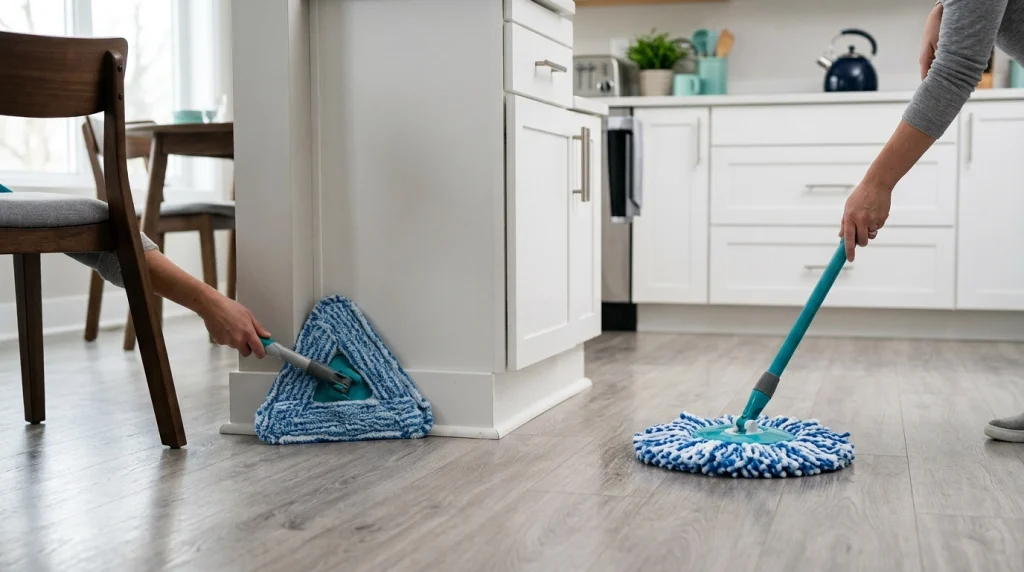
Both designs can clean everyday hard floors well when paired with a suitable microfiber head and proper technique. The important differences involve access and maneuverability rather than cleaning chemistry.
| Feature | Circular Head | Triangular Head |
|---|---|---|
| Open floor cleaning | Excellent freedom of movement | Good, but more directional |
| 90-degree corners | May leave a small untouched area | Pointed shape reaches deeper |
| Along baseboards | Good with flexible strands | Straight edges offer more control |
| Around furniture | Good in wider gaps | Usually easier in narrow gaps |
| Direction changes | Very natural | May require repositioning |
| Small bathrooms | Good | Excellent for tight layouts |
| Large kitchens | Excellent | Good to excellent |
I wouldn’t choose a mop from shape alone. Handle articulation, microfiber quality, head size, wringer efficiency, and replacement-head availability can matter just as much.
Which Spin Mop Head Is Better for Corners and Edges?
A triangular spin mop generally has the advantage in corners. One point can reach closer to the intersection of two walls than a rigid circular frame.
This becomes noticeable in bathrooms and kitchens. Dust and hair often collect where walls, cabinets, and fixtures meet the floor.
Triangular heads provide more precise positioning
I can guide one triangle point beside a toilet base or cabinet toe kick. That feels more controlled than pushing a broad round frame toward the same space.
- Room corners
- Baseboard edges
- Under cabinet lips
- Beside toilets
- Between narrow furniture legs
Circular heads can still clean edges well
A round head isn’t automatically poor near walls. Long, flexible microfiber strands may extend beyond the plastic base and contact edges effectively.
This is why the actual mop construction matters. A compact circular frame with generous microfiber can outperform a bulky triangular mop with a stiff border.
Section Takeaway: Triangular heads usually win for precise corner access, but flexible microfiber can reduce the practical difference.
Which Shape Works Better on Large Open Floors?
A circular head is usually my preference for broad, open spaces. It moves smoothly through arcs, figure-eight motions, and quick overlapping passes.
There isn’t a front or back to manage. That makes direction changes feel almost automatic.
Why circular heads feel fast
- Continuous movement: You can rotate the mop without aligning a point.
- Natural overlap: Curved passes blend easily into the previous pass.
- Easy direction changes: Moving left, right, or backward requires little adjustment.
- Comfort: Repetitive movements can feel less awkward across a large room.
For example, I notice the difference when cleaning an open kitchen and dining area. A round head lets me keep moving instead of repeatedly steering the frame.
Head size still matters
A larger head can cover more floor per pass, but it can also feel clumsy around chair legs. A smaller head offers better control but requires more passes.
Don’t assume every circular mop has a wider cleaning path. Always look at the actual head dimensions if coverage speed matters to you.
Section Takeaway: For large open rooms, circular heads tend to offer smoother movement, while actual head diameter determines how much floor each pass covers.
Does Mop Head Shape Matter for Different Floor Types?
Floor type affects moisture and cleaner choice more than head geometry. The safest mop is one that lets you control water and use a cleaner approved for the surface.
Hardwood and engineered wood
For wood, I focus on moisture control first. The National Wood Flooring Association advises minimizing moisture and following the flooring manufacturer’s cleaning recommendations.
A well-wrung circular or triangular microfiber head can work if the flooring maker allows damp mopping. Never assume a floor tolerates heavy wet mopping.
Safety note: Check your flooring manufacturer’s care guide before using water, cleaning chemicals, or a new mopping method on wood.
Laminate and vinyl/LVP
Both head shapes can work well on laminate and luxury vinyl plank. Again, controlling excess water is more important than choosing round or triangular.
Use the triangular shape if your plank layout includes many cabinets and corners. Choose circular when most of the room is open.
Tile
Tile is where both designs feel particularly useful. Microfiber strands can move across the tile surface and work around shallow grout lines.
A triangular head gains an advantage near bathroom fixtures and wall edges. A circular head often feels faster across a large tiled kitchen.
Natural stone
Stone deserves extra care because cleaners that suit one surface may harm another. Avoid assuming a household DIY mixture is safe.
Safety note: Use a cleaner approved for your specific stone and finish, and follow its label instead of relying on a universal vinegar or acid-based recipe.
Which Shape Is Easier Around Furniture?
Triangular heads usually provide more deliberate navigation around furniture. A point can lead the mop between obstacles where a wide curved edge may catch.
However, swivel range can matter more than shape. A poorly articulated triangular head may be harder to steer than a flexible circular one.
Look at the complete joint design
When testing a mop, I pay attention to whether the head stays flat as the handle angle changes. This matters under sofas, beds, and cabinets.
- Low handle angle: Helps the mop reach under furniture.
- Wide swivel: Makes turns easier around table and chair legs.
- Compact frame: Fits into smaller openings.
- Flexible microfiber: Extends cleaning contact past the frame.
- Stable connection: Prevents the head from flipping during fast turns.
A triangular shape helps most when you have a crowded apartment, small bathroom, or dining area with many chair legs. I value circular freedom more in open-plan rooms.
Which Mop Head Is Easier to Clean and Maintain?
Maintenance depends more on the mop material than its shape. Most reusable microfiber heads need thorough rinsing and complete drying after use.
I rinse mine until the runoff looks clear. Then I let the head dry fully before storage instead of leaving damp microfiber inside the bucket.
What to check before buying replacement heads
- Attachment system: Confirm replacements fit the exact mop model.
- Washability: Check whether the manufacturer permits machine washing.
- Replacement availability: Common replacement heads make long-term ownership easier.
- Fabric density: Look for enough material to contact the floor without an oversized rigid frame.
- Drying: Avoid storing the head wet, which can lead to unpleasant odors.
The CDC distinguishes routine cleaning from disinfection. For normal household situations, cleaning removes dirt and germs without requiring routine disinfection of every floor.
If disinfection is needed, use a product appropriate for the surface. Follow label directions, including contact time and ventilation instructions.
Safety note: Never mix cleaning or disinfecting chemicals unless the product labels specifically direct you to do so.
How Do You Choose the Right Spin Mop Head?
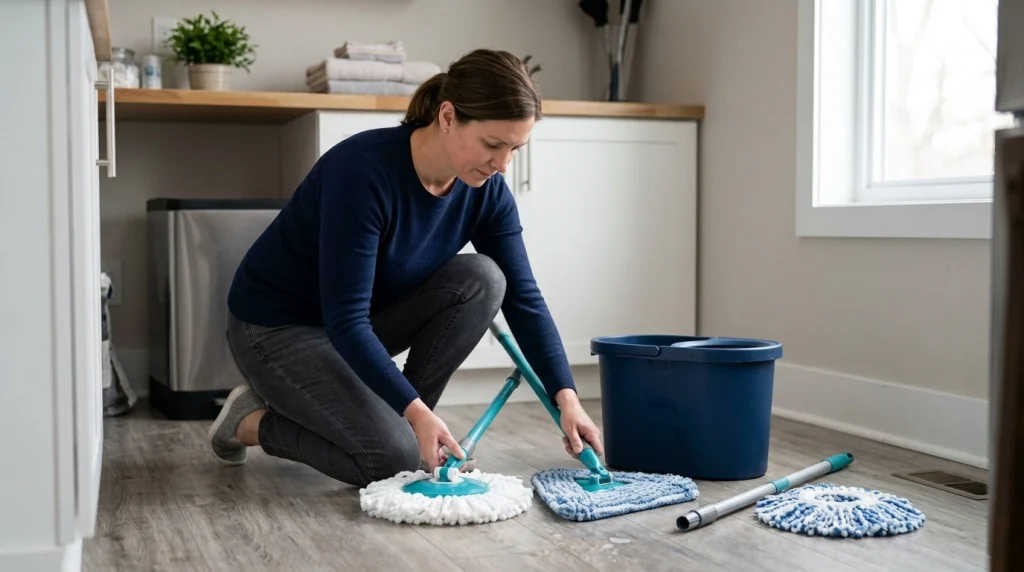
Choose according to your home’s layout rather than assuming one shape is universally superior. Start by looking at the rooms you mop most often.
Choose a circular spin mop if:
- You have large open kitchens or living areas.
- You prefer sweeping, flowing mop movements.
- You frequently change direction while cleaning.
- Your rooms have relatively few tight corners or obstacles.
- You value fast coverage more than precise corner positioning.
Choose a triangular spin mop if:
- You have small bathrooms or crowded kitchens.
- You clean along many cabinets and baseboards.
- Furniture legs create narrow gaps.
- You want stronger access to room corners.
- You prefer positioning the mop precisely over specific spots.
What matters more than shape?
In 2026, I would still place several practical features ahead of head geometry. These affect almost every mopping session.
- Wringer effectiveness: You need reliable control over how wet the mop remains.
- Microfiber quality: Good floor contact improves pickup and wiping.
- Handle comfort: Length and grip affect fatigue.
- Head articulation: A flexible swivel improves furniture access.
- Bucket stability: A stable bucket makes spinning and carrying easier.
- Replacement parts: Easy-to-find heads can extend the useful life of the system.
I also avoid judging performance by how much water a mop can hold. More water is not always useful, especially on moisture-sensitive flooring.
The EPA explains the difference between cleaning, sanitizing, and disinfecting. For everyday dirt removal, focus first on effective cleaning and proper product use.
Section Takeaway: Pick circular for easy open-floor movement and triangular for tighter edge control, then judge the complete mop system before buying.
Frequently Asked Questions
Is a triangular spin mop better than a circular spin mop?
Not in every home. A triangular spin mop generally reaches corners and narrow spaces better, while a circular head usually moves more freely across large open floors.
Do circular spin mops clean corners?
Yes, especially when long microfiber strands extend beyond the circular frame. However, the rigid round base cannot fit as deeply into a sharp 90-degree corner as a pointed triangular head.
Which spin mop shape is better for a small bathroom?
I usually prefer a triangular head in small bathrooms because it can navigate around toilets, cabinets, walls, and other tight obstacles more precisely. A compact circular mop can still work well if its swivel joint is flexible.
Which spin mop head is best for hardwood floors?
Shape is less important than moisture control. Use a well-wrung mop only when damp cleaning is permitted by your flooring manufacturer, and avoid leaving standing water on wood.
Are triangular spin mop heads harder to use?
They aren’t necessarily harder, but they can feel more directional. You may need to rotate the head so a point or straight edge faces the area you want to reach.
Which spin mop head covers more floor?
Head dimensions determine coverage more accurately than shape alone. Many circular mops feel efficient in large spaces because they change direction smoothly, but a large triangular model may have a similar cleaning footprint.
Does a circular or triangular mop remove more dirt?
Shape alone doesn’t determine dirt removal. Microfiber quality, floor contact, cleaning solution, pressure, rinsing frequency, and your technique can all influence how much dirt the mop picks up.
Final Takeaway
For a simple circular vs triangular spin mop head decision, think about where you spend the most time mopping. Circular heads suit open spaces, while triangular heads offer stronger precision around corners and obstacles.
I would still prioritize moisture control, microfiber quality, swivel movement, and replacement-head availability. Those features can affect everyday cleaning more than the outline of the mop head itself.
If your home mixes large rooms with cramped bathrooms, either design can work. Choose the system that fits the majority of your floor plan and your normal cleaning routine.
