
What Are the Different Types of Spray Mops?

Quick Answer
The main types of spray mops are refillable spray mops, cartridge-based mops, reusable microfiber spray mops, disposable-pad spray mops, dual-chamber models, and powered or electric spray mops. The best type depends on your floor, the mess, and how much control you want over the cleaning solution. A mop comparison from Consumer Reports also shows why ease of use and pad cleaning matter alongside cleaning performance.
Main spray mop types
- Refillable spray mop: Fill the reservoir with an approved cleaner or water mixture.
- Cartridge spray mop: Uses a removable bottle or proprietary cleaning-solution cartridge.
- Microfiber spray mop: Uses washable microfiber pads for routine floor cleaning.
- Disposable-pad mop: Uses single-use pads that can simplify cleanup after dirty jobs.
- Dual-chamber mop: Keeps liquids separate until you choose which one to spray.
- Powered spray mop: Adds motorized scrubbing or other powered cleaning action.
Quick distinction
- A spray mop applies liquid cleaner directly to the floor. A steam mop heats water and produces hot vapor, so the two tools are not the same.
I’ve used spray mops on everything from dusty laminate to sticky kitchen tile. Their biggest advantage is simple: you control where the moisture goes.
That makes spray mops useful for quick floor cleaning without carrying a bucket. However, choosing the right design matters more than many first-time buyers expect.
In This Guide
What Are the Main Types of Spray Mops?
Spray mops are usually classified by their reservoir, pad system, and cleaning action. As of 2026, most household models fit into six practical categories.
Definition: A spray mop is a floor-cleaning tool with an onboard reservoir and a trigger or powered system that sprays liquid in front of the mop head.
1. Refillable spray mops
A refillable spray mop has a removable or built-in bottle that you fill yourself. These models give you the most control over what goes onto the floor.
- Best for: Regular household cleaning.
- Main advantage: You are not locked into proprietary refill cartridges.
- Watch for: Some cleaners can clog spray nozzles or damage seals.
I prefer refillable models when cleaning several floor types because I can match the liquid to the surface. That flexibility is especially useful with hardwood, laminate, and stone.
2. Cartridge-based spray mops
Cartridge models use a bottle or cleaning cartridge that locks into the mop. Some systems work mainly with cleaner made for that particular mop.
- Best for: People who value convenience.
- Main advantage: There is little measuring or mixing.
- Watch for: Replacement solution can increase long-term running costs.
3. Reusable microfiber spray mops
These models use washable microfiber pads under a flat mop head. Microfiber contains fine synthetic fibers that collect dust, hair, moisture, and loosened soil.
This is the spray-mop style I reach for most often. A clean microfiber pad leaves far less loose water than a saturated traditional mop.
4. Disposable-pad spray mops
Disposable-pad models use single-use cleaning sheets or pads. They can be useful for unpleasant spills when you do not want to wash the pad afterward.
- Best for: Fast cleanup and occasional messy jobs.
- Main advantage: No dirty pad needs laundering.
- Watch for: Replacement pads create recurring cost and waste.
5. Dual-chamber spray mops
A dual-chamber mop keeps two liquids separate. Depending on the design, you may switch between plain water and cleaner or combine them during use.
They are less common than simple refillable designs. Their extra valves and seals also give you more parts to rinse and maintain.
6. Powered or electric spray mops
Powered models combine controlled liquid application with motor-driven pads, rollers, or scrubbing action. They require less manual scrubbing on stubborn residue.
These overlap with electric mops and floor washers. Check whether a machine only sprays and scrubs or also collects dirty water.
Section Takeaway: Refillable microfiber spray mops offer the broadest everyday versatility, while cartridge and disposable systems prioritize convenience. Powered models make more sense when scrubbing effort is your main concern.
How Does a Spray Mop Work?
A spray mop stores cleaning liquid in a reservoir and releases a small amount ahead of the mop head. You then move the pad across that damp area to loosen and collect soil.
The system is simpler than a steam mop. There is normally no boiler, heating element, or continuous hot vapor.
Manual trigger systems
Most basic spray mops use a trigger in the handle. Pulling it activates a small mechanical pump that pushes liquid through the nozzle.
- Fill or install the reservoir.
- Sweep or vacuum loose debris.
- Spray a small section.
- Move the mop across the damp area.
- Repeat only when more moisture is needed.
Powered spray systems
Electric models may use a powered pump for more consistent liquid delivery. Some also rotate pads or rollers as you clean.
That can reduce scrubbing effort, but it increases weight and maintenance. Batteries, motors, tanks, and moving pads all need care.
Spray mop vs. steam mop
A spray mop and steam mop solve different problems. Spray mops prioritize controlled moisture, while steam mops use heat to soften stuck residue.
- Spray mop: Applies water or cleaner without producing steam.
- Steam mop: Heats water and sends hot vapor toward a cleaning pad.
- Spin mop: Uses spinning or wringing action and may have no spray system.
- Floor washer: Applies cleaning liquid and usually collects dirty water separately.
This distinction matters on moisture-sensitive flooring. Heat and steam introduce risks that a lightly damp spray mop may avoid.
Which Spray Mop Type Is Best?
There is no single best design for every home. The right choice depends on floor compatibility, mess level, pad preference, and maintenance.
| Spray Mop Type | Best Use | Solution Control | Pad System | Maintenance |
|---|---|---|---|---|
| Refillable | Everyday cleaning | High | Usually washable | Low |
| Cartridge | Fast convenient cleaning | Moderate | Varies | Low |
| Reusable microfiber | Routine light soil | High | Washable | Low |
| Disposable-pad | Quick messy cleanups | Moderate | Single-use | Very low |
| Dual-chamber | Multiple liquids | Very high | Usually washable | Moderate |
| Powered | Stubborn residue | Moderate to high | Reusable pads or rollers | Highest |
If you want one simple household tool, start with a refillable microfiber spray mop. It offers useful moisture control without adding batteries or proprietary consumables.
Which Spray Mop Works Best on Each Floor Type?
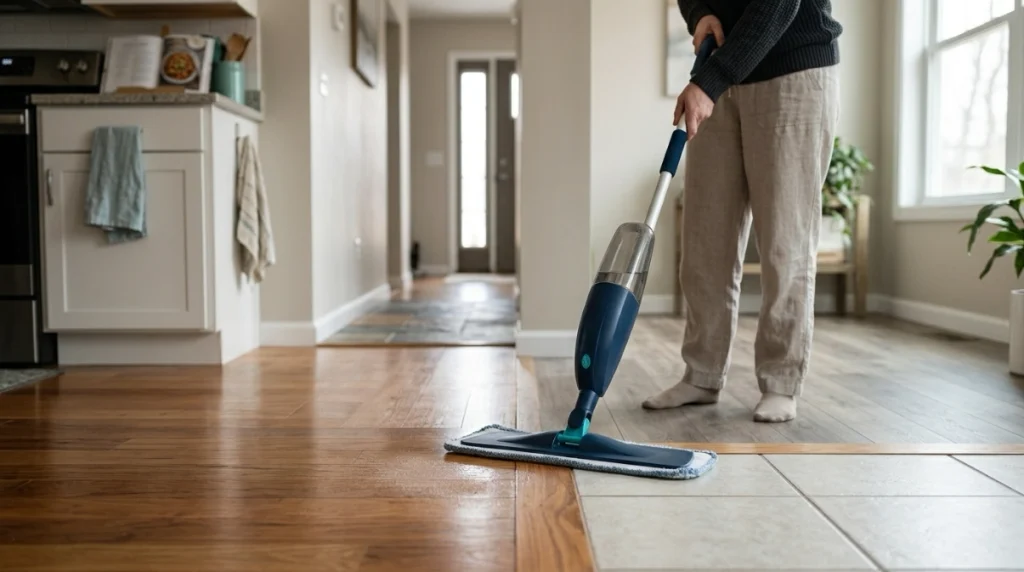
A spray mop is only as safe as the amount of moisture and cleaner you use. Always start with the care instructions supplied by the flooring manufacturer.
Hardwood and engineered wood
Use a microfiber spray mop with minimal liquid when your floor manufacturer permits damp cleaning. Avoid leaving droplets, puddles, or wet areas around joints.
The National Wood Flooring Association’s wood-floor guidance emphasizes minimal moisture and cleaners recommended for the floor or finish.
Safety note: Wood finishes and installation systems vary, so follow your flooring manufacturer’s care guide before wet cleaning.
Laminate
Laminate also benefits from controlled moisture. A trigger spray mop lets you apply less liquid than a heavily soaked string mop.
- Vacuum or sweep first.
- Use a clean microfiber pad.
- Spray lightly rather than soaking the floor.
- Wipe spills before liquid reaches seams.
Vinyl and LVP
Most routine vinyl cleaning works well with a lightly damp microfiber spray mop. Use a cleaner approved for your particular vinyl or luxury vinyl plank surface.
Avoid assuming that waterproof marketing means unlimited water is harmless. Liquid can still reach edges, transitions, and the subfloor.
Ceramic and porcelain tile
Tile is generally more tolerant of moisture than wood or laminate. A refillable or powered spray mop can handle everyday soil and sticky kitchen marks.
Textured tile may need extra mechanical scrubbing. A flat pad can glide over low areas instead of reaching into every texture.
Natural stone
Choose a pH-neutral cleaner approved for the exact stone. Acidic DIY cleaners may affect acid-sensitive materials and finishes.
Safety note: Test unfamiliar products in a hidden area and check the stone or sealer manufacturer’s instructions first.
Section Takeaway: A microfiber spray mop with precise liquid control suits the widest range of hard floors, but floor-manufacturer guidance always outranks a general cleaning rule.
What Cleaning Solution Should You Use in a Spray Mop?
Use a cleaner that is compatible with both the mop and the floor. Refillable does not mean every household liquid belongs inside the reservoir.
The EPA’s Safer Choice product search includes household floor cleaners for people who want to compare products that meet its program criteria.
For routine cleaning
- Hardwood: Use a cleaner approved by the flooring or finish manufacturer.
- Laminate: Choose a residue-controlled cleaner labeled for laminate.
- Vinyl/LVP: Use a compatible neutral floor cleaner when needed.
- Tile: A suitable hard-floor cleaner can help cut greasy soil.
- Stone: Choose a stone-safe, usually pH-neutral formulation.
Cleaning is not the same as disinfecting
Routine floor cleaning usually aims to remove dirt and residue. Disinfection is a separate process that depends on the correct product, surface, and label contact time.
The CDC’s cleaning and disinfecting guidance says cleaning alone is enough in many household situations. Disinfection becomes more relevant when someone is sick or increased germ control is needed.
Safety note: Never mix cleaning chemicals, and always follow the product label for dilution, ventilation, protective equipment, and surface compatibility.
What about vinegar?
Vinegar is not a universal floor cleaner. Its acidity can be unsuitable for some stone, grout, finishes, and manufacturer warranties.
If a floor maker does not approve it, I skip it. A purpose-made compatible cleaner is easier to control.
How Do You Choose a Spray Mop?
Start with your floor rather than the mop’s feature list. After compatibility, consider pad cost, bottle design, reach, and how much cleaning you normally do.
Check these features first
- Reservoir design: A wide opening is easier to fill and rinse.
- Spray pattern: Look for an even fan rather than a concentrated stream.
- Pad attachment: Hook-and-loop systems make pad changes fast.
- Swivel head: A low-profile rotating head reaches under furniture.
- Reusable pads: Extra washable pads help when cleaning several rooms.
- Trigger feel: The trigger should operate comfortably without excessive hand force.
- Replacement parts: Check whether bottles, pads, and cartridges remain easy to obtain.
Choose for your cleaning habits
For a small apartment, a lightweight refillable mop is usually enough. You can clean a spill without pulling out a bucket or powered machine.
For pets or busy kitchens, keep several washable pads ready. Switching pads prevents dirty microfiber from spreading grime into the next room.
For dried food and heavier residue, powered scrubbing can save effort. However, a floor washer may be more useful if dirty-water pickup matters.
Think about ongoing cost
The purchase price is only part of the decision. Disposable pads, proprietary cleaner bottles, cartridges, and replacement rollers add recurring expense.
I also look at how easy the mop is to clean after use. A complicated reservoir that traps old solution quickly becomes annoying.
Section Takeaway: Choose the simplest spray mop that safely handles your floors and normal messes. Extra features only help when they solve a problem you regularly have.
How Do You Use a Spray Mop Correctly?
Good technique matters because a spray mop can still leave streaks when you use too much solution. The floor should look lightly damp, not flooded.
- Remove loose debris. Sweep or vacuum grit, crumbs, pet hair, and dust first.
- Install a clean pad. A dirty pad can redistribute residue.
- Fill the reservoir correctly. Follow the mop and cleaner instructions.
- Start at the far side. Work toward the room exit.
- Spray sparingly. Apply only enough liquid to dampen the section ahead.
- Use overlapping passes. Keep the mop head moving across the damp area.
- Change dirty pads. Replace or rinse the pad when it becomes heavily soiled.
- Let the floor dry. Keep foot traffic away until the surface is dry.
Why does a spray mop leave streaks?
Streaks often come from excess cleaner, a dirty pad, or too much liquid. Using more product rarely fixes the problem.
- Use less solution.
- Start with a freshly washed pad.
- Do not mop over loose dust.
- Check the cleaner’s dilution instructions.
- Change pads between heavily soiled areas.
On smooth dark floors, I notice residue faster under side lighting. When that happens, I reduce the cleaner before changing the mop itself.
Spray Mop FAQs
Are spray mops better than regular mops?
Spray mops are better for quick cleaning and controlled moisture because they eliminate the separate bucket. Traditional mops can be better for large, heavily soiled areas where you need more water, rinsing, or aggressive scrubbing.
Are spray mops safe for hardwood floors?
A spray mop can be appropriate for some hardwood floors when the manufacturer allows damp cleaning. Use minimal moisture, a soft microfiber pad, and an approved wood-floor cleaner rather than soaking the boards.
What is the difference between a spray mop and a steam mop?
A spray mop dispenses liquid cleaner or water without intentionally heating it into steam. A steam mop uses a heating system to produce hot vapor, which creates different floor-compatibility and burn-safety concerns.
Can you put any cleaner in a refillable spray mop?
No. The solution must be compatible with the mop’s seals, bottle, pump, and nozzle as well as the flooring. Thick, foaming, oily, acidic, or otherwise unsuitable liquids can cause residue or equipment problems.
Are reusable spray mop pads better than disposable pads?
Reusable microfiber pads usually make more sense for routine cleaning because they can be washed and used again. Disposable pads are convenient for occasional unpleasant messes but create ongoing waste and replacement costs.
Do spray mops disinfect floors?
Not automatically. A mop only provides the application and wiping action, while disinfection depends on using an appropriate registered disinfectant exactly as its label requires, including surface compatibility and contact time.
Should you vacuum before using a spray mop?
Yes, especially when the floor has dust, grit, crumbs, or pet hair. Removing loose debris first helps the wet pad contact the floor and reduces the chance of dragging abrasive particles across the finish.
Which Type of Spray Mop Should You Buy?
For most homes, I would start with a refillable spray mop that uses washable microfiber pads. It offers the best balance of moisture control, low maintenance, and flexibility across compatible hard floors.
Choose a cartridge model when convenience matters more than solution flexibility. Pick a powered version when stubborn residue and manual scrubbing are regular problems.
- Best all-around choice: Refillable microfiber spray mop.
- Best for convenience: Cartridge-based spray mop.
- Best for low cleanup: Disposable-pad model.
- Best for stubborn grime: Powered spray mop.
- Best for solution control: Dual-chamber or refillable model.
Most importantly, match the mop to the floor instead of assuming one cleaner works everywhere. Controlled moisture, clean pads, and the correct solution make a bigger difference than flashy features.
Final Takeaway: The different types of spray mops mainly vary by reservoir, pad system, and cleaning action. A simple refillable microfiber model remains the most versatile starting point for everyday floor cleaning.