
Do Steam Mops Kill Viruses? What You Need to Know

Quick Answer
Steam mops may inactivate some viruses when enough heat reaches the surface for enough time. However, I would not assume every steam-mop pass provides reliable disinfection. When true disinfection is needed, the CDC recommends proper cleaning and an appropriate disinfecting method.
What matters most
- Heat matters: Steam must transfer enough heat to the surface to affect germs.
- Contact time matters: A fast pass may not keep an area hot long enough.
- Surface matters: Some flooring can be damaged by heat and moisture.
- Dirt matters: Soil and grime should be removed before serious disinfection.
- Instructions matter: Follow both the steam mop manual and flooring care guide.
My simple rule
- Use steam for cleaning only on approved surfaces. Use a proven disinfecting method when killing viruses is the main goal.
The question “do steam mops kill viruses?” sounds simple, but the useful answer needs a little context. Heat can help control germs, yet steam temperature alone does not prove that a floor has been disinfected.
I treat my steam mop as a cleaning tool first. When illness is the concern, I pay closer attention to the surface, contact time, product directions, and whether disinfection is actually needed.
In This Guide
- Do Steam Mops Kill Viruses?
- How Does Steam Affect Viruses?
- Is Steam Cleaning the Same as Disinfecting?
- Which Floors Are Safe for a Steam Mop?
- How Should You Clean Floors When Someone Is Sick?
- What Can a Steam Mop Not Guarantee?
- Steam Mop vs Disinfectant vs Regular Mop
- When Do Floors Actually Need Disinfecting?
- Frequently Asked Questions
- Final Takeaway
Do Steam Mops Kill Viruses?
Steam can help inactivate viruses, but that does not mean every steam mop reliably disinfects every floor. Temperature, contact time, surface condition, and the mop itself all affect the result.
A steam mop is an electric floor-cleaning device that heats water and sends hot vapor through a cleaning pad. The heat loosens grime while the pad collects the loosened material.
That process is useful. It is still different from assuming that one quick pass kills every virus present.
Why steam temperature alone is not enough
I often see steam-mop discussions focus only on how hot the machine gets. That number tells only part of the story.
The temperature inside the appliance is not always the same temperature reaching the floor. The pad, surface, movement speed, and moisture level can all change heat transfer.
- Slow contact: More heat may reach the surface, but excessive exposure can damage flooring.
- Fast contact: The floor gets less prolonged heat.
- Dirty pads: Soil can reduce cleaning performance and spread grime.
- Uneven floors: Steam and pad contact may vary across grout, texture, and seams.
This is why I avoid making a blanket claim that a steam mop “kills 99.9% of viruses.” A specific manufacturer may support a specific claim under defined test conditions, but that claim should not automatically be applied to every machine or floor.
How Does Steam Affect Viruses?
Heat can damage the structures viruses need to remain infectious. Steam can therefore play a role in germ control when a surface receives adequate heat for an adequate period.
The CDC includes steaming as one option for sanitizing certain nonporous household objects. That does not mean a floor steam mop automatically provides the same result under all conditions.
Contact time changes the result
Contact time means how long a treatment stays in effective contact with a surface. It is one of the details I watch most closely when people ask about disinfecting.
A steam mop is usually kept moving. Holding it still to increase heat exposure can create a different problem: floor damage.
That creates a practical tradeoff. You want enough heat exposure for cleaning, but you cannot ignore the limits of the flooring underneath.
Pre-cleaning still matters
Visible soil should be removed before you focus on disinfection. Dirt, grease, crumbs, and other material can make effective treatment harder.
I normally vacuum or dry-mop first. Then I use the appropriate wet-cleaning method for that floor.
- Vacuum loose grit and hair.
- Remove sticky or visible soil.
- Use a clean mop pad.
- Work in small sections, such as roughly 3-by-3 feet.
- Change the pad when it becomes heavily soiled.
This routine also prevents gritty debris from being dragged across the floor.
Is Steam Cleaning the Same as Disinfecting?
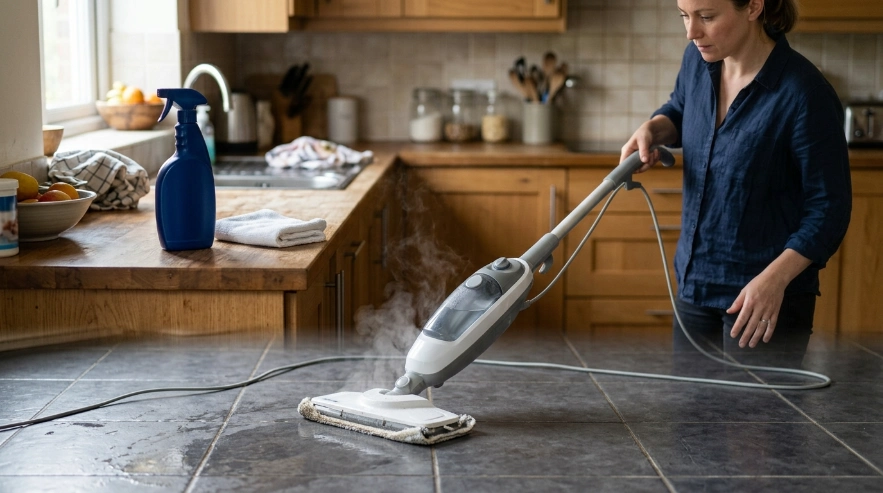
No. Cleaning, sanitizing, and disinfecting describe different goals, and using the terms correctly matters when viruses are involved.
The EPA explains the difference between cleaning, sanitizing, and disinfecting. Cleaning removes dirt and organic material, while EPA-registered surface disinfectants carry tested claims against listed germs.
Cleaning
Cleaning removes soil and reduces germs by physically removing material from a surface. A microfiber flat mop, spin mop, or steam mop can all perform this basic job.
For normal household floor care, cleaning is often the main goal.
Sanitizing
Sanitizing reduces certain germs to a lower level. The exact meaning depends on the method and product involved.
Do not assume the words “steam” and “sanitize” automatically mean that a specific virus has been eliminated.
Disinfecting
Disinfecting is a stronger claim. EPA-registered disinfectants must have appropriate supporting data for the organisms listed on their labels.
You can review EPA-registered disinfectants for common pathogens when verified surface disinfection is your priority.
Safety note: Never mix disinfectants or add household disinfecting chemicals to a steam mop tank unless the appliance manufacturer specifically allows them. Follow the disinfectant label and your flooring manufacturer’s care guide.
Which Floors Are Safe for a Steam Mop?
The floor underneath the mop matters as much as the steam itself. I never choose a steam setting before checking the flooring manufacturer’s instructions.
Seams, adhesives, finishes, protective coatings, and moisture-sensitive cores can all react differently to hot vapor.
Ceramic and porcelain tile
Sealed ceramic and porcelain tile are often the first surfaces people consider for steam cleaning. Even here, I check the grout, sealer, and flooring care instructions.
Damaged grout or failing sealant can allow unwanted moisture underneath the surface.
Hardwood and engineered wood
I would not use steam as a default cleaning method on wood flooring. Heat and vapor can reach joints and wood fibers where moisture may cause lasting damage.
The National Wood Flooring Association’s guidance specifically says not to use steam cleaners on wood floors.
A lightly damp microfiber mop and a manufacturer-approved wood-floor cleaner are safer choices for most wood flooring.
Laminate and vinyl/LVP
I also avoid assuming that laminate or luxury vinyl plank is steam-safe. These floors contain seams, layers, coatings, and sometimes adhesives that may react badly to excessive heat or moisture.
If the manufacturer clearly permits steam cleaning, follow those directions. If the care guide does not approve steam, choose a low-moisture microfiber method instead.
Natural stone and concrete
Stone and concrete vary widely because sealers and finishes differ. A surface that looks tough may still contain a coating that dislikes high heat.
Check the specific stone, grout, and sealer instructions before using steam.
Safety note: Test any new floor-cleaning method in a hidden area first. Stop if you notice whitening, dullness, swelling, soft seams, discoloration, or finish changes.
How Should You Clean Floors When Someone Is Sick?
If someone in the home is sick, I separate ordinary cleaning from true disinfection. That prevents me from relying on steam simply because it feels more powerful.
The CDC advises cleaning surfaces first and using an appropriate disinfectant when disinfection is needed. Product directions also tell you how long a treated surface must remain wet.
A practical floor-cleaning routine
- Remove loose debris. Vacuum or dry-mop dirt, hair, and crumbs.
- Clean visible soil. Use a cleaner approved for the floor.
- Decide whether disinfection is necessary. Routine household cleaning does not always require it.
- Check floor compatibility. Make sure your chosen disinfecting product is suitable for the surface.
- Follow the label. Pay attention to dilution, ventilation, and required contact time.
- Keep people away while wet. This reduces slip risk and gives the treatment time to work.
- Wash reusable mop pads. Do not store a dirty, damp pad on the machine.
I would not steam the floor and immediately apply an unrelated chemical product without checking both sets of instructions. Heat can affect chemicals, finishes, and residues in ways the product was not designed for.
Safety note: Never mix bleach, ammonia, acids, or other cleaning chemicals. Keep disinfectants away from children and pets, and provide ventilation when the label requires it.
What Can a Steam Mop Not Guarantee?
A steam mop cannot guarantee complete virus removal just because visible dirt disappears. A clean-looking floor and a disinfected floor are not automatically the same thing.
I use four checks before trusting any germ-killing claim.
- Which organism? A claim about one bacterium does not automatically cover every virus.
- Which surface? Test results may apply only to specific hard, nonporous materials.
- What contact time? A laboratory method may require longer exposure than normal mopping.
- Which machine and setting? Results from one model cannot automatically be transferred to another.
Marketing numbers need context
You may see steam products advertised with percentages such as 99.9%. I look past the number and read the conditions attached to the claim.
Check whether the claim names the organism, surface, steam setting, pad type, and treatment method. Those details determine what the number means.
The safest approach is simple. Treat manufacturer claims as specific to the tested product and directions, not as a universal rule for all steam mops.
Steam Mop vs Disinfectant vs Regular Mop
The best cleaning tool depends on what you are trying to accomplish. Removing dirt and achieving verified disinfection are separate goals.
| Method | Main Action | Virus-Killing Confidence | Best Use | Main Caution |
|---|---|---|---|---|
| Steam mop | Heat, moisture, and physical wiping | Conditional; follow the specific device claim and directions | Cleaning approved sealed hard floors | Heat and moisture can damage some flooring |
| Microfiber flat mop | Physical soil and germ removal | No automatic kill claim | Routine low-moisture cleaning | Dirty pads can spread residue |
| Spin or string mop | Water-based washing and soil removal | Depends on any separately approved disinfectant used | Larger washable hard-floor areas | Too much water can harm moisture-sensitive floors |
| EPA-registered disinfectant | Chemical disinfection | Label-backed for listed pathogens when used correctly | Situations where verified disinfection is needed | Must be compatible with the floor and used for full contact time |
For everyday cleaning, I usually prefer the least aggressive method that gets the floor clean. A microfiber mop with a floor-safe cleaner often handles routine dirt without unnecessary heat or moisture.
If verified virus disinfection becomes necessary, I choose a suitable registered product and follow its label rather than trying to make a steam mop do a job it was not proven to do.
When Do Floors Actually Need Disinfecting?
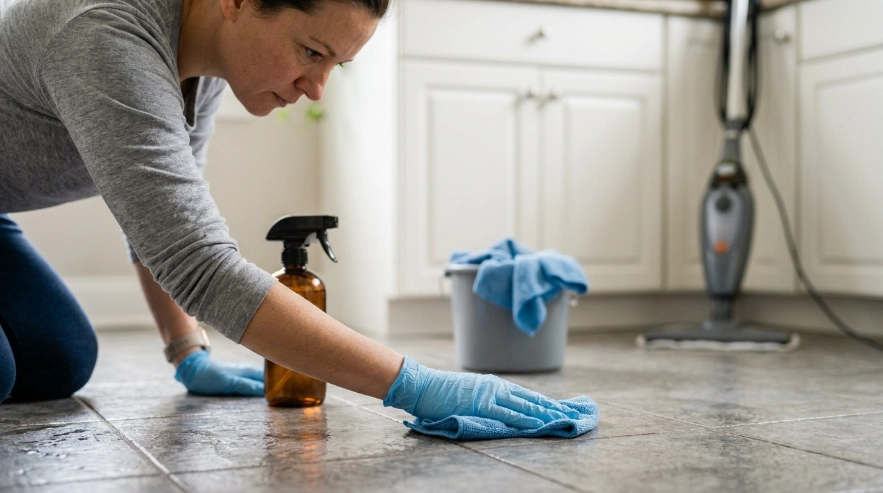
Most homes do not need constant floor disinfection. CDC guidance says regular cleaning is enough in many everyday situations.
Disinfection becomes more relevant when someone is sick or when a household member has a weakened immune system.
Focus on where contamination is likely
Floors are usually lower-touch surfaces than handles, switches, faucets, phones, and countertops. That does not mean floors never matter.
Extra cleaning can make sense after bodily-fluid contamination, illness-related spills, or heavy traffic through a contaminated area.
- Clean visible contamination promptly.
- Wear protection required by the product label.
- Keep the surface wet for the stated contact time.
- Prevent children and pets from entering the wet area.
- Allow the surface to dry as directed.
The EPA maintains information about disinfectants with claims against pathogens including SARS-CoV-2. Products should always be used according to their approved directions.
Safety note: More disinfectant is not better. Never increase concentration, mix products, or extend use to flooring that the label or floor manufacturer excludes.
Frequently Asked Questions
Do steam mops kill COVID-19 on floors?
Heat may inactivate SARS-CoV-2, but I would not assume a normal steam-mop pass provides verified COVID-19 disinfection. For situations requiring disinfection, use a method with instructions and claims appropriate for the surface and pathogen.
Do steam mops kill flu viruses?
Steam may affect viruses when adequate heat reaches them for enough time. However, results depend on the machine, temperature at the surface, contact time, and cleaning method, so a generic steam mop should not be treated as a guaranteed flu disinfectant.
Do steam mops kill viruses without chemicals?
Steam uses heat and water rather than a chemical disinfectant. It may reduce or inactivate germs under suitable conditions, but chemical-free does not automatically mean proven disinfection against every virus.
Should I add disinfectant to my steam mop?
No, unless your steam mop manufacturer specifically says the product is approved for the tank. Many steam appliances are designed for water only, and adding chemicals can damage components or create unsafe fumes.
Do I need to disinfect my floors every day?
Usually not. Routine cleaning is enough for many households, while extra disinfection becomes more useful when someone is sick or more vulnerable to infection.
Can I use a steam mop on hardwood to kill germs?
I would avoid it. The National Wood Flooring Association advises against steam cleaners on wood because vapor can penetrate wood fibers and damage the flooring and finish.
Is a microfiber mop better than a steam mop for viruses?
A microfiber mop is excellent for routine physical cleaning but does not automatically kill viruses. A steam mop adds heat, yet neither should replace a verified disinfecting method when confirmed virus disinfection is required.
Do Steam Mops Kill Viruses? Final Takeaway
So, do steam mops kill viruses? Steam has the potential to inactivate viruses, but a steam mop should not be treated as a universal or guaranteed disinfectant.
I use steam only where the floor and appliance instructions allow it. I also keep the mop moving, start with a clean pad, and remove visible dirt before wet cleaning.
When someone is sick and true disinfection matters, I follow CDC and EPA guidance instead of relying on steam alone. That gives me a clearer standard for both cleaning effectiveness and household safety.
Before your next cleaning session, check two things: your flooring care guide and your steam mop manual. Those few minutes can prevent floor damage while helping you choose the right method for the job.
