
Do Steam Mops Need Descaling? A Safe 2026 Maintenance Guide

Quick Answer
Yes, many steam mops can develop mineral scale and may need descaling or another manufacturer-approved mineral-removal procedure. Hard tap water raises the risk because calcium and magnesium deposits can restrict water passages and reduce steam output. The safest approach is to check your model’s instructions first; for example, BISSELL’s steam-mop support guidance notes that tap-water minerals can accumulate faster than minerals from distilled or reverse-osmosis water.
Signs Your Steam Mop May Need Attention
- Weak steam: Output has dropped even though the tank is full and the mop is hot.
- Uneven steam: Some outlet holes work while others appear blocked.
- White deposits: Chalky residue appears around the nozzle, cap, or steam outlet.
- Longer warm-up: The mop takes noticeably longer than usual to produce consistent steam.
- Hard tap water: Your home regularly gets scale around faucets, kettles, or showerheads.
Safest First Move
- Unplug and cool the mop, check its manual, then use only the cleaning or descaling method approved for that model.
I get this question often because steam mops look like simple water appliances. Inside, however, they contain narrow passages that can collect mineral deposits over time.
I’ve seen otherwise healthy steam mops lose output simply because hard-water residue restricted the steam path. The good news is that prevention is usually easier than repairing a badly scaled machine.
In This Guide
- Do Steam Mops Really Need Descaling?
- What Is Scale Inside a Steam Mop?
- How Do You Know a Steam Mop Needs Descaling?
- How Often Should You Descale a Steam Mop?
- How Do You Descale a Steam Mop Safely?
- Can You Use Vinegar or Citric Acid to Descale It?
- How Can You Prevent Mineral Buildup?
- What If the Steam Mop Still Will Not Steam?
- Frequently Asked Questions
Do Steam Mops Really Need Descaling?

Many steam mops eventually need some form of mineral-buildup maintenance, especially when they regularly run on hard tap water. However, not every manufacturer calls that maintenance “descaling.”
Some brands recommend distilled water as prevention. Others provide steps for clearing mineral deposits from specific outlets or components.
That difference matters. You should never assume a kettle-style vinegar treatment is appropriate for a steam mop.
- Use the manual first: Your exact model determines what can safely enter its water system.
- Treat weak steam as a symptom: Scale is possible, but an empty tank, airlock, damaged pump, or blocked nozzle can produce similar symptoms.
- Prevent buildup early: Low-mineral water can reduce how quickly deposits form.
- Protect the warranty: Unapproved chemicals inside the reservoir may create unnecessary warranty problems.
Steam-mop design also varies considerably. A basic water-only mop may have different seals, heating channels, and valves than a steam-and-scrub machine.
As of 2026, I treat descaling instructions as model-specific maintenance rather than a universal recipe. That approach is slower than copying a DIY vinegar hack, but it is much safer.
What Is Scale Inside a Steam Mop?
Scale is a hard mineral deposit left behind when mineral-containing water is heated or evaporates. Calcium and magnesium are common contributors to water hardness.
Steam mops repeatedly heat small amounts of water. That makes mineral accumulation possible in reservoirs, channels, heating areas, and steam outlets.
Why hard water creates more buildup
The U.S. Geological Survey explains that water hardness mainly comes from dissolved calcium and magnesium. Hard water can form scale in appliances and plumbing.
You can compare your local water report with the USGS water-hardness ranges below.
| Hardness as CaCO3 | USGS Classification | Steam-Mop Maintenance Implication |
|---|---|---|
| 0–60 mg/L | Soft | Lower scale-forming tendency, though deposits are still possible. |
| 61–120 mg/L | Moderately hard | Watch steam consistency and follow the water recommendation in your manual. |
| 121–180 mg/L | Hard | Scale can develop more readily; distilled water is worth considering when permitted. |
| More than 180 mg/L | Very hard | Mineral prevention becomes especially useful for frequently used steam mops. |
A useful clue is your kettle or showerhead. Heavy white crust there suggests your steam mop is receiving the same mineral-rich water.
How Do You Know a Steam Mop Needs Descaling?
Reduced steam output is the most obvious sign, but it is not proof by itself. First eliminate simple problems such as low water, poor tank seating, or incomplete warm-up.
Common mineral-buildup symptoms
- Steam becomes weaker: The mop heats normally but releases less vapor.
- Steam pulses irregularly: Output starts and stops despite a properly filled tank.
- Some holes stop steaming: Deposits can restrict individual outlets.
- Chalky residue appears: White or off-white crust is visible near water-contact areas.
- The mop needs longer to recover: Steam production becomes less consistent during normal passes.
- You hear normal operation without normal output: The heater or pump appears active, yet little steam reaches the floor.
Symptoms that may not be scale
A steam mop can stop producing steam for several other reasons. Do not automatically pour a descaling liquid into the reservoir.
- The tank is empty or incorrectly installed.
- An internal pickup tube is not drawing water.
- An air pocket interrupts water flow.
- The steam outlet has debris rather than mineral scale.
- The trigger or steam-control mechanism is faulty.
- The pump, heater, thermostat, or another electrical part has failed.
When I’m troubleshooting, I start with water level, tank seating, warm-up, and visible outlets. Those checks take little time and prevent unnecessary chemical treatment.
Safety note: unplug the steam mop and let it cool completely before inspecting its outlet, tank, or removable components.
How Often Should You Descale a Steam Mop?
There is no reliable universal schedule such as “every 30 days” for every steam mop. Water hardness, usage frequency, internal design, and manufacturer instructions all change the answer.
If your manual gives a descaling interval, use that interval. If it does not, I would not invent one.
A practical maintenance approach
- Distilled-water users: Watch for symptoms rather than descaling automatically.
- Soft-water homes: Check steam performance periodically and follow the manual.
- Hard-water homes: Inspect steam output and visible outlets more often.
- Very hard-water homes: Consider switching to distilled or other manufacturer-approved low-mineral water.
- Frequent users: Pay attention to gradual output loss because changes can be easy to miss.
When I test with mineral-heavy water, I compare the steam pattern after roughly every ten sessions. That is an inspection habit, not a manufacturer descaling interval.
The key is to catch deterioration early. A slightly restricted outlet is easier to address than a machine that barely produces steam.
How Do You Descale a Steam Mop Safely?
The safest method is the procedure printed in your steam mop’s manual or official support instructions. Different models may require completely different maintenance steps.
Step 1: Identify the exact model
Find the model number on the rating label, body, or underside of the machine. Search the manufacturer’s official support site rather than relying on instructions for a similar-looking mop.
Shark owners, for example, can use the company’s official manual library to locate model-specific documentation.
Step 2: Unplug and cool the mop
Never work around a hot steam outlet. Residual heat and pressurized steam can cause burns.
Empty the tank only after the machine is safe to handle. Place it on a stable surface away from children and pets.
Step 3: Follow the approved mineral-removal method
Depending on the manufacturer, the procedure may involve rinsing with approved water, cleaning a removable component, or clearing a specific opening. Use only the tool and method named in the instructions.
Some BISSELL troubleshooting guidance, for example, tells owners of particular models to clear buildup at a defined opening. That does not mean the same procedure is safe for every BISSELL or every other steam mop.
Step 4: Refill with the recommended water
After maintenance, refill only with the water type permitted by your manufacturer. Many water-only steam mops should not receive detergents, fragrances, oils, or improvised descaling mixtures.
Step 5: Test steam away from delicate flooring
Reassemble the mop correctly and test its operation according to the manual. Confirm that steam output is stable before cleaning a large floor area.
Safety note: never open a sealed boiler, heater, or pressurized component unless the manufacturer specifically designed it for user servicing.
Can You Use Vinegar or Citric Acid to Descale a Steam Mop?
You should not assume vinegar, citric acid, or a commercial kettle descaler is safe inside a steam mop. Use these products only when your exact model’s manufacturer explicitly approves them.
This is one of the biggest maintenance mistakes I see online. Advice that works for an electric kettle does not automatically transfer to pumps, seals, tubing, or heated steam channels.
| Method | Safe Default? | Best Practice |
|---|---|---|
| Distilled water | Often, when permitted | Use for prevention when the manual allows it. |
| White vinegar | No universal approval | Put it in the tank only if your exact manual says to. |
| Citric-acid solution | No universal approval | Avoid unless specifically approved by the manufacturer. |
| Kettle or coffee-machine descaler | No | Do not substitute appliance descalers without written approval. |
| Manufacturer-approved product | Yes, for listed models | Follow concentration, contact time, and rinsing directions exactly. |
Vinegar can dissolve some calcium-based deposits, but chemical compatibility is a separate question. An acid may affect materials that were designed for plain water.
Safety note: never mix vinegar with bleach or other cleaners, and never place any chemical in a steam mop unless its product instructions permit it.
How Can You Prevent Mineral Buildup?
Prevention is usually easier than descaling. The biggest improvement is controlling what goes into the tank.
Use the correct water
Check your manual before changing water types. Where distilled water is permitted, it can reduce the minerals available to form scale.
BISSELL notes on some steam-mop models that tap-water minerals can accumulate faster than minerals from distilled or reverse-osmosis water. That makes water choice especially useful in hard-water areas.
Keep cleaning chemicals out of a water-only tank
Do not add dish soap, floor cleaner, essential oils, fragrances, or disinfectant unless the manufacturer specifically instructs you to. These products can leave residues that create a different kind of blockage.
If you need a separate floor-cleaning product, choose one compatible with your floor and follow its label. The EPA maintains a searchable list of Safer Choice-certified cleaning products, including floor-cleaning categories.
Empty and dry removable tanks when appropriate
Do not leave old water sitting in a removable tank for long periods unless your manufacturer says storage with water is acceptable. Emptying it also gives you a chance to spot sediment or residue.
Wash the mop pad regularly
A dirty microfiber pad does not cause internal scale, but it can make a healthy steam mop seem ineffective. Wash or replace pads according to the care label.
- Start with a clean pad.
- Use the recommended detergent type.
- Avoid fabric softener when the pad instructions prohibit it.
- Let reusable pads dry fully before storage.
Section Takeaway: Water quality is the main controllable factor in mineral buildup. Use the water your manufacturer recommends and keep unapproved additives out of the tank.
What If the Steam Mop Still Will Not Steam?
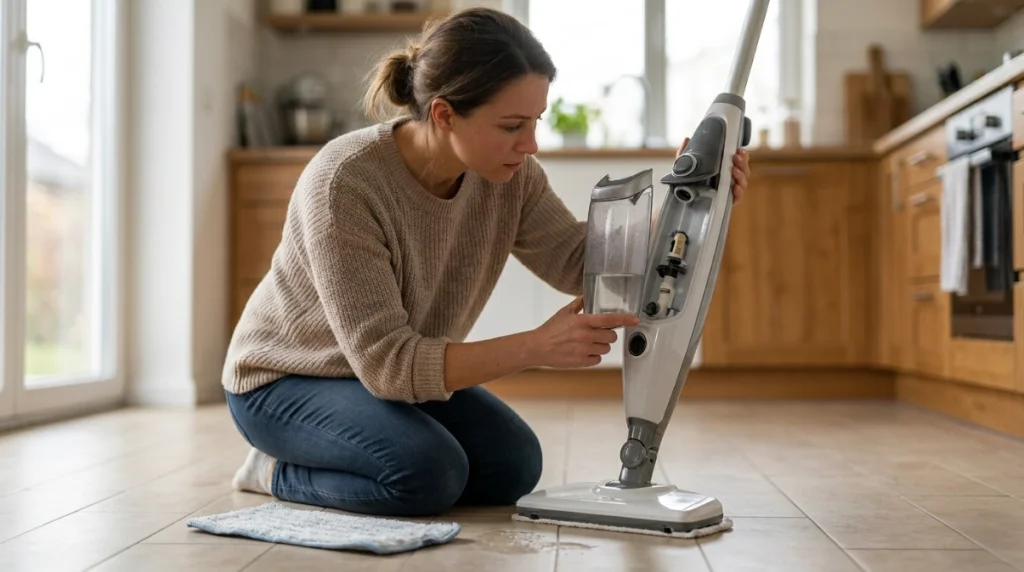
If approved maintenance does not restore steam, stop repeating the descaling process. The problem may have nothing to do with scale.
Work through basic troubleshooting
- Check the outlet: Confirm the electrical socket works with another appliance.
- Check the water level: Refill to the correct level without overfilling.
- Reseat the tank: A poorly fitted tank may prevent water flow.
- Allow normal warm-up: Give the machine the time specified in its manual.
- Check user-serviceable outlets: Clean them only using the approved tool and method.
- Inspect removable parts: Look for damaged caps, tubes, seals, or tanks.
- Contact support: Stop home troubleshooting when electrical or internal pump failure is suspected.
A persistent electrical smell, overheating, leaking body, tripped breaker, or damaged cord is different from a mineral blockage. Stop using the mop in those situations.
Replacing an inexpensive user-serviceable part can also make more sense than repeatedly treating the water system. Compare the machine’s age, warranty status, and replacement-part availability.
Safety note: electrical repairs, sealed heater repairs, and internal wiring work should be handled according to manufacturer service guidance.
Frequently Asked Questions
Do all steam mops need descaling?
No. Some models may only require preventive use of low-mineral water and occasional outlet cleaning, while others provide a specific descaling procedure. Follow your exact model’s maintenance instructions rather than using one method for every steam mop.
Does distilled water stop scale completely?
Distilled water greatly reduces the mineral content associated with hard-water scale, but you should still maintain the mop normally. Always confirm that your manufacturer allows distilled water before changing from the specified water type.
Can hard water damage a steam mop?
Hard water can leave calcium and magnesium scale as water is repeatedly heated. Over time, those deposits may restrict small passages or outlets and reduce steam performance.
Can I put vinegar directly in my steam mop tank?
Only if the manufacturer of your exact model explicitly permits it. Do not assume vinegar is safe because it works in kettles or coffee makers; steam mops contain different seals, pumps, plastics, and internal channels.
Why is my steam mop producing less steam?
Mineral buildup is one possibility. Other common causes include an empty or incorrectly seated water tank, blocked steam outlet, air-flow problem, faulty trigger, pump problem, or incomplete heating.
Should I use bottled water in a steam mop?
Regular bottled drinking water can still contain dissolved minerals, so it is not automatically the same as distilled water. Use the specific water type recommended in your steam mop’s manual.
Can I descale a steam mop while it is hot?
No. Unplug the machine and let it cool before inspecting, emptying, or cleaning user-serviceable components. Hot water and residual steam can cause burns even after the mop has been switched off.
Final takeaway: Steam mops can need mineral-scale maintenance, but there is no universal descaling recipe. Start with your model manual, use the recommended water, and treat weak steam as a troubleshooting symptom rather than automatically filling the tank with vinegar.
If you live in a hard-water area, prevention pays off. A small change in water choice can help keep steam output steadier and reduce the need for aggressive maintenance later.
