
Do Steam Mops Pick Up Dirt? What They Remove and Leave Behind

Quick Answer
Yes, steam mops pick up loose dirt, light dust, sticky residue, and softened grime with their microfiber pads. However, they do not vacuum crumbs, hair, sand, or larger debris, so sweep or vacuum first and follow appropriate household cleaning practices.
What a steam mop can and cannot do
- Picks up dust: The damp microfiber pad captures fine particles left after sweeping.
- Loosens grime: Heat and moisture soften dried spills and greasy films.
- Absorbs residue: A clean pad lifts the loosened material from the floor.
- Does not vacuum: Most models cannot collect crumbs, pet hair, grit, or litter.
- Needs safe flooring: Steam can damage unsealed wood, some laminate, and moisture-sensitive floors.
Best quick routine
- Vacuum first, use a fresh pad, move slowly, and replace the pad when it becomes visibly dirty.
I have tested steam mops on tile, sealed vinyl, and other hard floors where ordinary damp mopping left sticky marks. They can lift surprising amounts of dirt, but only when the floor and cleaning routine suit the machine.
This guide explains what steam mops collect, what they leave behind, and how to get a cleaner result without damaging your flooring.
In This Guide
- How Do Steam Mops Remove Dirt?
- What Types of Dirt Can a Steam Mop Pick Up?
- Do You Need to Vacuum Before Steam Mopping?
- Which Floors Can You Safely Steam Mop?
- Steam Mop vs Vacuum and Other Mops
- How to Make a Steam Mop Pick Up More Dirt
- Why Does My Floor Still Look Dirty?
- Frequently Asked Questions
- Final Takeaway
How Do Steam Mops Remove Dirt?
A steam mop loosens stuck dirt with heated water vapor. Its absorbent pad then wipes up the softened material.
A steam mop is an electric floor-cleaning appliance that heats water and directs vapor through a washable or disposable pad. Unlike a wet-dry vacuum, it has no suction system for pulling debris into a tank.
Steam softens the bond between dirt and flooring
Dried food, footprints, and thin grease films can cling to a hard surface. Heat and moisture soften these deposits, making them easier for the pad to remove.
The mop head still needs physical contact with the dirt. Steam alone does not make grime disappear.
The pad performs the actual pickup
Microfiber contains many fine synthetic fibers that trap moisture and small particles. A textured pad also provides mild scrubbing action as it moves across the floor.
During my tests, a fresh pad consistently removed more visible soil than a saturated one. Once the fibers filled with dirt, the mop began spreading a gray film instead.
- Steam: Softens dried residue and dampens fine dust.
- Pad fibers: Trap loosened grime and small particles.
- Mopping pressure: Helps the pad maintain contact with textured flooring.
- Repeated passes: Break down stubborn marks gradually.
Most manufacturers design steam mops for plain water. Adding detergent, vinegar, fragrance, or disinfectant to the tank can damage internal parts unless the manual permits it.
Safety note: Follow the mop manual and your flooring manufacturer’s care guide before exposing any surface to steam.
What Types of Dirt Can a Steam Mop Pick Up?

A steam mop handles fine dust, footprints, light residue, and some sticky spills. It performs poorly on bulky debris and heavy accumulations.
Dirt a steam mop usually handles well
- Fine dust: A slightly damp microfiber pad captures dust missed by a broom.
- Muddy footprints: Steam softens dry mud after loose soil has been vacuumed.
- Light kitchen film: Several slow passes can loosen thin, fresh grease residue.
- Dried drink spots: Heat helps release many water-based spills from tile or sealed vinyl.
- Water marks: A clean pad may remove mild surface residue from compatible floors.
- Small hairs: The pad may catch a few strands, although it is not reliable for pet hair.
Dirt it usually leaves behind
- Crumbs and cereal: The mop head often pushes these pieces around.
- Sand and grit: Hard particles can remain beneath the pad and scratch the finish.
- Pet hair clumps: Hair collects along the mop head instead of entering a dust bin.
- Large liquid spills: A small pad cannot safely absorb a puddle.
- Thick grease: Steam may loosen the surface without removing the complete layer.
- Ground-in grout soil: Deep discoloration often needs a suitable brush and cleaner.
Old wax, polish, adhesive, and mineral deposits may require a floor-approved product. Applying more steam can spread softened residue rather than remove it.
Cleaning and disinfecting also mean different things. The EPA’s disinfectant guidance explains that registered products must follow label directions and required contact times.
A steam mop may reduce some microorganisms under specific tested conditions. Do not assume every pass disinfects every floor.
Do You Need to Vacuum Before Steam Mopping?
Yes, vacuuming or sweeping first produces a cleaner and safer result. It removes debris that a steam mop cannot collect.
This preparation takes only a few minutes. It also reduces scratches caused by dragging grit beneath the mop pad.
Use this cleaning order
- Clear the area. Move light furniture, cords, pet bowls, and loose mats.
- Vacuum or sweep. Collect crumbs, sand, hair, litter, and dust along the edges.
- Spot-treat compatible stains. Use only a method approved for the floor.
- Fill the steam mop. Use the water type recommended in its manual.
- Attach a clean pad. Never begin with yesterday’s dirty or damp pad.
- Test a hidden area. Check for haze, finish changes, swelling, or discoloration.
- Mop in controlled passes. Work toward the room exit without trapping yourself.
Pay special attention to entryways and kitchen work zones. These areas usually hold more abrasive grit and greasy residue.
I often use a crevice attachment around baseboards before steaming. Otherwise, the mop’s rectangular head pulls edge dust back onto the clean floor.
What if the steam mop also has suction?
Some combination machines vacuum and steam in one appliance. These models can collect loose debris when their vacuum function is running correctly.
Check the manual before treating the machine as a true one-step cleaner. Tank design, filter maintenance, and debris limits vary between models.
Which Floors Can You Safely Steam Mop?
Steam works best on manufacturer-approved, sealed, moisture-resistant hard floors. It can damage flooring that allows heat or moisture below the surface.
| Floor type | General steam-mop suitability | Main concern |
|---|---|---|
| Glazed ceramic or porcelain tile | Often suitable | Damaged grout or loose tiles may admit moisture |
| Sealed vinyl or LVP | Only with manufacturer approval | Heat may affect adhesive, seams, or wear layers |
| Laminate | Usually avoid unless expressly approved | Moisture can enter joints and swell the core |
| Hardwood or engineered wood | Use only if the flooring maker permits it | Steam can affect seams, coatings, and wood fibers |
| Natural stone | Depends on stone and sealer | Heat or moisture may affect sealers and filled cracks |
| Sealed concrete | Often suitable with approval | Worn coatings or cracks may trap moisture |
Hardwood deserves extra caution. The National Wood Flooring Association’s homeowner resources emphasize following care instructions appropriate to the specific wood floor and finish.
“Sealed” does not automatically mean steam-safe. Small gaps, worn finish, or damaged seams can allow vapor to reach vulnerable layers.
Signs you should stop immediately
- Planks begin curling, lifting, or separating.
- The finish develops white or cloudy patches.
- Laminate edges appear raised or swollen.
- Adhesive-backed flooring starts shifting.
- Water remains in seams after the mop passes.
- The surface becomes unusually dull or sticky.
Do not repeatedly steam one spot to remove a stubborn stain. That concentrates heat and moisture where damage is most likely.
Safety note: Test an inconspicuous area and check the flooring warranty before using steam.
Steam Mop vs Vacuum and Other Mops
A steam mop is best for loosening residue on compatible hard floors. A vacuum remains better for dry debris, while a flat or spin mop offers wider floor compatibility.
| Cleaning tool | Best at collecting | Main limitation |
|---|---|---|
| Steam mop | Fine dust, softened spills, light residue | No suction; limited floor compatibility |
| Vacuum | Hair, crumbs, sand, dry particles | Does not remove most sticky residue |
| Microfiber flat mop | Dust and controlled amounts of cleaning solution | May need more scrubbing on dried spills |
| Spin mop | General wet cleaning across larger rooms | Dirty water and over-wetting require careful control |
| Vacuum-steam combination | Loose debris and compatible sticky messes | Heavier, costlier, and more complex to maintain |
The best routine often uses two tools. Vacuum first, then steam mop only where the flooring permits it.
A microfiber flat mop with a pH-neutral cleaner is a safer alternative for many moisture-sensitive surfaces. “pH-neutral” means the solution is neither strongly acidic nor strongly alkaline.
How to Make a Steam Mop Pick Up More Dirt
Better pickup comes from floor preparation, clean pads, correct steam output, and slow movement. Extra steam is rarely the complete answer.
Start with the right pad
Use a pad recommended for your model. Soft pads suit everyday cleaning, while textured pads provide more friction on compatible tile and sealed surfaces.
Replace the pad when it looks dark or stops absorbing moisture. In a large kitchen, I may use two or three pads during one cleaning session.
Move slowly without parking the mop
Use overlapping forward-and-back passes. Give steam enough time to soften residue, but keep the head moving.
For a dried spot, make two or three controlled passes. Wipe the area by hand with an approved cleaner if the mark remains.
Use a practical routine
- Vacuum thoroughly: Remove grit from open areas, corners, and grout edges.
- Preheat correctly: Wait until the mop signals that steam is ready.
- Begin with a fresh pad: A dirty pad redeposits soil.
- Use overlapping paths: Avoid narrow strips of missed flooring.
- Change pads early: Do not wait until the pad becomes saturated and black.
- Let the floor dry: Keep people and pets away until the surface is no longer damp.
Ordinary cleaning is enough in many homes. As of 2026, the CDC still distinguishes routine cleaning from sanitizing and disinfecting, which may be needed in specific illness-related situations.
Safety note: Never mix cleaning chemicals or place an unapproved solution inside a steam mop tank.
Why Does My Floor Still Look Dirty?
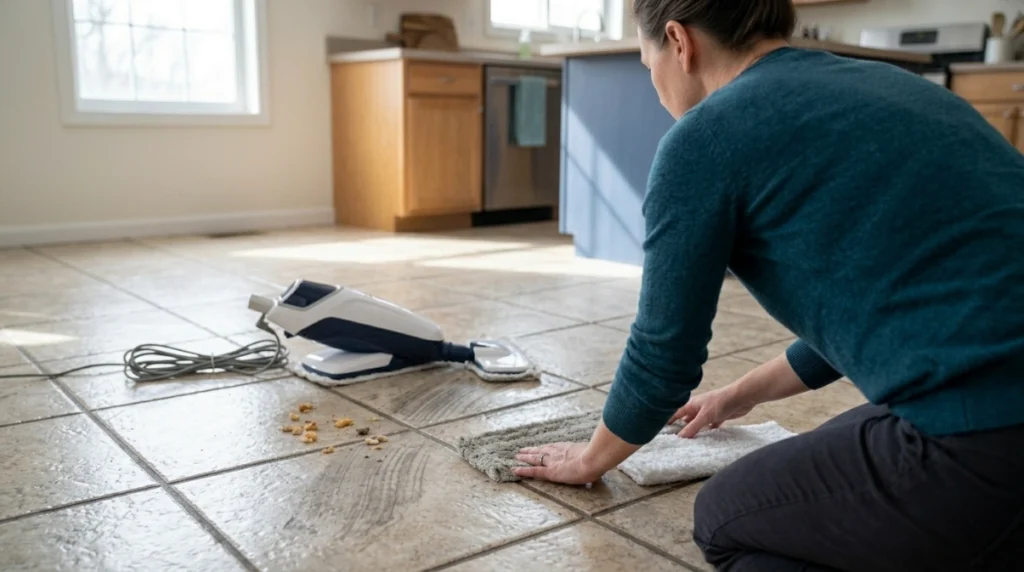
A floor may remain dirty because the pad is saturated, debris was not vacuumed, or residue already coats the surface. Hard water and unsuitable products can also cause haze.
The mop leaves gray streaks
A dirty pad is the most common cause. Replace it, let the floor cool, and repeat the area with a clean pad if the flooring allows.
Laundry softener can coat microfiber and reduce absorption. Wash reusable pads according to their label and avoid additives the manufacturer prohibits.
The floor feels sticky
Old cleaner residue may have built up over time. Steam can soften that layer, but one small pad may spread it across the room.
Use several clean pads or follow the flooring maker’s residue-removal instructions. Do not guess with strong vinegar, bleach, or alkaline degreasers.
The mop pushes debris into piles
This happens because a standard steam mop has no vacuum inlet. Stop and collect the debris before continuing.
Dragging sand beneath the pad may scratch glossy finishes. Quick removal protects the floor.
The floor looks cloudy after drying
Cloudiness can come from mineral-rich water, old polish, cleaning residue, or finish damage. Check whether the mop manual recommends distilled or demineralized water.
If haze remains, stop using steam until you identify the floor material and finish. Repeated heat may worsen an existing coating problem.
Allow the floor to dry fully before walking on it. Wet surfaces increase slip risk, particularly near stairs and doorways.
Frequently Asked Questions
Do steam mops suck up dirty water?
Most steam mops do not suck up water. Their pads absorb moisture and loosened dirt, while the machine supplies steam through the mop head. A vacuum-steam combination may collect debris or liquid differently, so check its manual.
Can a steam mop replace a vacuum?
No. A standard steam mop cannot reliably collect pet hair, crumbs, sand, litter, or other dry debris. Vacuum or sweep before steaming to prevent smears and reduce the risk of grit scratching the floor.
Will a steam mop remove sticky dirt?
A steam mop can soften and lift many light, water-based sticky spots from approved hard floors. Thick grease, wax, adhesive, and heavy cleaner buildup may require a floor-safe product and separate manual cleaning.
Why is the steam-mop pad so dirty after cleaning?
A dark pad usually means its fibers collected fine dust and softened residue. Change it before it becomes saturated, because an overloaded pad can spread dirt and leave streaks across the floor.
Can I put floor cleaner in a steam mop?
Use only liquids expressly permitted by the mop manufacturer. Many models are designed for water alone, and added cleaner can damage the heater, create residue, release irritating vapor, or void the warranty.
Does steam mopping disinfect floors?
Do not assume every steam mop disinfects every surface. Results depend on temperature, contact time, floor texture, and manufacturer testing. For illness-related disinfection, clean first and use an appropriate registered product according to its label.
How often should I change the steam-mop pad?
Change the pad whenever it becomes visibly dirty, saturated, or starts leaving streaks. A lightly soiled room may need one pad, while a busy kitchen or entryway may require several.
Final Takeaway
Steam mops do pick up fine dirt and softened grime, but the microfiber pad does the collecting. Most models cannot replace a vacuum because they lack suction.
For the best result, remove dry debris first, use a clean pad, and keep the mop moving. Change pads whenever they become loaded with soil.
Most importantly, confirm that your floor is steam-safe. If the manufacturer does not approve steam, choose a lightly damp microfiber mop and a compatible cleaner instead.
