
Do Steam Mops Use a Lot of Electricity?

Quick Answer
No, steam mops generally do not use a lot of electricity overall. Most household models draw roughly 1,000–1,600 watts while heating, but a typical 20-minute cleaning session uses only about 0.33–0.53 kWh. You can calculate the exact amount using the kilowatt-hour method explained by the U.S. Energy Information Administration.
What that means for your electric bill
- Typical power: Many corded steam mops are rated between about 1,000 and 1,600 watts.
- Twenty-minute session: A 1,500-watt steam mop uses about 0.50 kWh.
- Example cost: At $0.20 per kWh, that 20-minute session costs about $0.10.
- Weekly cleaning: One 20-minute session per week with a 1,500-watt model uses about 26 kWh yearly.
- Main cost factor: Cleaning time matters more than small differences in steam-mop wattage.
Quick money-saving tip
- Sweep or vacuum first so you can steam-mop efficiently instead of keeping the heating element running while you deal with loose debris.
Steam mops can look power-hungry because their labels often show wattages similar to small heating appliances. However, wattage alone doesn’t tell you how much electricity you’ll pay for.
The important number is how long the steam mop runs. In this guide, I’ll show you the electricity math, realistic costs, and ways to keep your floor-cleaning routine efficient.
In This Guide
- How Much Electricity Does a Steam Mop Use?
- How Much Does It Cost to Run a Steam Mop?
- Why Do Steam Mops Have Such High Watt Ratings?
- How Does Steam Mop Electricity Use Compare by Wattage?
- What Changes How Much Electricity a Steam Mop Uses?
- Can a Steam Mop Raise Your Electricity Bill?
- How Can You Reduce Steam Mop Electricity Use?
- Does Floor Safety Matter More Than Electricity Use?
- Steam Mop Electricity FAQs
- Are Steam Mops Energy-Efficient for Everyday Cleaning?
How Much Electricity Does a Steam Mop Use?

A typical household steam mop may draw roughly 1,000 to 1,600 watts while operating. That equals about 1.0 to 1.6 kilowatts of electrical power.
For perspective, Shark lists its S1000 Steam Mop at 1,050 watts. BISSELL lists its PowerFresh Steam Mop at 1,500 watts.
What does steam mop wattage mean?
Wattage measures power draw, not total electricity consumption. A higher-wattage mop can use more power at a given moment, but total energy depends on operating time.
A kilowatt-hour, or kWh, measures electricity used over time. One kilowatt running for one hour equals one kWh.
- 1,000-watt mop for one hour: about 1.0 kWh
- 1,200-watt mop for one hour: about 1.2 kWh
- 1,500-watt mop for one hour: about 1.5 kWh
- 1,500-watt mop for 20 minutes: about 0.50 kWh
Most people don’t steam-mop continuously for an hour. That’s why the actual electricity consumed per cleaning session stays fairly modest.
A simple definition
A steam mop is an electric floor-cleaning appliance that heats water and directs the resulting vapor through or around a cleaning pad. Most of its electrical demand comes from heating that water.
I find that looking only at the wattage label makes these machines seem more expensive to operate than they are. Cleaning duration gives you a much more useful number.
How Much Does It Cost to Run a Steam Mop?
The easiest way to estimate steam-mop running cost is to convert its wattage to kilowatts. Then multiply that figure by the hours used and your electricity price.
Use this electricity cost formula
Watts ÷ 1,000 × hours used × electricity rate = operating cost.
For example, imagine you own a 1,500-watt steam mop and clean for 20 minutes.
- Convert 1,500 watts to 1.5 kilowatts.
- Convert 20 minutes to 0.333 hours.
- Multiply 1.5 × 0.333 = about 0.50 kWh.
- At $0.20 per kWh, multiply 0.50 × $0.20.
- Your estimated session cost is about $0.10.
Even if your local rate were $0.30 per kWh, that same 20-minute session would cost about $0.15. Your actual utility rate may be higher or lower.
What about weekly use?
A 1,500-watt mop used for 20 minutes once weekly consumes about 26 kWh over 52 sessions. At $0.20 per kWh, that’s roughly $5.20 per year.
Using it twice weekly would approximately double that example to $10.40 annually. These figures assume the mop draws its full rated power throughout each session, so actual consumption can vary.
Why Do Steam Mops Have Such High Watt Ratings?
Steam mops need substantial power because turning cool water into steam requires heat. The heating element must raise the water temperature quickly enough to make the mop practical.
This explains why many models heat up in less than a minute despite holding cold or room-temperature water.
High wattage can shorten warm-up time
A stronger heating element can help produce steam quickly, although wattage isn’t the only factor. Heater design, tank size, water flow, and steam controls also affect performance.
The Shark S1000, for example, is rated at 1,050 watts and advertises steam readiness within roughly 30 seconds. BISSELL’s 1,500-watt PowerFresh also uses a high-output heater for steam cleaning.
Rated watts aren’t the same as constant energy use
The wattage on the machine tells you its rated electrical demand. It doesn’t necessarily mean the appliance draws that exact amount every second during every cleaning cycle.
Heating behavior can change as the appliance maintains steam. That’s why a plug-in electricity meter gives the best household-specific measurement.
How Does Steam Mop Electricity Use Compare by Wattage?
Cleaning time creates a larger difference than most people expect. Here is what several common wattage levels would use during a 20-minute session.
| Steam Mop Rating | Energy in 20 Minutes | Cost at $0.15/kWh | Cost at $0.20/kWh | Cost at $0.30/kWh |
|---|---|---|---|---|
| 1,050 W | 0.35 kWh | $0.05 | $0.07 | $0.11 |
| 1,200 W | 0.40 kWh | $0.06 | $0.08 | $0.12 |
| 1,500 W | 0.50 kWh | $0.08 | $0.10 | $0.15 |
| 1,600 W | 0.53 kWh | $0.08 | $0.11 | $0.16 |
These are straightforward nameplate estimates. They make it easy to substitute your own electricity rate and actual cleaning time.
A manual microfiber flat mop uses no electricity at all. However, that doesn’t automatically make it a better cleaning choice for every compatible floor or mess.
What Changes How Much Electricity a Steam Mop Uses?
The rated wattage sets the basic power level, but several practical habits determine how much energy a complete cleaning job consumes. Most are easy to control.
Cleaning time
Running a steam mop for 40 minutes uses roughly twice as much energy as running the same machine for 20 minutes. Cleaning efficiently therefore matters more than shaving 100 watts from the appliance rating.
Steam setting
Models with adjustable steam output may behave differently on low and high settings. Higher steam demand can require the heater to work more frequently.
The exact difference depends on the appliance. Check your manual rather than assuming a specific percentage saving.
Starting water temperature
The mop must heat its water before producing steam. However, I don’t recommend adding unusually hot or boiling water unless the manufacturer explicitly allows it.
Saving a few seconds of heating isn’t worth risking the tank or seals. Follow the appliance instructions.
Pauses during cleaning
Leaving a powered steam mop sitting while you move chairs or pick up clutter extends the session. Prepare the floor before plugging it in.
- Remove toys and cables.
- Move lightweight chairs.
- Sweep or vacuum loose grit.
- Fill the tank correctly.
- Attach a clean microfiber pad.
Once I have the room prepared, the actual steaming portion becomes much quicker. That approach saves both time and unnecessary heating.
Can a Steam Mop Raise Your Electricity Bill?
Technically, every electric appliance adds something to your electricity bill. A steam mop usually contributes only a small amount because cleaning sessions are short.
Consider a 1,500-watt machine used for 30 minutes. That session consumes about 0.75 kWh at the full rated draw.
- At $0.15/kWh: about $0.11 per session
- At $0.20/kWh: about $0.15 per session
- At $0.30/kWh: about $0.23 per session
Even frequent weekly use is unlikely to become one of the largest household electricity expenses. Heating, air conditioning, water heating, and other long-running equipment generally operate for far more hours.
When could consumption become noticeable?
A steam mop could use more electricity if you clean large areas for long periods or run it daily. Commercial-style cleaning habits change the math considerably.
For normal household floor cleaning, runtime usually keeps consumption limited. As of 2026, I would pay more attention to floor compatibility and cleaning technique than to a small wattage difference between comparable models.
How Can You Reduce Steam Mop Electricity Use?
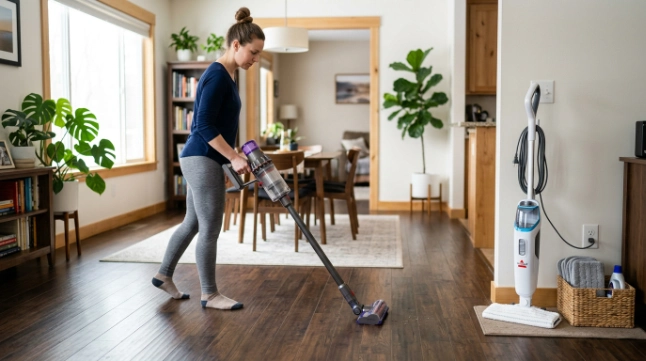
The best way to lower steam-mop energy use is simple: finish the job faster without rushing the cleaning itself. Preparation makes that possible.
Use these efficiency habits
- Vacuum first: Remove hair, crumbs, and grit before heating the mop.
- Prepare the room: Move obstacles before plugging the appliance in.
- Use the right steam level: Choose only as much steam as the approved surface and mess require.
- Change dirty pads: A saturated or dirty pad can spread grime and force repeat passes.
- Work systematically: Clean from the far side of the room toward the exit.
- Spot-clean first: Loosen stubborn material before repeatedly steaming the whole area.
- Unplug after cleaning: Don’t leave the heater powered longer than necessary.
Should you buy a lower-wattage steam mop to save money?
Not necessarily. A lower wattage can reduce instantaneous power draw, but it may also change heat-up speed or steam performance.
For example, the difference between 1,200 watts and 1,500 watts over only 20 minutes is 0.10 kWh. At $0.20 per kWh, that difference is just two cents per session.
Choose a model that suits your floors, cleaning area, pad system, and steam controls. Wattage should be only one part of the decision.
Does Floor Safety Matter More Than Electricity Use?
Yes. For many homeowners, floor compatibility is more important than the electricity cost of steam cleaning.
Steam combines heat and moisture. Those two things can harm materials that aren’t designed to tolerate them.
Be especially careful with wood
The National Wood Flooring Association advises against using steam cleaners on wood flooring. Steam and excessive moisture can penetrate wood and damage the flooring or finish.
A lightly damp microfiber mop is generally a safer approach for wood when it matches the flooring manufacturer’s care instructions. Never assume that a sealed-looking surface is steam-safe.
Check laminate, vinyl, and other sensitive floors
Laminate seams can be vulnerable to heat and moisture. Some vinyl and LVP manufacturers also restrict or prohibit steam cleaning.
Natural stone requires its own care rules because sealers and finishes vary. Ceramic and porcelain tile are often better candidates, but you should still check the manufacturer’s instructions.
Safety note: Always check your flooring manufacturer’s care guide and your steam mop’s label before using heat or moisture on a floor. Warranty requirements should take priority over generic cleaning advice.
Steam Mop Electricity FAQs
Do steam mops use more electricity than vacuum cleaners?
A steam mop can have a similar or higher watt rating than some household vacuums because it must create heat. Total electricity use still depends on how long each appliance runs, so wattage alone doesn’t determine which costs more.
How much electricity does a 1,500-watt steam mop use in 30 minutes?
A 1,500-watt steam mop running for 30 minutes uses about 0.75 kWh at its full rated draw. At an electricity rate of $0.20 per kWh, that equals roughly $0.15.
How much electricity does a steam mop use in 20 minutes?
A 1,000-watt model uses about 0.33 kWh in 20 minutes. A 1,500-watt model uses about 0.50 kWh, while a 1,600-watt model uses roughly 0.53 kWh.
Does a steam mop use electricity when it is plugged in but not steaming?
Some models may continue maintaining heat while plugged in, depending on their controls. Unplug the steam mop when you’re finished and follow the manufacturer’s shutdown instructions rather than leaving it connected unnecessarily.
Is a 1,500-watt steam mop expensive to run?
Usually not for normal household use. A 20-minute session consumes about 0.50 kWh, which costs $0.10 when electricity costs $0.20 per kWh.
Can I calculate my steam mop’s exact electricity cost?
Yes. Divide the rated watts by 1,000, multiply by the hours used, then multiply by your electricity rate per kWh. For a more exact real-world measurement, use a compatible plug-in electricity meter.
Should I unplug my steam mop immediately after cleaning?
Yes, once you’ve finished and your manual’s shutdown procedure allows it. Unplugging prevents unnecessary heating and is also a sensible appliance-safety habit before emptying, cleaning, or storing the machine.
Are Steam Mops Energy-Efficient for Everyday Cleaning?
For most homes, steam mops use a noticeable amount of power while operating but not a large amount of electricity over time. Their short cleaning sessions keep total kWh consumption relatively low.
A 1,500-watt model used for 20 minutes consumes around 0.50 kWh. At $0.20 per kWh, that’s about ten cents per cleaning session.
Don’t choose a steam mop based on wattage alone. Floor compatibility, steam control, cleaning speed, pad quality, and manufacturer guidance matter more in everyday use.
If you’re trying to cut electricity use, prepare the room first, work efficiently, and unplug the machine when you’re finished. Most importantly, only steam-clean flooring that its manufacturer confirms can safely handle heat and moisture.
