
What Is a Handle Operated Spin Mop?

Quick Answer
A handle operated spin mop is a mop-and-bucket system that uses downward pressure on the mop handle to spin the mop head inside a wringer basket. The spinning action removes excess water without hand-wringing or a foot pedal, giving you better control over how damp the mop stays. For general household cleaning, follow CDC cleaning and disinfecting guidance and always match the moisture level to your floor.
How It Works
- Unlock the handle: The handle must normally be in its spinning or unlocked position.
- Wet the mop: Dip the microfiber head into the bucket or wash chamber.
- Enter the wringer: Place the mop head flat inside the spinning basket.
- Push downward: Repeated handle strokes rotate the mop head and wringer mechanism.
- Control moisture: More spinning usually removes more water before mopping.
Quick Tip
- Keep the handle upright during spinning and follow your model’s locking instructions.
A handle operated spin mop looks similar to a regular spin mop, but the wringing mechanism works differently. Instead of pressing a pedal with your foot, you activate the spinning action through the handle itself.
I like this design when I want a simple bucket without extra pedal hardware. It also makes moisture control easier once you get used to the push-down motion.
In This Guide
- What Is a Handle Operated Spin Mop?
- How Does a Handle Operated Spin Mop Work?
- Handle Operated vs Foot-Pedal Spin Mop
- How Do You Use a Handle Operated Spin Mop?
- Which Floors Can You Clean With One?
- What Are the Benefits and Drawbacks?
- What Should You Look for When Choosing One?
- How Do You Clean and Maintain a Spin Mop?
- Handle Operated Spin Mop FAQs
- Final Takeaway
What Is a Handle Operated Spin Mop?
A handle operated spin mop is a manual floor-cleaning system with a spinning wringer activated through the mop handle. You push the unlocked handle downward while the mop head sits inside the bucket’s spinner.
Definition: A handle operated spin mop uses a push-down or pump-style handle mechanism to rotate a wet mop head at speed and remove excess water.
The system usually contains several basic parts:
- Microfiber mop head: Absorbs liquid and collects dirt from the floor.
- Rotating mop plate: Allows the strands or pad to spin freely.
- Telescoping handle: Provides both normal mopping control and the spinning action.
- Locking mechanism: Switches the handle between mopping and spin modes on many models.
- Bucket: Holds water and cleaning solution.
- Wringer basket: Spins the mop head and throws excess water away through centrifugal force.
The important difference is where the spinning power comes from. Your hand and arm provide that energy through the handle instead of your foot operating a bucket pedal.
How Does a Handle Operated Spin Mop Work?
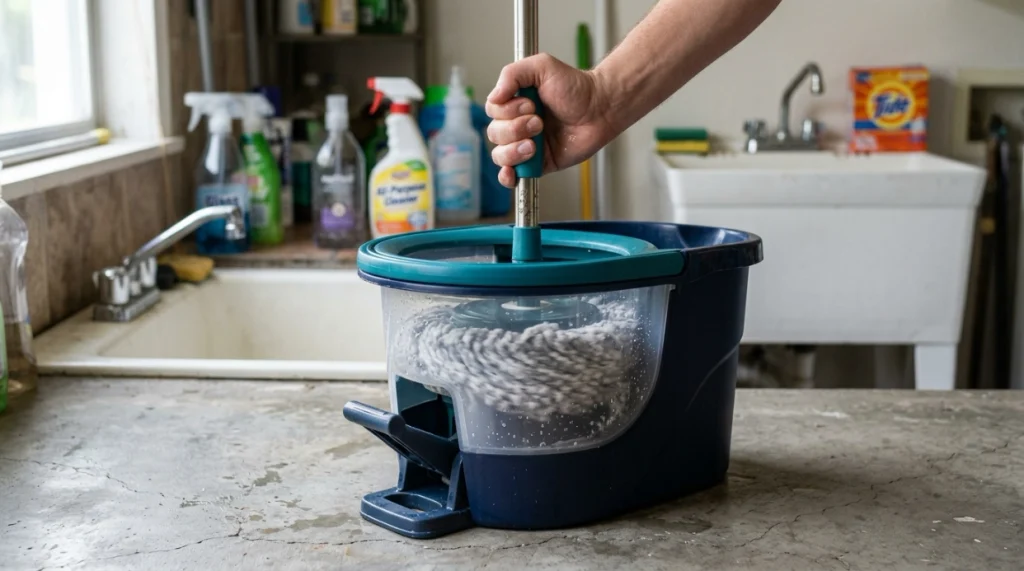
The handle converts a downward pumping movement into rotational motion at the mop head. Inside the wringer, that rotation forces excess water away from the microfiber strands.
What happens when you push the handle?
Most handle-driven designs have an internal rotating mechanism in the lower handle or mop plate. With the handle unlocked, pushing downward causes the mop head to rotate.
The practical process looks like this:
- Wet the mop head in the bucket.
- Place it flat inside the wringer basket.
- Hold the handle close to vertical.
- Unlock the spinning mechanism if your model requires it.
- Push downward to start the spin.
- Repeat until the mop reaches the moisture level you want.
- Lock the handle again before normal mopping if required.
More spinning generally means less water remains in the mop head. Some systems specifically instruct users to push once for a damper mop and repeat the action for a drier head.
Why does spinning remove water?
Rapid rotation pushes water outward from the mop fibers. The wringer basket lets that water escape while keeping the mop contained.
This gives you more control than squeezing a traditional string mop by hand. It also reduces the need to touch a dirty, wet mop head.
Section Takeaway: The handle is both your normal mop handle and the power source for the wringing mechanism. Repeated downward strokes let you adjust how much moisture remains in the mop.
Handle Operated vs Foot-Pedal Spin Mop
Both designs use a spinning basket to remove water. The main difference is how you make that basket or mop head rotate.
| Feature | Handle Operated Spin Mop | Foot-Pedal Spin Mop | Microfiber Flat Mop |
|---|---|---|---|
| Wringing method | Downward handle strokes | Repeated foot-pedal presses | Hand wringing, spray, or pad replacement |
| Bucket mechanism | Usually simpler | Contains pedal linkage | Often no bucket |
| Moisture adjustment | Repeat handle spins | Repeat pedal spins | Control spray or pad dampness |
| Best fit | Whole-room wet or damp cleaning | Users who prefer foot-controlled wringing | Quick, low-moisture maintenance |
| Main drawback | Requires correct handle technique | Pedal adds moving parts | Less suited to heavy wet cleaning |
I prefer the handle system when simplicity matters most. There is no pedal to position under my foot while I steady the bucket.
A flat microfiber mop still wins for fast touch-ups. A spin mop becomes more useful when the floor is dirty enough to require repeated rinsing.
How Do You Use a Handle Operated Spin Mop?
Start by removing dry dirt before introducing water. Sand, crumbs, pet hair, and grit become much harder to manage once wet.
Step-by-step mopping method
- Vacuum or sweep first. Remove loose particles from the entire cleaning area.
- Fill the bucket correctly. Stay below its maximum fill line.
- Add cleaner carefully. Follow the cleaner label rather than estimating a stronger mixture.
- Wet the mop. Submerge the microfiber head without flooding the surrounding floor.
- Move to the wringer. Center the mop head inside the spinning basket.
- Activate spin mode. Unlock the handle if your model uses a lock.
- Push the handle down. Repeat until the mop feels appropriately damp.
- Lock the handle. Secure it before mopping if the design requires this.
- Mop in sections. Work toward the doorway instead of walking across freshly cleaned areas.
- Rinse and repeat. Refresh the mop whenever the microfiber becomes visibly dirty.
I usually start with more wringing rather than less. It is easier to add a little moisture than deal with water collecting around floor seams.
Safety note: Check both your floor manufacturer’s care guide and cleaning-product label before introducing water, disinfectant, vinegar, bleach, or another chemical.
Which Floors Can You Clean With a Handle Operated Spin Mop?
A spin mop can clean many hard floors, but the mop itself does not make every cleaning method safe. The amount of water and the cleaner you choose matter just as much.
- Ceramic and porcelain tile: Well-suited to spin mopping when the tile and grout are properly maintained.
- Vinyl and LVP: Use a well-wrung microfiber head and a cleaner approved for the flooring.
- Laminate: Keep moisture low and never leave water sitting along seams.
- Hardwood: Use only minimal moisture and follow the flooring manufacturer’s instructions.
- Engineered wood: Treat it cautiously because edges and joints can still be moisture-sensitive.
- Natural stone: Choose a stone-compatible, often pH-neutral cleaner and avoid unapproved acidic solutions.
- Sealed concrete: A spin mop can work well, although cleaner compatibility depends on the coating or sealer.
Be especially careful with wood
The National Wood Flooring Association emphasizes controlled moisture and proper care for wood flooring. A soaking-wet mop is not a good cleaning strategy for wood.
On moisture-sensitive flooring, spin the mop until it feels damp rather than wet. Wipe accidental puddles immediately.
Safety note: Never assume a surface is waterproof because it looks sealed. Follow the manufacturer or installer guidance for your exact flooring.
What Are the Benefits and Drawbacks?
The main advantage is adjustable wringing without touching the dirty mop head. The biggest limitation is that you still use a bucket containing water that becomes dirtier as you clean.
Benefits
- Hands stay cleaner: You do not need to twist or squeeze microfiber by hand.
- Adjustable dampness: Extra handle strokes can remove more water.
- No foot pedal required: The wringing action comes directly from the mop handle.
- Good floor contact: Round microfiber heads spread into corners and around furniture legs.
- Reusable mop heads: Many microfiber replacements can be washed and reused.
- Useful for bigger areas: A bucket system can be convenient for kitchens, tile rooms, and larger hard-floor spaces.
Drawbacks
- Technique takes practice: The handle often needs to stay nearly vertical while spinning.
- Bucket water gets dirty: Repeated rinsing can eventually return soil to the cleaning water.
- More storage space: The bucket occupies more room than a slim spray mop.
- Moving parts can wear: Handle locks and internal spinning mechanisms need proper use.
- Easy to over-wet floors: Insufficient spinning can leave too much moisture in the mop head.
For ordinary household hygiene, stronger chemicals are not automatically necessary. The CDC notes that routine cleaning is enough in many household situations, while disinfection becomes more relevant when someone is sick.
Section Takeaway: A handle-operated spin mop combines strong rinsing and wringing control with a relatively simple bucket. Its biggest advantage disappears if you leave the mop too wet or keep cleaning with heavily soiled water.
What Should You Look for When Choosing One?
Start with the wringing mechanism rather than flashy accessories. A spin mop is frustrating if its handle slips, jams, or requires excessive force.
- Reliable handle lock: It should switch clearly between spin and cleaning positions.
- Stable bucket: A wide base helps reduce tipping during repeated downward strokes.
- Replaceable microfiber head: Check that replacement heads are easy to obtain.
- Comfortable handle length: A telescoping pole reduces unnecessary bending.
- Easy-drain bucket: A pour spout or drain opening makes dirty-water disposal easier.
- Accessible wringer: The mop head should sit flat without catching the basket edges.
- Machine-washable microfiber: Reusable heads lower ongoing replacement needs.
Don’t choose by spinning speed alone
A faster-looking spinner does not automatically clean floors better. The microfiber still needs to collect soil, and your cleaning method must suit the surface.
If you are choosing cleaning products too, the EPA Safer Choice program provides information about products that meet its ingredient and performance criteria.
Safety note: Never mix cleaners just because both products are suitable for floors. Follow label directions and use only products compatible with the surface.
How Do You Clean and Maintain a Spin Mop?
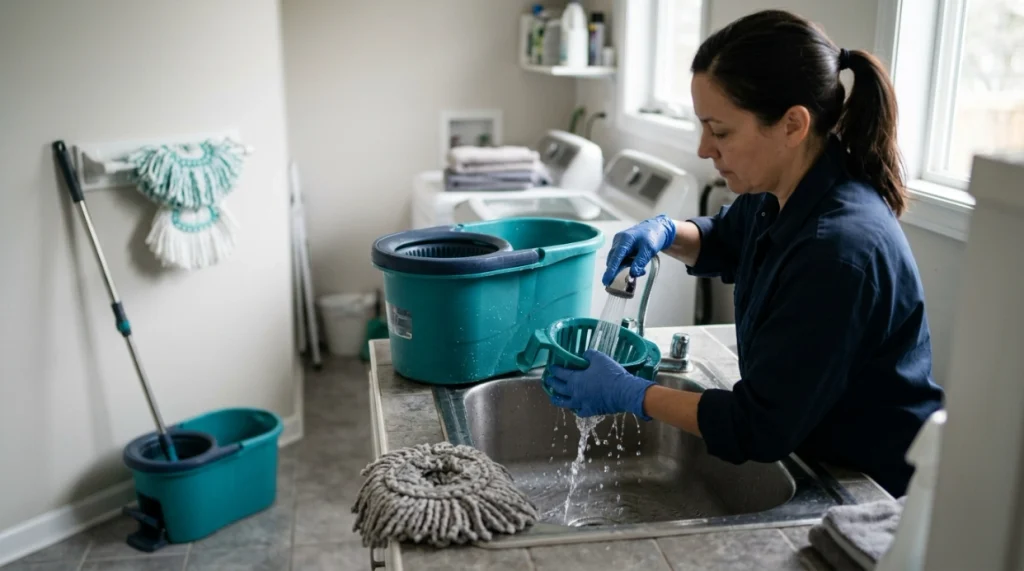
Rinse the system after use instead of storing dirty water inside the bucket. Damp microfiber left in a closed space can also develop unpleasant odors.
- Empty the bucket: Dispose of dirty water after every cleaning session.
- Rinse the wringer: Remove trapped hair, grit, and cleaner residue.
- Detach the mop head: Follow your model’s removal method instead of pulling aggressively.
- Wash the microfiber: Follow its care label and avoid products the manufacturer prohibits.
- Dry it fully: Air-dry the head before storing it in an enclosed space.
- Inspect the handle: Check the lock, threaded sections, and spin movement occasionally.
- Store the bucket dry: Leave it open until remaining moisture evaporates.
One mistake I avoid is pouring extra detergent into the bucket because the floor looks dirty. Excess cleaner can leave residue and make rinsing harder.
The EPA also advises users to follow cleaning-product labels and avoid mixing incompatible products. Cleaner concentration should come from the label, not guesswork.
Handle Operated Spin Mop FAQs
Is a handle operated spin mop the same as a regular spin mop?
It is one type of spin mop. The key difference is that downward movement of the handle activates the spinning mechanism, while other spin mops use a foot pedal or another wringing design.
Do I have to push hard on a handle operated spin mop?
You normally need controlled downward strokes rather than extreme force. Keep the mop centered and follow the handle’s lock or unlock instructions, because forcing a locked mechanism may damage it.
Can I use a handle operated spin mop on hardwood?
Only when your flooring manufacturer permits damp mopping. Wring the microfiber thoroughly so it is only lightly damp, keep water away from seams, and wipe spills immediately.
Why isn’t my spin mop spinning?
First check whether the handle is still locked in normal mopping mode. Also make sure the mop head is correctly seated, the pole sections are assembled properly, and nothing is blocking the rotating mechanism.
How many times should I spin the mop?
There is no universal number because designs vary. Use fewer strokes when you need a damper head and continue spinning when you need less moisture, while following your mop’s instructions.
Can I put disinfectant in a spin-mop bucket?
Only if both the mop manufacturer and the disinfectant label allow that use on your floor. Cleaning and disinfecting serve different purposes, so routine home mopping does not always require a disinfectant.
Is a handle spin mop better than a spray mop?
A handle spin mop is more convenient for larger or dirtier areas that need repeated rinsing. A spray mop is lighter and quicker for everyday touch-ups where only a small amount of cleaning solution is needed.
Final Takeaway
A handle operated spin mop uses downward handle strokes to spin and wring its microfiber mop head. That simple mechanism lets you control moisture without hand-wringing or operating a foot pedal.
For the best results, vacuum first, keep the mop head clean, and use only enough moisture to lift the dirt. Spin it more thoroughly on hardwood, laminate, LVP, and other moisture-sensitive surfaces.
Most importantly, match the cleaning method to the floor beneath you. A well-wrung spin mop can be a practical whole-room cleaning tool when you use the right cleaner, control the water, and maintain the microfiber head after every session.