
How Does a Spin Mop Bucket Work?

Quick Answer
A spin mop bucket works by rotating the mop head rapidly inside a wringer basket. Centrifugal force pushes water outward from the microfiber strands, so the mop comes out damp instead of dripping wet. Depending on the design, you create the spinning motion with a foot pedal or a push-down handle. Good moisture control matters because the cleaning product should suit the surface you are mopping.
How the bucket works in practice
- Wet the mop: Dip the microfiber head into the water or cleaning solution.
- Move to the wringer: Place the mop head flat inside the spinning basket.
- Start the spinner: Press the pedal or pump the mop handle, depending on the design.
- Remove excess water: Fast rotation throws water from the mop fibers into the bucket.
- Adjust moisture: Spin longer when you need a drier mop for moisture-sensitive flooring.
Quick tip
- Start with a well-wrung mop rather than a soaking-wet one. You can always add moisture, but removing excess water from a floor is harder.
If you’ve never looked closely at a spin mop bucket, the mechanism can seem more complicated than it is. I’ve used these systems on tile, vinyl, laminate, and sealed wood, and most rely on the same basic idea: spin water out instead of squeezing it out by hand.
The design makes floor cleaning quicker and gives you better control over how wet your mop stays. Here’s exactly what happens inside the bucket and how to get the best results from it in 2026.
In This Guide
- What Is a Spin Mop Bucket?
- How Does a Spin Mop Bucket Work Step by Step?
- What Parts Make a Spin Mop Bucket Work?
- How Does the Spinning Action Remove Water?
- How Dry Should You Spin the Mop for Different Floors?
- Spin Mop Bucket vs Other Mop Systems
- Why Does a Spin Mop Stop Spinning?
- Spin Mop Bucket FAQs
- Final Takeaway
What Is a Spin Mop Bucket?
A spin mop bucket is a floor-cleaning bucket with a rotating wringer that removes excess water from a mop head. Most systems pair the bucket with a round microfiber mop.
Microfiber is a synthetic material made from extremely fine fibers. Those fibers absorb liquid and collect fine dust, hair, and soil as the mop moves across the floor.
What makes it different from a normal mop bucket?
A traditional bucket usually requires you to squeeze, twist, or press the mop against a manual wringer. A spin system turns the mop rapidly instead.
- Less hand wringing: You usually don’t need to touch the wet mop head.
- Better moisture control: More spinning generally removes more water.
- Less bending: Pedal and handle-operated systems let you wring while standing.
- Faster repeated rinsing: You can rinse, spin, mop, and repeat quickly.
- Microfiber cleaning: Most models use washable microfiber strands rather than traditional cotton strings.
Some newer buckets also separate clean and dirty water. These designs reduce how much contaminated rinse water returns to the mop head.
How Does a Spin Mop Bucket Work Step by Step?
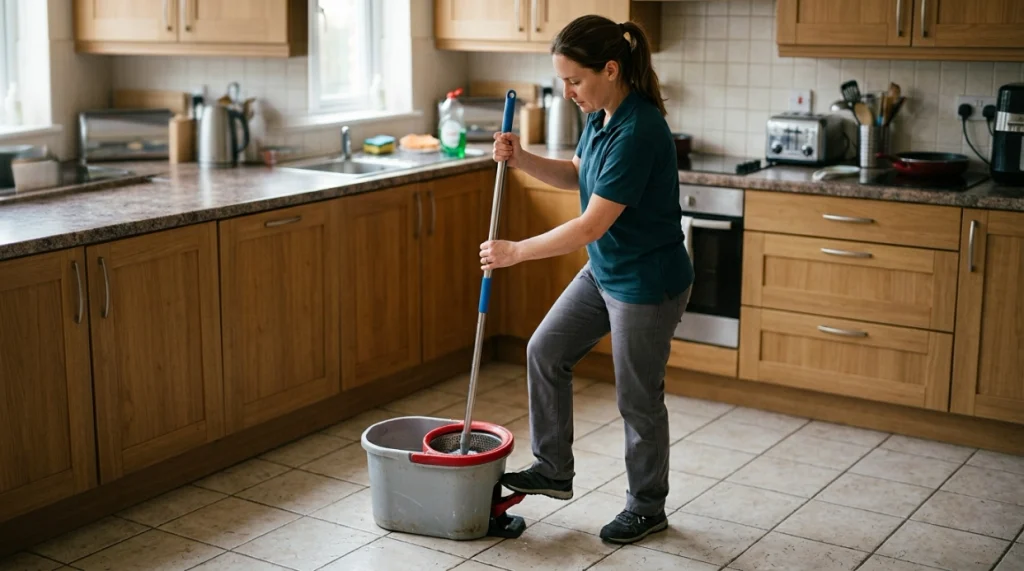
The basic process has two stages: soaking the mop and spinning away excess liquid. The exact control mechanism depends on your bucket.
1. Fill the bucket
Add clean water to the marked fill level. Add floor cleaner only when both the flooring manufacturer and cleaner label allow it.
Safety note: Always check your floor manufacturer’s care instructions and the cleaning-product label before adding chemicals.
2. Wet and rinse the mop head
Place the microfiber head into the water and move it enough to saturate the fibers. This also loosens soil already trapped in the mop.
3. Place the mop in the spinner
Move the mop head into the wringer basket and position it flat. Keeping the handle reasonably upright helps the basket spin smoothly on many designs.
4. Activate the spinning mechanism
Pedal-operated models use your foot to drive the spinning basket. Handle-operated models spin when you push the telescoping handle downward.
- Light wringing: Use a short spin when you want the mop fairly damp.
- Medium wringing: Spin several times for ordinary tile or vinyl cleaning.
- Heavy wringing: Spin longer when the flooring requires minimal moisture.
5. Mop a small area and repeat
I normally work in manageable sections instead of trying to cover an entire room from one rinse. Once the mop becomes visibly dirty, I rinse and spin it again.
This routine matters more than pressing harder. A cleaner mop head normally lifts soil more effectively than a saturated, gray one.
What Parts Make a Spin Mop Bucket Work?
Most spin mop systems look simple from the outside, but several parts work together. Understanding them also makes troubleshooting easier.
- Bucket reservoir: Holds water and cleaning solution.
- Spinner basket: Supports the mop while rotating and lets expelled water pass through.
- Drive mechanism: Transfers movement from the pedal or mop handle to the spinner.
- Bearings or rotating shaft: Help the basket turn with less resistance.
- Pedal assembly: Converts repeated foot pressure into rotation on pedal models.
- Telescoping handle: On push-to-spin designs, downward handle movement drives the rotation.
- Microfiber mop head: Absorbs water and captures loosened soil.
- Splash guard: Helps keep spinning water inside the bucket.
What about two-tank spin mops?
Dual-chamber systems add a separate clean-water or rinse section. The details vary, so one brand’s mechanism may work differently from another.
The main advantage is cleaner rinse water. With a conventional single-bucket system, every rinse sends some collected soil back into the same water.
How Does the Spinning Action Remove Water?
The wringer relies on rapid rotation. As the mop spins, water in the fibers tends to move outward and escapes through openings in the basket.
This effect is commonly described in everyday terms as centrifugal force. You see a similar result when a washing machine enters its spin cycle.
Why does spinning longer make the mop drier?
Continued rotation gives more loosely held water a chance to leave the microfiber. That’s why a few extra pedal presses can noticeably change the mop’s moisture level.
The mop won’t become completely dry. Water held closely within the microfiber remains, which is useful because damp fibers still need enough moisture to loosen and collect soil.
Does spinning clean the mop head too?
Spinning mainly removes water. Rinsing is what releases much of the dirt from the fibers.
That’s an important distinction. A mop can feel fairly dry after spinning while still containing trapped soil, so rinse dirty fibers before relying on another spin cycle.
How Dry Should You Spin the Mop for Different Floors?
The safest moisture level depends on the floor. I use noticeably less water on wood and laminate than I do on ceramic tile.
| Floor Type | Suggested Mop Moisture | Main Concern |
|---|---|---|
| Sealed hardwood | Barely damp and thoroughly wrung | Standing moisture and finish damage |
| Engineered wood | Lightly damp | Water entering joints or seams |
| Laminate | Very well wrung | Moisture around plank edges |
| Vinyl/LVP | Lightly damp | Residue and liquid around seams |
| Ceramic or porcelain tile | Damp | Slow drying and dirty grout water |
| Natural stone | Lightly damp | Cleaner compatibility and porosity |
| Sealed concrete | Damp | Residue and long drying times |
The National Wood Flooring Association guidance emphasizes limiting moisture on wood flooring. I follow the same conservative approach whenever a floor has seams or a moisture-sensitive core.
A properly wrung mop should usually leave a thin film that disappears as the floor dries. Puddles or water collecting around plank joints mean the mop is too wet.
Safety note: Flooring constructions and finishes differ. Follow the manufacturer-specific care guide when it conflicts with general cleaning advice.
Spin Mop Bucket vs Other Mop Systems
A spin mop sits between a traditional string mop and a low-moisture flat mop. It gives you a bucket’s rinsing capacity while offering much better wringing control than hand squeezing.
| Mop System | Moisture Control | Best Use | Main Limitation |
|---|---|---|---|
| Spin mop | Moderate to high | Whole-room cleaning and dirtier floors | Bucket setup and dirty rinse water |
| Traditional string mop | Low to moderate | Large spills and durable floors | Easy to leave excess water |
| Flat microfiber mop | High | Controlled damp cleaning | Pad needs frequent rinsing or replacement |
| Spray mop | High | Fast daily touch-ups | Less convenient for heavy soil |
| Steam mop | Machine controlled | Steam-approved sealed surfaces | Heat and moisture restrictions |
When do I reach for a spin mop?
I prefer one when footprints, kitchen soil, or tracked-in grime cover a larger area. Being able to rinse the head repeatedly is useful when one flat pad would become dirty too quickly.
For a five-minute touch-up, I usually prefer a spray or flat microfiber mop. Pulling out a bucket makes more sense when the job is large enough to justify the setup.
Why Does a Spin Mop Stop Spinning?
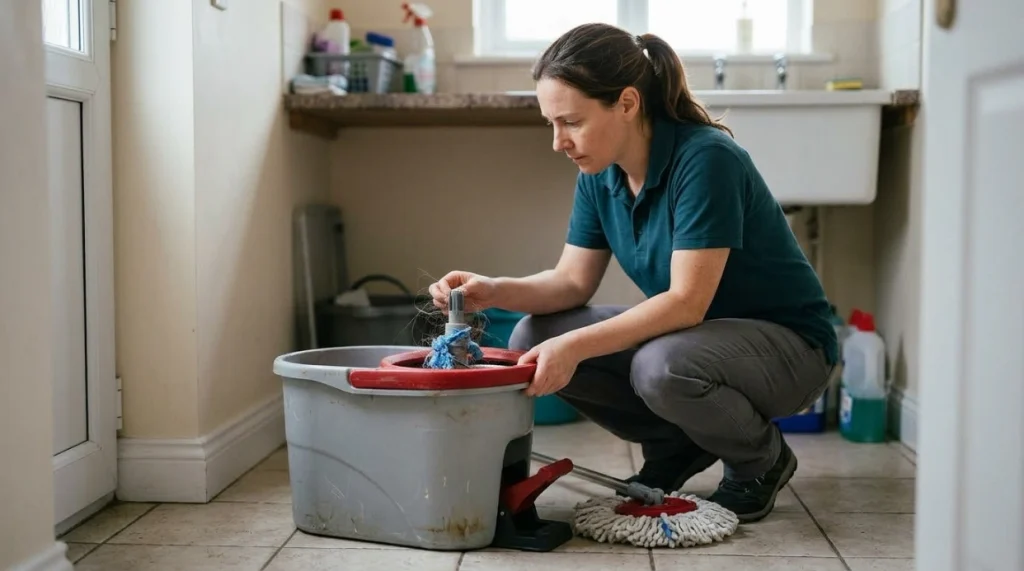
A spin mop usually stops working because something is preventing the drive mechanism or basket from rotating freely. Don’t immediately force the pedal or handle.
Common spin mop problems
- Basket won’t turn: Hair, fibers, or debris may be caught around the rotating shaft.
- Pedal feels stuck: The pedal linkage may be obstructed, misaligned, or damaged.
- Basket spins slowly: Excess friction, debris, or worn internal parts may be reducing movement.
- Mop wobbles badly: The mop head may not be centered inside the spinner.
- Push handle won’t spin: The handle may not be unlocked or extended correctly for spin mode.
- Water splashes out: The basket may be overloaded, tilted, or spun while the mop is off-center.
How should you clean the bucket?
Empty dirty water after every cleaning session. Rinse the reservoir and spinner rather than leaving gray water sitting overnight.
Remove the mop head when possible and wash it according to its care label. Let the head and bucket dry before storage because trapped moisture encourages odor.
What cleaning solution goes in a spin mop bucket?
Use a cleaner approved for your floor and dilute it exactly as directed. More concentrate doesn’t automatically clean better and can leave a sticky or streaky film.
If you’re choosing household cleaners, the EPA provides a searchable list of Safer Choice-certified products. Certification and floor compatibility are separate issues, so you still need to check your flooring guidance.
Never mix cleaning chemicals unless a product label specifically directs you to do so. EPA guidance warns that incompatible products can create hazardous vapors, so follow labels and keep the room ventilated when required.
Safety note: If you use a disinfectant, follow its label for surface compatibility, dilution, ventilation, and contact time. A spin mop does not disinfect a floor simply because its head is rotating.
Spin Mop Bucket FAQs
Does a spin mop bucket wash and dry the mop?
It rinses the mop when you place the head in water and removes excess water when you use the spinning basket. It doesn’t fully dry the mop head, so the head should air-dry after cleaning.
Why does a spin mop remove so much water?
Rapid rotation moves water outward from the microfiber strands. The water passes through the openings in the wringer basket and returns to the bucket.
How many times should I spin a spin mop?
There is no universal number because spinner speeds and mop heads vary. Spin until the head reaches the moisture level appropriate for your flooring, using extra wringing for moisture-sensitive surfaces.
Can I use a spin mop on hardwood floors?
You can use a suitable damp-mopping method on some finished wood floors, but excess water can cause damage. Check the flooring manufacturer’s instructions and keep the mop well wrung.
Do I need detergent in a spin mop bucket?
Not for every cleaning job. Water may handle light soil, while heavier residue may need a floor-compatible cleaner used according to its label.
Does spinning sanitize the mop head?
No. Spinning removes excess liquid but does not make the mop sanitary or disinfected. The EPA distinguishes cleaning, sanitizing, and disinfecting as different processes with different requirements.
Why is my floor still wet after using a spin mop?
The mop may not have been spun long enough, or the microfiber may be overloaded with water. Spin again and use thinner, overlapping passes rather than repeatedly wetting the same area.
Final Takeaway
A spin mop bucket is essentially a controlled wringing system. You wet and rinse the mop, place it in the basket, and use rapid rotation to throw excess water from the microfiber.
That simple mechanism is what makes spin mops convenient for larger floor-cleaning jobs. It also lets you adjust moisture without twisting a wet mop by hand.
- For tile and durable sealed floors: A normally damp mop usually gives you enough moisture to loosen soil.
- For wood, laminate, and similar surfaces: Wring more thoroughly and avoid standing water.
- For better results: Sweep or vacuum first, rinse dirty microfiber often, and replace the water when it becomes visibly soiled.
- For safer cleaning: Match both the cleaner and moisture level to the flooring manufacturer’s care instructions.
Once you understand what the spinner is doing, using the bucket becomes straightforward. Control the water, keep the mop head clean, and let the mechanism do the wringing for you.