
How Does Centrifugal Force Work in a Spin Mop?

Quick Answer
Centrifugal force helps a spin mop remove excess water by rotating its wet microfiber head rapidly inside a spinning basket. As the head turns, water moves outward through the mop fibers and escapes into the bucket, leaving the mop damp enough for cleaning. The result is better control over floor moisture, provided you spin the head for an appropriate amount of time.
What makes the mechanism work?
- Rotational motion: A pedal, handle mechanism, or motor spins the mop head.
- Outward movement: Water in the rotating fibers tends to move away from the axis of rotation.
- Water escape: The basket allows expelled droplets to pass through its openings.
- Moisture control: Longer or faster spinning generally removes more water, although the result depends on the mop design.
- Floor protection: A well-wrung head reduces excess moisture, which matters for moisture-sensitive surfaces.
A quick practical tip
- Start with a short spin, check how wet the microfiber feels, and repeat if necessary. For wood and laminate, follow the floor manufacturer’s cleaning instructions and avoid leaving standing water.
I find that understanding the spin mechanism makes it easier to control a mop’s moisture level and avoid common floor-cleaning mistakes. This guide explains the physics in plain English, compares spin mops with other cleaning tools, and shows how to get the best results on different floors.
I’ll also explain why some mop heads remain wetter than expected, what affects spinning performance, and how to maintain the bucket mechanism. These practical details matter whether you’re cleaning kitchen tile, vinyl plank, or a moisture-sensitive wood floor.
In This Guide
- What is centrifugal force in a spin mop?
- How does a spin mop remove water?
- What physics makes centrifugal wringing effective?
- What affects how dry a spin mop gets?
- How does a spin mop compare with other mop types?
- How should you use a spin mop on different floors?
- Why isn’t your spin mop wringing properly?
- How do you maintain a spin mop safely?
- Frequently asked questions
What Is Centrifugal Force in a Spin Mop?
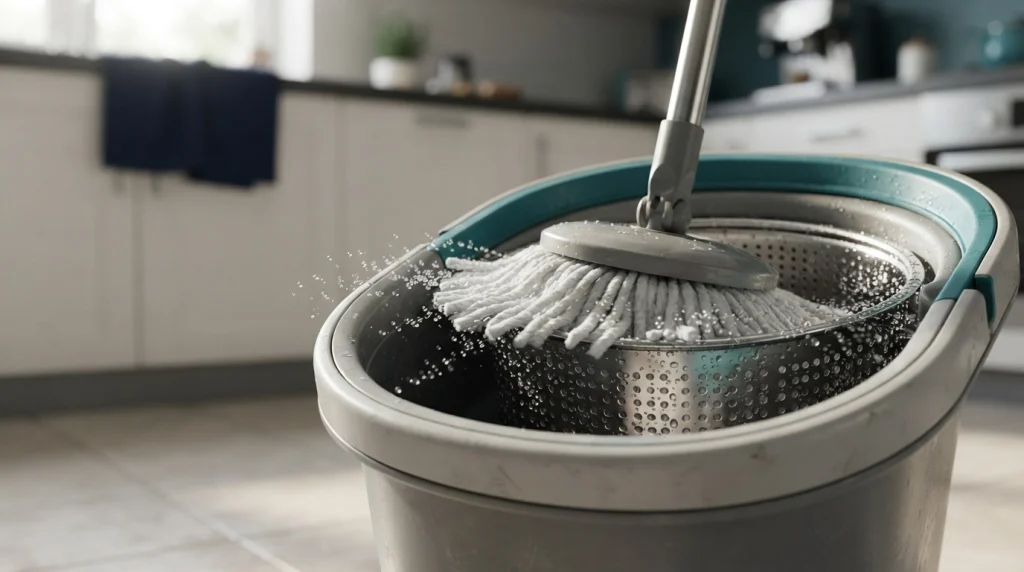
Centrifugal force in a spin mop is the apparent outward force experienced in the rotating mop’s reference frame. It helps explain why water separates from the spinning microfiber head and moves toward the basket’s outer walls.
Understanding the basic definition
A spin mop is a floor-cleaning tool that uses a rotating mop head and a special bucket mechanism to remove excess water from its absorbent fibers. Unlike a traditional string mop, it can wring out much of its water without requiring you to twist the mop by hand.
The important idea is rotation. When the mop head spins, its fibers and the water trapped between them move in a circular path, while the basket catches the water expelled from the head.
Is centrifugal force a real force?
In everyday explanations, centrifugal force describes the outward effect you feel in a rotating system. In a stationary reference frame, the water’s inertia makes it resist the inward acceleration needed to follow the mop head’s circular path.
The rotating fibers exert forces on the water, but they cannot keep every droplet moving in the same circular path indefinitely. Water that escapes the fibers travels outward relative to the spinning head and enters the basket.
Think of swinging a wet umbrella in a circle. Water droplets leave its surface because their motion changes when the umbrella can no longer keep them following the same curved path.
Why does this matter for cleaning?
The spin mechanism helps you control how much water remains in the mop head before it touches the floor. A properly wrung head can remove everyday dirt without depositing as much liquid as a heavily soaked mop.
That difference matters most on floors that tolerate only limited moisture. Hardwood, engineered wood, and many laminate floors need careful moisture control rather than repeated passes with a dripping mop.
How Does a Spin Mop Remove Water?
A spin mop removes water by rotating its wet head inside a perforated basket. The spinning action encourages water to leave the absorbent fibers, while the bucket collects the expelled liquid.
Step 1: The mop absorbs water
First, the microfiber head enters the cleaning solution or rinse water. Its fine fibers hold liquid and pick up dirt from the floor during cleaning.
Microfiber consists of very fine synthetic fibers that create a large surface area for capturing particles and retaining moisture. That absorbency is useful for cleaning, but the head must release excess water before returning to the floor.
Step 2: The mechanism starts rotating
Depending on the design, you may press a foot pedal, pump the handle, or activate an electric spinning system. Gears, a rotating shaft, or a motor transfer energy to the basket or mop head.
Many manual spin mops use a pedal-and-gear arrangement. Each press drives the mechanism, and the basket continues rotating briefly as the pedal returns.
Step 3: Water moves out of the fibers
As rotation speeds up, water inside the mop head experiences the effects associated with circular motion. Droplets that cannot remain attached to the fibers move outward and escape through the openings in the basket.
The basket does not need to squeeze the mop like a pair of hands. Instead, the spinning action separates much of the liquid from the absorbent material.
Step 4: The bucket catches the water
The expelled water strikes the basket or bucket walls and drains into the collection area. This keeps most of the liquid contained instead of spraying freely across the room.
Once the mop slows down, you can lift it out and check its moisture level. If the head still drips heavily, another short spin may help.
Step 5: The mop returns to the floor
A well-wrung head should feel damp rather than saturated for many routine cleaning tasks. You can then mop the floor with better control over the amount of water left behind.
There is no universal spinning time. Basket design, head material, water absorption, and the mechanism’s speed all influence the result.
What Physics Makes Centrifugal Wringing Effective?
Centrifugal wringing works because rotation changes how water moves relative to the mop head. The result depends on rotational speed, distance from the axis, and how easily water can escape the fibers.
Rotation speed and outward acceleration
For circular motion, the magnitude of centripetal acceleration is \(a = \omega^2 r\), where \(\omega\) is angular speed and \(r\) is the distance from the rotation axis. The acceleration increases with the square of angular speed.
In plain language, faster rotation can create a much stronger effect on the water. Doubling the rotational speed increases the corresponding acceleration by a factor of four, assuming the radius stays the same.
This explains why a faster spin can remove water more effectively. However, real mop performance also depends on fiber structure, drainage openings, friction, and the design’s operating limits.
Why the basket has holes
The basket’s openings let expelled water escape instead of collecting around the mop head. Without a clear drainage path, the head could remain surrounded by water and become wet again.
Some buckets use narrow slots, while others use a more open mesh design. Both aim to separate the spinning head from the water it releases.
Why a mop head never becomes completely dry
Spinning does not remove every trace of moisture. Water can remain trapped between closely packed fibers or held by surface tension, which is the tendency of liquid surfaces to resist separation.
The head may also retain water in its backing and attachment points. As a result, a high-speed spin generally produces a damp head rather than a fully dry one.
Does a heavier mop head spin better?
Not necessarily. A heavier head may contain more water, but weight alone does not determine wringing performance.
What matters is how the mop head distributes water, how quickly the mechanism rotates, and how easily liquid can pass through the fibers. A well-designed lightweight microfiber head may wring out more effectively than a bulky head with poor drainage.
For a useful overview of wood-floor moisture precautions, consult the National Wood Flooring Association’s maintenance guidance. Its recommendations reinforce why removing excess water matters when cleaning wood flooring.
What Affects How Dry a Spin Mop Gets?
A spin mop’s dryness depends on more than how long you press the pedal. The head’s construction, the speed of rotation, the amount of water it absorbed, and the condition of the mechanism all make a difference.
Rotational speed and spinning time
A faster basket generally removes water more effectively than a slow one, provided the mop operates within its intended design limits. Longer spinning may remove additional water, but the benefit eventually becomes less noticeable.
Start with a short spin and inspect the head before repeating. This is more practical than assuming every mop needs the same number of pedal presses.
Microfiber condition
Clean, well-maintained fibers tend to absorb and release water as intended. Residue from detergent, fabric softener, or accumulated dirt can affect how the mop performs.
Wash reusable mop heads according to the manufacturer’s instructions. Avoid fabric softener unless the manufacturer explicitly permits it, because residue can interfere with microfiber performance.
Water level and basket design
The spinning basket needs enough clearance to rotate freely. Overfilling the bucket or allowing debris to obstruct the basket can interfere with drainage and operation.
Follow the bucket’s fill markings where provided. A basket designed for wringing should not be treated as a substitute for a separate rinse compartment unless the manufacturer specifies that function.
Mechanical condition
Worn gears, a slipping pedal, a bent shaft, or a damaged basket can reduce rotation speed. A loose connection between the handle and mop head can also cause wobbling instead of smooth spinning.
Check the mechanism if the head suddenly becomes harder to wring. Stop using it if the basket cracks, the handle connection loosens, or the pedal jams.
How can you tell whether the mop is dry enough?
Lift the head over the bucket and watch for continuous dripping. A head that releases only a few drops may be ready for routine mopping, depending on the floor and cleaning task.
For sealed tile or vinyl, a slightly wetter head may be acceptable. For wood or laminate, aim for a well-wrung head and follow the flooring manufacturer’s care instructions.
How Does a Spin Mop Compare With Other Mop Types?
A spin mop stands out because its bucket helps control moisture without requiring a powered cleaning appliance. Other mop types use different methods to collect dirt, release water, or assist with stubborn grime.
| Mop type | How it handles moisture | Main advantage | Main limitation |
|---|---|---|---|
| Spin mop | Spins excess water from a reusable head | Adjustable moisture and bucket-based rinsing | Needs bucket space and occasional mechanism care |
| Flat microfiber mop | Uses a washable or disposable pad, often with manual wringing or a spray system | Slim profile for edges and furniture | Some models offer limited wringing control |
| Traditional string mop | Water is removed by a wringer or manual pressure | Absorbs spills and covers broad areas | Can remain heavy and waterlogged |
| Steam mop | Heats water and releases steam through a pad | Useful for compatible sealed floors without a bucket | Heat and moisture can damage unsuitable flooring |
| Cordless electric mop | Varies by model; some dispense solution and recover dirty liquid | May reduce manual scrubbing and rinsing | Requires charging and component maintenance |
| Robot mop | Dispenses controlled amounts of liquid through a pad or cleaning system | Automates routine floor maintenance | May struggle with heavy soil, corners, and some obstacles |
When is a spin mop the better choice?
A spin mop suits people who want a reusable mop head and direct control over wringing. It can be useful for larger homes, frequent kitchen cleaning, and sealed floors that tolerate damp mopping.
A flat microfiber mop may suit a small apartment better because it stores easily and can reach under low furniture. A steam mop is a different choice altogether, and its use depends on the floor’s heat and moisture tolerance.
Does centrifugal wringing clean the floor by itself?
No. Centrifugal wringing removes water from the mop head; it does not remove dirt from the floor on its own.
Cleaning still depends on the microfiber, your wiping technique, the solution’s suitability, and how often you rinse the head. For best results, remove loose grit first and avoid spreading heavily soiled water across a clean area.
How Should You Use a Spin Mop on Different Floors?
The main benefit of centrifugal wringing is better moisture control, but the correct dampness depends on the flooring material. Always check the floor manufacturer’s instructions before choosing a cleaning method or solution.
Hardwood and engineered wood
Use a well-wrung head and avoid leaving puddles or wet streaks. Excess moisture can enter seams, damage finishes, or contribute to swelling and other problems over time.
The National Wood Flooring Association advises against wet mopping and steam mopping wood floors in its maintenance guidance. Follow the care requirements for your specific finish, especially with oiled or waxed surfaces.
Laminate flooring
Use only the moisture level permitted by the laminate manufacturer. Water that enters joints or exposed edges can cause swelling or other damage in some laminate products.
A nearly dry microfiber head is often the safer starting point when damp cleaning is allowed. Avoid soaking the floor or assuming that every laminate product tolerates the same amount of water.
Vinyl and luxury vinyl plank
Many vinyl and LVP floors tolerate damp mopping, but the recommended cleaner and technique depend on the product’s wear layer and installation. A spin mop can help reduce excess liquid before cleaning.
Do not assume a steam mop is suitable simply because vinyl is water-resistant. Heat can affect some vinyl flooring products or adhesives.
Ceramic and porcelain tile
Glazed ceramic and porcelain tile generally tolerate routine damp mopping well. A spin mop can help clean broad surfaces while allowing you to remove excess water between passes.
Pay attention to grout, which may need a different cleaning approach depending on its type and sealant. Excess cleaner can also leave a film that makes tile look streaky.
Natural stone and concrete
Natural stone varies widely in porosity and chemical sensitivity. Use a cleaner approved for the particular stone, and avoid acidic solutions on stone types that can react with them.
Sealed concrete may tolerate damp mopping, but unsealed concrete can absorb liquid and cleaning products. Confirm the surface treatment before choosing a solution.
Safety note: Check your flooring manufacturer’s care guide and the cleaner’s label before using water, vinegar-based mixtures, disinfectants, or other chemicals. Never assume one solution is safe for every floor.
Why Isn’t Your Spin Mop Wringing Properly?
If your spin mop remains soaked after spinning, the problem may involve the head, the basket, or the drive mechanism. A few simple checks can help identify the cause without forcing the parts.
The mop head still drips heavily
Try another short spin and check whether the basket reaches its normal speed. If the mechanism turns slowly, inspect the pedal, handle, and drive components for visible damage or obstruction.
Also check whether the head sits correctly inside the basket. A poorly positioned head may wobble or fail to rotate smoothly.
The basket barely moves
A pedal that moves without spinning the basket may indicate a worn gear or a disconnected drive mechanism. Handle-operated systems can also lose effectiveness if the internal shaft or locking mechanism fails.
Do not force the pedal or press harder than the instructions recommend. Stop using the mop if the mechanism jams or makes unusual grinding noises.
Water splashes outside the bucket
Splashing may happen when the head spins too close to the basket’s rim, the basket is damaged, or the mop is not seated correctly. Excess water around the basket can also contribute to mess during wringing.
Pause the mechanism and reposition the mop head. Check the basket and bucket for cracks before continuing.
The mop leaves streaks after wringing
Streaks often result from dirty water, excessive cleaning solution, residue on the microfiber, or a floor surface that needs a different cleaner. They do not automatically mean the centrifugal mechanism has failed.
Rinse the mop head thoroughly and use the recommended solution at the correct dilution. If the floor still looks streaky, test a small area with a clean, well-wrung head and the appropriate product.
The mop smells unpleasant
A damp mop head can develop an odor when dirt and moisture remain trapped in the fibers between uses. Rinse it after cleaning and let it dry completely in a ventilated place.
Wash the head according to its care label, and clean the bucket so residue does not accumulate. Never mix cleaning chemicals to try to remove odors.
How Do You Maintain a Spin Mop Safely?
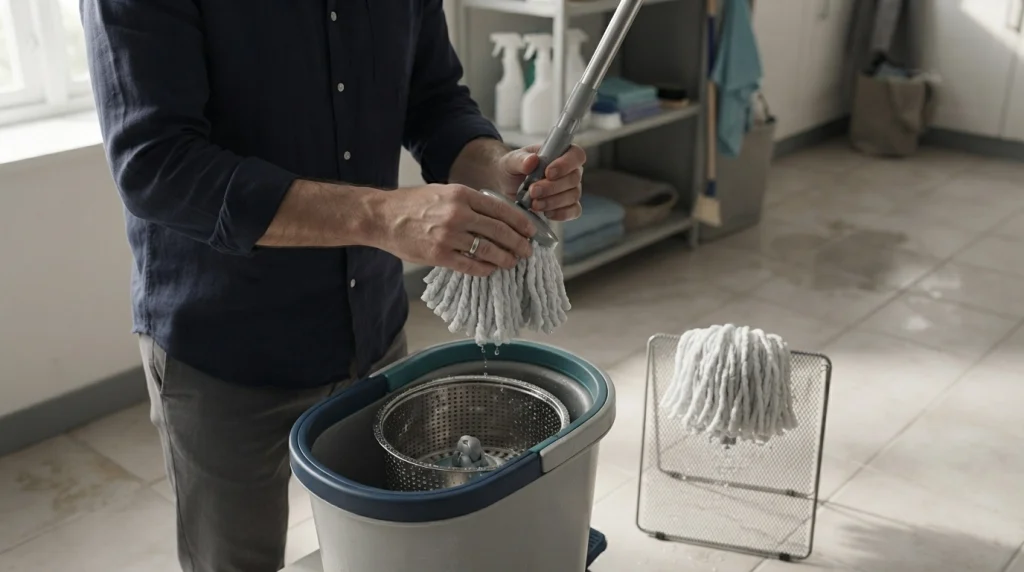
Regular maintenance helps the spinning mechanism work smoothly and keeps dirty residue from returning to the floor. The most useful routine is simple: rinse, clean, inspect, and dry.
Clean the mop head after use
Remove the head if the design allows it, then wash it according to the manufacturer’s instructions. Use a suitable detergent and avoid softeners or harsh treatments that may damage the fibers.
Allow the head to dry fully before storing it. Leaving it damp in a closed bucket can encourage unpleasant odors and microbial growth.
Empty and rinse the bucket
Discard dirty water after each cleaning session. Rinse away sediment, hair, and cleaning-product residue that could obstruct the basket or drainage openings.
Wipe the bucket dry when practical, particularly around metal components or moving parts. Keep the basket free of debris so it can rotate without interference.
Inspect moving parts
Look for cracks, loose screws, bent rods, damaged gears, or a pedal that no longer returns properly. Replace worn parts only with components approved for the model.
Keep hands and loose clothing away from a moving basket. Wait until it stops completely before removing a jammed mop head or cleaning the mechanism.
Prevent slips while mopping
Even a well-wrung mop can leave a slippery surface if you use too much cleaner or fail to remove residue. Keep people away from wet areas until the floor is safe to walk on.
Use warning signs in shared spaces where appropriate, and avoid leaving the bucket where someone could trip over it. Follow the cleaning product’s label for ventilation, protective equipment, and safe handling.
For cleaning and disinfecting guidance, the U.S. Environmental Protection Agency provides information about registered antimicrobial products and label requirements. A cleaner does not automatically disinfect a surface, and disinfection claims depend on using an appropriate product as directed.
For household hygiene advice, the CDC’s hygiene resources offer additional guidance on routine cleaning and reducing the spread of germs. Choose the level of cleaning your situation requires rather than assuming every floor needs disinfectant.
Frequently Asked Questions
1. Does centrifugal force pull water out of a spin mop?
In the rotating frame, centrifugal force describes the apparent outward effect that helps explain water leaving the mop fibers. In a stationary frame, the water’s inertia and the forces acting on it explain why droplets cannot keep following the same circular path when the fibers no longer hold them.
2. Does spinning faster always make a mop drier?
Faster rotation generally increases the outward acceleration associated with circular motion, which can help expel water. However, the final moisture level also depends on fiber construction, drainage, basket design, and the mop’s operating limits, so speed alone does not guarantee a completely dry head.
3. How long should I spin a mop to remove water?
There is no universal spinning time because manual and electric models use different mechanisms. Start with the manufacturer’s recommended technique, check the head for dripping, and repeat briefly if needed. Use a drier head on moisture-sensitive flooring when the flooring instructions permit damp mopping.
4. Can a spin mop damage hardwood floors?
A spin mop can leave too much moisture on hardwood if the head remains saturated or the user repeatedly wets the floor. Wood flooring can be damaged by excessive water, so use the approved cleaning method and follow the finish manufacturer’s instructions. Some wood floors should not be wet-mopped at all.
5. Why does my spin mop still feel wet after wringing?
Microfiber holds some moisture even after effective wringing, so a damp head is normal. If it drips continuously, check the spinning speed, head placement, basket drainage, and drive mechanism. Clean the head if detergent residue or dirt appears to interfere with its normal water release.
6. Is a spin mop better than a flat microfiber mop?
Neither option is best for every home. A spin mop offers bucket-based rinsing and adjustable wringing, while a flat microfiber mop often stores more easily and reaches under low furniture. Choose based on your floor type, available storage, cleaning routine, and preferred way to control moisture.
7. Does centrifugal wringing kill bacteria?
No. Centrifugal wringing removes water; it is not a disinfection method. Effective disinfection depends on the product, the surface, the label’s contact time, and proper use. Wash reusable mop heads and clean buckets regularly, and use a suitable disinfectant only when the cleaning task requires one.
The Bottom Line: Why Centrifugal Force Matters
Centrifugal force helps a spin mop release excess water by allowing liquid to move outward as the head rotates. The spinning basket collects that water, leaving the microfiber damp enough for the next cleaning pass.
The best results come from combining effective wringing with a clean mop head, a working mechanism, and the right amount of moisture for your floor. Speed helps, but good technique matters just as much.
Before your next mopping session, check your flooring care instructions, rinse away loose dirt, and test the head’s moisture level over the bucket. Those small habits can make routine floor cleaning more effective and help prevent avoidable moisture damage.