
How Much Do Steam Mops Cost? 2026 Price Guide

Quick Answer
Most steam mops cost about $50 to $180 in 2026, although basic models can start near $40 and premium multipurpose or vacuum-steam machines can reach $250 to $350 or more. For current examples, compare the latest steam mop ratings and prices before buying because retail prices change frequently.
Typical Steam Mop Price Ranges
- Budget: $40–$80: Basic steam cleaning, smaller tanks, and fewer controls or attachments.
- Mid-range: $80–$150: Better steam control, washable pads, larger tanks, and improved maneuverability.
- Premium: $150–$260: Scrubbing systems, detachable handheld tools, extra accessories, or more advanced controls.
- Hybrid: $300–$350+: Machines that combine steam with functions such as vacuuming or powered floor washing.
- Extra costs: Replacement pads, optional accessories, and distilled or demineralized water may add to ownership costs.
My Budget Rule
- For most homes with compatible tile floors, I would start shopping around $70 to $130 rather than automatically paying for the most expensive model.
If you’re wondering how much steam mops cost, the shelf price tells only part of the story. Features, replacement pads, floor compatibility, and how often you’ll use the mop all affect its real value.
I’ve found that paying more makes sense only when the extra feature solves a cleaning problem you actually have. This guide breaks down steam mop prices so you can set a practical budget without overbuying.
In This Guide
- How Much Do Steam Mops Cost in 2026?
- What Do You Get at Each Steam Mop Price Level?
- Why Do Some Steam Mops Cost More?
- How Does a Steam Mop Compare With Other Mop Costs?
- What Does a Steam Mop Cost to Own?
- Is a Steam Mop Worth Buying for Your Floor Type?
- How Much Should You Spend on a Steam Mop?
- Steam Mop Cost FAQs
- Is a Steam Mop Worth the Cost?
How Much Do Steam Mops Cost in 2026?

A typical household steam mop costs about $50 to $180 in 2026. Models outside that range exist, with basic units near $40 and advanced multipurpose machines reaching $250 to $350 or more.
A steam mop is an electric floor-cleaning tool that heats water and sends vapor through a cleaning head and reusable pad. The heat helps loosen stuck-on soil while the pad wipes it away.
Simple definition: A steam mop cleans compatible hard floors with heated water vapor instead of a bucket filled with cleaning solution.
Real 2026 steam mop price examples
Current tested models show how wide the category has become. Prices can change during sales, so treat these as shopping benchmarks rather than permanent retail prices.
| Example | Approx. 2026 Price | Price Position |
|---|---|---|
| Black+Decker Classic HSM13E1 | About $41 | Entry level |
| Shark S1000 | About $60 | Budget |
| Bissell PowerFresh 1940 | About $100 | Mid-range |
| Bissell SpinWave SmartSteam 3897A | About $120 | Mid-range |
| Shark Steam & Scrub S8201 | About $160–$170 | Upper mid-range |
| Tineco Floor One S5 Steam | About $349 | Premium hybrid |
The important distinction is that a $350 hybrid is not simply a more luxurious version of a $60 steam mop. It may combine several floor-care functions in one appliance.
Section Takeaway: Most shoppers do not need $300 equipment to get useful steam cleaning. The strongest value zone for a conventional steam mop is usually around $70 to $150.
What Do You Get at Each Steam Mop Price Level?
Higher prices usually buy more control, convenience, scrubbing ability, and attachments. They do not automatically guarantee better cleaning on every floor.
Budget steam mops: about $40 to $80
Budget models focus on basic steam cleaning. They suit smaller homes, occasional bathroom cleaning, or buyers who mainly need a simple tool for compatible tile.
- Basic steam output: You may get one steam level rather than several settings.
- Smaller accessory kit: Expect fewer specialty brushes, scrubbers, or handheld tools.
- Simple controls: Heating and operation tend to be straightforward.
- Washable pad: Most useful models include at least one reusable microfiber pad.
I would choose this range when floor area is modest and sticky messes are occasional. Spending another $100 for attachments you will never unpack offers little value.
Mid-range steam mops: about $80 to $150
This is the range where many households will find the best balance. You often gain better steam control without moving into bulky multipurpose equipment.
- Adjustable steam: Multiple settings give you more control over moisture.
- Better maneuverability: Swivel heads make cleaning around toilets and furniture easier.
- Useful indicators: Ready lights and other status controls reduce guesswork.
- Extra pads: Some packages include different textures for everyday soil and tougher spots.
Premium models: about $150 to $260
Premium steam mops increasingly compete with handheld steam cleaners. A detachable steamer, powered scrubber, or large attachment kit can push the price upward.
That can be worthwhile for tile-heavy homes. It makes less sense if you only plan to steam a small kitchen once each week.
Hybrid systems: around $300 to $350 or more
Hybrid machines may vacuum, wash, scrub, or collect dirty water alongside steam cleaning. You are paying for a broader floor-care system rather than steam alone.
Compare that price with owning separate machines. One $350 appliance can be reasonable if it replaces two tools you genuinely need.
Why Do Some Steam Mops Cost More?
The price difference comes mainly from engineering and convenience features. Brand name matters, but the feature set usually explains more of the gap.
Steam control and heating system
Adjustable steam lets you match output to the cleaning job. Consumer Reports also recommends looking for practical features such as steam control, adequate tank capacity, and a ready indicator.
A higher-output machine may tackle stuck-on soil faster. However, more steam is not automatically safer for the flooring underneath it.
Powered scrubbing
Some premium models use rotating or moving pads to add mechanical scrubbing. That reduces the amount of force you need to apply by hand.
This feature matters most on textured tile and dried kitchen residue. Smooth floors with light dust rarely need it.
Detachable handheld tools
A removable steam unit can clean grout, fixtures, approved countertops, or other heat-safe surfaces. Extra brushes and nozzles add both versatility and cost.
Count only the accessories you expect to use. A ten-piece kit is poor value when nine pieces stay in a storage drawer.
Tank size and cord length
A larger tank can reduce interruptions during a big floor-cleaning session. A longer cord can also save time when moving through several rooms.
Those benefits matter more in a larger house. In an apartment, a smaller and lighter machine may be easier to store.
How Does a Steam Mop Compare With Other Mop Costs?
A steam mop costs more upfront than a basic microfiber or spin mop. Its ongoing cleaning-solution cost can be lower because many models are designed to run on water.
| Mop Type | Typical Upfront Cost | Ongoing Needs | Best Fit |
|---|---|---|---|
| Microfiber flat mop | Low | Pads and suitable cleaner | Routine cleaning and moisture-sensitive floors |
| Spin mop | Low to moderate | Water, cleaner, replacement heads | Larger washable floor areas |
| Steam mop | About $40–$260+ | Pads and possibly distilled water | Sticky soil on approved heat-resistant floors |
| Robot mop | Moderate to high | Pads, solution, brushes, or other consumables | Automated maintenance cleaning |
A $25 microfiber mop can be the better purchase when your home contains mostly hardwood or laminate. Buying a $120 steam mop that you can safely use in only one bathroom is harder to justify.
On the other hand, a tile-heavy home can give a steam mop regular work. The convenience becomes more valuable as usable floor area increases.
What Does a Steam Mop Cost to Own?
Steam mops have relatively few consumables, but they are not completely free to operate. Pads are the most obvious recurring expense.
Replacement mop pads
Current manufacturer prices put many individual or small-pack replacement steam pads around the mid-teens to upper-$20 range. For example, common Bissell replacements are roughly $19 to $28, while some Shark pads sit around $14 to $20.
You may not need replacements often if you rotate several pads and wash them properly. Having two or three pads also prevents a dirty pad from spreading residue across the next room.
Water and descaling
Check the owner’s manual before choosing water. Some manufacturers recommend distilled or demineralized water, especially where mineral buildup is a concern.
Special scented or demineralized water is optional for compatible models. Plain approved water keeps ownership costs lower.
Cleaning products
Many conventional steam mops are designed to use water without floor detergent in the tank. Never add cleaner, bleach, vinegar, fragrance, or oil unless the manufacturer explicitly allows it.
If you also maintain floors with conventional cleaners, the EPA Safer Choice program can help you identify products whose ingredients meet its program criteria.
Safety note: Always check the steam-mop manual, floor-care instructions, and cleaning-product label before combining any cleaning method or chemical.
Repairs versus replacement
A failed tank cap or worn pad may be inexpensive to replace. A major heater or electrical failure on a low-cost steam mop may make replacement more practical.
Before discarding the appliance, check whether the manufacturer sells the failed component. Parts availability can make a slightly more expensive model cheaper over several years.
Is a Steam Mop Worth Buying for Your Floor Type?
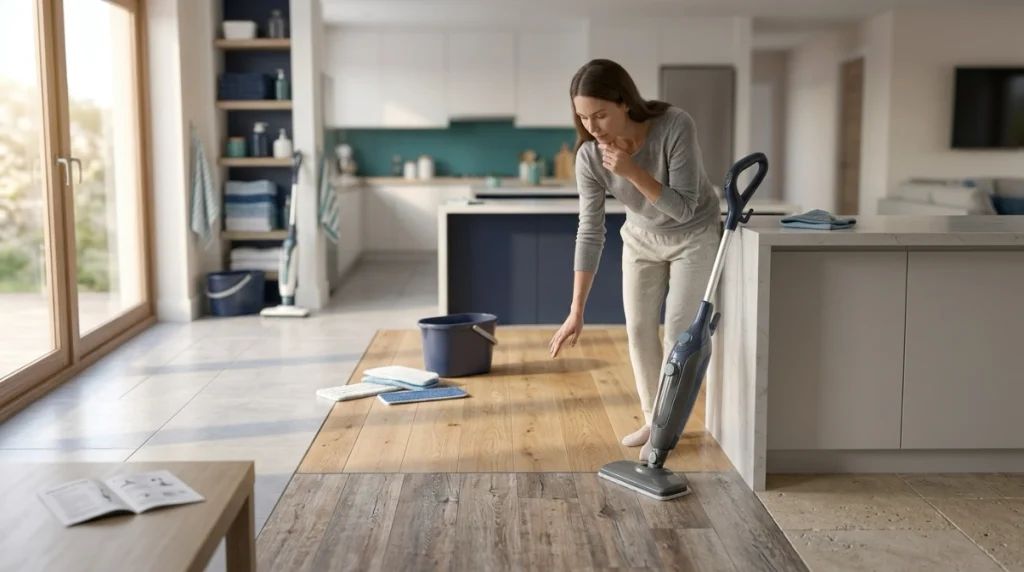
Floor compatibility can matter more than the purchase price. A bargain steam mop is still wasted money if your flooring manufacturer tells you not to use steam.
Tile and other heat-tolerant surfaces
Sealed ceramic and porcelain tile are among the strongest use cases for steam mops. Heat can help soften greasy or dried residue without carrying a bucket around the room.
Inspect damaged grout and loose tiles before cleaning. Moisture entering failed areas can create problems below the surface.
Hardwood and engineered wood
Wood requires much greater caution. The National Wood Flooring Association guidance says not to use steam cleaners on wood floors because vapor can penetrate wood fibers and damage flooring and finish.
If most of your home is wood, I would put the steam-mop budget toward a quality microfiber system instead. It gives you better moisture control.
Safety note: Follow your flooring manufacturer’s care guide even if a steam-mop package makes broad claims about sealed flooring.
Laminate and vinyl/LVP
Heat, seams, adhesives, and moisture make these floors complicated. Some manufacturers prohibit steam, so approval needs to come from the specific flooring care instructions.
When you cannot identify the product or warranty, a lightly damp microfiber mop is the conservative choice. Avoid treating “waterproof” as proof that a floor tolerates heat and vapor.
Natural stone
Stone varies by material, sealer, and installation. A pH-neutral stone-care method is often easier to control than exposing an unknown sealer to heat.
Safety note: Confirm both the stone and sealer manufacturer’s instructions before steam cleaning natural stone.
How Much Should You Spend on a Steam Mop?
For most households, I would budget $70 to $130. That range is high enough to offer useful features while staying below the cost of many specialized premium machines.
Spend $40 to $80 if:
- You have a small amount of steam-safe flooring.
- You mainly clean a kitchen or bathroom.
- You do not need a handheld steamer.
- You are comfortable with simple controls.
Spend $80 to $150 if:
- You steam clean several rooms regularly.
- You want adjustable output or better indicators.
- You value a larger tank or longer cord.
- You want multiple reusable pad types.
Spend $150 to $260 if:
- Powered scrubbing would save you meaningful effort.
- You will use handheld steaming attachments often.
- Your home has a large amount of compatible tile.
- The model offers serviceable parts or features you specifically need.
Spend $300 or more if:
- You are deliberately buying a hybrid floor-care appliance.
- Vacuuming or dirty-water pickup will replace another machine.
- You have enough compatible flooring to justify the investment.
My rule is simple: buy for your floors first and features second. A premium machine cannot overcome an incompatible floor-care warranty.
Also compare storage size and setup time. A lighter $90 model you use weekly can provide better value than a $300 machine that feels too cumbersome to retrieve.
Steam Mop Cost FAQs
What is the average price of a steam mop?
Most conventional steam mops fall around $50 to $180 in 2026. Budget models can cost roughly $40 to $80, while advanced scrubbing or multipurpose steam cleaners may cost $150 to $260 or more.
Is a $50 steam mop worth buying?
Yes, a $50 steam mop can be worthwhile for a small amount of compatible tile or occasional sticky messes. Check pad availability, cord length, tank size, steam controls, and warranty instead of judging the appliance by price alone.
Why are some steam mops over $150?
Models above $150 often add powered scrubbing, multiple steam levels, larger accessory kits, or detachable handheld cleaning tools. Decide whether those features replace another tool or save enough effort to justify the extra cost.
Do steam mops save money on floor cleaner?
They can, because many steam mops are designed to clean with water instead of detergent in the reservoir. However, you may still spend money on replacement pads, distilled water, separate spot cleaners, or other products for floors that cannot be steamed.
How much do replacement steam mop pads cost?
Current manufacturer examples commonly sit around $14 to $28 for individual pads or small compatible sets. Prices vary by model, pad type, quantity, and whether you purchase genuine or third-party replacements.
Do you need an expensive steam mop to sanitize floors?
Price alone does not determine sanitizing performance. Follow the exact appliance instructions for temperature, preparation, and contact time rather than assuming visible steam automatically disinfects a floor.
The CDC’s cleaning and disinfecting guidance also notes that routine cleaning is enough in many household situations. Disinfection becomes more relevant in specific circumstances, such as illness in the home.
When do steam mops usually go on sale?
Steam-mop discounts commonly appear during major retail promotions, holiday sales, and clearance periods. Consumer Reports currently identifies December as a particularly favorable buying period, although individual model prices can change at any time.
Is a Steam Mop Worth the Cost?
A steam mop is worth buying when you have enough approved, heat-resistant flooring to use it regularly. For many homes, a conventional model between about $70 and $130 provides the best balance of price and practical features.
Do not pay extra simply for the largest accessory bundle. Steam control, washable pads, manageable weight, tank capacity, cord reach, and reliable replacement parts matter more.
If your home is dominated by hardwood, laminate, or flooring whose care instructions prohibit steam, choose a microfiber flat mop instead. The cheapest cleaning tool is the one that cleans effectively without risking an expensive floor repair.
Before buying, list the floors you plan to clean and confirm steam compatibility for each one. Then choose the lowest-priced model that provides the features you will genuinely use.
My final takeaway: Expect to spend roughly $50 to $180 for a normal steam mop in 2026, with $70 to $130 being a sensible starting budget for most buyers. Pay more only when the added scrubbing, attachments, or hybrid functions solve a specific cleaning need.