
How to Use a Spray Mop: A Complete Step-by-Step Guide

Quick Answer
To use a spray mop, first vacuum or sweep away loose dirt. Fill or attach the approved cleaning solution, lightly spray a small section, then move the microfiber pad across the floor using overlapping strokes. Keep the floor damp rather than wet, and follow your flooring manufacturer’s care instructions, especially on wood. The National Wood Flooring Association’s wood-floor care guidance is a useful starting point for hardwood.
Quick spray-mopping steps
- Clear the floor: Vacuum, sweep, or dust-mop loose grit and pet hair first.
- Check compatibility: Confirm that your cleaner and spray mop are suitable for your floor.
- Attach a clean pad: Start with a clean microfiber pad rather than a previously soiled one.
- Spray lightly: Apply only enough solution to dampen the area you are about to clean.
- Mop systematically: Use overlapping strokes while working toward the room exit.
- Let it dry: Keep people and pets off the damp floor until it is dry.
A spray mop is one of my favorite tools for quick floor cleaning because it gives you much better moisture control than a traditional wet mop.
The technique still matters. Used correctly, a spray mop can clean hardwood, laminate, vinyl, LVP, tile, and other compatible hard floors without leaving puddles, sticky residue, or obvious streaks.
In This Guide
- What Is a Spray Mop and How Does It Work?
- How Do You Use a Spray Mop Step by Step?
- Can You Use a Spray Mop on Every Floor Type?
- What Cleaning Solution Should You Put in a Spray Mop?
- How Do You Use a Spray Mop Without Leaving Streaks?
- Spray Mop vs. Other Mop Types
- What Spray Mop Mistakes Should You Avoid?
- How Do You Clean and Maintain a Spray Mop?
- Frequently Asked Questions
What Is a Spray Mop and How Does It Work?
A spray mop is a floor mop with a built-in reservoir or attached cleaner bottle that sprays liquid directly in front of the mop head. You control how much cleaner reaches the floor with a trigger or button.
Most models use a flat microfiber pad. Microfiber contains fine synthetic fibers that help pick up dust, grime, and liquid instead of simply pushing it around.
Why spray mops are useful
- Better moisture control: You decide how much liquid reaches the floor.
- No mop bucket: You don’t need to carry or empty a bucket.
- Fast spot cleaning: A small spill or footprint can be handled in seconds.
- Reusable pads: Many models use washable microfiber pads.
- Easy storage: Most spray mops have a slim, upright design.
I find spray mops particularly useful when cleaning moisture-sensitive flooring. It’s much easier to create a light mist than to control water from a heavily soaked string mop.
That control matters because excess liquid can work into seams, joints, edges, or damaged finishes.
How Do You Use a Spray Mop Step by Step?
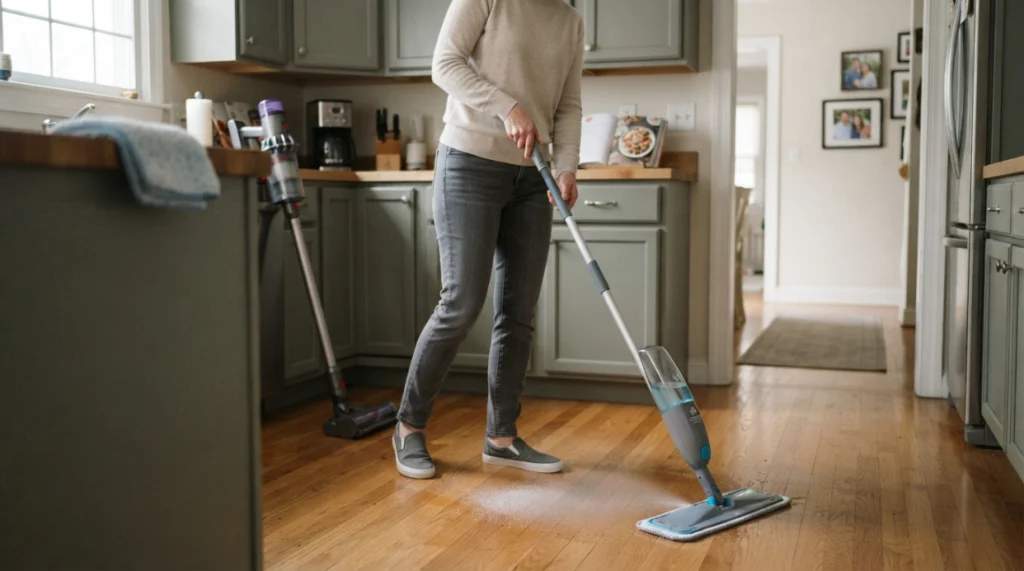
The best spray-mopping method is to remove dry debris first, use a small amount of compatible cleaner, and work in manageable sections. This keeps dirty liquid from spreading across the room.
1. Remove loose dirt before mopping
Vacuum, sweep, or use a dry microfiber mop first. Pay extra attention to entryways, kitchens, and areas where shoes track in grit.
This step prevents hard particles from becoming trapped beneath the pad. Dragging grit across a finished floor can create scuffs or scratches.
2. Check your spray mop and pad
- Make sure the spray nozzle is clear.
- Attach a clean microfiber pad securely.
- Check that the reservoir or solution bottle is properly seated.
- Confirm that the cleaner is compatible with both the mop and flooring.
A dirty pad defeats the purpose of mopping. Once the pad becomes visibly gray or gritty, change or rinse it before continuing.
3. Fill the reservoir correctly
Some spray mops accept diluted floor cleaner in a refillable tank. Others use proprietary cartridges or bottles.
Follow the mop manufacturer’s directions. Don’t assume every reservoir can safely hold homemade cleaners, concentrated detergent, or disinfectant.
4. Start at the far side of the room
Begin away from the doorway and work toward your exit. This prevents you from walking across sections you’ve just cleaned.
A systematic route also makes missed areas easier to spot.
5. Spray a small section
Use one or two light sprays over a manageable area instead of saturating a large section.
For moisture-sensitive floors, less is better. The surface should look lightly damp, never puddled.
6. Mop with overlapping strokes
Move the mop forward and back using slightly overlapping passes. Turn the mop head as needed to clean around furniture legs and edges.
For larger open areas, long S-shaped or overlapping passes work well. Don’t repeatedly scrub the same dry grit into the finish.
7. Change the pad when it gets dirty
In a busy kitchen, I sometimes need two pads for one cleaning session. The first handles the main soil, while the second leaves the floor noticeably cleaner.
If your floor suddenly develops gray streaks midway through cleaning, inspect the pad first.
8. Allow the floor to dry
Freshly mopped floors can be slippery. Keep children and pets away until the surface is completely dry.
Good airflow helps. Open a window or use a fan when appropriate, but don’t aim dusty airflow directly onto the wet floor.
Can You Use a Spray Mop on Every Floor Type?
No spray mop is automatically safe for every floor. The tool may be suitable while the amount of moisture, pad, or cleaning solution is not.
| Floor Type | Spray Mop Suitability | Best Approach |
|---|---|---|
| Sealed hardwood | Usually suitable with caution | Use minimal moisture and manufacturer-approved cleaner. |
| Engineered wood | Depends on manufacturer | Spray lightly and avoid standing liquid at seams. |
| Laminate | Usually suitable with low moisture | Use a barely damp microfiber pad. |
| Vinyl/LVP | Generally suitable | Use a pH-compatible cleaner and avoid flooding seams. |
| Ceramic/porcelain tile | Well suited | Use normal spray control and give grout extra passes when needed. |
| Natural stone | Only with compatible cleaner | Use a stone-safe, typically pH-neutral product. |
| Sealed concrete | Usually suitable | Vacuum grit first and use cleaner approved for the sealer. |
Using a spray mop on hardwood
Wood requires the most moisture control. Current NWFA technical guidance recommends minimizing moisture and using cleaning products approved by the flooring or finish manufacturer.
A high-quality spray mop can help because the trigger gives you direct control over solution application.
Safety note: Always check the flooring or finish manufacturer’s care guide before applying any liquid cleaner to hardwood or engineered wood.
Using a spray mop on laminate
Laminate may resist everyday spills, but that doesn’t mean the joints should be flooded. Spray sparingly and wipe each section promptly.
If you see liquid collecting along plank edges, you’re using too much.
Using a spray mop on vinyl and LVP
Spray mops are a practical choice for many vinyl and luxury vinyl plank floors. A soft microfiber pad cleans well without requiring much water.
Avoid abrasive pads and highly concentrated cleaners unless the flooring manufacturer specifically permits them.
Using a spray mop on tile
Tile is generally more forgiving of moisture than wood or laminate. However, cleaner residue can still make glazed tile look cloudy or streaky.
Use only the amount of cleaning solution you need.
What Cleaning Solution Should You Put in a Spray Mop?
Use a cleaner that is compatible with your floor and permitted by your spray mop manufacturer. A pH-neutral cleaner is often a practical choice for many finished hard floors, but it isn’t universal.
Never assume that stronger cleaner means cleaner floors.
Good options depend on the surface
- Hardwood: Use a product approved by the flooring or finish manufacturer.
- Laminate: Choose a laminate-safe cleaner and keep moisture low.
- Vinyl/LVP: Use a compatible low-residue floor cleaner.
- Tile: Use a cleaner designed for your specific tile and grout.
- Natural stone: Choose a cleaner specifically labeled for that stone.
Don’t pour laundry detergent, dishwashing liquid, concentrated all-purpose cleaner, or random DIY mixtures into the reservoir simply because they create suds.
Too much detergent can leave a film that attracts dirt and makes floors feel sticky.
Cleaning is not the same as disinfecting
The CDC’s cleaning and disinfecting guidance explains that routine cleaning removes dirt and many germs from surfaces. Disinfection is a separate process and is most relevant in situations such as illness in the home.
The EPA also distinguishes cleaning, sanitizing, and disinfecting. If you use a disinfectant, follow the product label, including its required contact time.
Safety note: Never mix cleaning or disinfecting chemicals. Follow both the product label and your flooring manufacturer’s compatibility guidance.
How Do You Use a Spray Mop Without Leaving Streaks?
Most spray-mop streaks come from excess cleaner, dirty pads, leftover grit, or too much liquid. Fixing the technique usually works better than adding more cleaner.
Use less spray
A common beginner mistake is pulling the trigger before every mop stroke. That often puts far more product on the floor than necessary.
Spray only when the pad begins losing moisture or you reach a fresh dirty section.
Start with a clean pad
A pad loaded with grease and soil cannot keep absorbing dirt. Eventually it begins redistributing that contamination.
For large rooms, keep a second clean pad nearby.
Measure concentrated cleaner
Guessing the dilution can create a sticky film. Follow the label exactly when a product requires dilution.
If a floor becomes streakier as it dries, cleaner residue is one likely cause.
Work in smaller sections
Try cleaning roughly 4-by-4-foot or 5-by-5-foot sections. That gives you enough time to loosen dirt and pick it up before the solution partially dries.
On glossy floors, finish with a clean microfiber pad if you still see faint haze.
Spray Mop vs. Other Mop Types
A spray mop is best when convenience and moisture control matter most. Other mop designs can be better for heavy soil, deep grout cleaning, or specialized jobs.
| Mop Type | Best For | Moisture Control | Main Limitation |
|---|---|---|---|
| Spray mop | Routine cleaning and quick messes | Excellent | Small pad may soil quickly |
| Spin mop | Larger areas and heavier dirt | Good when wrung properly | Requires bucket and water |
| Flat microfiber mop | Low-moisture routine cleaning | Excellent | Cleaner applied separately |
| String mop | Heavy wet cleaning | Lower | Can leave excess water |
| Steam mop | Compatible steam-safe surfaces | Varies by model | Heat and steam aren’t safe for every floor |
Consumer Reports has also evaluated popular mop designs based on factors such as cleaning performance and ease of use. You can review its mop testing overview for another perspective on choosing a cleaning tool.
For everyday kitchens, hallways, and small apartments, I usually reach for a spray mop first. For a heavily soiled tiled room, I may prefer a mop system that lets me rinse or replace the cleaning surface more frequently.
What Spray Mop Mistakes Should You Avoid?
The biggest spray-mop mistakes are using too much liquid, skipping dry cleaning, using the wrong solution, and continuing with a dirty pad. Each can make a floor look worse after cleaning.
- Mopping over grit: Loose dirt can scratch or scuff finished surfaces.
- Overspraying: Excess liquid can pool around seams and edges.
- Using too much cleaner: Concentrated residue can cause haze, stickiness, and streaks.
- Ignoring the floor finish: A cleaner that suits tile may not suit wood or stone.
- Using abrasive pads: Rough scrubbing pads can damage delicate finishes.
- Keeping one pad too long: A saturated dirty pad spreads soil instead of collecting it.
- Walking on wet flooring: Footprints return quickly and damp surfaces can be slippery.
Another mistake is treating every mess as a disinfection job. Routine household floor cleaning usually does not require repeatedly coating the surface with disinfectant.
The CDC notes that cleaning is often sufficient in normal household situations, while disinfection becomes more relevant when illness is present. :contentReference[oaicite:0]{index=0}
How Do You Clean and Maintain a Spray Mop?
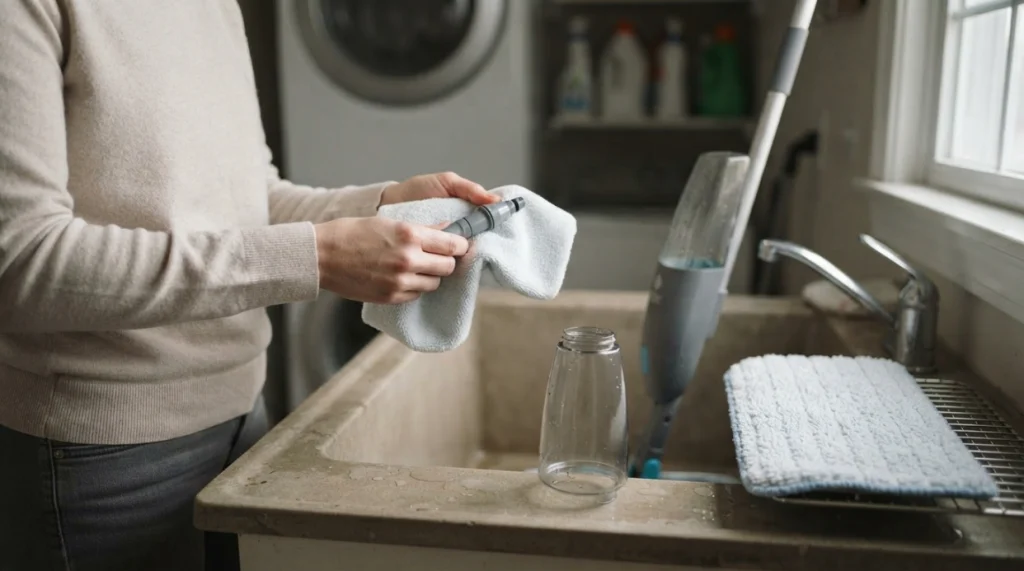
Clean the microfiber pad after use, empty the reservoir when required, and keep the nozzle free of dried cleaner. A maintained spray mop gives more consistent spray coverage and leaves less residue.
Wash reusable microfiber pads
Follow the pad’s care label. Many reusable microfiber pads can be machine washed, but fabric softener can coat microfiber and reduce its ability to collect dirt.
Let the pad dry completely before storage.
Check the spray nozzle
If the spray becomes uneven, inspect the nozzle for dried cleaner or mineral buildup. Follow your mop manufacturer’s cleaning method rather than forcing a sharp object into the opening.
Keep the reservoir clean
Don’t leave a questionable cleaner mixture sitting in a refillable reservoir for long periods. Some formulas can separate, thicken, or leave deposits.
If your mop requires a proprietary bottle, avoid modifying the container unless the manufacturer allows it.
Store the mop dry
Remove a damp pad before putting the mop in a closet. Storing the mop with a wet, dirty pad can create odors and makes the next cleaning session less hygienic.
As of 2026, my preferred spray-mop routine remains simple: fresh pad, minimal product, small sections, and enough drying time.
Frequently Asked Questions
Do I need to sweep before using a spray mop?
Yes. Sweep, vacuum, or dry-mop first to remove hair, crumbs, sand, and other loose debris. Wet mopping over grit can push debris around and may create scratches or muddy residue.
How many times should I spray the floor?
There is no universal number because nozzle output and floor type vary. Start with one or two light sprays over a small section, then add more only if the pad becomes too dry to clean effectively.
Can I put vinegar in a spray mop?
Only if both the mop manufacturer and your flooring manufacturer permit it. Acidic vinegar solutions can be unsuitable for some natural stone, floor finishes, grout, or mop components, so don’t treat vinegar as a universal cleaner.
Can I use plain water in a spray mop?
Some refillable spray mops can be used with plain water for light cleaning, but check the product instructions first. Plain water can remove light dust or footprints but may not cut greasy soil effectively.
Why does my spray mop leave my floor sticky?
Sticky floors usually point to excess cleaner, an overly concentrated solution, dirty pads, or product incompatibility. Use a clean microfiber pad and reduce the amount of cleaner according to its label directions.
Is a spray mop safe for hardwood floors?
A spray mop can be suitable for many sealed hardwood floors when it uses very little moisture and an approved cleaner. NWFA guidance emphasizes minimizing liquid and following the flooring or finish manufacturer’s maintenance instructions. :contentReference[oaicite:1]{index=1}
Should I disinfect my floors every time I mop?
Usually not. CDC guidance says routine cleaning with an appropriate cleaner is sufficient in many household situations, while disinfecting is more important when someone is sick or at increased risk. :contentReference[oaicite:2]{index=2}
The Bottom Line
Learning how to use a spray mop comes down to controlling dirt, moisture, and cleaning solution. Sweep first, spray lightly, use a clean microfiber pad, and work toward the doorway in overlapping passes.
Match every cleaning product to your floor rather than relying on one mixture for the whole house. With that routine, a spray mop becomes one of the quickest tools for regular floor maintenance without dragging out a bucket.
Before your next cleaning session, check the floor-care label, wash your microfiber pad, and start with less cleaning solution than you think you need.