
What Are the Parts of a Spin Mop? Complete Guide

Quick Answer
A spin mop has two main systems: the mop itself and the spinning bucket. The mop usually includes a microfiber mop head, base plate, swivel joint, connector, and telescopic handle, while the bucket contains the wringer basket, spinning mechanism, carry handle, and often a foot pedal or water-separation chamber. You can see these core components on a typical spin mop and bucket system.
Main spin mop parts
- Mop head: Absorbs water and lifts dirt from the floor.
- Mop base: Holds the refill and lets the head move across the floor.
- Swivel joint: Lets the mop pivot around furniture and corners.
- Telescopic handle: Gives you reach and often adjusts in length.
- Wringer basket: Spins the wet mop head to remove excess water.
- Spin mechanism: Drives the wringer through a pedal, handle action, or another mechanical system.
The part that matters most
- For floor protection, the wringer matters most because it controls how much water remains in the mop head.
A spin mop looks simple until you take one apart. After testing and cleaning with several styles, I’ve found that understanding each part makes troubleshooting much easier.
It also helps you replace a worn mop head, diagnose a bucket that won’t spin, and control moisture on hardwood, laminate, vinyl, and tile.
In This Guide
- What are the main parts of a spin mop?
- What parts make up the mop head and base?
- What parts are inside a spin mop handle?
- What parts are in a spin mop bucket and wringer?
- How do all the spin mop parts work together?
- How is a spin mop built differently from other mops?
- Which spin mop parts usually wear out?
- Can you replace individual spin mop parts?
- Frequently asked questions
What are the main parts of a spin mop?
A spin mop is a floor-cleaning system that uses a rotating wringer to remove water from a reusable mop head. That spinning action separates it from a basic string mop and bucket.
Definition: A spin mop combines a washable floor-cleaning head with a bucket-mounted centrifugal wringer that spins excess liquid out of the mop fibers.
Most models can be divided into a mop assembly and a bucket assembly. Designs differ, but the basic job of each component stays similar.
- Microfiber or fabric mop head: Contacts the floor and collects dirt, dust, spills, and cleaning solution.
- Mop base or head plate: Supports the refill and connects it to the handle.
- Swivel or pivot joint: Allows the head to tilt and rotate.
- Handle: Gives you control and transfers movement to the mop head.
- Connector or locking collar: Joins handle sections or secures the handle to the base.
- Bucket: Holds water and cleaning solution.
- Wringer basket: Holds the mop head while it spins.
- Drive mechanism: Rotates the wringer using a pedal, handle, or mechanical linkage.
Some modern systems add clean-water reservoirs, dirty-water chambers, drain plugs, splash guards, soap dispensers, and measuring marks. Those are useful extras rather than universal spin mop parts.
As of 2026, you’ll find both traditional single-bucket designs and systems that separate fresh and dirty water.
What parts make up the mop head and base?

The lower half of the mop does most of the actual floor cleaning. Small differences here affect corner reach, water pickup, and how easily the mop moves under furniture.
The microfiber mop head
Most spin mops use strands or loops made from microfiber. Microfiber contains fine synthetic fibers that can trap dust and pick up moisture without needing a heavy cotton head.
The mop head is normally removable. That lets you wash it or replace it after the fibers become worn, matted, stained, or difficult to rinse clean.
- Long strands: Reach into grout lines and irregular surfaces.
- Dense strands: Improve liquid pickup and general scrubbing.
- Scrubbing strips: Some refills add textured fibers for stuck-on dirt.
- Attachment ring: Locks the refill onto the mop base.
The mop base or plate
The base is the plastic structure between the fibers and the handle. Round bases are common, while triangular bases can reach more closely into corners.
When a mop head repeatedly falls off, I check this connection before replacing anything else. A worn refill socket or damaged locking tabs often cause the problem.
The swivel joint
A pivoting joint lets the mop head change angle while the handle stays in your hands. This is what helps a spin mop slide around chair legs and under cabinet edges.
The joint can become loose after extended use. It can also become stiff if dried cleaning solution or grit builds up around the moving surfaces.
What parts are inside a spin mop handle?
A spin mop handle looks like one simple pole, but many models contain several connected pieces. Understanding them helps when the handle won’t extend, lock, or rotate correctly.
Handle grip
The grip is the upper section you hold while mopping. Some models use textured plastic or foam to improve control with wet hands.
Telescopic tubes
Many handles contain two or three nesting metal sections. Sliding these sections changes the overall handle length.
For example, O-Cedar lists a telescopic handle that extends to 51 inches on its EasyWring system. Other brands use different dimensions and locking arrangements.
Locking collar
The locking collar keeps telescopic sections from sliding during use. Depending on the design, you twist the handle or rotate a plastic collar to lock it.
- Handle collapses: The collar may not be fully locked.
- Handle won’t extend: A tube may be overtightened or slightly bent.
- Sections separate: A threaded connector may have loosened.
Lower connector
The bottom connector attaches the shaft to the mop base. It must remain secure while still allowing the pivot joint to move.
Some spin systems also use handle movement as part of the spinning process. Those models may contain a rotational coupling that transfers downward pressure into spinning motion.
What parts are in a spin mop bucket and wringer?
The bucket assembly contains more moving parts than most people expect. This is also where many spin mop failures occur.
Bucket body
The bucket stores water and supports the wringer assembly. A sturdy base matters because the spinner creates rotational force while you wring the mop.
Many buckets include a carry handle, pouring lip, fill marks, or drain opening. Dual-tank models may divide fresh water from used cleaning water.
Wringer basket
The wringer basket is the perforated basket where you place the wet mop head. As it rotates, centrifugal force pushes water outward through the openings.
The result is a damp mop instead of a dripping one. I usually spin longer before touching moisture-sensitive flooring and leave more water in the head for textured tile.
Spindle and bearing area
The basket rotates around a central spindle or similar support. A bearing or low-friction connection helps it turn smoothly.
Hair, thread, grit, or dried cleaner around this area can slow the basket. Cleaning visible debris is often more useful than forcing the pedal harder.
Foot pedal and drive system
Pedal-operated models convert repeated foot presses into basket rotation. Inside the bucket base, gears or a mechanical linkage transfer that movement to the spinner.
Not every spin mop has a pedal. Some use downward handle pressure, while others use different manual wringing systems.
Splash guard
A raised rim around the spinner helps keep water inside the bucket. It also guides the mop head into the wringer.
A damaged guard usually won’t stop the mop from spinning, but it can make wringing messier.
How do all the spin mop parts work together?
The system follows a simple cycle: wet the head, clean the floor, rinse it, then spin out extra water. Each component supports one stage of that process.
- Wet the mop head. Place the microfiber head into the bucket water or clean-water chamber.
- Lift and position it. Move the head into the wringer basket.
- Activate the spinner. Press the pedal, pump the handle, or use the mechanism provided by your model.
- Control moisture. More spinning generally removes more water from the fibers.
- Mop the floor. The swivel joint lets the damp head move around obstacles.
- Rinse and repeat. Return the dirty head to the bucket as needed.
Moisture control is one reason I like spin mops for mixed-floor homes. I can leave a tile floor slightly wetter while wringing the head much more thoroughly before moving onto sealed wood or laminate.
The National Wood Flooring Association advises using a slightly moistened, well-wrung mop and minimizing moisture on wood flooring. Its wood-floor care guidance also recommends dealing with spills promptly.
Safety note: Always check your flooring manufacturer’s care instructions before wet mopping, especially with hardwood, engineered wood, laminate, or natural stone.
How is a spin mop built differently from other mops?
The biggest difference is the wringer. A spin mop actively removes water from the cleaning head instead of requiring you to squeeze it by hand.
| Feature | Spin Mop | Flat Microfiber Mop | Traditional String Mop |
|---|---|---|---|
| Cleaning head | Round or triangular microfiber strands | Flat microfiber pad | Cotton, rayon, or synthetic strings |
| Wringing method | Rotating basket | Usually manual or spray-controlled | Hand, lever, or bucket wringer |
| Main moving parts | Swivel joint plus spinner mechanism | Swivel plate; few bucket parts | Usually few moving mop parts |
| Moisture control | Controlled by repeated spinning | Controlled by spray amount or pad dampness | Depends heavily on wringing method |
| Typical strength | General wet cleaning with hands-free wringing | Light cleaning and low-moisture maintenance | Heavy wet cleaning on durable surfaces |
A steam mop adds another group of components, including a water tank, heater, steam channels, and electrical controls. A robot mop adds motors, sensors, wheels, batteries, and electronic navigation.
That makes a manual spin mop mechanically more complicated than a flat mop but far simpler than powered floor-cleaning equipment.
Which spin mop parts usually wear out?
The replaceable mop head normally shows wear first. The mechanical components can last much longer if they stay clean and aren’t forced when jammed.
- Mop head: Fibers become flattened, tangled, stained, or less absorbent.
- Head connector: Tabs or threads wear and stop holding the refill securely.
- Swivel joint: The joint becomes loose, stiff, or cracked.
- Handle lock: Telescopic sections start slipping during use.
- Wringer basket: The basket becomes obstructed or develops excessive wobble.
- Pedal mechanism: The pedal stops returning or no longer drives the basket reliably.
- Bucket handle: Repeated carrying can loosen its mounting points.
How I maintain the spinner
I rinse loose grit from the bucket after each substantial cleaning session. I also check around the spinner for hair before storing it.
Letting the bucket and mop head dry helps prevent stale odors. Avoid storing a dirty, wet refill inside a closed bucket.
Be careful with cleaning chemicals
You don’t need to disinfect every floor during routine cleaning. The CDC’s household cleaning guidance says regular cleaning is often sufficient, while disinfection becomes more relevant when someone is sick or at higher risk.
If you do use a disinfectant, cleaning and disinfecting are different processes. The EPA explains the difference between cleaning, sanitizing, and disinfecting and advises following product-label directions.
Safety note: Never assume a disinfectant, vinegar mixture, bleach solution, or concentrated cleaner is safe for your floor. Check both the cleaner label and your flooring manufacturer’s care guide first.
Can you replace individual spin mop parts?
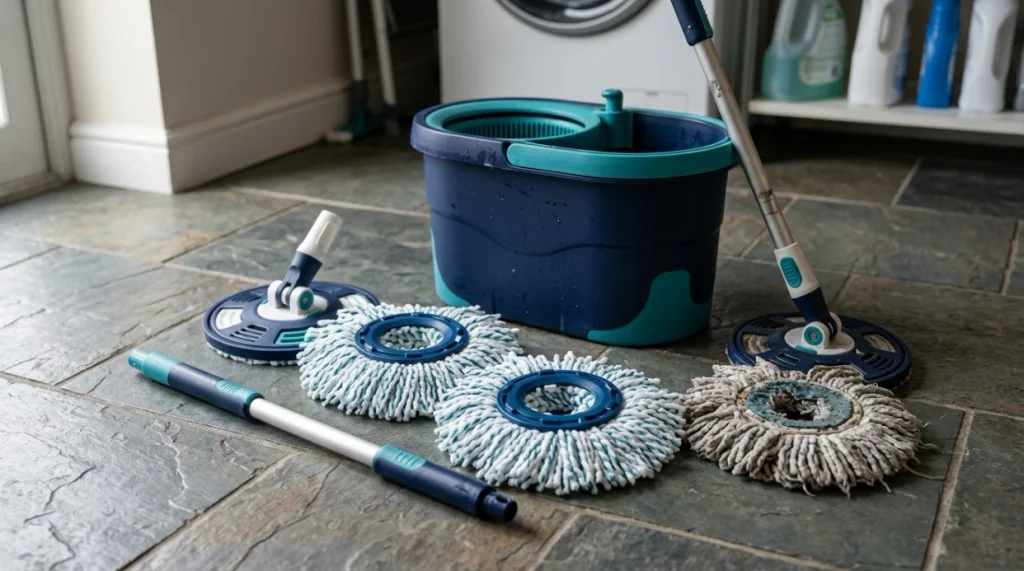
Some spin mop parts are easy to replace, while others are effectively part of the bucket assembly. Compatibility matters more than appearance.
Parts commonly sold separately
- Mop head refills: The most common replacement item.
- Handles: Available for some brands and product lines.
- Mop bases: Occasionally available as separate assemblies.
- Bucket components: Availability varies widely by manufacturer.
Don’t assume two round mop heads are interchangeable. The attachment diameter, locking tabs, threads, and connector shape can differ.
What should you check before buying a replacement?
- Exact mop brand and model name
- Refill attachment style
- Connector diameter
- Thread type if the part screws on
- Original product number or refill number
- Manufacturer compatibility statement
I prefer matching replacement heads by model number instead of relying on photos. Small differences in the center connector can make an otherwise similar refill unusable.
If the foot pedal, internal gear system, or bucket spindle has failed, compare repair cost with replacing the complete system. Many inexpensive buckets aren’t designed for convenient internal repairs.
Frequently asked questions
What is the spinning part of a spin mop called?
The spinning section is usually called the wringer basket, spinner, or spin wringer. It sits inside or above the bucket and rotates the wet mop head quickly enough to throw excess water through openings in the basket.
What is the bottom part of a spin mop called?
The rigid section under the handle is commonly called the mop base, mop plate, or head plate. It holds the removable microfiber refill and usually connects to the handle through a swivel or pivot joint.
Why does my spin mop no longer spin?
Check for hair or debris around the basket first. Then inspect the pedal, handle-drive mechanism, spindle, and connection points. A jammed basket, stripped gear, disconnected linkage, or damaged spinner assembly can prevent rotation.
Can I replace only the spin mop head?
Usually, yes. Replaceable microfiber heads are one of the main advantages of spin mops. Match the refill to your exact brand and model because center connectors, locking tabs, and attachment sizes aren’t universal.
What does the pedal on a spin mop do?
On pedal-driven models, pressing the pedal transfers mechanical movement to the wringer basket. The basket rotates the mop head and removes excess water, allowing you to control dampness without squeezing the fibers by hand.
Does every spin mop have a foot pedal?
No. Foot pedals are common, but some spin mops use downward pressure on the handle or another manual mechanism. The goal is the same: rotate the wringer basket so water leaves the mop head.
Which spin mop part is most important for hardwood floors?
The wringer is especially important because it lets you reduce moisture before mopping. The microfiber head also matters because it should clean without scratching. Always follow your wood-floor manufacturer’s instructions and avoid leaving standing water behind.
Final takeaway: A spin mop is more than a mop head and bucket. Its microfiber refill, base, swivel joint, telescopic handle, wringer basket, spindle, and drive mechanism all work together to clean the floor while controlling water. Learn those parts once, and diagnosing most everyday spin-mop problems becomes much easier.