
Spin Mop Base Parts: What They Do, How to Identify Them, and When to Replace Them

Quick Answer
Spin mop base parts are the components at the bottom of a spin mop bucket or mop assembly that support the unit, hold the mop head, or help it operate. The exact parts depend on the design, but common examples include the bucket base, drainage plug, caster wheels, mop-head attachment, and lower pole connection. Identify the faulty component before ordering a replacement, because parts from different mop models may not fit.
Common spin mop base parts
- Bucket base: Supports the bucket and helps keep it stable during mopping and wringing.
- Drain plug: Seals the drainage opening on models equipped with one.
- Wheels or casters: Allow some buckets to move across the floor.
- Spinner or wringer support: Holds the spinning basket or related mechanism in position on applicable designs.
- Mop-head connector: Secures the microfiber head to the mop frame or lower assembly.
- Lower pole joint: Connects the handle to the mop head and transfers movement during cleaning.
Before replacing a part
- Check the mop’s brand, model number, and original parts diagram.
- Inspect for cracks, loose fasteners, worn connectors, or a blocked drain.
- Avoid using a bucket with a damaged base or unstable wringer until it’s repaired.
When a spin mop becomes wobbly, leaks around the bottom, or stops spinning smoothly, the problem may be a worn or damaged base component. I recommend identifying the exact part first rather than replacing the entire mop system unnecessarily.
This guide explains the main spin mop base parts, how to recognize common failures, and what to check before buying replacements. It also covers bucket stability, floor safety, maintenance, and the differences between base components and the wringer parts above them.
In This Guide
- What Are Spin Mop Base Parts?
- Which Parts Make Up a Spin Mop Base?
- How Do You Identify a Damaged Base Part?
- How Do You Choose the Right Replacement?
- Spin Mop Base Parts Compared
- How Can You Maintain and Repair Base Parts?
- How Do Base Problems Affect Floor Cleaning?
- Should You Replace a Part or Buy a New Mop?
- Frequently Asked Questions
What Are Spin Mop Base Parts?
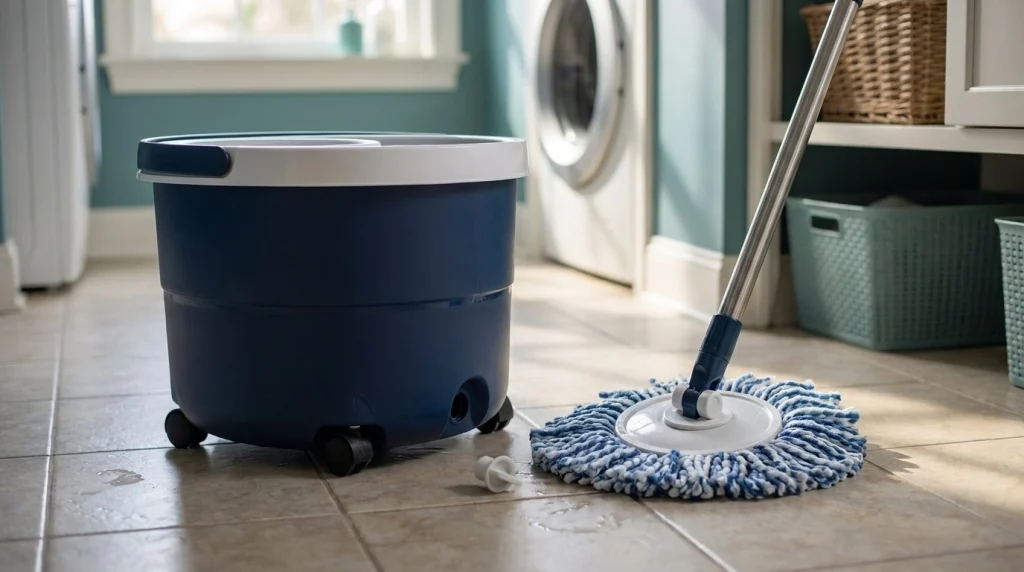
Spin mop base parts are the lower structural and functional components that support the bucket or connect the mop handle to its cleaning head. Their exact arrangement varies between bucket systems, foot-operated models, and other spin mop designs.
What does the base do?
The base provides support, stability, and a secure connection between working components. In a bucket system, it helps the container stand upright while you move the mop between washing and wringing.
In a mop-head assembly, the lower connector holds the cleaning head in place. It also helps transfer movement from the handle to the head during everyday floor cleaning.
Are bucket bases and mop-head bases the same?
No. A bucket base supports the water container and may include wheels or a drain opening, while the mop-head base belongs to the moving cleaning assembly.
- Bucket base: The bottom structure beneath the water reservoir.
- Wringer support: The structure holding the spinning basket or wringing mechanism.
- Mop-head base: The lower frame or connector that holds the microfiber head.
These components serve different purposes. Before shopping, determine which assembly has failed so you don’t accidentally order a compatible-looking but incorrect part.
Which Parts Make Up a Spin Mop Base?
A spin mop may have several lower components, but not every model uses all of them. The manufacturer’s design determines whether a particular part is removable, replaceable, or integrated into a larger assembly.
1. Bucket bottom or base shell
The bucket base is the lower portion of the container that supports its weight and helps distribute the load across the floor. It may be molded as one piece with the bucket rather than sold separately.
Look for cracks, splits, distorted plastic, or a bucket that rocks on a flat surface. Damage in this area can compromise stability and allow water to escape.
2. Drain plug and sealing washer
Some spin mop buckets have a drain opening near the bottom. A removable plug or seal closes that opening after emptying the dirty water.
A missing plug, damaged seal, or loose fitting may cause a slow leak. Other buckets have no drain plug, so this component isn’t universal.
3. Wheels and caster sockets
Wheels help move certain spin mop buckets without lifting a full container. Their sockets or mounting points hold the wheels against the underside of the bucket.
Hair, grit, and dried cleaning residue can prevent smooth movement. A cracked socket or wheel that repeatedly falls out usually needs a compatible replacement component.
4. Spinner support and lower wringer housing
The wringer support holds the spinning basket and related parts in the correct position. Depending on the model, the support may be attached to the bucket, secured with fasteners, or integrated into the wringer assembly.
A loose support can cause wobbling, rubbing, or unusual movement during spinning. Stop using the wringer if the basket tilts sharply or the surrounding plastic shows cracks.
5. Mop-head frame and connector
The mop-head frame distributes pressure across the microfiber strands or pad. Its connector attaches the head to the lower end of the handle.
A loose joint may make the head tilt, detach, or rotate unpredictably. Check the locking tabs, threads, clips, and other attachment features before replacing the complete head assembly.
6. Lower pole joint
The lower pole joint connects the handle to the mop head. It may use a threaded fitting, swivel joint, locking mechanism, or another model-specific connection.
Excessive play at this joint can make cleaning harder and increase stress on surrounding plastic. A worn connection may need a new fastener or a replacement assembly, depending on the design.
How Do You Identify a Damaged Base Part?
Start by observing what the mop does incorrectly. A leak, wobbling bucket, loose mop head, and noisy spinner point toward different components, although one symptom can have several causes.
Match the symptom to the likely problem
| Symptom | Possible cause | First check |
|---|---|---|
| Water leaking underneath | Cracked bucket or faulty drain seal | Inspect the bottom and drain opening |
| Bucket rocks on a flat floor | Warped base or damaged wheel mount | Check the underside and all contact points |
| Wheels fall off | Broken clips or worn sockets | Examine the wheel and mounting socket |
| Wringer wobbles | Loose support or damaged spinner assembly | Check for movement and visible cracks |
| Mop head tilts or detaches | Worn connector or locking mechanism | Inspect the head and lower pole joint |
| Spinner feels stiff | Debris, misalignment, or a worn mechanism | Check the basket and follow the manual |
How to inspect the base safely
- Empty the bucket. Remove the water and place the mop on a stable, dry surface.
- Inspect the underside. Look for cracks, missing clips, loose wheels, and signs of leaking.
- Check removable fittings. Examine the drain plug, connectors, and accessible fasteners.
- Test stability. Place the empty bucket on a level surface and check whether it rocks.
- Consult the manual. Confirm which parts can be removed without damaging the assembly.
For example, a small puddle near a bucket’s drain may indicate a worn seal, but water running down from a higher crack can collect in the same place. Dry the empty bucket thoroughly before investigating the source.
Section Takeaway: Match the symptom to the physical component before buying anything. Stop using the mop if its bucket, wringer support, or head connection is structurally unstable.
How Do You Choose the Right Replacement?
The safest way to choose a replacement is to match the part to your mop’s exact make and model. Similar-looking buckets and connectors can use different dimensions, mounting systems, or locking features.
Find the brand and model number
Check the product label, original packaging, instruction manual, or purchase record. If the model number isn’t printed on the bucket, look for identifying information on the handle or underside.
Take clear photographs of the damaged component from several angles. Include its attachment points and any molded numbers, letters, or markings.
Check compatibility before ordering
Confirm these details before purchasing a replacement:
- Dimensions: Compare the component’s width, diameter, height, and mounting measurements.
- Attachment method: Check whether the part uses screws, clips, threads, or a press-fit connection.
- Model compatibility: Verify that the seller explicitly lists your mop model.
- Part availability: Determine whether the manufacturer sells the individual component or only a larger assembly.
- Return policy: Check whether an incompatible replacement can be returned.
Can you use a universal spin mop base part?
Some accessories and replacement components fit multiple models, but “universal” doesn’t guarantee compatibility with every spin mop. Structural components deserve particular care because an incorrect fit can cause instability or prevent the wringer from operating properly.
For instance, a replacement caster may fit several buckets with the same mounting socket. A complete bucket base with different wheel spacing or molded supports is less likely to interchange.
Don’t drill new holes or force a mismatched component into place. Contact the manufacturer if you can’t confirm compatibility.
Safety note: Follow the mop manufacturer’s repair instructions, and don’t use a damaged bucket or wringer that could collapse, leak, or tip during use.
Spin Mop Base Parts Compared
Different base components have different functions and replacement requirements. The following comparison helps you narrow down what to inspect first.
| Component | Main purpose | Typical concern | Replacement approach |
|---|---|---|---|
| Bucket base | Supports the bucket | Cracks or instability | Check for a model-specific base or bucket assembly |
| Drain plug | Seals the drain | Leaks or a loose fit | Match the plug and seal to the drain opening |
| Caster wheel | Moves the bucket | Sticking or detachment | Match wheel dimensions and socket design |
| Wringer support | Positions the spinner | Wobbling or misalignment | Inspect the support and complete wringer assembly |
| Mop-head connector | Secures the head | Loose joint or broken clip | Match the connector to the frame and pole |
| Lower pole joint | Transfers handle movement | Excessive play or stripped threads | Check whether the joint or full pole is replaceable |
Prices and availability vary by brand, model, and whether the manufacturer sells individual components. I wouldn’t rely on a generic price estimate without identifying the exact part first.
How does a spin mop base compare with other mop designs?
A spin mop base isn’t interchangeable with the lower assemblies of flat microfiber mops, steam mops, or cordless electric mops. Each design uses different structures and operating mechanisms.
| Mop type | Lower assembly | Main maintenance focus |
|---|---|---|
| Spin mop | Bucket, wringer, or rotating mop-head assembly | Cracks, seals, joints, and spinner alignment |
| Flat microfiber mop | Flat pad holder and swivel joint | Worn pad fasteners and damaged swivels |
| Steam mop | Steam plate, pad holder, and internal connections | Pad condition and manufacturer-approved maintenance |
| Cordless electric mop | Motorized pads or rotating cleaning heads | Brushes, pad mounts, and electrical safety |
Choose replacement components for the exact mop design. Never assume that a part made for a steam mop, electric mop, or flat mop will work with a manual spin mop.
How Can You Maintain and Repair Base Parts?
Regular cleaning can prevent some base problems, especially those caused by dried detergent, grit, and trapped hair. It won’t repair cracked plastic or restore a worn locking mechanism, but it can help keep serviceable components working smoothly.
Clean the bucket and base regularly
After mopping, empty the dirty water and rinse away loose debris. Wipe accessible surfaces with a soft cloth and let the bucket dry before storing it.
- Remove hair and lint from caster wheels, if fitted.
- Wipe around the drain opening and plug.
- Remove accessible dirt from the wringer support.
- Check the bottom for trapped grit that could scratch the floor.
- Inspect plastic joints for new cracks or loose fittings.
Don’t immerse a motorized assembly or use water on electrical components unless the product instructions explicitly permit it. Manual spin mops generally have fewer electrical concerns, but their moving mechanisms still require proper care.
Which repairs are reasonable to attempt at home?
Simple maintenance is often manageable without special tools. Structural repairs require more caution.
| Problem | Reasonable next step |
|---|---|
| Dirt around a wheel | Clean accessible debris and test the wheel |
| Loose removable plug | Inspect the seal and install the correct replacement |
| Loose screw or fastener | Tighten only as directed by the manufacturer |
| Cracked bucket bottom | Replace the approved assembly or bucket |
| Broken wringer support | Replace the specified support or wringer assembly |
A household adhesive may not withstand repeated water exposure, twisting forces, and pressure from a loaded bucket. Avoid improvised repairs to load-bearing parts or mechanisms that spin at speed.
What cleaning products should you use?
For routine bucket maintenance, mild soap and water are often sufficient when permitted by the product instructions. Avoid harsh solvents or abrasive pads that could weaken, scratch, or discolor plastic.
For the floor itself, select a cleaner suitable for the specific surface. Laminate, vinyl, tile, and natural stone have different care requirements, while hardwood and engineered wood need careful moisture control.
Safety note: Follow your flooring manufacturer’s care guide and the cleaner’s label. The National Wood Flooring Association’s wood-floor maintenance guidance recommends appropriate cleaning methods and cautions against excess moisture on wood flooring.
Section Takeaway: Clean and inspect serviceable components regularly, but replace damaged structural parts instead of relying on makeshift repairs.
How Do Base Problems Affect Floor Cleaning?
A damaged base can turn a routine cleaning job into a spill or slip hazard. A leaking bucket may leave water on the floor, while an unstable wringer can cause splashing or sudden movement.
Prevent water leaks and slippery floors
Water left on a floor can create a slipping risk, particularly on smooth tile, polished stone, and some vinyl surfaces. Check the bucket for leaks before filling it, and wipe up spills promptly.
If the bucket rocks, keep it out of use until you identify the cause. Don’t compensate for a broken wheel mount or uneven base by placing loose objects underneath it.
Protect hardwood and laminate
Hardwood and laminate can be vulnerable to excess moisture, although their construction and finish differ. A leaking bucket can cause damage even when the mop itself leaves only a small amount of water behind.
- Hardwood: Use the cleaning method recommended for the floor’s finish and avoid standing water.
- Engineered wood: Follow the flooring manufacturer’s instructions for moisture and cleaner compatibility.
- Laminate: Use a lightly damp mop only when the product’s care instructions permit it.
- Vinyl or LVP: Use a compatible cleaner and avoid excess water around vulnerable seams.
- Tile and natural stone: Choose a cleaner appropriate for the tile, grout, and stone type.
When choosing a spin mop for delicate flooring, look for reliable wringing and good control over the amount of water left in the microfiber head. No mop design makes excessive moisture safe for every floor.
Safety note: Never mix cleaning chemicals, and don’t assume that vinegar or a disinfectant is suitable for every floor. Read the product label and follow the flooring manufacturer’s instructions.
Does a damaged base affect cleaning performance?
Yes, depending on the component. A loose mop-head connector may distribute pressure unevenly, while a bucket that leaks or tips makes it harder to control dirty water.
A damaged spinner support can also prevent the wringer from operating correctly. If the basket rubs, tilts, or moves unexpectedly, stop using the mechanism until the fault is corrected.
For disinfecting tasks, distinguish routine cleaning from disinfection. The U.S. Environmental Protection Agency’s cleaning and disinfection guidance explains that disinfectant labels specify how to use products effectively, including required surface contact time.
Should You Replace a Part or Buy a New Mop?
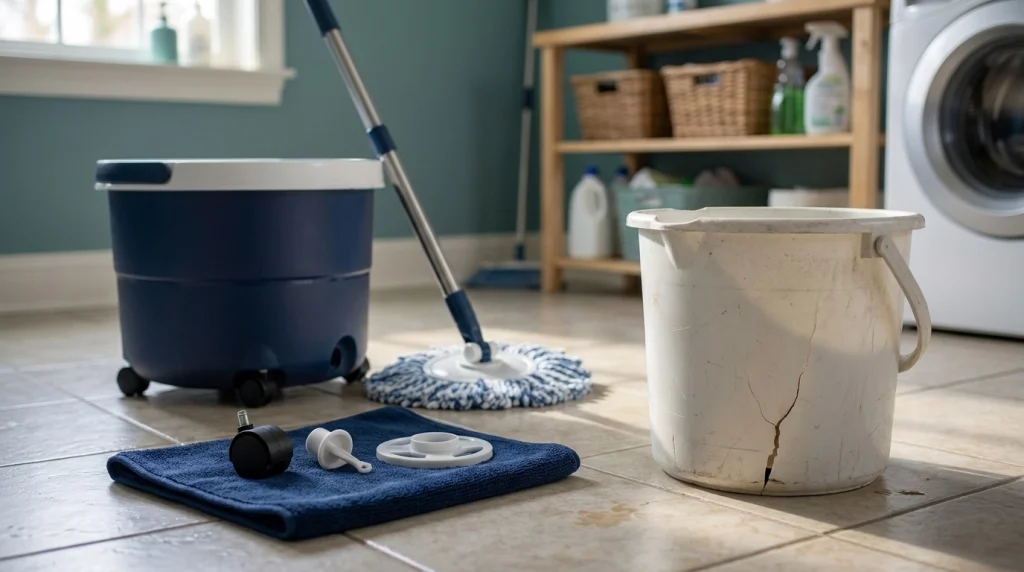
Replacing one component makes sense when the rest of the mop remains sound and the correct spare is available. Buying a complete replacement may be more practical when several important parts have failed or the manufacturer no longer supports the model.
When a replacement part is the better option
- The damage is limited to a removable wheel, plug, seal, or connector.
- The bucket and other structural components remain stable and intact.
- The manufacturer confirms that the spare fits your model.
- The replacement is available at a reasonable cost compared with a new unit.
When should you replace the whole mop?
- The bucket base has a major crack or permanent deformation.
- The wringer support is broken and isn’t available separately.
- Several components have worn out at the same time.
- The replacement costs nearly as much as a comparable new mop.
- You cannot obtain a safe, compatible repair component.
How do you compare the total cost?
Compare the price of the spare part with the total cost of getting the mop back into working condition. Include shipping, any required tools, and additional components that must be replaced together.
Don’t base the decision on price alone. A sound, repairable bucket with one failed caster is a different situation from a cracked bucket and a loose wringer assembly.
Before discarding the old mop, check whether the manufacturer offers replacement parts or a compatible bucket assembly. Replacing only the failed component can reduce waste when the repair is safe and economical.
Frequently Asked Questions
1. What are the main parts of a spin mop base?
The main parts depend on the model but may include the bucket bottom, drain plug, caster wheels, spinner support, mop-head frame, and lower pole connector. Some designs integrate several components into one molded assembly, so not every part is sold separately.
2. Can I replace the base of my spin mop bucket?
Sometimes. Certain manufacturers offer replacement bucket or base assemblies, while others sell only a complete bucket. Check the model number and parts diagram before ordering, and replace the entire bucket if the damaged base cannot be safely repaired.
3. Why does my spin mop bucket leak from the bottom?
A leak may come from a cracked bucket, a damaged drain plug, a worn seal, or water running down from another part. Empty and dry the bucket, inspect it carefully, and identify the actual source before purchasing a replacement component.
4. Are spin mop base parts interchangeable between brands?
Not necessarily. Different brands and models may use different dimensions, clips, threads, wheel sockets, and wringer mounts. Buy a part only when the manufacturer or seller confirms compatibility with your exact model, even if another component looks similar.
5. Can I glue a cracked spin mop base?
Gluing a structural crack is generally not a dependable long-term repair because the base may face repeated loads, twisting, and water exposure. Replace the damaged bucket or approved base assembly rather than relying on adhesive to hold an unstable component together.
6. How can I prevent spin mop base parts from wearing out?
Empty and rinse the bucket after use, remove debris from wheels and accessible fittings, and store the mop dry. Avoid dropping the bucket, forcing the wringer, or dragging a damaged unit across the floor, and inspect the base periodically for cracks.
7. How do I know which spin mop base part to order?
Find the mop’s brand and model number, consult its parts diagram, and compare the damaged component’s dimensions and attachment points. If the exact part is unclear, send the manufacturer photographs and ask whether the component is sold separately or requires a complete assembly.
Final Takeaway: Identify the Fault Before Replacing the Base
Spin mop base parts support the bucket, secure moving components, and help keep routine floor cleaning controlled. Understanding their individual roles makes it easier to diagnose leaks, wobbling, loose wheels, and unstable mop-head connections.
My recommendation is straightforward: inspect the damaged area, identify your exact model, and confirm compatibility before ordering a spare. If the bucket base or wringer support is structurally compromised, stop using it until you can make a safe repair.
With the correct replacement and regular maintenance, you may be able to extend the useful life of your spin mop without replacing the entire system.