
Spin Mop Basket Parts: What Each Part Does and How to Fix Common Problems

Quick Answer
Spin mop basket parts include the spinning wringer basket, its support or mounting base, the center opening, and any locking clips or splash guards fitted to the bucket. Some models also use a foot pedal, drive mechanism, or removable inner basket. If your mop basket wobbles, sticks, or stops spinning, identify the damaged component and check your model’s parts diagram before buying a replacement.
Common basket parts and problems
- Wringer basket: Holds the mop head while spinning excess water out of the microfiber.
- Center opening: Helps position the mop head during wringing.
- Mounting clips or base: Keep compatible basket assemblies seated securely in the bucket.
- Foot pedal or drive: Powers the spinning action on pedal-operated models.
- Drainage area: Allows water to return to the bucket instead of collecting around the wringer.
- Removable inner basket: Makes cleaning easier on models designed with a detachable assembly.
Quick troubleshooting tip
- Unplug no electrical equipment unless the mop has a powered feature; for a manual mop, empty the bucket and inspect the basket, clips, and drive mechanism before testing it again.
- Match the replacement to the exact brand and model because baskets, center fittings, and drive systems are not universally interchangeable.
A spin mop basket does more than hold a wet mop head. Its shape, mounting points, and spinning mechanism determine how smoothly the wringer works and how much water stays in the microfiber.
In this guide, I’ll explain the main spin mop basket parts, how to recognize common failures, and what to check before replacing an assembly. I’ll also cover cleaning, safe troubleshooting, and the differences between common spin mop designs.
In This Guide
- What are spin mop basket parts?
- What are the main parts of a spin mop basket?
- How do you identify a broken basket part?
- Why is the spin mop basket not spinning?
- How do you clean and maintain the basket?
- How do you choose the right replacement basket?
- How do different spin mop basket systems compare?
- When should you replace the basket or entire bucket?
- Spin mop basket parts: frequently asked questions
What are spin mop basket parts?
A spin mop basket is the perforated or slotted wringer assembly that holds a mop head while rotation forces excess water out of its fibers. Depending on the model, the basket may attach directly to the bucket or sit inside a removable inner container.
The basket is only one part of the complete spin mop system. The bucket holds the water, the mop head absorbs dirt and liquid, and the wringer mechanism helps control moisture before floor cleaning.
What does the basket do?
The basket keeps the mop head in position while it spins. Its openings allow extracted water to drain back into the bucket, helping prevent unnecessary splashing.
A properly fitted basket also helps the mop rotate without excessive wobbling. If the basket sits crookedly or rubs against the bucket, the problem may involve its mounting points rather than the basket itself.
Which spin mop designs use different baskets?
- Foot-pedal spin mops: A pedal activates the spinning mechanism, often through a linkage or drive assembly.
- Handle-operated spin mops: Repeated handle movements create the rotation needed to wring the mop.
- Removable-basket systems: The wringer or inner bucket lifts out for rinsing and maintenance.
- Dual-compartment systems: Separate sections may provide different washing and wringing functions.
These designs can look similar from above but use different fittings underneath. Always identify the mechanism before ordering a replacement part.
What are the main parts of a spin mop basket?
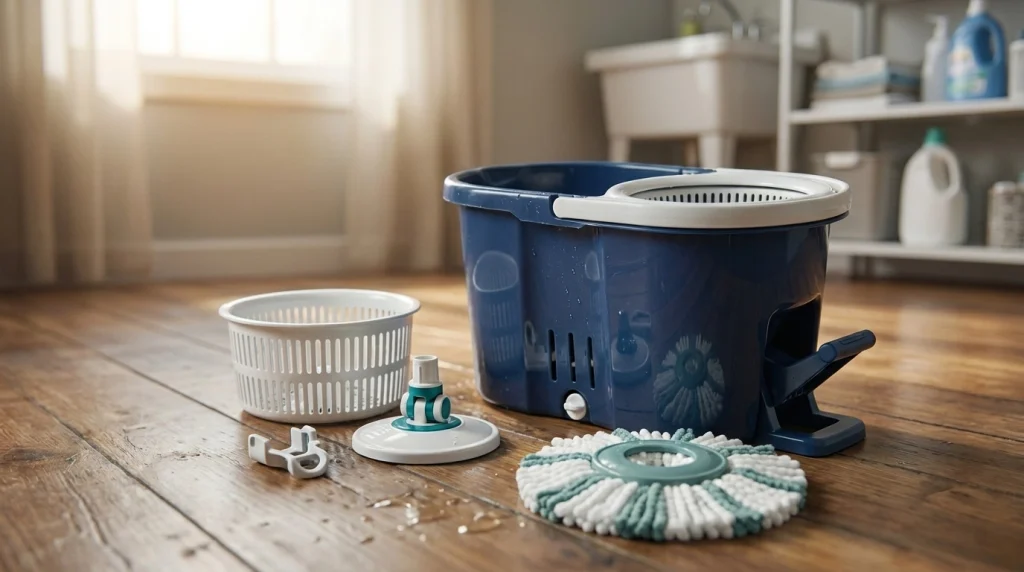
Most spin mop basket assemblies combine a spinning cage with components that position, support, or drive it. The exact names and arrangement vary by manufacturer, so use the list below as a practical identification guide rather than a universal parts diagram.
| Part | Purpose | Common warning sign |
|---|---|---|
| Wringer basket | Holds the mop head during spinning | Cracks, deformation, or wobbling |
| Basket hub or center fitting | Connects the basket to its rotating support | Loose fit or irregular rotation |
| Mounting base or clips | Keeps the assembly seated | Basket lifts, shifts, or tilts |
| Drive mechanism | Transfers pedal or handle movement into rotation | Pedal moves without spinning |
| Splash guard or cover | Helps contain splashes and guides the mop head | Loose cover or increased splashing |
| Drainage openings | Allow water to flow back into the bucket | Blocked holes or retained debris |
Wringer basket and center hub
The basket is usually the most visible component. Its openings allow water to escape while its sides support the mop head during rotation.
The center hub or fitting connects the basket to the spinning support on designs that use a separate connection. Damage here can cause wobbling even when the outer basket looks intact.
Mounting clips, base, and splash guard
Some models use clips, a locking ring, or a shaped base to hold the wringer in position. Others have an integrated assembly that should not be disassembled by the owner.
A splash guard may be a separate part or molded directly into the bucket. Check the manufacturer’s diagram before trying to remove it.
Drive parts and drainage openings
Pedal-operated systems may use a linkage, spring, or other drive components beneath the basket. Handle-operated designs can use a different transmission mechanism, so their replacement parts are not necessarily interchangeable.
Drainage openings are simpler but equally important. Lint, hair, and dried cleaner residue can block them and slow water return.
Section takeaway: Identify the visible basket, its mounting system, and its drive mechanism separately. A damaged connection can cause the same symptoms as a broken basket.
How do you identify a broken basket part?
Start by checking how the basket sits, how it rotates, and whether water drains normally. These three observations help narrow down the fault without taking the entire spin mop apart.
Check for cracks, wobbling, and loose fittings
Empty the bucket and inspect the basket under good lighting. Look for split plastic, bent sections, worn mounting tabs, and cracks around the center fitting.
Gently check whether the basket sits securely in its intended position. Don’t force it or pull on components that appear permanently attached.
- Cracked basket wall: The basket may need a complete replacement.
- Broken retaining clip: A compatible clip or mounting component may solve the problem if sold separately.
- Worn center fitting: Check whether the manufacturer offers a replacement basket with the fitting included.
- Loose pedal assembly: Inspect the drive system instead of assuming the basket has failed.
Look for drainage and rotation problems
Hair, lint, and dried cleaning solution can collect around the basket’s openings. Remove loose debris and rinse accessible surfaces before deciding that a component is broken.
Next, check whether the empty basket sits evenly. If it tilts or scrapes against the bucket, look for an incorrectly seated assembly, damaged mounting points, or a distorted basket.
Never put your fingers inside a moving basket to test its rotation. Inspect the assembly only when it is stationary and safe to handle.
Match the symptom to the likely cause
| Symptom | Possible cause | First check |
|---|---|---|
| Basket wobbles | Loose fitting or damaged support | Mounting points and center hub |
| Basket won’t spin | Blocked rotation or drive failure | Debris and pedal or handle action |
| Water stays in basket | Blocked openings or poor drainage | Drainage slots and bucket seating |
| Loud clicking or grinding | Misalignment or damaged drive parts | Stop using it and inspect while stationary |
| Basket lifts out of place | Missing clip or failed locking feature | Retaining parts and model-specific fit |
*Safety note: Follow the manufacturer’s assembly and maintenance instructions. Never operate a cracked, loose, or visibly misaligned spinning basket.*
Why is the spin mop basket not spinning?
A spin mop basket may stop spinning because debris blocks its movement, the basket isn’t seated correctly, or the drive mechanism has worn out. The correct fix depends on whether the basket itself or the part that drives it has failed.
Step 1: Empty the bucket and inspect the basket
Pour out the water and remove the mop head. Check the basket for trapped threads, tangled hair, small debris, or visible damage.
Clean accessible areas with a soft cloth. If the basket is designed to detach, remove it only according to the product instructions.
Step 2: Check how the mechanism operates
For a foot-pedal model, inspect the pedal for visible damage and check whether it returns to its resting position. A pedal that moves freely without driving the basket may indicate a disconnected or worn mechanism.
For a handle-operated model, check the handle lock and follow the manual’s instructions for engaging the spin function. Some models require a specific handle position before rotation works correctly.
Step 3: Refit the basket correctly
A removable basket may stop rotating properly if it hasn’t seated on its support. Remove it if the instructions allow, inspect the fitting, and reinstall it according to the diagram.
Don’t improvise with glue, metal screws, or makeshift clips. These changes can interfere with balance and may cause the basket to detach during use.
Step 4: Decide whether a replacement is needed
If cleaning and correct seating don’t solve the problem, inspect the basket and drive assembly for damage. A cracked hub or broken drive component usually needs a compatible replacement rather than further adjustment.
For manufacturer-specific troubleshooting, consult the official O-Cedar EasyWring use and care guide if you own that system. Its instructions apply to the listed product, not every spin mop design.
**Section takeaway:** Clean and reseat accessible parts before buying replacements. If the drive mechanism is damaged, replacing the basket alone may not restore spinning.
How do you clean and maintain a spin mop basket?
Regular basket cleaning removes hair, dirt, and detergent residue that can interfere with drainage. It also makes cracks and loose fittings easier to spot before they become bigger problems.
Clean the basket after mopping
- Empty the bucket and remove the mop head.
- Remove the basket only if the manufacturer’s instructions permit it.
- Rinse away loose dirt and trapped fibers with clean water.
- Use a soft brush to clean accessible slots and corners.
- Wipe the surrounding bucket and mounting area.
- Allow the parts to dry before storing the mop.
Don’t use a knife or screwdriver to scrape dirt from the slots. Sharp tools can damage plastic or create rough edges that trap more debris.
Prevent residue and unpleasant odors
Floor cleaner residue can build up when too much solution remains in the bucket or on the wringer. Follow the cleaner’s dilution instructions and rinse the bucket when needed.
Let the bucket and basket air-dry in a ventilated area. Avoid storing the mop with dirty water inside or leaving the wet microfiber head trapped in the basket.
*Safety note: Check the cleaner label and the mop manufacturer’s care guide before using disinfectants, bleach, vinegar, or other chemicals. Never mix cleaning products, and don’t assume a household cleaner is suitable for every plastic component or floor surface.*
Keep the basket working smoothly
- After each use: Remove loose fibers and empty dirty water.
- Weekly, if used frequently: Inspect the drainage slots, basket seating, and pedal area.
- When performance changes: Check for wobbling, unusual sounds, or cracks before further use.
- During storage: Keep the bucket dry and away from excessive heat that could deform plastic.
The schedule is a practical starting point, not a universal manufacturer requirement. Increase cleaning frequency if you mop muddy entryways, pet areas, or other heavily soiled floors.
Section takeaway: A clean, dry basket is easier to inspect and less likely to suffer from avoidable debris buildup. Gentle cleaning is safer than forcing or dismantling the spinning mechanism.
How do you choose the right replacement basket?
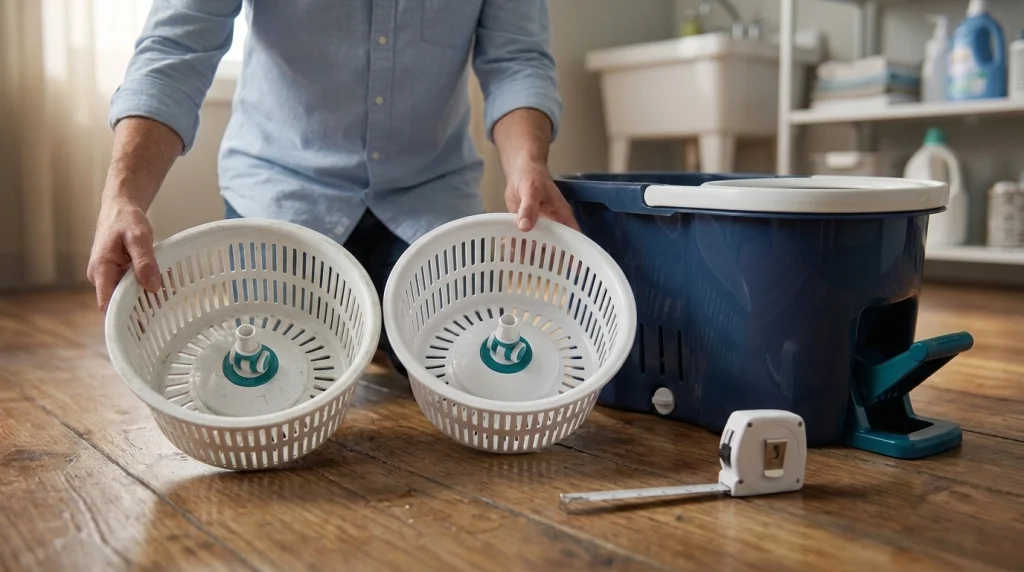
The safest replacement is one confirmed for your exact spin mop model. Similar-looking baskets can have different diameters, center fittings, mounting tabs, or drive connections.
Find the brand and model number first
Look for a label on the bucket, packaging, instruction booklet, or original purchase record. Record the brand and complete model number before searching for a part.
If the label is missing, compare the product’s shape and mechanism with the manufacturer’s diagrams. A photo can help customer support identify the product, but visual similarity alone doesn’t guarantee compatibility.
Compare the fitting and basket dimensions
When official documentation provides dimensions, compare them with the replacement listing. Pay attention to the center connection and mounting system, not just the basket’s outside diameter.
- Overall diameter: The basket must fit the intended bucket opening.
- Basket height: The assembly must clear the bucket and sit at the correct depth.
- Center fitting: The hub must match the original support or drive connection.
- Mounting features: Tabs, clips, and locking rings must align correctly.
- Drive compatibility: The replacement must suit a pedal-operated or handle-operated system.
Check whether the basket is sold separately
Some manufacturers offer individual replacement baskets or removable inner buckets. Others sell a complete wringer assembly or may only supply larger replacement components.
For example, True & Tidy’s SPIN11 inner bucket replacement is listed for the SPIN11 and SPIN11-Deluxe systems. That listing illustrates why model-specific compatibility matters; it isn’t a universal replacement for other spin mops.
Compare the cost with replacing the whole mop
Consider the complete repair cost, including shipping and any extra assembly needed. A basket-only replacement makes sense when the bucket and drive mechanism remain in good condition.
If the bucket is cracked and the drive mechanism is also failing, a complete replacement may be more practical. Check warranty coverage and official spare-part availability before paying for a repair.
Section takeaway: Match the model number, center fitting, dimensions, and drive design. Never purchase a basket based only on color or a claim that it fits most spin mops.
How do different spin mop basket systems compare?
Spin mop baskets vary mainly in how they spin, how they attach to the bucket, and whether they can be removed for cleaning. Understanding the mechanism helps you choose the right replacement and troubleshoot the right component.
| System type | How it works | What to check |
|---|---|---|
| Foot-pedal spin mop | A foot pedal drives the wringer | Pedal linkage, basket hub, mounting support |
| Handle-operated spin mop | Handle movement activates rotation | Handle lock, drive connection, basket fit |
| Removable-basket mop | The wringer or inner container lifts out | Locking tabs, seating, correct replacement size |
| Dual-compartment spin mop | Separate sections handle washing and wringing | Compartment layout, basket assembly, water flow |
Spin mop basket versus flat microfiber mop
A spin mop uses a bucket and wringer to remove excess water from a rotating microfiber head. A flat microfiber mop typically uses a removable pad attached to a flat base, often with a separate spray bottle or bucket.
A flat mop has no spin basket to replace. Its maintenance usually centers on the pad, attachment system, and handle connection.
Spin mop versus steam mop
A spin mop wrings water from a washable mop head. A steam mop heats water to produce steam and uses a different cleaning head and internal system.
Steam mops don’t use a conventional spin basket. Choose the cleaning method according to your floor manufacturer’s guidance, especially for wood, laminate, and other moisture-sensitive surfaces.
*Safety note: Always confirm that your flooring permits the selected cleaning method. Don’t use steam or excess water on a floor unless its manufacturer explicitly approves that approach.*
Why the mechanism matters when buying parts
A basket that fits a pedal-operated mop may not fit a handle-operated system, even when both buckets look similar. Their central connections and support structures may be completely different.
For floor cleaning, the basket’s job is to control excess moisture rather than clean the floor directly. The microfiber head and an appropriate floor-safe cleaner do most of the actual cleaning work.
Section takeaway: Identify the mechanism before comparing replacement baskets. Basket compatibility depends on the design underneath, not simply the shape of the top opening.
When should you replace the basket or entire bucket?
Replace the basket when it has structural damage, no longer stays securely mounted, or cannot spin correctly despite appropriate cleaning and refitting. Replace the complete bucket assembly when damage extends to the bucket, support, or drive mechanism and individual parts aren’t available.
Signs the basket needs replacement
- Visible cracks: Splits around the center hub or basket wall can worsen during rotation.
- Broken mounting tabs: The basket won’t remain properly seated.
- Persistent wobbling: The basket tilts or shakes after correct installation.
- Severe deformation: Warped plastic rubs against the bucket or prevents normal rotation.
- Unrepairable fitting damage: The basket no longer connects securely to its support.
When is replacing the whole spin mop better?
A complete replacement is worth considering when the bucket leaks, several structural parts have failed, or the manufacturer no longer supplies compatible components. Compare the cost of all required parts with the cost of a new system.
Don’t discard a mop solely because its basket is dirty or its pedal feels stiff. First check for removable debris, incorrect assembly, and an available model-specific replacement.
Can you repair a cracked spin mop basket?
For a basket that spins at high speed, replacement is safer than relying on glue or improvised reinforcement. Adhesives may not withstand repeated movement, water exposure, and mechanical stress.
Never drill new mounting holes or modify the center fitting unless the manufacturer provides an approved repair procedure. A poorly balanced basket can wobble, detach, or damage the bucket.
*Safety note: Stop using any wringer with cracked plastic, exposed drive components, or loose mounting parts. Keep hands, clothing, hair, and jewelry away from moving parts during operation.*
Section takeaway: Replace damaged structural components rather than improvising repairs. If multiple major parts have failed, compare the full repair cost with a replacement mop system.
Spin mop basket parts: frequently asked questions
1. What is the spinning basket in a spin mop called?
It’s commonly called a spin mop wringer basket, spinning wringer, or mop basket. Some manufacturers describe it as a wringer assembly or inner bucket, depending on its construction. Check your model’s parts diagram because these names can refer to different components.
2. Are spin mop baskets universal?
No. Spin mop baskets differ in diameter, height, center fittings, mounting clips, and drive connections. A basket that looks similar may not fit securely or rotate correctly. Confirm the brand and model number before ordering replacement parts.
3. Can I replace only the spin mop basket?
Yes, if the manufacturer offers a compatible basket separately and the remaining bucket and drive mechanism are in good condition. Some models require a complete wringer assembly or inner bucket instead. Check the parts diagram and availability before deciding.
4. Why does my spin mop basket wobble?
A wobbling basket may have a loose mounting connection, a damaged center fitting, worn supports, or a distorted basket. Empty the bucket, inspect the assembly, and refit removable components according to the manual. Replace cracked parts rather than continuing to operate them.
5. Why won’t my spin mop basket drain properly?
Blocked drainage openings, trapped fibers, or a poorly seated assembly can interfere with water returning to the bucket. Remove loose debris and rinse accessible slots. If drainage remains poor, check the manufacturer’s instructions for removable components and inspect for damage.
6. How do I find the correct spin mop basket replacement?
Find the mop’s brand and model number on its label, packaging, or manual. Compare the replacement’s dimensions, mounting features, and center connection with the original part. If identification remains uncertain, send the manufacturer a clear photo of the basket and bucket.
7. Is it worth replacing a spin mop basket instead of buying a new mop?
Replacing the basket is often worth considering when the bucket and drive mechanism still work properly and the compatible part is reasonably priced. If the bucket leaks, the drive has failed, or several parts need replacement, compare the combined repair cost with a new system.
Final takeaway: identify the part before replacing it
The best way to fix a spin mop basket is to identify the exact component causing the problem. Check the basket, center fitting, mounting clips, drainage openings, and drive mechanism before purchasing anything.
Keep the assembly clean, avoid forcing stuck parts, and follow the manufacturer’s instructions when removing or installing components. A compatible replacement can restore normal wringing without requiring an entirely new mop.
If you’re comparing replacement parts, start with the brand and model number, then confirm the fitting and assembly type. That simple step helps prevent wasted money on a basket that doesn’t fit.
For general floor care, also choose a mop head and cleaning solution appropriate for your flooring. Hardwood, laminate, vinyl, tile, and natural stone can have different moisture and cleaner requirements, so follow the flooring manufacturer’s care guidance.
Research and verification note: Basket configurations vary by model. The component descriptions in this guide are general identification guidance, not a claim that every spin mop contains every listed part. Confirm exact part numbers and repair procedures with the relevant manufacturer before purchasing or disassembling an assembly.