
Spin Mop Bucket Parts: Names, Functions, and Replacement Guide

Quick Answer
The main spin mop bucket parts are the bucket body, spinning wringer basket, drive mechanism, foot pedal or pump handle, carry handle, and drain plug when fitted. The mop itself has a handle, locking joints, rotating mop plate, and microfiber head. If a spin mop stops working, identify the damaged component first and check your model’s parts diagram before buying a replacement.
Common bucket parts and their functions
- Bucket body: Holds rinse water and catches water removed during spinning.
- Wringer basket: Holds the mop head while excess water spins out.
- Drive mechanism: Transfers motion from the pedal or handle to the spinner.
- Foot pedal: Activates the spinning mechanism on pedal-operated models.
- Carry handle: Helps move the bucket when it is empty or filled appropriately.
- Drain plug: Allows water to leave the bucket without tipping it, if included.
Before replacing a part
- Check the brand, model number, basket diameter, and attachment style.
- Remove hair and debris before assuming the spinner is broken.
- Never force a mismatched basket or operate a cracked bucket.
A spin mop bucket looks simple until the spinner stops turning, the pedal sticks, or water leaks across the floor. Knowing the parts makes troubleshooting much easier.
In this guide, I’ll explain what each component does, how bucket and mop parts work together, and what to check before replacing anything. I’ll also cover common faults, cleaning, and safe use in 2026.
In This Guide
- What are the main spin mop bucket parts?
- What does each bucket part do?
- How are mop parts different from bucket parts?
- How do you identify the correct replacement parts?
- Why is the spin mop bucket not working?
- How do you clean and maintain bucket parts?
- What are the differences between spinner designs?
- Should you repair or replace the bucket?
- Frequently asked questions
What Are the Main Spin Mop Bucket Parts?
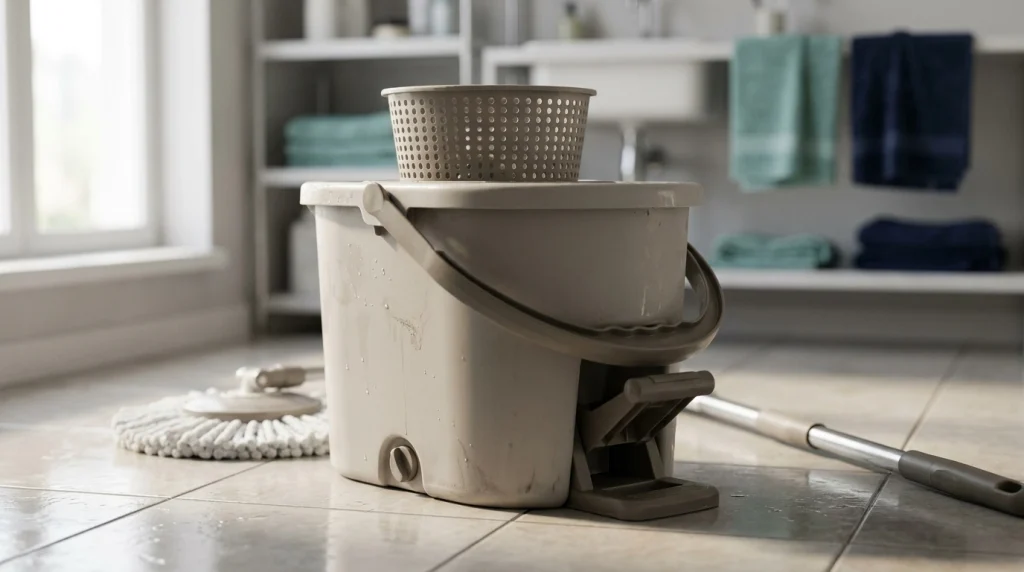
A spin mop bucket is a floor-cleaning container with a mechanical wringer that removes excess water from a mop head. Most systems combine a water-holding bucket with a rotating basket and a mechanism that powers the basket.
The exact design depends on the manufacturer. Some use a foot pedal, while others use a pump action or a twisting mop handle.
1. Bucket body
The bucket body holds rinse water and supports the wringer assembly. Most household models use molded plastic, although construction and capacity vary.
Look for cracks around the spinner mount, base, handle sockets, and drain opening. These areas deserve attention because stress or repeated handling can damage them.
2. Spinning wringer basket
The wringer basket is the perforated or slotted container that holds the mop head during spinning. Its openings allow excess water to escape into the bucket.
A loose, cracked, or badly misaligned basket can wobble, scrape, or fail to spin correctly. Always check the basket’s attachment and shape before ordering another one.
3. Spinner drive mechanism
The drive mechanism transfers movement from the pedal, pump handle, or compatible mop mechanism to the wringer basket. Depending on the design, it may include gears, shafts, bearings, or a one-way clutch.
These internal components aren’t interchangeable across all spin mop brands. A replacement that looks similar may have different mounting points or dimensions.
4. Foot pedal or pump assembly
A pedal-operated bucket uses a foot pedal to activate the spinner. A pump-style system uses repeated movement of a handle or shaft to produce rotation.
If the pedal feels loose, stays down, or fails to engage the spinner, inspect its visible connections first. Don’t force it because a damaged linkage can make the problem worse.
5. Carry handle and drain plug
The carry handle helps you transport the bucket, while a drain plug provides a convenient way to empty certain models. Neither component powers the spinner, but both affect everyday use.
Check the handle pivots for cracks and make sure a fitted drain plug seals properly. A missing or damaged plug can cause leaks even when the bucket body remains intact.
What Does Each Spin Mop Bucket Part Do?
Each component has a distinct job, so identifying the symptom helps narrow down the faulty part. A spinner that won’t rotate points to a different set of checks than a bucket that leaks.
| Part | Main function | Typical warning sign |
|---|---|---|
| Bucket body | Holds water and supports the assembly | Visible cracks or leaks |
| Wringer basket | Holds and spins the mop head | Wobbling, scraping, or broken slots |
| Drive shaft or gears | Transfers motion to the spinner | Slipping or no rotation |
| Foot pedal | Activates pedal-driven rotation | Sticking or failure to engage |
| Bucket handle | Supports carrying and moving | Loose pivots or cracked mounts |
| Drain plug or valve | Releases water from compatible buckets | Dripping or a poor seal |
How does the wringer remove water?
As the basket rotates, centrifugal force moves water outward through its openings. The expelled water falls back into the bucket instead of remaining in the microfiber strands.
A faster or longer spin often leaves the mop head drier, but follow the manufacturer’s operating instructions. Excessive force or an incorrectly seated basket can strain the mechanism.
Which parts wear out first?
Wear depends on the mechanism, cleaning frequency, maintenance, and construction quality. Moving components and frequently handled joints generally deserve more inspection than the stationary bucket walls.
- Wringer basket: Check for cracks, deformation, and loose fittings.
- Pedal or pump: Check for sticking, looseness, or lost movement.
- Drive components: Watch for slipping, grinding, or inconsistent rotation.
- Drain seal: Check for drips after filling the bucket.
Don’t replace a part solely because it looks old. A clean, properly fitted component may still work well, while a small crack can make another part unsafe to use.
How Are Mop Parts Different From Bucket Parts?
The bucket removes excess water, while the mop assembly carries the cleaning head across the floor. Both systems work together, but their replacement parts usually serve different purposes.
Which parts belong to the mop?
- Upper handle: The section you hold while guiding the mop.
- Lower handle or pole: Connects the upper handle to the mop head.
- Locking collar: Secures adjustable handle sections on compatible models.
- Rotating mop plate: Connects the pole to the cleaning head and allows it to pivot.
- Microfiber mop head: Collects dirt, dust, and moisture from the floor.
Can you replace a mop head without replacing the bucket?
Usually, yes. Many spin mop systems let you replace the microfiber refill independently of the bucket, although the attachment pattern must match.
For example, a circular refill that attaches with clips may not fit a head designed for screw-on or socket-style connections. Check the original manual or replacement diagram first.
The same principle applies to the handle and mop plate. A compatible replacement can restore the mop without requiring an entirely new set.
How do the parts work together?
The handle transfers your movement to the rotating mop plate, which keeps the microfiber head in contact with the floor. After rinsing, you place the head inside the wringer basket to remove excess water.
This separation matters when troubleshooting. A mop that cleans poorly may need a fresh microfiber refill, while a mop that stays soaking wet may have a bucket or wringer problem.
How Do You Identify the Correct Spin Mop Bucket Replacement Parts?
The safest way to find a replacement is to match the exact brand and model before comparing dimensions. Similar-looking spin mop buckets often use different baskets, drive connections, and pedal assemblies.
Step 1: Find the model information
Check the bucket base, product label, packaging, instruction manual, or original purchase record. Record the brand and model number before searching for parts.
Step 2: Identify the damaged component
Compare the faulty component with the parts diagram in the manual. Look at how it attaches, where the fasteners sit, and whether the part includes a shaft or locking mechanism.
Step 3: Compare dimensions and fittings
For a replacement wringer basket, measure its outside diameter, height, central opening, and mounting connection. For a pedal, check its shape, pivot points, and drive linkage.
Measurements help narrow the options, but matching dimensions alone doesn’t prove compatibility. The internal drive connection must also fit.
Step 4: Check availability and warranty coverage
Contact the manufacturer or seller to ask whether the component is sold separately. Some brands offer replacement mop heads and selected mechanical parts, while others sell the bucket only as part of a complete set.
Keep your purchase receipt if the mop is still under warranty. Opening a sealed mechanism or using an unapproved replacement could affect warranty coverage.
- Confirm the model number.
- Ask for the official parts diagram or compatible part number.
- Check whether screws, seals, clips, or other fittings are included.
- Compare the complete replacement cost with the price of a new set.
For broader floor-care guidance, the EPA Safer Choice program provides information about products designed with safer chemical ingredients. It doesn’t establish mechanical compatibility, so use your mop manual for parts decisions.
Why Is the Spin Mop Bucket Not Working?
Most spin mop bucket problems fall into a few categories: an obstructed basket, a loose connection, a worn drive mechanism, or a damaged bucket component. Start with a visual inspection before attempting repairs.
Why won’t the wringer basket spin?
Hair, tangled fibers, or debris can obstruct movement, while a loose connection or damaged drive mechanism may prevent rotation. A basket that spins freely by hand when the system is disconnected may still fail under operating load.
- Empty the bucket and remove the mop head.
- Inspect the basket for tangled fibers and visible obstructions.
- Check whether the basket sits evenly in its mounting point.
- Inspect the pedal or pump linkage for visible damage.
- Consult the manual before testing the mechanism again.
Why does the foot pedal feel loose or stuck?
A loose pedal may have a disconnected linkage, worn pivot, or damaged drive component. A stuck pedal may also have debris around its moving parts.
Don’t stand on a jammed pedal or force it through its full travel. If the mechanism remains stuck after cleaning accessible debris, stop using it until you can identify the fault.
Why does the bucket leak water?
Leaks often come from a cracked bucket, a loose drain plug, or a damaged seal. Water spilling during spinning can also indicate overfilling, excessive wobble, or a poorly seated wringer basket.
Dry the outside of the empty bucket, add a small amount of water, and inspect the drain area and base. Never use a bucket with a structural crack or unstable handle mount.
Why does the mop remain too wet?
A soaking mop head doesn’t always indicate a broken bucket. The spinner may need a proper operating motion, or the basket may be overloaded with tangled fibers.
Remove the mop head and inspect its attachment and condition. Follow the correct spinning procedure for your model rather than assuming every bucket uses the same pedal or handle action.
Section takeaway: Clean accessible obstructions and check visible connections first. Replace damaged components only after identifying the likely cause.
*Safety note: Keep fingers clear of the spinner and moving linkages. Empty the bucket before inspecting internal parts, and follow the manufacturer’s instructions for disassembly.*
How Do You Clean and Maintain Spin Mop Bucket Parts?

Regular cleaning removes hair, detergent residue, and dirty water that can interfere with the spinner. A quick rinse after each mopping session also makes the next cleaning job more hygienic.
After every use
- Remove the mop head and rinse away loose dirt.
- Empty the bucket using its drain plug, if fitted, or carefully pour the water away.
- Rinse the bucket and wipe visible residue from the wringer basket.
- Clear accessible hair or fibers without reaching into moving components.
- Leave the bucket open to dry in a ventilated area.
How often should you inspect the parts?
Inspect the bucket, basket, handle, and pedal during routine cleaning. Check more carefully whenever the spinner becomes noisy, the pedal changes resistance, or the bucket starts leaking.
There is no universal replacement interval for every spin mop. Materials, usage, storage, and the manufacturer’s maintenance instructions all affect service life.
How do you prevent odors and residue?
Dirty water left in a closed bucket can produce unpleasant smells. Rinsing away cleaner residue and allowing the components to dry helps prevent buildup.
Wash microfiber refills according to their care labels. Some manufacturers advise against fabric softener because it can coat fibers and reduce their ability to absorb moisture.
For cleaning-product selection, the CDC’s cleaning and disinfecting guidance explains the distinction between removing dirt and disinfecting surfaces.
Use only cleaning solutions permitted by your bucket and mop manufacturer. Never mix bleach with ammonia, acids, vinegar, or other incompatible cleaners.
*Safety note: Follow the cleaning product’s label, ventilate the area, and check your flooring manufacturer’s care instructions before applying any solution to hardwood, laminate, vinyl, or natural stone.*
What Are the Differences Between Spin Mop Bucket Designs?
Spin mop buckets use different mechanisms to rotate their wringer baskets. The mechanism determines which components you should inspect and which replacement parts may fit.
| Design | How it works | Parts to check |
|---|---|---|
| Foot-pedal spin bucket | A pedal activates the spinner | Pedal, linkage, drive, basket |
| Pump-action bucket | Repeated pump movement drives rotation | Pump shaft, collar, drive, basket |
| Handle-operated spinner | Compatible handle movement spins the head in the wringer | Handle lock, shaft, wringer connection |
| Electric or powered system | A powered mechanism handles part of the cleaning or wringing process | Model-specific motor, controls, approved accessories |
Which design is easiest to maintain?
A simple manual bucket may have fewer mechanical components than a powered system, but actual repair difficulty depends on its construction. A foot pedal can be convenient when it works correctly, while a pump-action design requires compatible shaft and drive components.
Don’t assume that a universal-looking basket will fit every model. The central mounting point, basket height, and drive coupling can differ even when two buckets look nearly identical.
What should you consider when buying a replacement bucket?
- Replacement availability: Check whether the manufacturer sells baskets and drive components separately.
- Bucket stability: Look for a broad, stable base and secure handle mounts.
- Ease of cleaning: Consider accessible corners, drainage, and removable components.
- Spare mop heads: Confirm that compatible microfiber refills are available.
- Floor-care needs: Choose a system that lets you control moisture for your flooring.
A spin mop can suit routine tile and vinyl cleaning, but moisture-sensitive floors need extra care. The National Wood Flooring Association’s wood flooring care resources are a useful starting point for understanding wood-floor maintenance.
Should You Repair or Replace the Spin Mop Bucket?
Repair makes sense when the damaged part is available, compatible, and inexpensive relative to a complete replacement. Replacing the entire set may be more practical when the bucket body or several essential mechanical parts are damaged.
When is a replacement part worthwhile?
Consider a replacement when the fault is limited to a removable component, such as a compatible wringer basket, carry handle, drain plug, or microfiber refill. Confirm that the replacement is designed for your model before buying it.
When should you replace the whole bucket?
A new bucket is often the safer option if the body has a structural crack, the spinner mount has broken away, or the handle attachment cannot support the load securely. Extensive mechanical damage may also make repair uneconomical.
Compare the full cost of the part, delivery, and any required fittings against a complete replacement set. Don’t spend money on a speculative repair when the actual fault remains unknown.
Can you repair the bucket yourself?
Simple maintenance, such as rinsing debris from an accessible basket or replacing a model-approved drain plug, may be straightforward. Repairs involving sealed drive mechanisms, damaged structural mounts, or electrical components require more caution.
A glued crack isn’t a dependable fix for a bucket that must hold water and support moving parts. Follow the manufacturer’s repair guidance, and retire any component that remains unstable.
Section takeaway: Replace a clearly identified, compatible part when the repair is safe and economical. Replace the complete bucket when structural damage compromises stability or reliable operation.
Frequently Asked Questions About Spin Mop Bucket Parts
1. What are the main parts of a spin mop bucket?
The main parts are the bucket body, spinning wringer basket, drive mechanism, and pedal or pump assembly. Depending on the model, the bucket may also include a carry handle, drain plug, and removable fittings.
2. Can you replace a spin mop wringer basket?
Yes, if a compatible replacement is available for your model. Check the basket diameter, height, mounting connection, and drive coupling before ordering. A basket that looks similar may not attach securely or rotate correctly.
3. Why does my spin mop bucket spin but not remove enough water?
The mop head may be overloaded, tangled, incorrectly positioned, or worn out. Check the manufacturer’s spinning procedure and inspect the basket for obstructions. If the basket wobbles or slips, the drive mechanism may also need attention.
4. Are spin mop bucket parts universal?
No. Some accessories fit multiple models, but baskets, pedals, shafts, and drive components often use different dimensions or connections. Confirm the brand, model number, and compatible part number before purchasing replacements.
5. How do I fix a spin mop bucket that leaks?
Check the drain plug, seals, and bucket body for visible damage. Empty the bucket before inspection, then test the drain area with a small amount of water if the bucket remains structurally sound. Replace damaged seals or plugs with compatible parts, and discontinue use if the body is cracked.
6. How often should spin mop bucket parts be replaced?
There is no single replacement schedule for every spin mop. Clean the bucket after use and inspect moving components regularly. Replace a part when it becomes damaged, fails to function reliably, or cannot be cleaned adequately according to the manufacturer’s guidance.
Keep Your Spin Mop Bucket Working Properly
Understanding spin mop bucket parts helps you identify faults without replacing the entire cleaning system unnecessarily. Start with the bucket body, wringer basket, and drive mechanism, then inspect the pedal, handle, and drain fittings as needed.
Before buying anything, check your model number and consult its parts diagram. Regular rinsing, careful storage, and prompt attention to loose or damaged components can help your spin mop remain useful for everyday floor cleaning.
If the bucket has structural damage or an unreliable spinning mechanism, prioritize safe replacement over a temporary fix. A stable bucket and a properly functioning wringer make it easier to control moisture and clean floors effectively.
For the best results, pair a well-maintained spin mop with a floor-appropriate cleaner and follow your flooring manufacturer’s care recommendations.