
Spin Mop Carry Handle Parts: What They Do and How to Fix Them

Quick Answer
Spin mop carry handle parts let you lift, move, and sometimes transport the mop bucket safely. Depending on the model, the assembly may include a fixed or folding handle, grip, pivot joints, mounting pins, side brackets, and attachment points. If the handle feels loose, sticks, or comes away from the bucket, inspect these parts before attempting a repair.
Common carry handle parts
- Handle or grip: The section you hold when lifting or carrying the bucket.
- Pivot joints: Allow a folding handle to move between positions.
- Mounting pins: Connect the handle to its brackets or bucket body.
- Side brackets: Support the handle where it attaches to the bucket.
- Fasteners or clips: Keep compatible handle components secured in place.
Quick inspection tips
- Empty the bucket before inspecting or repairing its handle.
- Check for cracks, missing pins, loose fasteners, and worn plastic around the attachment points.
- Match replacement parts to the exact bucket model instead of relying on appearance alone.
A spin mop makes floor cleaning easier by combining a rotating mop head with a bucket-based wringing system. The carry handle is a small part of that setup, but damage to its joints or mounting points can make a full bucket difficult and unsafe to move.
In this guide, I’ll explain the common spin mop carry handle parts, how their designs differ, and what to inspect when something breaks. I’ll also cover replacement compatibility, simple maintenance, and safe ways to handle a loaded bucket.
In This Guide
- What are spin mop carry handle parts?
- What are the main carry handle components?
- How do spin mop carry handle designs differ?
- How do you inspect a damaged carry handle?
- How do you fix common handle problems?
- How do you choose replacement parts?
- How do you maintain the handle safely?
- How do the parts and repair options compare?
- Frequently asked questions
What are spin mop carry handle parts?
Spin mop carry handle parts are the components that connect a bucket’s lifting handle to its body and allow you to move the bucket. Their exact shape and arrangement depend on the manufacturer and bucket design.
How does the carry handle work?
A typical carry handle transfers the bucket’s weight through its grip and attachment points into the bucket walls. On a folding design, pivot joints allow the handle to swing down when it’s not needed.
The carry handle is different from the mop handle. The mop handle is the long pole attached to the microfiber mop head, while the carry handle belongs to the bucket.
Keep these two assemblies separate when identifying a replacement. A compatible mop pole won’t solve a broken bucket handle, and a bucket handle won’t repair a damaged wringer.
Why does the handle matter during floor cleaning?
Spin mop buckets hold water and cleaning solution, so their combined weight can increase substantially during use. A damaged carry handle can slip, detach, or place extra strain on the bucket’s attachment points.
This matters whether you’re cleaning tile in a large kitchen or carefully damp-mopping laminate in a small apartment. Moving a stable bucket is easier than dealing with spilled water near furniture, electrical equipment, or freshly cleaned floors.
What are the main carry handle components?
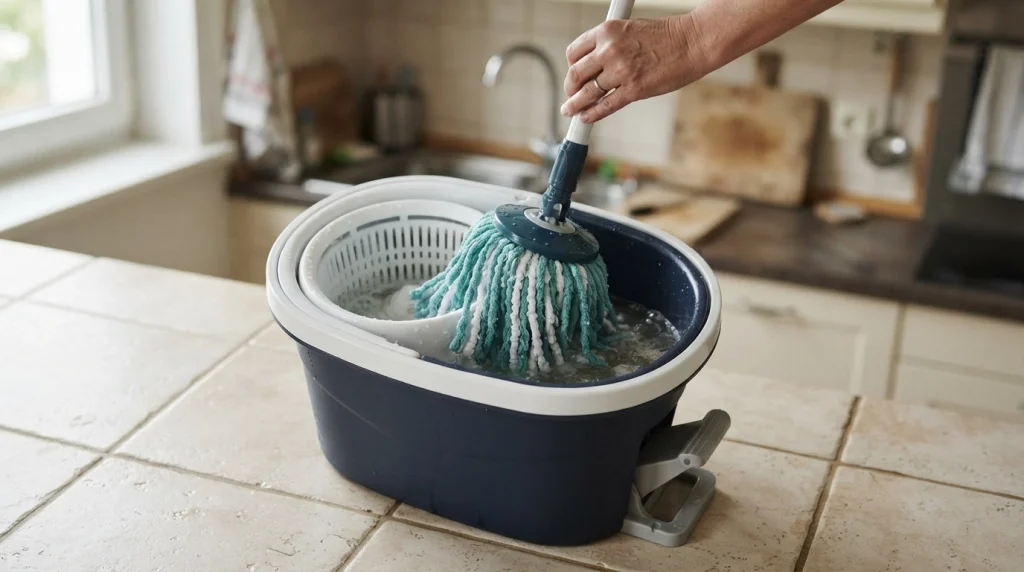
Most spin mop carry handles use a grip and some form of attachment mechanism, but not every model has the same parts. Identify the physical design before ordering anything.
1. Handle grip
The grip is the section your hand holds. It may be molded directly into a plastic handle or formed as a separate sleeve around a rigid supporting piece.
Look for cracks, sharp edges, deformation, and areas that feel unusually flexible. A cracked grip can make carrying uncomfortable, but damage to the supporting handle may be the more serious problem.
2. Handle arm or curved frame
The handle arm is the main structural section connecting the grip to the bucket. Some designs use a single curved piece, while others use a frame with separate pivoting ends.
Inspect both sides for stress marks, splits, or bending. Don’t assume that a handle is safe simply because its grip remains intact.
3. Pivot joints and mounting pins
Pivot joints allow the handle to rotate, while pins or molded pivots hold the moving components together. Some buckets use separate fasteners; others have integrated plastic connections that aren’t designed for user disassembly.
Excessive sideways movement, a missing pin, or a handle that falls away from its normal position may indicate wear or a broken connection. Check the manufacturer’s parts diagram before trying to remove a pivot.
4. Side brackets and mounting sockets
Side brackets or mounting sockets connect the handle assembly to the bucket walls. These attachment points carry the force generated when you lift the bucket.
Cracks around a mounting socket deserve particular attention. Replacing the handle alone won’t solve the problem if the bucket body itself has split.
5. Fasteners, clips, and retaining pieces
Some models use screws, clips, washers, or retaining pins to keep the handle aligned. Other models rely on molded connections that don’t have separate replacement fasteners.
Never substitute an arbitrary screw or metal pin based only on its diameter. An incorrect fastener may damage the plastic, interfere with the pivot, or fail under load.
How do spin mop carry handle designs differ?
Spin mop carry handles generally fall into fixed, folding, and removable designs. The most useful distinction is how the handle attaches and whether its joints are intended to be serviced.
Fixed handles
A fixed handle has a relatively simple structure with little or no folding movement. Its straightforward design can reduce the number of moving components that wear out.
However, a fixed handle can still crack at its grip, arms, or attachment points. The simplicity of the design doesn’t guarantee that the handle can be replaced separately.
Folding handles
A folding handle rotates at one or more joints to sit closer to the bucket when stored. This design can save space in a cupboard or laundry area.
Check the pivot areas if the handle becomes loose or refuses to move smoothly. Forcing a stuck joint can break a plastic retaining feature that may be difficult to replace.
Removable handles
Some bucket designs allow the handle or part of its assembly to be removed for servicing or replacement. Others require the whole bucket or handle assembly to be replaced.
Before disassembly, confirm that the manufacturer intends the connection to come apart. A molded joint that looks removable may be permanently assembled.
What about spin mop bucket brands?
Different manufacturers can use different attachment layouts, even when their buckets appear similar. Product families may also change their designs between generations.
Don’t assume that a handle from an O-Cedar spin mop, for example, fits another brand or every bucket sold under the same brand. Compare the model number, mounting arrangement, dimensions, and official replacement information.
How do you inspect a damaged carry handle?
Start by emptying the bucket and placing it on a stable, level surface. A visual inspection can often reveal whether the problem comes from the grip, a pivot, a mounting connection, or the bucket body.
Follow this inspection checklist
- Check the grip: Look for splits, sharp edges, and deformation where your fingers hold the handle.
- Examine both arms: Compare the left and right sides for cracks, bends, or uneven movement.
- Inspect the pivots: Look for missing retaining pieces, excessive looseness, or a joint that catches.
- Check the bucket walls: Look closely around the handle mounting points for stress whitening, cracks, or separation.
- Review the connection: Determine whether the handle uses screws, clips, molded pins, or another attachment design.
How can you tell which part has failed?
The location of the movement often provides a useful clue. If the grip moves independently of the handle arm, the grip or its connection may be damaged.
If the entire handle shifts where it meets the bucket, inspect the pivots and mounting points instead. A cracked bucket wall needs a different solution from a loose handle fastener.
Don’t test a questionable handle by lifting a full bucket. Even a small crack can spread under load, and a sudden failure may spill water across the floor.
When should you stop using the handle?
Stop carrying the bucket by its handle if you find a structural crack, a missing retaining pin, a detached bracket, or a connection that could release unexpectedly. Keep the bucket stationary until you can repair or replace the damaged component.
For an undamaged handle that merely feels stiff, check whether the design requires a particular folding position or assembly sequence. Resistance alone doesn’t prove that a component needs lubrication or replacement.
How do you fix common handle problems?
The right repair depends on the failed component and whether the manufacturer designed it to be serviced. Start with inspection and model-specific instructions rather than forcing parts into place.
Problem: The carry handle feels loose
A loose handle may have a worn pivot, a missing fastener, or a damaged mounting socket. First, identify exactly where the movement occurs.
- If a manufacturer-approved screw has loosened, follow the specified tightening instructions.
- If a retaining clip or pin is missing, obtain the correct replacement for that model.
- If the surrounding plastic has cracked, replace the affected structural component or bucket assembly as appropriate.
Avoid overtightening screws into plastic. Excessive force can strip the threads or split the surrounding material.
Problem: The handle won’t fold or rotate
A folding handle may stick because dirt has accumulated around its pivot or because the joint is misaligned. With the bucket empty, inspect the joint for visible debris and damage.
Remove loose dirt with a soft cloth or brush, then follow the manufacturer’s cleaning instructions. Don’t force the joint or add oil unless the manufacturer permits it, since lubricants may affect plastic components or attract more grime.
Problem: A mounting pin has come out
A displaced pin may indicate that a retaining feature has worn or broken. Check whether the pin is intended to be removable and whether a separate clip or retainer is missing.
Install only the specified replacement and assembly components. If the receiving hole has enlarged or the bucket wall has cracked, simply inserting another pin may not restore a secure connection.
Problem: The handle or bucket has cracked
A crack in a load-bearing handle arm or bucket mounting point is a reason to stop carrying the bucket. Replace the damaged part if an approved, compatible component is available.
Don’t rely on household glue, tape, cable ties, or improvised metal hardware to support a loaded bucket. Such fixes haven’t established that the handle can safely carry the weight of water and cleaning equipment.
Section takeaway: Find the actual point of failure before buying a part. When structural plastic is cracked, replacement is generally more dependable than an improvised repair.
How do you choose replacement parts?
The safest way to choose spin mop carry handle parts is to match the replacement to the bucket’s exact model or part number. Similar-looking components aren’t necessarily interchangeable.
Where can you find the model information?
Check the bucket’s underside, its product label, the original packaging, and the instruction manual. If the label is missing, look for a purchase record or contact the manufacturer’s customer support with clear photographs.
For example, photograph the full bucket, both handle attachment points, and the damaged component from several angles. Include a ruler in close-up photographs when dimensions are needed, but don’t treat measurements alone as proof of compatibility.
What should you compare before ordering?
- Model identification: Confirm the bucket’s model number and generation when available.
- Attachment style: Compare pivot shape, pin placement, bracket design, and fastener arrangement.
- Dimensions: Check the overall handle width, connection spacing, and pin dimensions against documented specifications.
- Part scope: Determine whether the seller supplies the grip alone, the complete handle, or the handle and mounting hardware together.
- Return policy: Check whether an unused part can be returned if it doesn’t match the verified model.
Should you replace one part or the entire assembly?
Replacing a single component may cost less when the remaining parts are intact and the manufacturer offers that component separately. A complete handle assembly may be more practical when the pivots and arms have sustained widespread wear.
If the bucket’s mounting points are damaged, a replacement handle alone may not solve the problem. Compare the cost and availability of an approved bucket replacement against the cost of individual parts.
Don’t assume that a replacement exists for every spin mop. Some manufacturers sell only complete assemblies, while older models may no longer have supported spare parts.
How do you maintain the handle safely?
Routine cleaning and careful handling can help prevent avoidable wear around spin mop carry handle parts. The most important habits are keeping the joints clean, inspecting attachment points, and avoiding unnecessary strain.
Clean the handle and pivot areas
After mopping, wipe away cleaning solution, dirt, and residue from the grip and accessible joints. Follow the product manual for any restrictions on water exposure or disassembly.
Allow the bucket and its components to dry as recommended before storing them. Avoid soaking joints or applying solvents that could damage the plastic.
Lift and move the bucket carefully
- Empty dirty water before moving the bucket between rooms whenever practical.
- Keep the bucket upright and avoid sudden swinging or jerking movements.
- Use two hands to move a heavy or awkward bucket, or empty it further before lifting.
- Never lift the bucket by its wringer, mop pole, or another component that isn’t designed to carry its weight.
- Keep children away from buckets containing water and cleaning products.
How often should you inspect the carry handle?
There is no universal inspection interval for every spin mop model. Check the handle during routine cleaning and whenever it starts moving differently, develops a noise, or becomes difficult to fold.
More frequent checks make sense in busy households where the bucket gets used daily. Pay special attention to older plastic parts and connections that have repeatedly carried a full bucket.
Protect the floor while maintaining your mop
Spilled water can create a slipping hazard and damage moisture-sensitive flooring. If a bucket leaks or tips, remove standing water promptly and dry the affected area.
For hardwood, engineered wood, and laminate, follow the flooring manufacturer’s care instructions. The National Wood Flooring Association’s floor maintenance guidance explains why limiting moisture matters for wood floors.
Safety note: Follow the mop manufacturer’s instructions for cleaning and repairs, and the floor manufacturer’s guidance when cleaning up spills. Use cleaning products only as directed on their labels.
How do the parts and repair options compare?
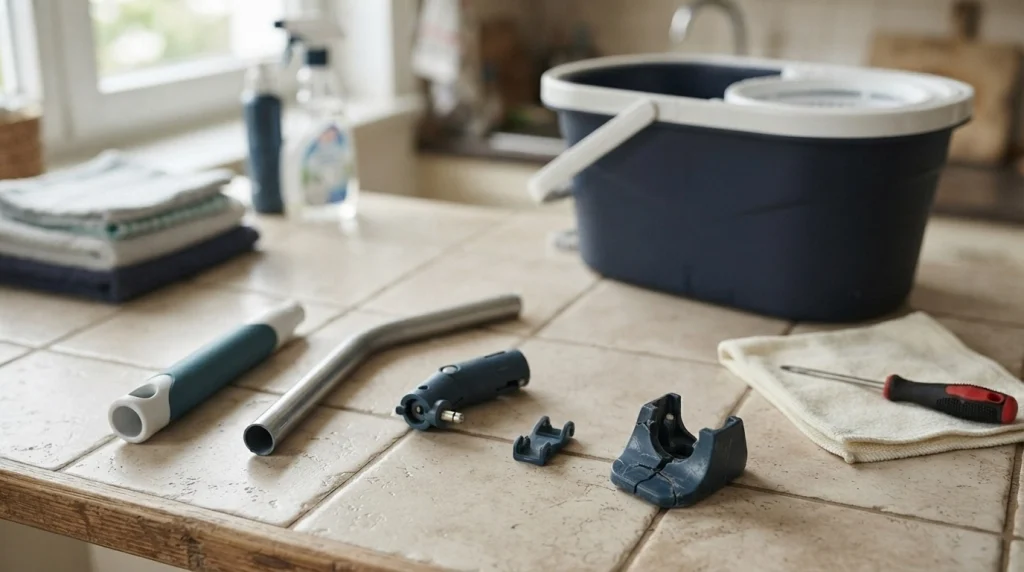
Choosing a repair becomes easier when you match the symptoms to the likely failure point. The following table is a practical diagnostic guide, not a universal parts diagram.
| Part or issue | Common symptom | Recommended next step |
|---|---|---|
| Grip | Cracking or uncomfortable edges | Replace the grip or assembly if supported |
| Handle arm | Bending, splits, or stress marks | Stop lifting and replace the damaged component |
| Pivot joint | Sticking or excessive movement | Clean and inspect according to the manual |
| Pin or clip | Handle separates or shifts at the joint | Fit the correct approved retaining part |
| Bucket bracket | Movement or cracking at the bucket wall | Replace the supported bracket or bucket assembly |
| Multiple damaged components | Several loose or cracked connections | Compare the cost of an approved complete replacement |
When is a replacement bucket the better choice?
A new bucket may be more sensible when the original mounting sockets are broken, the plastic body is extensively damaged, or compatible spare parts are unavailable. Consider the availability of replacement wringers and other bucket components before deciding.
Don’t replace a working mop pole or microfiber head just because the bucket handle has failed. These are separate parts, and an isolated handle problem may not affect the rest of the floor-cleaning equipment.
For broader floor-care decisions, remember that the right tool depends on the surface. A spin mop is useful for many washable hard floors, while microfiber flat mops, string mops, and some electric mops serve different cleaning needs.
Frequently asked questions
Can I buy spin mop carry handle parts separately?
Sometimes. Availability depends on the manufacturer and bucket model, and some designs require replacing the entire handle assembly. Check the product manual or contact the manufacturer’s support team before ordering a separate grip, pivot, pin, or bracket.
How do I know which spin mop handle replacement fits my bucket?
Start with the bucket’s model number and manufacturer’s parts information. Compare the attachment points, pivot arrangement, dimensions, and included fasteners. Similar-looking handles aren’t necessarily compatible, so confirm the fit before purchasing or installing a replacement.
Why does my spin mop bucket handle keep falling down?
A folding handle may fall because its pivot or retaining mechanism has worn, loosened, or broken. Inspect the joint with the bucket empty. If the design includes a replaceable retaining component, use the correct part; otherwise, consult the manufacturer about replacing the assembly.
Can I repair a cracked plastic carry handle?
A cracked load-bearing handle shouldn’t be trusted to carry a bucket of water. Replace the damaged component or assembly with a compatible part. Household glue, tape, and improvised fasteners don’t establish that a repaired handle can safely support the bucket’s weight.
Are spin mop carry handles universal?
No. Handle width, pivot design, mounting points, and attachment hardware can vary by brand and model. Even products from the same manufacturer may use different components. Verify compatibility using the model number and official replacement information rather than appearance alone.
Can I carry a spin mop bucket when it’s full?
Only if the manufacturer permits it and the handle, attachments, and bucket remain in sound condition. A full bucket can be heavy and awkward to lift. Whenever practical, empty some or all of the water before moving it, and never carry a bucket with a visibly damaged handle.
How can I make my spin mop bucket handle last longer?
Clean residue from accessible joints, avoid jerking or swinging the bucket, and inspect the handle for cracks and looseness during routine maintenance. Store the bucket as directed and replace worn components promptly. Avoid forcing folding joints or using unapproved lubricants and repair materials.
Final takeaway: Choose the right carry handle parts
Spin mop carry handle parts may look simple, but each component helps keep the bucket secure when you move it. Identifying the grip, handle arms, pivots, retaining pins, and mounting brackets makes it easier to diagnose problems accurately.
My recommendation is to inspect the bucket while it’s empty, identify the failed component, and verify the replacement against the exact model. If the handle or bucket mounting points are cracked, stop carrying the bucket until you have a suitable replacement.
Good floor care starts with equipment that’s safe to use. A sound carry handle, a clean microfiber mop head, and the right cleaning method help make everyday mopping easier without unnecessary spills or damage.
For further guidance on cleaning-product handling, consult the U.S. Environmental Protection Agency’s Safer Choice program and follow the instructions on your chosen cleaner’s label.