
Spin Mop Splash Guard Parts: What They Do and How to Replace Them

Quick Answer
Spin mop splash guard parts help contain water inside the bucket during rinsing and spinning. Depending on the model, the assembly may include a plastic guard ring, splash shield, retaining clips, mounting tabs, or a separate wringer cover. If water escapes during spinning, check the guard’s position, cracks, loose fittings, bucket fill level, and spinning technique before ordering replacement parts. For broader floor-care safety, follow the EPA’s Safer Choice cleaning guidance when selecting compatible cleaning products.
Common splash guard problems
- Loose guard: A displaced or poorly seated shield can let spinning water escape.
- Cracked plastic: Broken edges or mounting tabs may prevent the guard from containing splashes.
- Overfilled bucket: Excess water can spill over the rim when the mop head rotates.
- Damaged fittings: Worn clips, hooks, or mounting points may stop the guard from staying in place.
- Incorrect assembly: A guard fitted in the wrong position may interfere with the wringer or fail to redirect water.
Quick troubleshooting steps
- Stop spinning, empty the bucket if necessary, and inspect the guard for damage.
- Reseat loose parts, remove trapped debris, and check that the wringer turns freely.
- Replace broken components only with parts confirmed compatible with your exact mop model.
Spin mop splash guard parts may look like minor plastic accessories, but they can make a noticeable difference when you’re cleaning around cabinets, furniture, and finished floors. Understanding how the guard fits into the bucket assembly helps you identify the problem without replacing the entire mop.
In this guide, I’ll explain the common guard components, how to identify compatible replacements, and what to check when water keeps splashing onto the floor. I’ll also cover maintenance, repair decisions, and ways to prevent water-related floor damage in 2026.
In This Guide
- What Are Spin Mop Splash Guard Parts?
- What Parts Make Up a Spin Mop Splash Guard?
- How Do You Identify Compatible Replacement Parts?
- Why Does a Spin Mop Splash Water?
- How Do You Replace a Spin Mop Splash Guard?
- Should You Repair or Replace a Broken Guard?
- How Do You Maintain the Guard and Protect Floors?
- Splash Guard Parts Compared
- Frequently Asked Questions
What Are Spin Mop Splash Guard Parts?
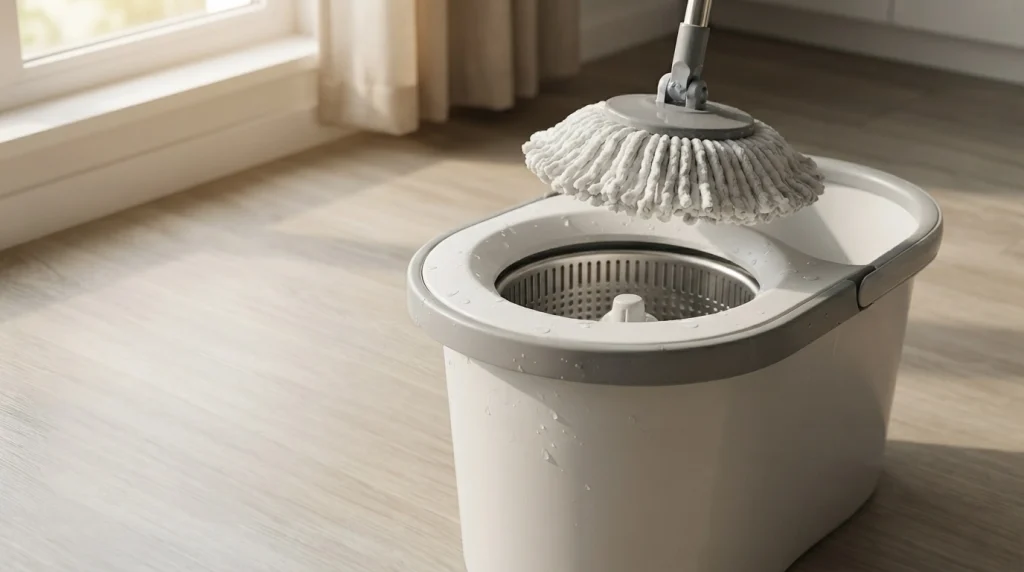
Spin mop splash guard parts are the components that help contain or redirect water around a spin mop bucket’s wringing area. Their exact shape and arrangement depend on the bucket design, so not every model has a removable guard.
A spin mop splash guard is a protective plastic shield, ring, or cover positioned around part of the bucket or wringer to reduce water escaping during rinsing and spinning. It works alongside the bucket walls and spinning basket rather than replacing them.
What does the splash guard actually do?
When a wet microfiber head spins inside a wringer, its movement can send droplets outward. The bucket and guard help contain those droplets and direct water back toward the reservoir.
The guard also helps keep nearby surfaces cleaner. However, it cannot prevent every splash, particularly when the mop head is excessively wet or the bucket is overfilled.
- Water containment: Helps keep droplets inside the bucket.
- Wringer protection: Covers selected areas around the spinning basket on compatible designs.
- Cleaner surroundings: Reduces water reaching nearby walls, cabinets, and floors.
- Component positioning: Keeps certain exposed edges or openings partially covered.
Is a splash guard the same as a spin basket?
No. The splash guard helps contain water, while the spin basket holds the mop head during wringing and rotates as the mechanism operates.
These components may sit close together, but they serve different purposes. If the basket wobbles, the guard alone will not correct the underlying mechanical problem.
What Parts Make Up a Spin Mop Splash Guard?
The parts vary by brand and model, but several common component types are worth recognizing. Some are sold separately, while others come only as part of a larger bucket or wringer assembly.
1. Splash guard ring
A splash guard ring forms a raised barrier around the wringing area. Depending on the design, it may attach to the bucket rim, fit around the spinner, or form part of a larger molded cover.
Look for cracks, warped edges, and sections that no longer sit flat. A distorted ring may leave gaps through which droplets escape.
2. Splash shield or cover
A splash shield is a broader panel or cover that blocks water from escaping through a particular opening. Some designs incorporate the shield directly into the bucket’s upper assembly.
Check whether the cover has broken edges or interferes with the spinning basket. A replacement must match the original arrangement rather than simply cover the largest possible area.
3. Retaining clips and mounting tabs
Small clips or molded tabs may hold the guard in position. If one breaks, the shield can loosen even when its main plastic surface remains intact.
Inspect the attachment points before replacing the entire guard. A compatible replacement clip may be sufficient when the manufacturer supplies one separately.
4. Wringer cover and supporting assembly
Some spin mop buckets use a larger wringer cover that combines splash protection with support for nearby components. Other models have an exposed spinning basket with no separate cover.
Identify the actual damaged part before purchasing anything. A wringer assembly may include several pieces that are unnecessary if only a small guard is broken.
5. Bucket rim and molded attachment points
The bucket rim may provide the mounting surface for a splash guard. Cracks or deformation around this area can prevent a new guard from fitting securely.
Examine the bucket itself if replacement guards repeatedly become loose. Replacing the shield won’t help when its mounting surface is damaged.
How Do You Identify Compatible Replacement Parts?
The most reliable way to find the correct spin mop splash guard is to identify the exact bucket model and compare the replacement’s attachment points, dimensions, and shape. Similar-looking parts aren’t necessarily interchangeable.
Step 1: Identify the mop brand and model
Start by checking the bucket’s underside, handle label, packaging, instruction manual, or original product listing. Record any model number, product code, or other identifying information you find.
Don’t rely on the mop’s color alone. Manufacturers may sell different bucket designs with similar colors and nearly identical appearances.
Step 2: Inspect the existing guard
Remove the guard only if the manufacturer’s instructions allow it. Photograph the part from above, below, and from the side before separating it from the bucket.
Pay particular attention to these details:
- Overall diameter, width, and height.
- Shape of the central opening.
- Number and position of clips or mounting tabs.
- Rim profile and any molded grooves.
- Clearance around the spinning basket.
These measurements help narrow your options, but matching dimensions alone doesn’t guarantee compatibility. The attachment design and clearance requirements also matter.
Step 3: Check the manufacturer’s replacement information
Look for an official replacement-parts page, product manual, or customer support listing for your exact model. If the guard isn’t listed separately, ask whether the manufacturer sells the upper bucket assembly or wringer cover.
When shopping through a retailer, compare the part number and compatibility notes rather than relying on a title that says “universal spin mop splash guard.” Ask the seller to confirm fit if the listing doesn’t identify supported models.
Step 4: Compare the part with the original
Before installing a replacement, compare its shape and mounting features with your old component. Stop if the new part requires force, leaves a large gap, or obstructs the spinner.
A properly fitting guard should sit securely without bending the bucket rim. It should also leave the wringer free to operate as intended.
Why Does a Spin Mop Splash Water?
A spin mop usually splashes because water escapes from the bucket during wringing, the mop head enters the spinner too wet, or the guard and wringer aren’t positioned correctly. A broken part is only one possible cause.
Is the bucket overfilled?
Excess water reduces the room available for water displaced by the spinning mop head. As the head rotates, liquid can rise above the bucket’s rim or escape through openings around the spinner.
Keep the water below the manufacturer’s maximum fill line, if one is marked. If no line exists, use less water and test the wringer cautiously.
Is the mop head too wet?
A saturated microfiber head can release a large amount of water during the first few seconds of spinning. This can overwhelm a small bucket or splash guard, especially when the head is unevenly positioned.
Allow excess water to drain before spinning, then use the wringer according to its instructions. Avoid forcing the handle or applying more pressure than the mechanism requires.
Is the guard loose, cracked, or misaligned?
A loose guard can leave an opening near the spinner, while a cracked shield may allow water to pass through its damaged section. A guard fitted backward or at the wrong height can also fail to contain droplets.
Stop using the wringer if the guard moves into the spinning basket’s path. Correct the assembly before testing it again.
Could the spin basket or mechanism be responsible?
A bent basket, loose mounting point, or damaged spinner can create excessive wobble. That movement may direct water outside the bucket even when the splash guard appears undamaged.
Check the basket for visible damage and unusual movement while the system is stopped. If the mechanism binds, wobbles significantly, or makes unfamiliar noises, follow the manufacturer’s troubleshooting instructions instead of continuing to spin it.
Quick troubleshooting checklist
- Water spills over the rim: Reduce the fill level and check the mop head’s saturation.
- Water escapes from one side: Inspect the guard for gaps, cracks, and incorrect positioning.
- Guard falls off: Check its clips, mounting tabs, and bucket rim.
- Basket wobbles: Inspect the wringer and its mounting points.
- Problem continues after adjustment: Compare the assembly with the manufacturer’s instructions or request support.
Section takeaway: Check the water level, mop head, guard, and spinner before buying replacement parts. The simplest adjustment may solve the problem without a repair.
How Do You Replace a Spin Mop Splash Guard?
You can replace a removable splash guard by identifying its attachment system, removing the damaged part, and fitting a compatible replacement. The process depends on whether the guard uses clips, tabs, grooves, or screws.
What you’ll need
- A compatible replacement guard, if available.
- The manufacturer’s instruction manual.
- A soft cloth for removing dirt and residue.
- A suitable screwdriver if the assembly uses screws.
Most simple replacements need few tools. Don’t use pliers, knives, or other tools to force a molded plastic part loose.
Follow these replacement steps
- Empty the bucket: Remove the mop head and drain the water before working on the assembly.
- Stabilize the bucket: Place it on a level, dry surface away from foot traffic.
- Check the attachment: Find the clips, tabs, screws, or grooves that secure the existing guard.
- Remove the damaged part: Release the intended fasteners carefully, following the manufacturer’s instructions.
- Clean the mounting area: Wipe away hair, grit, dried cleaner, and other debris that might prevent a secure fit.
- Fit the replacement: Align the attachment points and press or fasten the guard into position as instructed.
- Inspect the clearance: Confirm that the guard doesn’t touch or obstruct the spinner.
- Test cautiously: Add a small amount of water and test the wringer according to the product instructions.
What if the splash guard won’t fit?
Don’t force it. An incorrect part can crack the bucket, damage the mounting tabs, or interfere with the spinning basket.
Recheck the model number and compare the old and new parts. If they differ in mounting shape or clearance, contact the manufacturer or seller for a compatible alternative.
Never operate a bucket with a guard that is loose enough to contact moving parts. If the guard forms an integral part of the wringer assembly, replacement may require servicing or replacing that assembly.
Should You Repair or Replace a Broken Guard?
Repair makes sense when the problem involves removable debris or a loose but undamaged fitting. Replacement is generally the better option when the guard has a structural crack, broken attachment tab, or distorted mounting edge.
When cleaning or adjustment is enough
Try cleaning and reseating the guard when it has shifted out of position or accumulated dried cleaning solution. A small amount of debris around the mounting groove can prevent an otherwise sound component from sitting correctly.
Use a soft cloth and a cleaner approved for the bucket material. Rinse only when the manufacturer’s instructions permit it, and dry the assembly before testing.
When should you replace the guard?
Replace the component when its damaged shape prevents it from staying in place or containing splashes as intended. Missing tabs, spreading cracks, and warped edges are common reasons to stop using a damaged guard.
A replacement also makes sense when the part no longer attaches securely after proper cleaning and assembly. Confirm compatibility before ordering.
When is a complete bucket assembly necessary?
A full assembly may be necessary when the bucket rim, integrated cover, or wringer mounting structure has broken. Some manufacturers don’t offer individual guards, making a larger replacement the practical option.
Compare the availability and cost of the complete assembly with a replacement bucket or mop system. Consider the condition of the handle, basket, pedal, and other major components before spending money on repairs.
Safety note: Don’t repair a cracked guard with an improvised adhesive or tape unless the manufacturer explicitly approves that repair. Adhesives may not withstand repeated water exposure or the forces around a spinning mechanism.
How Do You Maintain the Guard and Protect Floors?
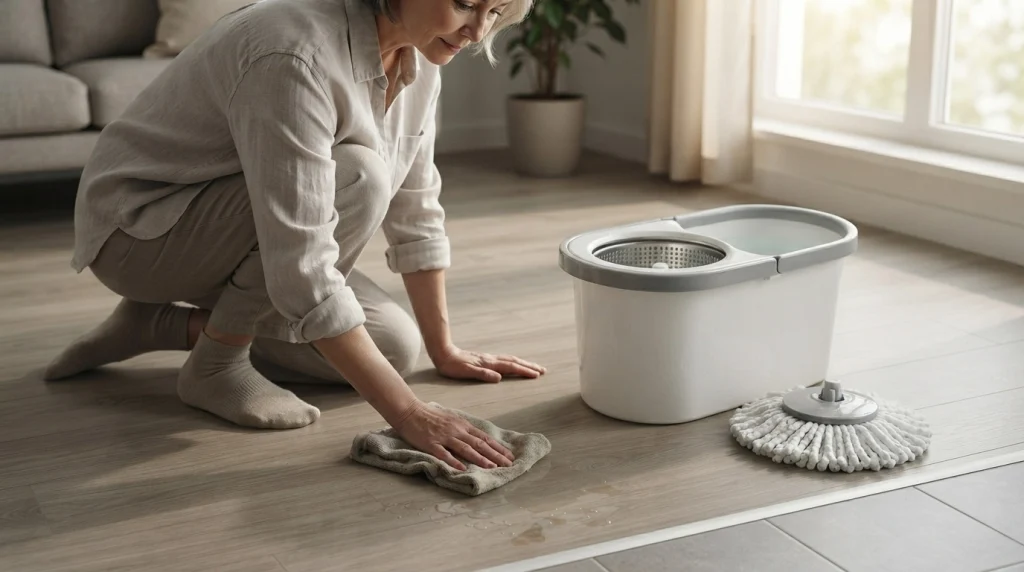
Regular cleaning and careful wringing help keep a splash guard effective. They also reduce the risk of water reaching floor seams, cabinet bases, and other moisture-sensitive surfaces.
Clean the guard after dirty mopping sessions
Remove visible hair, dirt, and dried residue from the guard and nearby bucket surfaces. Follow the manufacturer’s instructions before removing parts or applying cleaning products.
Avoid abrasive pads that can scratch plastic or leave rough edges around attachment points. Inspect the guard after cleaning, particularly if it has become brittle or discolored.
Check the attachment points regularly
Inspect the clips, tabs, grooves, and bucket rim whenever the guard becomes loose. Catching a small problem early can prevent a damaged fitting from making the entire assembly unreliable.
Don’t assume every loose guard needs replacing. Remove trapped debris and reseat the part first, provided the design allows it.
Prevent water damage on different floor types
Spilled mop water can affect floors differently depending on their material, finish, installation, and condition. Use a dry cloth to pick up escaped water promptly rather than letting it sit.
- Hardwood and engineered wood: Wipe spills immediately and avoid standing water, which can damage finishes, seams, or exposed wood.
- Laminate: Keep water away from seams and edges, and follow the flooring maker’s low-moisture cleaning guidance.
- Vinyl and LVP: Clean up puddles and use a compatible cleaner to avoid residue or slippery surfaces.
- Tile: Remove excess water, particularly near grout lines and smooth, slippery finishes.
- Natural stone: Use only cleaners approved for the specific stone and finish.
For wood-floor maintenance, consult the National Wood Flooring Association and your flooring manufacturer’s care instructions. Their guidance is more appropriate than assuming every sealed wood floor tolerates the same amount of water.
Safety note: Check your floor manufacturer’s care guide and the cleaner’s product label before using a chemical, disinfectant, or homemade solution. Never mix cleaning products unless their labels explicitly direct you to do so.
Use the right amount of water and cleaner
A spin mop bucket doesn’t need to be filled to the top to clean effectively. Use the quantity recommended by the bucket manufacturer and dilute any concentrate according to its label.
Excess cleaner can leave residue on floors and bucket surfaces. More detergent isn’t automatically better, and unsuitable products may damage some floor finishes.
Section takeaway: A clean, securely fitted guard and controlled water level help reduce splashes. Prompt spill cleanup and floor-compatible cleaners provide an extra layer of protection.
Spin Mop Splash Guard Parts Compared
Before ordering a replacement, compare the damaged component with the parts commonly found around a spin mop bucket. The table below describes typical functions rather than specifications for a particular brand.
| Part | Main function | Common problem | What to check |
|---|---|---|---|
| Splash guard ring | Helps contain water around the wringer | Cracks or warping | Diameter and rim fit |
| Splash shield | Blocks selected openings | Gaps or broken edges | Shape and clearance |
| Retaining clip | Secures the guard | Loose or missing attachment | Clip position and part number |
| Mounting tab | Connects the guard to the assembly | Snapped plastic | Matching attachment design |
| Wringer cover | Covers or supports part of the wringer | Damage to an integrated assembly | Model-specific assembly compatibility |
| Bucket rim | Supports the guard on applicable models | Cracks or deformation | Structural condition |
Which part should you replace first?
Start with the visibly damaged or loose component rather than ordering an entire assembly immediately. If the guard itself is intact, investigate the clips, mounting points, water level, and wringer alignment before purchasing anything.
If several components are broken or the bucket rim is cracked, a larger replacement may offer a more reliable solution. Availability depends on the model and whether the manufacturer sells individual parts.
Frequently Asked Questions
Are spin mop splash guards universal?
No, spin mop splash guards aren’t universally interchangeable. They vary in diameter, shape, mounting points, and clearance around the wringer. Check the bucket’s brand and model number, then confirm compatibility with the manufacturer or seller before purchasing a replacement.
Can I use a spin mop without its splash guard?
That depends on the bucket design and the manufacturer’s instructions. Some models have no separate guard, while others rely on it to cover openings or maintain safe clearance. Don’t operate a mop with a missing component if the instructions require it or if the spinner becomes exposed or obstructed.
Why does my spin mop still splash after replacing the guard?
A new guard won’t solve every splash problem. The bucket may be overfilled, the mop head may be too wet, or the spinner may be loose or damaged. Check the assembly, water level, and spinning technique before assuming the replacement part is defective.
Can I repair a cracked plastic splash guard?
Minor dirt or a loose fitting may be fixable through cleaning and correct assembly. A cracked guard or broken mounting tab should generally be replaced rather than patched with tape or unapproved adhesive. The replacement needs to fit securely and remain clear of moving parts.
How do I find the correct splash guard for my mop?
Look for the model number on the bucket, packaging, or manual. Compare the replacement’s dimensions, mounting tabs, and shape with the original, and verify the seller’s compatibility information. If the manufacturer doesn’t sell the guard separately, ask about a compatible wringer cover or bucket assembly.
Does a splash guard stop all water from escaping?
No. A splash guard helps contain water but can’t guarantee a completely dry surrounding area. Excess water, a saturated mop head, incorrect assembly, and a damaged spinner can still cause splashes. Use the recommended water level and clean up escaped water promptly.
How often should I inspect spin mop splash guard parts?
Inspect the guard whenever you notice unusual splashing, looseness, or difficulty fitting the assembly. It’s also sensible to check the clips and bucket rim during routine bucket cleaning. Replace damaged parts when they can no longer stay securely in place or function as intended.
Final Takeaway: Choose the Right Splash Guard Parts
Spin mop splash guard parts help control water around the bucket’s wringing area, but the correct solution depends on the actual cause of the problem. A loose clip, cracked shield, overfilled bucket, and damaged spinner each require a different response.
Identify your mop model before ordering parts, inspect the guard’s attachment points, and confirm that a replacement fits securely. If the bucket or wringer is structurally damaged, consider replacing the larger assembly instead of attempting an unreliable repair.
Most importantly, keep the water level under control and wipe up spills promptly. These simple habits make routine floor cleaning safer and help protect moisture-sensitive flooring.