
Are Steam Mops Better Than Regular Mops?

Quick Answer
Steam mops are better for loosening sticky grime on steam-safe ceramic or porcelain tile. Regular microfiber mops are safer and more versatile for hardwood, laminate, vinyl, natural stone, and everyday cleaning. Steam can reduce some germs, but the CDC’s home-cleaning guidance explains that routine cleaning with soap or detergent is usually enough in most homes.
Choose based on these differences
- Cleaning power: Steam loosens dried spills and greasy residue with less scrubbing.
- Floor safety: A damp microfiber mop works on more floor types with less heat and moisture risk.
- Disinfection: Steam may reduce germs when the machine maintains enough heat and contact time.
- Convenience: Regular mops start faster, reach edges well, and need no outlet or warm-up period.
- Best overall choice: Buy a regular microfiber mop unless most of your home has steam-approved tile.
The safest buying rule
- Check both the flooring warranty and steam-mop manual before using steam on any surface.
I’ve tested steam mops and regular mops on everything from textured tile to delicate laminate. The better floor-cleaning tool depends less on advertising claims and more on your floor, soil level, and cleaning routine.
This guide compares their performance, safety, cost, and daily convenience. It also explains when steam helps and when it creates an unnecessary damage risk.
In This Guide
- What Is the Difference Between a Steam Mop and a Regular Mop?
- Does a Steam Mop Clean Better Than a Regular Mop?
- Which Mop Is Safest for Each Floor Type?
- Do Steam Mops Kill More Germs?
- What Are the Pros and Cons of Steam Mops?
- Which Mop Costs Less to Own?
- Should You Buy a Steam Mop or a Regular Mop?
- Frequently Asked Questions
- Final Verdict
What Is the Difference Between a Steam Mop and a Regular Mop?
A steam mop heats water and releases vapor through a washable cleaning pad. A regular mop uses water, cleaner, and physical wiping to lift soil from the floor.
How a steam mop works
The internal heater usually needs between 20 seconds and several minutes to produce steam. The vapor softens dried food, grime, and greasy films before the pad collects them.
Most models use plain distilled or demineralized water. Adding detergent, vinegar, fragrance, or essential oil can damage machines not designed for additives.
- Heat: Helps soften sticky or dried residue.
- Moisture: Leaves less pooled water than a dripping string mop when used correctly.
- Pad: Collects loosened dirt and must be changed when visibly dirty.
- Power: Usually comes from an electrical cord, though some specialty models use batteries.
What counts as a regular mop?
“Regular mop” covers several designs. Their performance varies, so a modern microfiber mop should not be judged like an old cotton string mop.
- Microfiber flat mop: Controls moisture well and reaches under furniture.
- Spin mop: Uses a bucket wringer to remove extra water with less hand effort.
- String mop: Covers large areas but may hold excessive dirty water.
- Sponge mop: Scrubs smooth floors but can push soil into grout lines.
- Spray mop: Dispenses a small amount of solution for quick daily cleaning.
Microfiber consists of extremely fine synthetic fibers that collect small particles and absorb liquid. In my testing, a clean microfiber pad is the fairest comparison with a steam mop.
Section Takeaway: A steam mop combines heat, vapor, and wiping. A regular microfiber mop relies on a floor-safe solution and controlled physical contact.
Does a Steam Mop Clean Better Than a Regular Mop?
Steam mops clean certain stuck-on messes faster, but they do not produce better results on every floor. A well-used microfiber mop often matches them during routine cleaning.
Where steam has an advantage
Steam can soften dried sauces, muddy footprints, and greasy films on compatible tile. This reduces the scrubbing pressure needed to release the mess.
I notice the biggest difference around stoves and pet feeding areas. A slow initial pass softens the residue, while a second pass collects it.
- Sealed ceramic and porcelain tile
- Steam-approved grout and textured tile
- Dried food spills
- Greasy surface films
- Bathrooms where cleaner residue collects
Where a regular mop performs better
A microfiber mop gives you precise control over moisture and cleaning solution. That matters on surfaces where heat, standing water, or repeated vapor can weaken seams and finishes.
Regular mops also handle corners and narrow edges better. Many steam-mop heads cannot clean flush against baseboards.
- Loose dust: A dry microfiber pad catches it without turning it into damp debris.
- Everyday footprints: A lightly damp pad usually removes them in one pass.
- Floor-specific cleaner: You can use a manufacturer-approved product when water alone is insufficient.
- Small spills: There is no warm-up time or electrical cord to manage.
Side-by-side performance comparison
| Cleaning factor | Steam mop | Microfiber mop | Better choice |
|---|---|---|---|
| Dried sticky spills | Softens residue with heat | May need pretreatment | Steam mop on approved tile |
| Routine dust and footprints | Effective but requires setup | Fast and easy to control | Microfiber mop |
| Edges and corners | Head may leave a narrow gap | Flexible pad reaches edges | Microfiber mop |
| Greasy kitchen tile | Heat helps loosen film | Cleaner may cut grease better | Depends on residue |
| Sensitive flooring | Heat and vapor add risk | Moisture can be tightly controlled | Microfiber mop |
*Safety note: Always check the floor manufacturer’s care guide before applying steam or a new cleaning product.
Section Takeaway: Steam wins on stubborn residue over compatible tile. Microfiber wins for routine cleaning, detailed work, and sensitive surfaces.
Which Mop Is Safest for Each Floor Type?
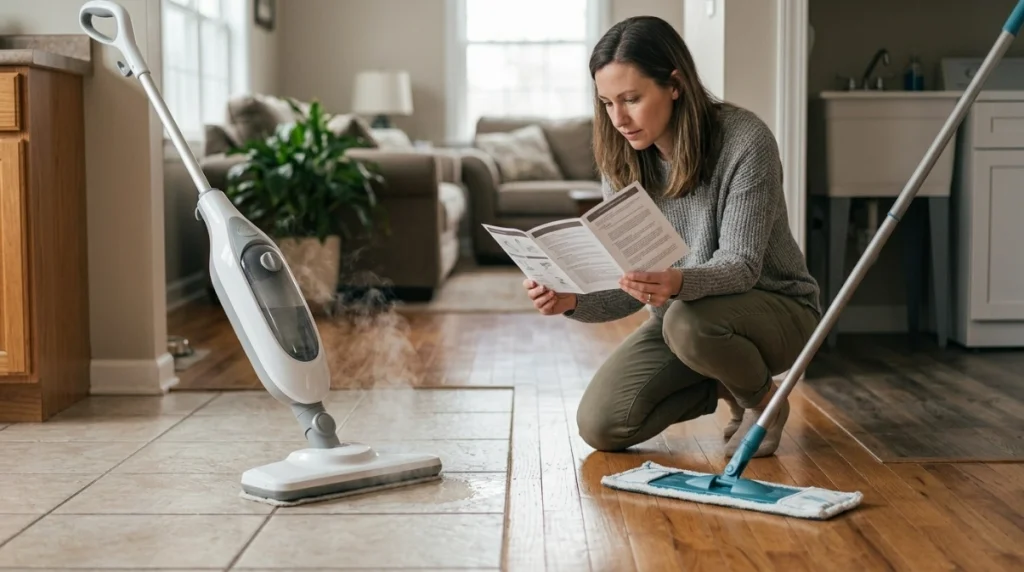
A regular damp microfiber mop is the safer default for most residential flooring. Steam should be limited to surfaces whose manufacturer expressly approves it.
| Floor type | Steam mop | Recommended method | Main risk |
|---|---|---|---|
| Ceramic or porcelain tile | Often suitable when approved | Steam or damp microfiber | Weak grout or damaged sealant |
| Solid hardwood | Generally avoid | Barely damp microfiber | Finish damage and board movement |
| Engineered wood | Generally avoid | Approved cleaner and microfiber | Moisture entering seams |
| Laminate | Avoid unless expressly approved | Nearly dry microfiber pad | Swollen edges and weakened joints |
| Vinyl or LVP | Usually not recommended | Damp microfiber and mild cleaner | Heat, adhesive, and seam damage |
| Natural stone | Use only with written approval | pH-neutral stone cleaner | Sealant damage or trapped moisture |
| Sealed concrete | May be suitable | Steam or microfiber if approved | Damage to coating or finish |
Why “sealed” does not always mean steam-safe
A sealed floor may resist small spills without tolerating repeated hot vapor. Tiny finish gaps and open seams can still admit moisture.
The National Wood Flooring Association is a useful starting point for professional wood-floor care information. Your flooring brand’s warranty remains the controlling guidance.
*Safety note: Test any approved method in a hidden area, use minimal moisture, and stop if seams darken or edges rise.
Section Takeaway: Steam-safe tile is the clearest use case for a steam mop. For wood, laminate, vinyl, and stone, choose a damp microfiber mop unless written guidance says otherwise.
Do Steam Mops Kill More Germs?
Steam may reduce more microorganisms than ordinary water mopping, but only under the right conditions. Temperature, surface contact time, pad cleanliness, and machine performance all affect the result.
Moving the mop quickly across a floor may not maintain enough contact time. A marketing claim about steam temperature does not prove that every part of the floor receives the same treatment.
Cleaning is not the same as disinfecting
Cleaning removes dirt and many germs from a surface. Disinfecting uses an appropriate method or registered product to kill targeted germs after visible soil is removed.
- Routine household cleaning: Soap or detergent is usually sufficient when no one is ill.
- Illness in the home: Follow current public-health guidance and use a suitable disinfectant where needed.
- Visible dirt: Remove it before attempting disinfection.
- Product contact time: Keep the surface wet for the label’s stated period.
- Steam claims: Follow the machine’s exact instructions rather than assuming one pass disinfects.
The EPA Safer Choice program can help shoppers identify cleaning products that meet its ingredient and performance criteria. EPA registration should be checked separately when a disinfectant is required.
A dirty steam pad can spread loosened soil across the room. I replace the pad whenever it becomes gray instead of waiting until the whole floor is finished.
*Safety note: Never combine disinfectants or add chemicals to a steam mop unless its manual permits them. Follow every product label.
What Are the Pros and Cons of Steam Mops?
Steam mops offer strong spot-cleaning power without a bucket. Their weaknesses are restricted floor compatibility, electrical setup, and possible heat or moisture damage.
Steam mop advantages
- Less scrubbing: Heat softens many dried spills.
- No traditional bucket: The self-contained tank reduces heavy lifting.
- Low cleaner use: Many machines need only water.
- Fast surface drying: A controlled vapor output may dry quickly on nonporous tile.
- Washable pads: Reusable pads reduce dependence on disposable sheets.
Steam mop disadvantages
- Limited surfaces: Heat and vapor are unsuitable for many common floors.
- Power cord: The cord can slow room-to-room cleaning and create a trip hazard.
- Warm-up time: It is inconvenient for one small spill.
- Pad changes: One dirty pad cannot effectively clean a large home.
- Mineral buildup: Hard tap water may leave deposits inside some machines.
- Higher purchase price: Internal heaters and pumps add cost and failure points.
Regular mop advantages and disadvantages
A microfiber mop is lightweight, inexpensive, quiet, and compatible with floor-specific cleaners. It also gives you direct control over how wet the pad becomes.
However, it may require pretreatment or extra scrubbing on dried grime. Buckets and dirty water also become problems with string or spin systems.
- Best regular-mop advantage: Broad floor compatibility.
- Biggest regular-mop weakness: Cleaning quality depends on rinsing pads and changing dirty water.
- Best steam-mop advantage: Fast loosening of stubborn residue.
- Biggest steam-mop weakness: Floor damage when used on an unsuitable surface.
Which Mop Costs Less to Own?
A regular microfiber mop usually costs less upfront and over its life. Steam mops cost more because they contain a heater, water tank, seals, controls, and electrical parts.
Typical ownership expenses
- Basic microfiber mop: Commonly about $15–$40 before extra pads.
- Spin-mop system: Often about $30–$60 with a bucket and wringer.
- Steam mop: Commonly about $60–$200, depending on controls and attachments.
- Replacement pads: Both systems need clean, washable pads for good results.
- Floor cleaner: Regular mops may require a compatible solution.
- Water treatment: Some steam mops work best with distilled or demineralized water.
Prices vary by retailer and model as of 2026. A cheap steam mop is not a bargain if it damages a floor or fails after mineral buildup.
How to maintain each mop
Wash reusable microfiber pads after each session without fabric softener. Softener coats the fibers and reduces their ability to collect dirt.
Empty a steam mop after cooling if its instructions recommend it. Never open the tank while the machine is hot or pressurized.
- Unplug the steam mop and let it cool completely.
- Remove and wash the dirty pad.
- Empty or rinse the reservoir as directed.
- Wipe the mop head and inspect the steam openings.
- Store the machine upright in a dry location.
*Safety note: Follow the appliance manual for descaling. Do not pour vinegar into the reservoir unless the manufacturer specifically allows it.
Should You Buy a Steam Mop or a Regular Mop?
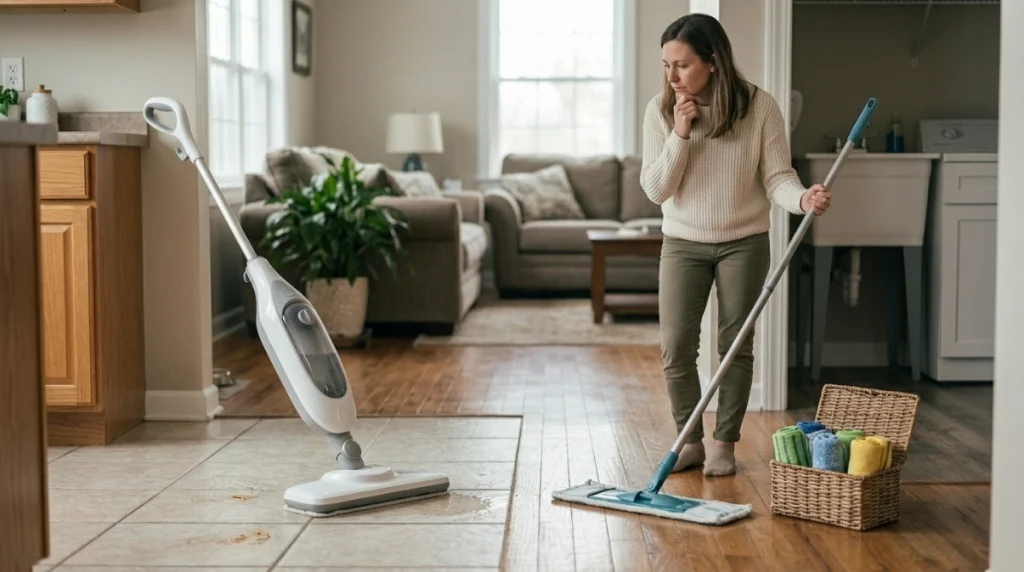
Choose a microfiber mop for the safest all-purpose option. Choose a steam mop only when you have enough steam-approved flooring to justify a specialized tool.
Buy a steam mop if:
- Most of your home has compatible ceramic or porcelain tile.
- You frequently clean dried food, grease, or muddy residue.
- Your flooring manufacturer permits steam cleaning.
- You can change pads during large cleaning jobs.
- You are comfortable managing a cord and hot appliance.
Buy a regular microfiber mop if:
- Your home contains hardwood, laminate, vinyl, or mixed flooring.
- You need fast daily cleaning without warm-up time.
- You want to use a floor-specific pH-neutral cleaner.
- You prefer a lightweight tool with fewer parts.
- You need precise moisture control near seams and edges.
Consider owning both when:
A two-mop setup can work in a home with large tile areas and sensitive flooring elsewhere. Use steam only on approved tile and microfiber everywhere else.
I use this approach in mixed-floor homes because it removes guesswork. Color-coded pads also prevent bathroom soil from reaching kitchen or living areas.
A pH-neutral cleaner is formulated near the middle of the acid-to-alkaline scale. It is often safer for finishes, but the floor manufacturer must still approve it.
*Safety note: Keep children and pets away while steam is operating and until the floor is dry. Hot vapor can burn skin.
Section Takeaway: A microfiber mop is the stronger first purchase for most homes. Steam is a useful specialist tool, not a universal replacement.
Frequently Asked Questions
Can a steam mop replace a regular mop?
No. A steam mop cannot safely replace a regular mop in many homes because hardwood, laminate, vinyl, and some stone floors may not tolerate steam. A microfiber mop also handles quick spills, dry dust, edges, and floor-specific cleaners more conveniently.
Do steam mops clean floors using only water?
Most steam mops are designed to use water without detergent. Check the manual before adding anything to the tank. Cleaners, vinegar, or fragrance oils can damage internal parts, leave residue, or void the warranty.
Why is my floor sticky after steam mopping?
Steam may soften old cleaner buildup without removing all of it. A saturated, dirty pad can then spread that residue. Change the pad, let the floor cool, and use a manufacturer-approved method to remove the remaining film.
Are steam mops safe for pets and children?
They can be used safely when instructions are followed, but the vapor, head, and nearby surfaces become hot. Keep children and pets away during cleaning, manage the cord carefully, and wait until the floor is cool and dry.
Can I use a steam mop on sealed hardwood?
A sealed surface is not automatically steam-safe. Heat and vapor can enter small finish cracks or plank seams. Use a barely damp microfiber mop unless the flooring manufacturer and warranty specifically permit steam cleaning.
How often should I steam-mop tile floors?
There is no universal schedule. Vacuum or sweep regularly, spot-clean spills promptly, and steam-mop approved tile when ordinary damp cleaning cannot remove buildup. Excessive steam cleaning may wear grout sealers or surface coatings faster.
Is a steam mop better than a spin mop?
A steam mop is better for loosening dried grime on approved tile. A spin mop is more versatile and lets you adjust water and cleaner, but its performance depends on thorough wringing and frequent changes of dirty water.
Final Verdict
Steam mops are not universally better than regular mops. They are better at one main job: loosening stubborn grime from floors designed to tolerate steam.
A microfiber flat mop is the better overall choice for most households. It costs less, starts faster, reaches edges, and protects a wider range of flooring.
Before buying, list every floor type in your home and check its care guide. If most surfaces prohibit steam, invest in a quality microfiber system and several washable pads.
If you have extensive steam-approved tile, a steam mop can be a worthwhile second tool. Use it carefully, change pads often, and never treat heat as a substitute for proper cleaning technique.
