
Types of Spin Mop Buckets: Complete 2026 Guide

Quick Answer
The main types of spin mop buckets include single-compartment buckets, clean-and-dirty-water separation buckets, foot-pedal spin buckets, handle-press spin buckets, rinse-and-wring systems, and larger buckets with wheels or drain plugs. The best design depends on how much floor you clean, how carefully you need to control moisture, and whether keeping rinse water separate matters to you. For general household floor hygiene, the CDC’s cleaning and disinfecting guidance also explains why routine cleaning and disinfection are different jobs.
Main spin mop bucket types
- Single-compartment: One main reservoir holds the cleaning water and usually includes a separate spinning wringer.
- Dual-compartment: Separate sections help reduce contact between cleaner water and extracted dirty water.
- Foot-pedal spin: A pedal powers the wringer while your hands remain on the mop handle.
- Handle-press spin: Pushing the mop handle activates the spinning mechanism without a pedal.
- Rinse-and-wring: Dedicated rinsing and spinning zones give you more control over how dirty the mop head becomes.
- Mobile or drainable: Wheels, handles, or drain plugs make larger buckets easier to move and empty.
Spin mop buckets look similar until you use them side by side. After cleaning everything from tile kitchens to moisture-sensitive laminate, I’ve found that the bucket design can matter as much as the mop head.
This guide breaks down the major designs, their differences, and the situations where each one makes sense. I’ll also explain which features are useful and which can complicate an otherwise simple floor-cleaning job.
In This Guide
- What Is a Spin Mop Bucket?
- What Are the Main Types of Spin Mop Buckets?
- Single vs. Dual-Compartment Spin Mop Buckets
- Foot Pedal vs. Handle-Press Spin Buckets
- Which Spin Mop Bucket Is Best for Your Floor?
- How Do You Choose the Right Spin Mop Bucket?
- How Should You Use and Maintain a Spin Mop Bucket?
- Spin Mop Bucket FAQ
- Which Type Should You Buy?
What Is a Spin Mop Bucket?
A spin mop bucket is a floor-cleaning bucket with a rotating mechanism that rinses, wrings, or dries a mop head. The spinning action removes water from the fibers using centrifugal force.
That moisture control is the main reason spin mops differ from traditional string mop buckets. Instead of twisting the mop by hand, you let the bucket mechanism do most of the wringing.
- Bucket reservoir: Holds water and an approved floor-cleaning solution.
- Spin basket: Rotates the mop head and throws excess water away from the fibers.
- Mop head: Usually uses absorbent microfiber strands.
- Activation mechanism: May use a pedal, mop-handle movement, or another mechanical system.
One important point gets overlooked. The water arrangement and the spinning mechanism are two separate design choices.
For example, a dual-compartment bucket can still use either a foot pedal or a handle-press wringer. That’s why product names sometimes make different systems sound more similar than they are.
What Are the Main Types of Spin Mop Buckets?
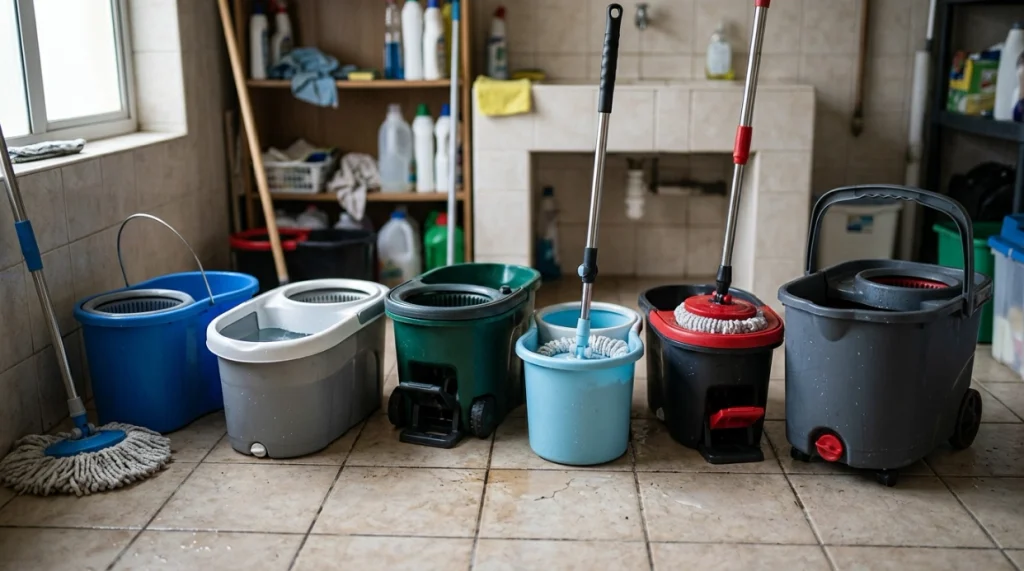
The most useful way to classify spin mop buckets is by water management and wringing method. As of 2026, most household systems fit into one or more of the following categories.
1. Single-Compartment Spin Mop Buckets
A single-compartment model uses one main water reservoir. The spinning basket usually sits above or beside that water.
I like these for straightforward weekly cleaning because there are fewer sections to fill and wash afterward. Their biggest weakness is that soil can gradually contaminate the water.
- Best for: Apartments, small homes, and routine cleaning.
- Main advantage: Simple design with fewer parts.
- Main limitation: Cleaner water becomes dirtier as you rinse the mop repeatedly.
2. Dual-Compartment Clean-and-Dirty-Water Buckets
These buckets separate water into different zones or reservoirs. Depending on the design, clean water may stay isolated while extracted water collects elsewhere.
This approach is useful when I’m cleaning a muddy entryway or a large tile area. I don’t want the last section receiving water that looks like the first section’s dirt.
- Best for: Larger spaces and visibly dirty floors.
- Main advantage: Better separation of cleaner and dirtier water.
- Main limitation: More parts need rinsing after use.
3. Foot-Pedal Spin Mop Buckets
A pedal near the bottom of the bucket powers the spin basket. You place the mop in the wringer and pump the pedal several times.
The system gives good control because you can stop spinning when the mop reaches the dampness you want. It also avoids repeated downward pressure through your wrists.
4. Handle-Press or Push-to-Spin Buckets
These models use movement in the mop handle to rotate the wringer. You push downward, and the internal mechanism turns the mop head rapidly.
The floor footprint can be simpler because there’s no external pedal. However, the handle mechanism adds moving parts that must stay clean and aligned.
5. Separate Rinse-and-Wring Systems
Some spin buckets give you one area for loosening soil and another for spinning out liquid. This creates a clearer rinse-then-wring workflow.
I find the distinction useful after greasy kitchen spills. Rinsing before the final spin removes more loose soil than immediately wringing a dirty head.
6. Wheeled or Drain-Plug Spin Mop Buckets
Larger buckets may include caster wheels, a pull handle, or a drain opening near the base. These features don’t change the cleaning action, but they change handling.
A gallon of water weighs about 8.3 pounds before you add the bucket and mop. Easier draining matters more than it seems when you’re carrying water through a finished home.
Section Takeaway: Spin mop bucket types overlap. First compare how the system manages clean and dirty water, then compare how it powers the spinning wringer.
Single vs. Dual-Compartment Spin Mop Buckets
A single-compartment bucket wins on simplicity, while a dual-compartment design gives you stronger separation between different stages of cleaning. Neither design automatically cleans every floor better.
| Feature | Single-Compartment | Dual-Compartment |
|---|---|---|
| Water zones | Usually one main reservoir | Two separated zones or reservoirs |
| Setup | Fast and simple | Slightly more involved |
| Dirty-water control | Limited | Better separation |
| Cleaning after use | Fewer surfaces to rinse | More chambers to clean |
| Storage | Often easier | Often bulkier |
| Ideal situation | Routine small-area cleaning | Larger or dirtier areas |
Does separating dirty water really help?
Yes, especially when the floor carries visible soil. A separate rinse arrangement reduces how much extracted dirt immediately returns to your cleaning solution.
The same principle appears in professional cleaning guidance. Separate cleaning and rinse water help prevent the cleaning solution from becoming contaminated as quickly.
That benefit matters less when you’re lightly damp-mopping a nearly clean room. For a studio apartment, the extra bucket complexity may offer little practical advantage.
- Choose single-compartment when storage and fast cleanup matter most.
- Choose dual-compartment when you regularly clean mud, kitchen soil, or larger floor areas.
- Change dirty water anyway when it becomes visibly cloudy or heavily contaminated.
Foot Pedal vs. Handle-Press Spin Buckets: Which Is Easier?
Foot-pedal systems use your leg to power the wringer, while handle-press systems use downward movement through the mop shaft. Both can remove substantial moisture when the mechanism works smoothly.
Why choose a foot pedal?
A pedal separates the spinning action from the mop handle. That makes the movement intuitive when you’re switching between rinsing and wringing.
- Good control over repeated spins.
- Less repeated twisting through the hands.
- Easy to add another spin when the head still feels wet.
- The pedal mechanism can add width and another part to maintain.
Why choose a handle-press system?
Push-to-spin buckets remove the need for a foot pedal. They’re useful where a protruding pedal would make storage awkward.
- Cleaner bucket footprint.
- No need to balance while pumping a pedal.
- Fast transition from rinse to spin.
- Repeated downward pressing may feel tiring for some users.
When I test either design, I pay attention to stability before spin speed. A wringer that rotates quickly isn’t helpful if the bucket rocks across smooth tile.
I also check whether I can stop at a barely damp mop head. Moisture control is more important than producing the fastest possible spin.
Which Spin Mop Bucket Is Best for Your Floor?
The bucket itself doesn’t determine floor safety. What matters is how well the complete system controls water, cleaner, heat, grit, and repeated passes.
For wood-based floors, I prioritize moisture control above bucket capacity. The National Wood Flooring Association advises minimizing moisture and following flooring or finish manufacturer care recommendations.
| Floor Type | Useful Bucket Style | Main Priority |
|---|---|---|
| Finished hardwood | Strong wringing system | Leave mop only slightly damp |
| Engineered wood | Controlled-wring model | Protect joints from excess liquid |
| Laminate | Efficient spin wringer | Minimal standing moisture |
| Vinyl/LVP | Single or dual bucket | Avoid flooding seams and edges |
| Ceramic/porcelain tile | Dual or rinse-and-wring bucket | Remove soil without redistributing it |
| Natural stone | Controlled-wring bucket | Use stone-compatible cleaner |
| Sealed concrete | Larger or mobile bucket | Capacity for larger areas |
On laminate, I usually spin the mop again if the fibers still release droplets when lifted. That extra few seconds can prevent water from collecting around joints and transitions.
Tile tolerates more moisture than many wood-based surfaces, but flooding is still unnecessary. Extra water creates longer drying times and a temporary slip hazard.
Safety note: Always check your floor manufacturer’s care guide before using a new cleaner, disinfectant, vinegar mixture, steam method, or moisture-heavy cleaning routine.
How Do You Choose the Right Spin Mop Bucket?
Start with your cleaning routine rather than the longest feature list. A complicated bucket isn’t automatically better if you dislike filling, moving, cleaning, or storing it.
Consider these seven factors
- Water separation: Decide whether you want one reservoir or separated clean and dirty zones.
- Wringing control: Look for a basket that can produce a lightly damp mop for moisture-sensitive flooring.
- Bucket stability: A wider, stable base reduces movement during fast spinning.
- Carrying handle: The handle should feel secure when the bucket contains water.
- Drain system: A low drain plug can save you from lifting a heavy bucket into a sink.
- Storage footprint: Measure your closet before buying an oversized dual-chamber system.
- Replacement availability: Check whether compatible mop heads are easy to obtain.
Does bucket size matter?
Yes, but bigger isn’t always better. More water means fewer refills, yet it also means more weight when moving or emptying the bucket.
I prefer filling only what I expect to use. It makes the bucket easier to carry and discourages leaving old cleaning solution sitting between jobs.
Should you choose a bucket with wheels?
Wheels can help across large tile, concrete, or commercial-style areas. They’re less useful on stairs, thresholds, or cramped bathrooms.
Check whether the wheels lock or whether the bucket remains stable during spinning. Easy mobility shouldn’t turn into unwanted movement under your foot.
Are extra brushes and agitators necessary?
Not always. Some buckets include textured rinsing surfaces intended to help release debris from microfiber strands.
I treat those features as secondary. A stable wringer, manageable bucket, washable head, and good moisture control matter more during everyday use.
Section Takeaway: Choose the bucket around your floor, room size, storage space, and tolerance for maintenance. Useful fundamentals beat extra mechanisms you won’t use.
How Should You Use and Maintain a Spin Mop Bucket?

Good technique prevents a spin mop from becoming a system for spreading dirty water. Start with dry debris removal, then work through the room in manageable sections.
- Sweep or vacuum first. Remove sand, crumbs, pet hair, and other loose debris.
- Check your floor-care instructions. Confirm the cleaner and moisture level are appropriate.
- Fill the bucket correctly. Follow the bucket’s fill line and cleaner-label dilution instructions.
- Wet the mop head. Let the microfiber absorb enough solution to clean effectively.
- Spin out excess water. Use additional spins for floors needing tighter moisture control.
- Mop a small section. Work toward an exit rather than walking across freshly cleaned flooring.
- Rinse when the head becomes dirty. Don’t wait until microfiber is visibly packed with soil.
- Change heavily soiled water. Fresh solution is better than repeatedly working with muddy water.
- Empty and rinse the bucket. Don’t store it with used cleaning water inside.
- Dry the mop head and bucket. Airflow helps prevent stale odors between cleaning sessions.
Do you need disinfectant in a spin mop bucket?
Usually not for routine household floor cleaning. CDC guidance says regular cleaning is enough in many home situations, while disinfection becomes more relevant when someone is sick or another specific need exists.
If you do disinfect, use a product approved for the surface and follow its instructions. The EPA explains the difference between cleaning, sanitizing, and disinfecting and stresses following registered-product label directions.
Can you mix different cleaners in the bucket?
No. Don’t combine cleaning chemicals unless the product directions specifically say the combination is safe and intended.
More chemicals don’t mean a cleaner floor. They can create residue, damage finishes, or cause hazardous reactions.
Safety note: Follow the cleaning-product label for dilution, ventilation, surface compatibility, protective equipment, and contact time. Never improvise chemical combinations.
How often should the mop head be washed?
Wash a reusable head after dirty jobs and whenever it develops odor, visible soil, or residue. Follow the mop manufacturer’s laundering instructions.
I keep a spare head available for large cleaning sessions. Switching to a clean head halfway through is often more effective than adding extra cleaner to dirty fibers.
Section Takeaway: A spin mop works best when you control three things: loose debris, dirty water, and excess moisture. Keep all three under control and the bucket design can do its job properly.
Spin Mop Bucket FAQ
What is the best type of spin mop bucket?
There isn’t one best design for every home. A simple single-compartment bucket suits routine cleaning, while a dual-compartment or rinse-and-wring system is more useful for larger areas where water becomes dirty quickly.
Is a dual-bucket spin mop better than a single bucket?
A dual system is better at separating different stages of cleaning, but it can be bulkier and harder to wash afterward. For small, lightly soiled spaces, a single-compartment model may be easier to live with.
Is a pedal spin mop better than a hand-press spin mop?
Pedal systems use leg movement to spin the basket, while handle-press systems rely on downward pressure through the mop. Choose the movement you find more comfortable and check that the bucket remains stable during use.
Can I use a spin mop on hardwood floors?
A spin mop may work on some finished wood floors when the manufacturer allows damp cleaning and the head is wrung nearly dry. Avoid leaving standing water and always follow your flooring or finish manufacturer’s maintenance instructions.
Can I use a spin mop on laminate?
Many laminate floors require tight moisture control. If your manufacturer permits damp mopping, spin the head thoroughly so it’s only slightly damp and avoid allowing water to collect along joints, edges, or damaged seams.
How often should I change spin mop water?
Change the water whenever it becomes visibly dirty, heavily cloudy, or contaminated after a messy area. Large or muddy rooms may require several changes, while a lightly soiled small room may not.
Why does my spin mop bucket smell?
Odor usually develops when dirty water, damp microfiber, or residue remains trapped after cleaning. Empty and rinse the bucket after each use, wash the mop head as directed, and let every part dry before storage.
Which Type of Spin Mop Bucket Should You Buy?
For a small home and routine cleaning, I’d start with a straightforward single-compartment spin bucket with a strong wringer. It’s easy to fill, move, rinse, and store.
For larger homes, pets, muddy traffic, or heavily used tile areas, a dual-compartment or rinse-and-wring system offers better control over dirty water.
- Small apartment: Compact single-compartment bucket.
- Large family home: Dual-compartment or rinse-and-wring system.
- Hardwood or laminate: Prioritize strong moisture control over bucket capacity.
- Tile or sealed concrete: Consider larger capacity and easier draining.
- Limited mobility: Compare carrying weight, wheels, drain plugs, and pedal versus handle activation.
The best spin mop bucket is the one that helps you use clean water, control moisture, and complete the job without unnecessary effort. Choose those fundamentals first, then treat extra features as bonuses.