
Types of Spin Mop Wringers: How Each System Works

Quick Answer
The main types of spin mop wringers are foot-pedal wringers, push-down or pump-action wringers, handle-activated systems, and simple manual spinning baskets. All remove water by spinning the mop head, but they differ in effort, control, durability, and how much moisture remains. For moisture-sensitive floors, I also follow National Wood Flooring Association guidance and keep the mop only slightly damp.
Main Wringer Types
- Foot-pedal: You press a pedal to spin the basket while holding the mop upright.
- Push-down: Pushing the mop handle downward activates the spinning mechanism.
- Handle-activated: A built-in grip, trigger, or twisting system spins the mop without a bucket pedal.
- Manual basket: You rotate or press the mop manually, giving simple operation with fewer moving parts.
What Matters Most
- Choose a system that lets you control how wet the mop remains.
- Check the pedal, bearings, basket, and handle mechanism for easy maintenance.
- Match moisture levels to your flooring rather than spinning every floor the same way.
After using spin mops on tile, vinyl, laminate, and sealed wood, I’ve learned that the wringer matters almost as much as the mop head. A good wringer saves your hands and gives you much better control over how much water reaches the floor.
As of 2026, you’ll find several wringer designs rather than one universal system. Here’s how each type works, where it performs well, and what I check before choosing one.
In This Guide
- What Is a Spin Mop Wringer?
- What Are the Main Types of Spin Mop Wringers?
- Which Spin Mop Wringer Type Is Best?
- Which Wringer Works Best for Different Floors?
- How Do You Choose a Spin Mop Wringer?
- Why Do Spin Mop Wringers Stop Working?
- How Do You Clean and Maintain a Wringer?
- Frequently Asked Questions
- Which Wringer Should You Pick?
What Is a Spin Mop Wringer?
A spin mop wringer is the part of a mop system that removes water from a wet mop head through centrifugal force. The mop rotates rapidly inside a basket, throwing excess water outward instead of forcing you to twist the microfiber by hand.
That spinning action is what separates a spin mop from a traditional string mop and bucket. It gives you much more control over moisture.
Why does wringer design matter?
The mechanism determines how you create the spinning motion. Some designs use your foot, while others transfer movement through the mop handle.
- Less hand contact: You don’t have to squeeze a dirty mop head.
- Moisture control: Extra spins can leave the mop noticeably drier.
- Faster cleaning: Wringing normally takes only a few seconds.
- Better ergonomics: A good system reduces bending and hand twisting.
- Cleaner workflow: The dirty mop stays inside the bucket during wringing.
I find moisture control especially useful when moving from a tiled kitchen into a moisture-sensitive room. I can spin the same microfiber head a few extra times before continuing.
What Are the Main Types of Spin Mop Wringers?
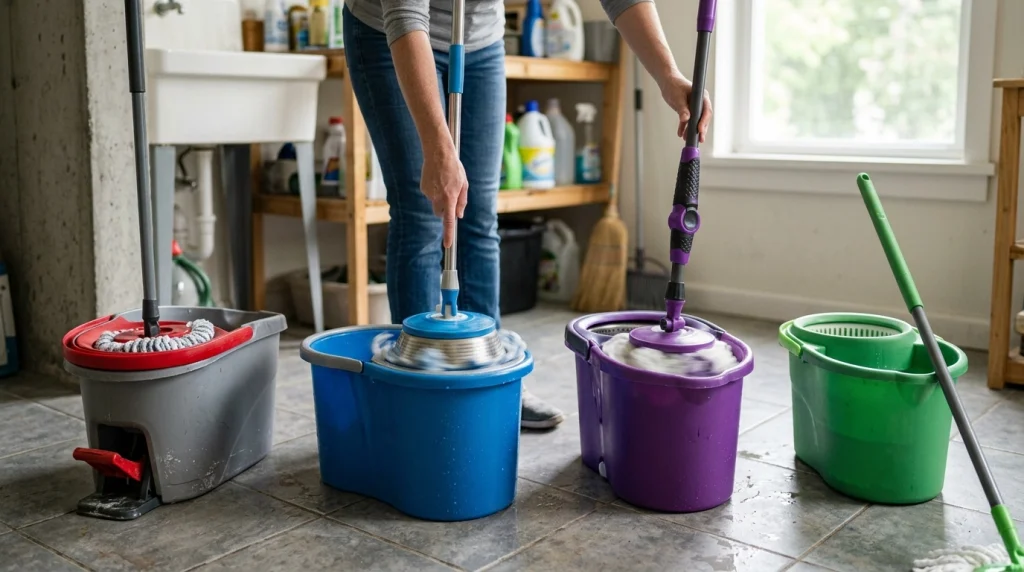
Most household spin mop systems fit into four broad wringer categories. Their purpose is similar, but the way you power the spinning basket changes.
1. Foot-Pedal Spin Mop Wringer
A foot-pedal wringer uses a pedal mounted near the bottom of the bucket. Pressing it turns gears connected to the spinning basket.
You hold the mop vertically inside the wringer and pump the pedal several times. Faster or additional presses usually remove more water.
- Good control: You can stop spinning whenever the mop reaches the moisture level you want.
- Hands stay relaxed: Your arms mainly stabilize the mop.
- Easy to learn: The movement feels natural after a few uses.
- More mechanical parts: The pedal, gears, and linkage can wear over time.
I like pedal systems when cleaning a larger tiled area because I can rinse and wring repeatedly without working the mop handle hard.
2. Push-Down or Pump-Action Wringer
A push-down wringer moves the spinning mechanism into the mop handle. Pressing the handle downward makes the mop head or basket rotate.
There’s no foot pedal. Your upper body supplies the force instead.
- Compact bucket: Removing the pedal can make the bucket simpler.
- Quick spinning: Several short pumps can remove a surprising amount of water.
- No foot coordination: Everything happens through the handle.
- Handle wear: The internal spinning joint becomes an important failure point.
These systems work well when I want a bucket that doesn’t have a pedal sticking out from one side. They’re also convenient in tight storage spaces.
3. Handle-Activated or Self-Wringing Spin System
Some spin mops use a rotating grip, sliding sleeve, trigger, or built-in handle mechanism. Activating that part spins the mop without a conventional bucket pedal.
The exact motion varies by manufacturer. That’s why I always test how naturally the handle moves before judging this type.
- Fewer bucket controls: Most of the mechanism stays in the mop.
- Portable: The bucket can remain relatively straightforward.
- Controlled operation: You activate the spin directly with your hands.
- More handle complexity: Replacement handles may be harder to match.
4. Manual Spinning Basket Wringer
A basic manual system uses a basket that spins through direct pressure, twisting, or another simple mechanical action. It may not have a dedicated foot pedal or sophisticated handle drive.
The advantage is simplicity. There are fewer complicated parts to break.
- Simple construction: Maintenance is usually straightforward.
- Lower complexity: There are fewer gears and linkages.
- More effort: You may need to supply more physical force.
- Variable results: Water removal depends heavily on your technique.
Section Takeaway: Foot-pedal and push-down systems are the most convenient for frequent household mopping. Simpler manual systems trade convenience for fewer moving parts.
Which Spin Mop Wringer Type Is Best?
There isn’t one wringer that’s best for every cleaner. The strongest choice depends on whether you prioritize low effort, simplicity, compact storage, or moisture control.
| Wringer Type | How It Spins | Physical Effort | Main Advantage | Main Drawback |
|---|---|---|---|---|
| Foot-pedal | Foot pedal drives basket | Low to moderate | Easy repeated wringing | Extra pedal and gear parts |
| Push-down | Vertical handle pumping | Moderate upper-body effort | Compact bucket design | Handle mechanism can wear |
| Handle-activated | Grip, sleeve, trigger, or twist | Low to moderate | Control stays in your hands | More complex mop handle |
| Manual basket | Direct manual movement | Moderate to high | Simple construction | Requires more effort |
For frequent whole-house cleaning, I’d usually prefer a smooth foot-pedal or push-down system. Both let me adjust moisture without touching the mop head.
For occasional cleaning, mechanical simplicity becomes more attractive. A basic design can be easier to rinse, inspect, and store.
Which Wringer Works Best for Different Floors?
The wringer doesn’t directly touch your floor, but it controls something important: how much water the mop carries. That makes wringing technique especially important on moisture-sensitive surfaces.
Hardwood and engineered wood
Use a wringer that lets you make the mop head only slightly damp. I give the mop extra spins rather than leaving visible water behind.
NWFA guidance emphasizes minimizing moisture on wood floors and following the flooring manufacturer’s cleaning recommendations.
Safety note: Always check the wood-floor manufacturer’s care guide before wet mopping, and avoid leaving standing water on seams or edges.
Laminate flooring
I also use a well-wrung microfiber head on laminate. Water collecting around joints and edges is something I try to avoid.
A wringer with good moisture control is therefore more useful than one that merely spins quickly.
Vinyl and LVP
Vinyl and luxury vinyl plank are usually easy to mop, but I still prefer controlled moisture. A damp microfiber head tends to leave fewer puddles and dries faster.
Ceramic and porcelain tile
Tile generally gives you more flexibility. I may leave the mop slightly wetter when loosening sticky kitchen soil, then wring it drier for the finishing pass.
- Wood: Use minimal moisture.
- Laminate: Wring thoroughly and avoid standing water.
- Vinyl/LVP: Use controlled moisture and an approved cleaner.
- Tile: Moderate moisture usually works well.
- Natural stone: Follow the stone and sealer manufacturer’s cleaner guidance.
Section Takeaway: The best wringer isn’t simply the fastest one. It should let you adjust the mop’s moisture level for the surface you’re cleaning.
How Do You Choose a Spin Mop Wringer?
Start with the mechanism you’ll use comfortably every week. A clever wringer isn’t helpful if it feels awkward after ten minutes.
Check these features before buying
- Spin stability: The basket should rotate without severe wobbling.
- Moisture control: You should be able to keep spinning for a drier mop.
- Bucket balance: The bucket shouldn’t slide easily while you wring.
- Basket access: Hair and debris should be reasonably easy to remove.
- Handle strength: Pump-style systems need a solid locking mechanism.
- Pedal feel: Pedal systems should move smoothly without sticking.
- Replacement parts: Check whether mop heads and handles are readily available.
- Storage size: Measure your cabinet or utility area before choosing a large bucket.
One detail I pay close attention to is bucket movement. An aggressive wringer isn’t pleasant if each pedal press pushes the bucket across the floor.
I also prefer microfiber mop heads that release easily for washing. The wringer can’t compensate for a dirty, overloaded mop head.
Why Do Spin Mop Wringers Stop Working?
Most wringer problems come from debris, worn mechanical parts, incorrect alignment, or excessive force. You can often identify the problem before replacing the entire mop.
The basket won’t spin
- Check for hair or thread wrapped around the spindle.
- Make sure the mop head sits correctly in the basket.
- Inspect the pedal or handle linkage for obvious damage.
- Confirm that any handle lock is in the correct spinning position.
The basket spins slowly
Grime around the rotating parts can increase resistance. Rinse accessible areas and remove visible debris without dismantling sealed mechanisms unless the manual allows it.
The pedal feels loose
A loose pedal can indicate wear in the linkage, spring, or gear system. Forcing it usually makes the damage worse.
The mop stays too wet
Make sure the mop head is centered before spinning. An overloaded or tangled microfiber head may also prevent efficient rotation.
I usually test the wringer with clean water after inspection. That makes it easier to see whether the problem comes from dirt or the mechanism itself.
How Do You Clean and Maintain a Spin Mop Wringer?
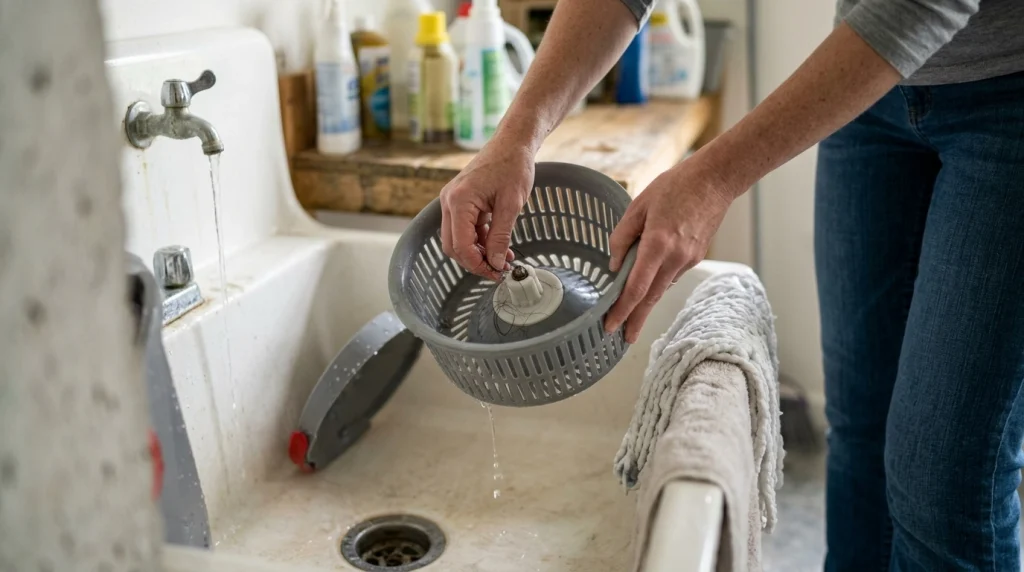
Rinse the wringer after dirty cleaning jobs rather than letting muddy water dry around the basket. This simple habit prevents much of the gritty buildup I’ve seen around spinning parts.
- Empty the bucket: Dispose of dirty water safely after cleaning.
- Rinse the basket: Flush away hair, grit, and cleaner residue.
- Inspect the spindle: Remove visible thread or hair that may restrict rotation.
- Wash the mop head: Follow its care instructions and let it dry fully.
- Dry the bucket: Leave it open until the interior has air-dried.
- Store it dry: Avoid sealing damp microfiber inside the bucket.
The CDC distinguishes routine cleaning from sanitizing and disinfecting. Regular cleaning removes dirt and many germs, while disinfection is generally more relevant when illness or specific contamination makes it necessary.
If you do use a disinfectant, follow the product label and use a product suitable for the surface. The CDC’s home cleaning guidance also recommends cleaning surfaces before disinfecting when disinfection is needed.
The EPA Safer Choice program can also help when you’re looking for cleaning products made with ingredients that meet its safety criteria.
Safety note: Never mix cleaning chemicals unless a product label specifically directs you to do so. Check both the cleaner label and your flooring manufacturer’s care instructions.
Frequently Asked Questions About Spin Mop Wringers
What are the most common types of spin mop wringers?
The most common types are foot-pedal, push-down or pump-action, handle-activated, and simple manual spinning wringers. Each uses rotational force to remove water from the mop head, but the way you create that rotation differs.
Is a pedal spin mop better than a push-down spin mop?
A pedal model lets your foot power the basket, while a push-down model uses movement through the mop handle. Pedal models reduce arm work, while push-down systems can offer a simpler, more compact bucket.
How many times should I spin a spin mop?
There’s no universal number because mop heads and wringers vary. Spin until the microfiber reaches the moisture level your floor needs. I use extra spinning for wood and laminate compared with ceramic tile.
Why is my spin mop still wet after wringing?
The mop may be off-center, overloaded, tangled, or not spinning quickly enough. Check for debris around the basket or spindle and make sure the mop is seated correctly before activating the wringer again.
Can a spin mop be used on hardwood floors?
A well-wrung microfiber spin mop may be appropriate for some finished wood floors when the flooring manufacturer permits damp cleaning. Keep moisture minimal and follow the floor manufacturer’s instructions rather than assuming every hardwood floor can be wet-mopped.
Do spin mop wringers need lubrication?
Not necessarily. Some mechanisms are designed to remain sealed and maintenance-free. Don’t add oil or lubricant unless the manufacturer specifically recommends it because the wrong product can attract dirt or damage plastic components.
How do I keep my spin mop bucket from smelling?
Empty dirty water immediately, rinse the bucket and wringer, wash the microfiber head, and let every part dry before storage. Keeping a wet mop sealed inside a bucket encourages stale odors.
Which Spin Mop Wringer Should You Pick?
For frequent home cleaning, a foot-pedal wringer gives easy repeated spinning, while a push-down wringer removes the need for a bucket pedal. Handle-activated models can also work well when you prefer controlling everything from the mop.
If durability and simplicity matter more than convenience, a basic manual design has fewer components to worry about. Whichever system you choose, prioritize stable spinning and good moisture control.
That’s the feature I notice most in everyday cleaning. A wringer that leaves the mop as damp—or as dry—as I need makes a spin mop far more useful across different floors.