
What Are Steam Mops Used For? A Complete Floor-Care Guide

Quick Answer
Steam mops are used to loosen grease, dried spills, tracked-in dirt, and sticky residue on compatible sealed hard floors. They clean with heated water vapor and a washable pad, but regular cleaning is usually enough unless illness or another reason makes disinfection necessary, according to the CDC’s household cleaning guidance.
Common steam mop uses
- Cleaning sealed tile: Steam softens grime on ceramic and porcelain surfaces.
- Loosening sticky spills: Heat helps release dried food and drink residue.
- Cutting light grease: Steam can lift oily kitchen soil without detergent.
- Refreshing grout: Focused steam helps loosen surface dirt along sealed grout lines.
- Reducing cleaner use: Most models work with plain water rather than floor solution.
Before you start
- Confirm that both the flooring manufacturer and steam mop manual permit steam cleaning.
Steam mops look simple, but they are not safe for every hard floor. I have seen excellent results on sealed tile and disappointing dull patches on heat-sensitive finishes.
This guide explains what steam mops do, where they work, and when a microfiber mop is safer. It also covers technique, limitations, and common mistakes.
In This Guide
- How Does a Steam Mop Work?
- What Are Steam Mops Used For Around the Home?
- Which Floors Can You Clean With a Steam Mop?
- Where Should You Not Use a Steam Mop?
- Steam Mop vs. Other Mops: Which Should You Use?
- How Do You Use a Steam Mop Correctly?
- Common Steam Mop Mistakes and Maintenance Tips
- Frequently Asked Questions
- Is a Steam Mop Right for Your Home?
How Does a Steam Mop Work?
A steam mop heats water inside a reservoir and sends hot vapor through a floor head. A reusable microfiber pad collects the loosened soil.
The machine does not usually vacuum. Crumbs, hair, grit, and other loose debris must be removed before steaming.
What steam does to floor grime
Heat softens many water-soluble spills and greasy films. Moisture also reaches shallow texture where a dry pad may skip over dirt.
The pad provides the physical wiping action. Steam alone cannot carry removed grime away from the floor.
- Heat: Softens sticky and oily residue.
- Moisture: Rehydrates dried spills so they release more easily.
- Pad friction: Lifts the loosened soil from the surface.
- Absorption: Holds dirty moisture until the pad is changed.
Cleaning is not automatically disinfecting
Cleaning removes dirt and many germs. Disinfecting means using a validated process to kill specific microorganisms.
The EPA explains the difference between cleaning, sanitizing, and disinfecting. A steam mop should not be called a disinfectant unless its manufacturer provides tested instructions for that claim.
Those instructions may specify a steam setting, movement speed, and contact time. A quick pass might clean a floor without meeting the model’s sanitizing directions.
Safety note: Follow the machine manual and flooring care guide before relying on steam for sanitizing or cleaning.
What Are Steam Mops Used For Around the Home?
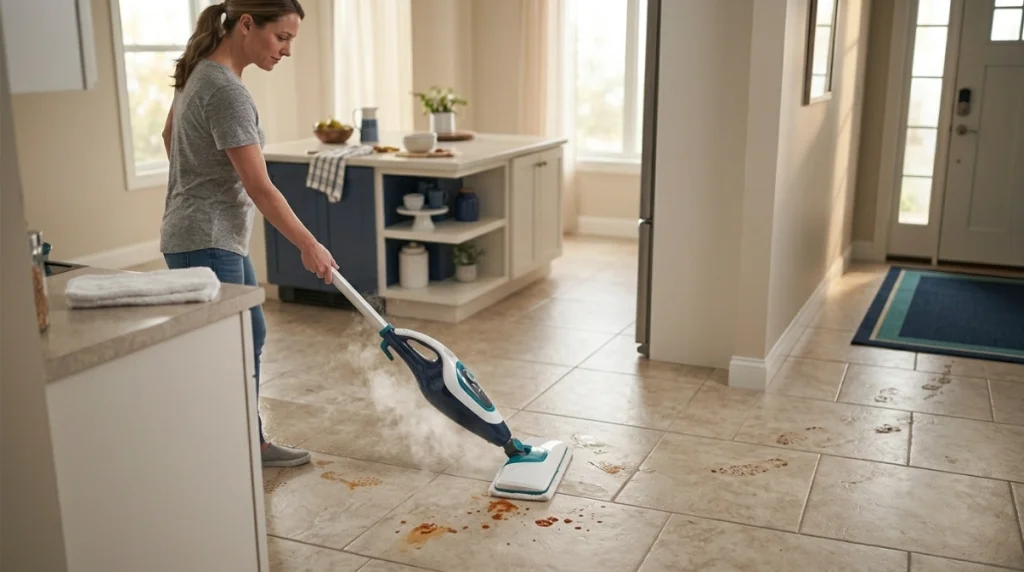
Steam mops are mainly used for routine or deeper cleaning on compatible sealed hard floors. They are especially useful when a damp mop needs repeated passes over sticky soil.
Cleaning kitchen floors
Kitchen floors collect cooking film, food drips, muddy footprints, and dried drink splashes. Steam can soften these messes without filling a bucket with detergent.
I get the best result by vacuuming first and making one slow pass. I then change the pad before cleaning the rest of the room.
- Dried sauce spots
- Light cooking residue
- Sticky juice or soft-drink marks
- Footprints near sinks and doors
- Surface grime around appliance edges
Cleaning bathrooms and entryways
Sealed bathroom tile often develops soap residue, dust, and water spots. Entryways collect tracked-in soil that can turn muddy during ordinary wet mopping.
Steam helps release this surface film. It does not remove mineral deposits as effectively as a compatible descaling product.
Loosening dirt from textured tile
Microfiber flat mops sometimes glide over dirt trapped in shallow tile texture. Heat and moisture help loosen that soil before the pad wipes it away.
Deep grout discoloration may need a brush and grout-safe cleaner. A steam mop’s broad pad cannot reach every recessed line.
Refreshing sealed grout
A steam mop can remove recent surface dirt from sealed grout. It cannot reverse permanent staining, failed sealer, or mold growing beneath damaged material.
Use a small attachment only if the appliance includes one. Never force the main mop head against walls or narrow joints.
Handling pet and child messes
Steam can help clean muddy paw prints and dried food from compatible floors. Remove solid material and absorb liquid before using the machine.
For urine, vomit, or other biological messes, steam may set odor-producing proteins. Start with a floor-safe enzyme cleaner if the flooring and product directions permit it.
Safety note: Keep children and pets away until the floor is clean, dry, and cool.
Section Takeaway: Steam mops work best on stuck-on surface grime. They do not replace vacuuming, stain treatment, or floor repairs.
Which Floors Can You Clean With a Steam Mop?
Sealed ceramic and porcelain tile are usually the strongest candidates. Every surface still requires approval from its flooring manufacturer.
“Sealed” means the surface has a protective barrier that limits moisture entry. It does not guarantee resistance to high heat or pressurized vapor.
| Floor type | General steam suitability | Main concern | Safer default |
|---|---|---|---|
| Sealed ceramic or porcelain tile | Often suitable | Damaged grout or sealer | Use low steam and keep moving |
| Natural stone | Only with explicit approval | Sealer, pores, or heat sensitivity | pH-neutral stone cleaner |
| Hardwood or engineered wood | Generally avoid | Swelling, finish damage, or warping | Barely damp microfiber mop |
| Laminate | Usually avoid unless approved | Moisture entering seams | Laminate-approved cleaner |
| Vinyl or LVP | Usually avoid unless approved | Heat, adhesive, and seam damage | Damp microfiber mop |
| Sealed concrete | Sometimes suitable | Coating or wax damage | Check coating instructions |
Why flooring instructions matter
Flooring and appliance brands do not always give identical advice. Some steam-mop makers permit sealed wood, while wood-floor specialists recommend avoiding it.
The National Wood Flooring Association’s maintenance guidance advises against wet and steam mops on wood. Its concern is long-term damage to both the finish and wood.
The safest decision follows the floor manufacturer’s warranty. That company determines whether heat or moisture invalidates coverage.
Safety note: Test an approved method in a hidden area, but remember that a small test cannot predict cumulative seam damage.
Where Should You Not Use a Steam Mop?
Do not use steam on any floor whose care guide prohibits it. Avoid unsealed, waxed, loose, cracked, or heat-sensitive surfaces.
Unsealed and waxed floors
Unsealed materials can absorb vapor and moisture. Wax may soften, haze, or lift under heat.
A floor can look sealed while having worn spots near doors and sinks. Check for scratches, open joints, chipped coating, and dull exposed areas.
Damaged flooring and open seams
Steam can enter cracked grout, lifted plank edges, and gaps. Moisture may become trapped below the visible surface.
- Loose or hollow-sounding tiles
- Cracked grout and failed caulk
- Swollen laminate edges
- Gaps between wood boards
- Peeling vinyl or loose adhesive
Walls, furniture, and electronics
A floor steam mop is not automatically an all-purpose steamer. Do not direct vapor toward outlets, appliances, painted drywall, cabinets, or furniture.
Convertible models may include approved attachments. Use only the surfaces and methods listed in that model’s manual.
Carpet without an approved attachment
A carpet glider may help lightly refresh compatible carpeting. It does not extract dirty water like a carpet-cleaning machine.
Never drag a bare steam-mop plate across carpet. Heat can damage some synthetic fibers, backing, or adhesive.
Section Takeaway: When the floor material or finish is uncertain, skip the steam. A lightly damp microfiber mop creates less heat and moisture risk.
Steam Mop vs. Other Mops: Which Should You Use?
Choose a steam mop for compatible tile and stubborn surface residue. Choose a microfiber mop when moisture control and broad floor compatibility matter more.
- Steam mop: Useful for sticky residue on approved sealed floors, but requires power and careful surface checking.
- Microfiber flat mop: Best for controlled moisture, quick maintenance, and many wood, laminate, or vinyl routines.
- Spin mop: Useful for larger washable areas because the wringer controls the mop’s water level.
- String mop: Handles rough utility floors and larger spills, but can leave excess water.
- Cordless electric mop: Uses powered pads to scrub with less heat than steam.
- Robot mop: Supports frequent light cleaning but may struggle with dried-on spots.
When a steam mop is the better choice
It suits homes with extensive sealed tile and frequent sticky messes. It also appeals to cleaners who want to avoid adding detergent to every bucket.
When a regular mop is better
A standard microfiber mop gives you tighter control over moisture and cleaning solution. It is lighter, quieter, and easier to store.
Use a manufacturer-approved pH-neutral cleaner when plain water cannot remove the soil. A pH-neutral product is neither strongly acidic nor strongly alkaline.
How Do You Use a Steam Mop Correctly?
Prepare the floor, use the correct water, and keep the mop moving. Good technique prevents streaks and limits concentrated heat.
- Check compatibility: Read the flooring care guide and steam mop manual.
- Inspect the surface: Look for cracks, gaps, lifting edges, worn sealer, or wax.
- Remove loose debris: Vacuum or sweep grit, crumbs, hair, and dust.
- Attach a clean pad: A dirty pad spreads residue and creates streaks.
- Fill the tank: Use only the water type and additives permitted by the manual.
- Start at low steam: Increase output only when the surface and instructions allow it.
- Work in sections: Make controlled passes without holding the mop in one spot.
- Change dirty pads: Replace the pad when it becomes gray, saturated, or greasy.
- Let the floor dry: Keep people and pets away until the surface is dry and cool.
How slowly should you move?
Use a steady forward-and-back pace for normal cleaning. Follow the exact dwell-time procedure if your model makes a sanitizing claim.
Never park a hot mop on the floor. Rest it on its protective tray when you pause.
How do you prevent streaks?
Vacuum carefully and start with a freshly washed pad. Too much steam and a saturated pad can leave visible tracks.
- Use a second pad in kitchens or large rooms.
- Avoid cleaner residue unless the manual permits a specific product.
- Work toward the doorway instead of walking over damp areas.
- Wash reusable pads without fabric softener.
Safety note: Never mix disinfectants, bleach, vinegar, essential oils, or other chemicals inside the steam mop tank.
Section Takeaway: Surface approval and pad cleanliness matter as much as steam power. Keep the mop moving and stop if the finish changes.
Common Steam Mop Mistakes and Maintenance Tips
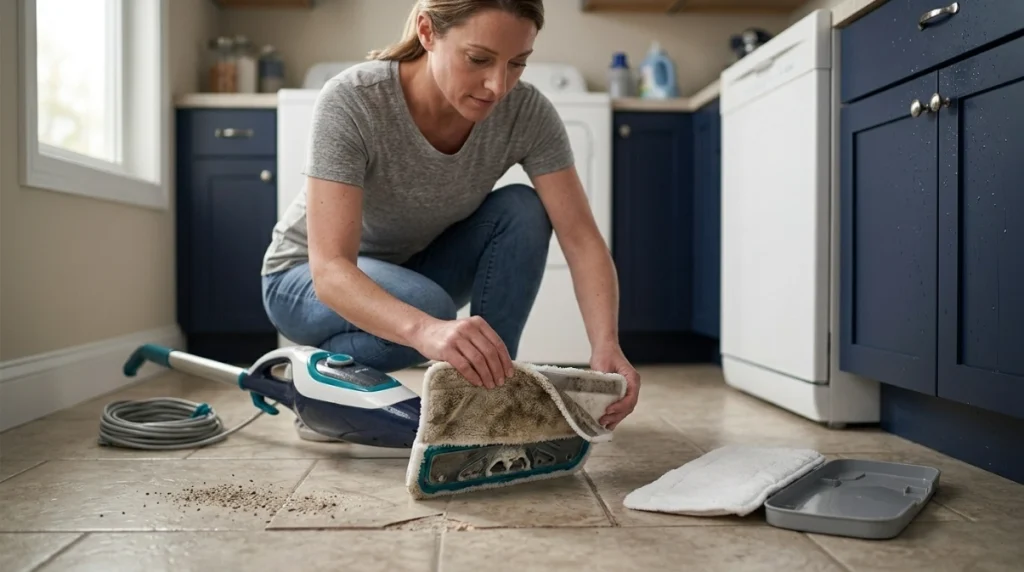
The biggest mistakes are using steam on the wrong floor and leaving the mop stationary. Dirty pads and unapproved tank additives cause many other problems.
Mistakes that can damage floors
- Skipping the care guide: “Sealed” does not mean every floor tolerates steam.
- Steaming over grit: The pad may drag abrasive particles across the finish.
- Holding the mop still: Concentrated heat and moisture can mark a surface.
- Using excessive steam: More vapor does not always produce a cleaner floor.
- Ignoring damaged seams: Vapor can enter gaps that ordinary damp mopping avoids.
- Walking on wet floors: Damp flooring creates a slip risk.
What should go in the water tank?
Use plain water unless the manufacturer permits something else. Some brands recommend distilled or demineralized water in hard-water areas.
For example, Shark’s steam-mop guidance tells users to add water only and check the flooring manufacturer’s care instructions. Your model may have different requirements.
How to maintain the mop
- Unplug the machine and let it cool before maintenance.
- Remove and wash the pad after each substantial cleaning session.
- Empty the tank if the manual advises against storing water.
- Check steam outlets for visible mineral buildup.
- Use only the manufacturer’s approved descaling method.
- Store the mop upright on its tray with a dry pad removed.
Fabric softener can coat microfiber and reduce absorption. Wash pads according to their label, then dry them completely.
Frequently Asked Questions
Can a steam mop replace a regular mop?
A steam mop can replace wet mopping on compatible sealed hard floors. You may still need a microfiber mop for wood, laminate, vinyl, quick spills, and areas without a nearby outlet.
Do you need to vacuum before using a steam mop?
Yes. Vacuuming or sweeping removes grit, hair, crumbs, and dust that a steam mop cannot collect efficiently. This step also reduces scratching and prevents the damp pad from turning loose debris into muddy streaks.
Can you put floor cleaner in a steam mop?
Only add cleaner when the appliance manual expressly permits it. Many models are designed for water alone, and unapproved cleaners can clog internal parts, create fumes, leave residue, or void the warranty.
Can you use a steam mop on hardwood floors?
The safest general answer is no unless the hardwood manufacturer explicitly permits steam. Heat and moisture can enter seams, affect the finish, and contribute to swelling or warping over time.
Can steam mops remove stains?
Steam mops can loosen surface spills and some greasy marks. They cannot reliably remove discoloration absorbed into grout, wood, stone, or damaged finishes. Treat those stains with a product approved for the specific material.
Do steam mops kill germs?
Some models carry tested sanitizing claims when used under precise conditions. Follow the listed steam setting, movement pattern, and contact time. Routine household cleaning is generally enough when no one is sick.
How often should you use a steam mop?
Use it when compatible flooring has visible grime or sticky residue. Many homes need only weekly or occasional steam cleaning, while high-traffic tile may need it more often. Avoid repeated unnecessary heat exposure.
Is a Steam Mop Right for Your Home?
A steam mop makes sense when your home has plenty of manufacturer-approved sealed tile. It is particularly helpful for kitchens, bathrooms, and entryways with sticky surface grime.
It is less suitable for homes dominated by hardwood, laminate, LVP, waxed surfaces, or damaged floors. A microfiber flat mop is the safer all-purpose choice in those spaces.
As of 2026, the most important buying question is not how much steam a model produces. It is whether your flooring warranty permits that heat and moisture.
Check the floor instructions first. Then choose the least aggressive method that removes the mess.
