
What Are Steam Mops? How They Work and Where to Use Them

Quick Answer
A steam mop is an electric floor-cleaning appliance that heats water and sends steam through a reusable cleaning pad. It loosens sticky dirt on sealed, heat-resistant floors without requiring a bucket or conventional floor cleaner, but you should follow your flooring manufacturer’s care guidance and the National Wood Flooring Association recommendations before using steam on wood.
What to know before using one
- Best surfaces: Steam mops usually work best on sealed ceramic tile, porcelain tile, and some sealed stone or vinyl floors.
- Risky surfaces: Heat and moisture may damage hardwood, laminate, unsealed stone, waxed flooring, and adhesive-backed tiles.
- Cleaning action: Hot vapor softens grime while the microfiber pad lifts the loosened material.
- Preparation required: Vacuum or sweep first because most steam mops cannot collect loose crumbs, grit, or hair.
- No automatic disinfection: A floor must reach the required temperature for the required contact time before a germ-killing claim applies.
Quick safety tip
- Test the lowest steam setting in a hidden area and stop if the finish becomes cloudy, soft, or discolored.
I’ve used steam mops on everything from textured kitchen tile to smooth bathroom floors. They can make sticky messes easier, but they are not safe for every hard floor.
This guide explains what steam mops do, how to use one, and when a microfiber mop is safer.
In This Guide
What Is a Steam Mop?
A steam mop is a corded or cordless electric appliance that cleans floors using heated water vapor. It normally has a water tank, heating element, mop head, handle, and washable microfiber pad.
The appliance resembles a slim upright vacuum. However, it does not usually suction dirt into a bin.
Instead, steam passes through openings in the mop head. The pad then wipes away softened grease, residue, and dirt.
A simple steam mop definition
A steam mop is a hard-floor cleaning tool that converts water into vapor and applies it through an absorbent pad. It combines moisture, heat, and wiping action.
Most household models heat up within about 20 to 60 seconds. Tank capacity and steam output determine how long you can clean before refilling.
Main parts of a steam mop
- Water tank: Holds the water that the appliance heats.
- Heating element: Raises the water temperature and produces vapor.
- Steam control: Adjusts the amount of moisture released on supported models.
- Mop head: Directs steam across the cleaning area.
- Microfiber pad: Collects grime and absorbs some remaining moisture.
- Power cord or battery: Supplies the energy needed to heat the water.
Brands such as Bissell and Shark offer traditional steam mops. Some models include scrubbers, spot-steam controls, or removable handheld units.
Steam mops are different from powered floor washers made by brands such as Tineco. Floor washers can apply cleaning liquid and suction dirty water, while a basic steam mop cannot.
How Do Steam Mops Work?
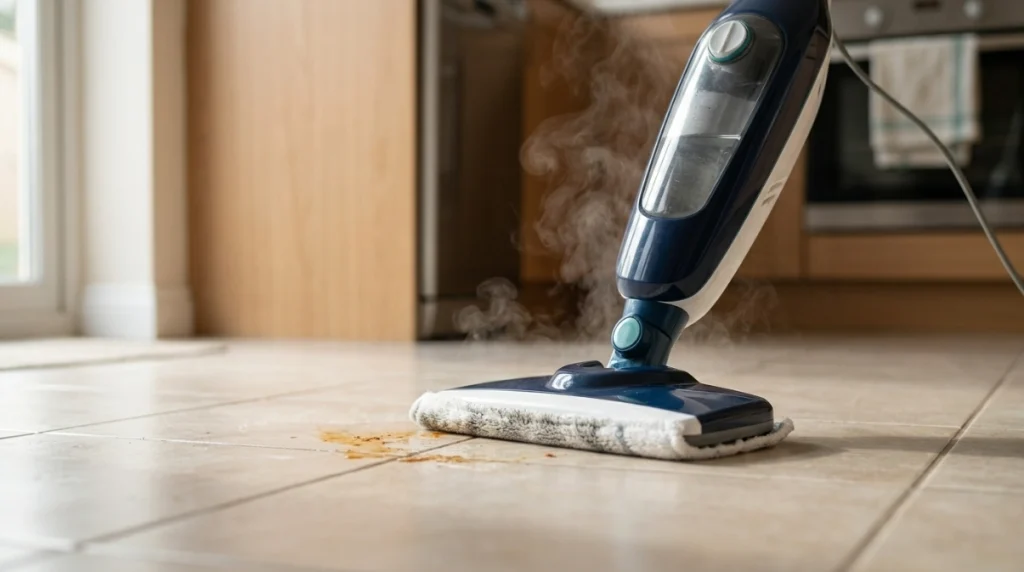
A steam mop heats water inside a small reservoir and directs the vapor toward the floor. The heat softens dried spills, while the damp pad provides the scrubbing action.
The process sounds simple. Floor compatibility and cleaning speed still determine whether it works safely.
The cleaning process
- Water enters the heating chamber. Use the type of water listed in the owner’s manual.
- The heating element produces vapor. An indicator normally shows when the mop is ready.
- Steam moves through the head. Some models release it continuously, while others use a trigger.
- Heat and moisture loosen residue. Grease and sticky spills become easier to wipe away.
- The pad collects the grime. Replace a dirty pad instead of spreading residue across the room.
Does a steam mop vacuum dirt?
Most steam mops do not vacuum. Hair, crumbs, sand, and other loose debris remain on the floor unless you remove them first.
Vacuuming also protects the finish. Grit trapped under the pad can act like sandpaper as you move the mop.
A few hybrid appliances combine vacuuming and steaming. Check the product description because “steam mop” alone does not promise suction.
Do steam mops disinfect floors?
Steam can reduce certain germs when the surface receives enough heat for enough time. However, a quick pass does not automatically disinfect the floor.
Check the appliance instructions for its validated treatment time. The CDC’s home-cleaning guidance also explains that routine cleaning is usually enough unless someone is sick or vulnerable.
Never assume visible steam proves disinfection. The floor surface may be cooler than the water inside the appliance.
Safety note: Follow the steam mop manual, flooring care guide, and any disinfectant label rather than combining unapproved chemicals with heat.
Which Floors Are Safe for Steam Mops?
Steam mops are safest on sealed, heat-resistant, nonporous floors approved by their manufacturers. Ceramic and porcelain tile are usually the strongest candidates.
“Sealed” does not mean every floor can tolerate steam. Seams, worn finishes, adhesives, and hidden cracks may still admit moisture.
| Floor type | General suitability | Main concern | Safer approach |
|---|---|---|---|
| Ceramic or porcelain tile | Often suitable | Cracked grout or loose tiles | Use low or medium steam and keep moving |
| Sealed concrete | Sometimes suitable | Heat-sensitive coating | Confirm with the coating manufacturer |
| Vinyl or LVP | Often restricted | Heat, seams, and adhesive damage | Use a damp microfiber mop unless approved |
| Laminate | Usually avoid | Swollen edges and core damage | Use a barely damp flat mop |
| Hardwood or engineered wood | Avoid unless expressly approved | Finish damage, cupping, and gaps | Use a wood-floor cleaner and microfiber pad |
| Natural stone | Depends on stone and sealer | Porosity, sealer damage, and thermal stress | Use a stone-approved pH-neutral cleaner |
| Waxed or unsealed flooring | Not suitable | Clouding, melting, and moisture absorption | Follow the floor maker’s dry or damp method |
Can you steam-mop hardwood?
Avoid steam on hardwood unless the flooring manufacturer expressly allows it. Moisture can enter seams, while repeated heat may weaken or cloud the finish.
Engineered wood has a real wood surface over layered material. That construction does not automatically make it steam-safe.
Can you steam-mop laminate or LVP?
Many laminate makers prohibit steam because moisture can reach the fiberboard core. Swollen seams and raised edges may not be repairable.
Luxury vinyl plank resists ordinary spills, but heat may affect its joints or adhesive. Check the exact product warranty before steaming.
What about tile and grout?
Sealed ceramic and porcelain tiles usually handle steam better than wood-based floors. Inspect cracked grout, loose tiles, and failed caulk before starting.
Do not hold the mop over one grout line to remove a stain. Use several moving passes or a grout-safe brush instead.
Safety note: Test a hidden area and follow the flooring manufacturer’s care guide before exposing any surface to heat or moisture.
What Are the Benefits and Drawbacks?
Steam mops make some hard-floor jobs quicker because they loosen residue without a bucket. Their main limitation is restricted floor compatibility.
Benefits of steam mops
- Effective on sticky grime: Heat can soften dried food, light grease, and tracked-in residue.
- Less cleaner residue: Many models use plain water, which reduces streaks caused by excess detergent.
- Reusable pads: Washable microfiber pads reduce dependence on disposable mop sheets.
- Fast setup: A small tank usually heats faster than preparing a bucket of hot water.
- Quick surface drying: A thin, controlled steam layer may dry within several minutes on nonporous flooring.
- Useful edge tools: Some heads swivel around toilets, table legs, and narrow kitchen spaces.
I find steam most helpful for dried spots on textured tile. Two slow moving passes often work better than heavy scrubbing with a wet string mop.
Drawbacks and limitations
- Floor restrictions: Steam may void warranties or damage moisture-sensitive surfaces.
- No debris collection: You still need to sweep or vacuum first.
- Small tanks: Compact models may require refilling during a large cleaning job.
- Cord management: A power cord can catch on furniture or cross the damp area.
- Pad changes: A saturated or dirty pad leaves streaks and redistributes grime.
- Burn risk: Hot vapor, the mop head, and a freshly removed pad can injure skin.
Steam also does not replace every cleaner. An enzyme cleaner may be more suitable for pet accidents, while a pH-neutral product may be safer for stone.
Safety note: Never add vinegar, bleach, essential oils, or floor cleaner to the tank unless the steam mop manufacturer specifically permits it.
Steam Mop vs. Regular Mop: Which Is Better?
A steam mop is better for sticky grime on approved heat-resistant floors. A regular microfiber or spin mop is more versatile and safer for moisture-sensitive surfaces.
| Feature | Steam mop | Microfiber flat mop | Spin mop |
|---|---|---|---|
| Cleaning action | Heat, moisture, and wiping | Light moisture and wiping | Water, cleaner, and scrubbing |
| Best use | Sticky spots on approved tile | Routine dust and light soil | Larger, dirtier washable floors |
| Loose debris pickup | Poor | Good for dust and hair | Limited |
| Floor compatibility | Most restricted | Broad with correct moisture level | Moderate |
| Cleaner needed | Usually no | Sometimes | Often |
| Typical drying time | About 2–10 minutes | About 5–15 minutes | About 10–30 minutes |
Drying times vary with steam output, humidity, ventilation, pad condition, and flooring texture. Puddles indicate excessive moisture or poor technique.
Choose a microfiber flat mop for hardwood, laminate, or quick daily cleaning. Choose a steam mop when the floor maker approves heat and sticky residue is the main problem.
How Do You Use a Steam Mop Correctly?
Vacuum first, attach a clean pad, and use the lowest effective steam setting. Keep the mop moving so heat and moisture do not build up in one area.
Step-by-step instructions
- Check floor approval. Read the flooring warranty and steam mop manual before cleaning.
- Inspect the surface. Look for open seams, damaged finish, loose tiles, or cracked grout.
- Remove loose dirt. Vacuum or sweep the entire area, including corners and edges.
- Attach a clean pad. Secure it before filling or heating the appliance.
- Fill the tank. Use the recommended water and never exceed the fill line.
- Allow the mop to heat. Wait for the ready light or signal.
- Test a hidden spot. Use the lowest setting and inspect the dry surface.
- Mop in controlled passes. Move with the grain or tile pattern and avoid prolonged pauses.
- Change dirty pads. Replace the pad when it turns dark or stops absorbing grime.
- Let the floor dry. Keep children and pets away until the surface is cool and dry.
How slowly should you move?
Follow the speed stated in your appliance manual. For ordinary cleaning, use overlapping passes without leaving the hot head stationary.
Do not increase contact time based on guesswork. Excessive exposure can damage finishes without guaranteeing disinfection.
Common steam-mopping mistakes
- Using steam without checking the flooring warranty.
- Mopping over sand, crumbs, pet hair, or sharp debris.
- Leaving the heated mop standing on an exposed floor.
- Continuing with a dirty or saturated microfiber pad.
- Adding unapproved chemicals or fragrance oils to the tank.
- Directing steam toward people, pets, electrical outlets, or appliances.
- Storing the mop with water remaining in its tank.
After cleaning, unplug the mop and let it cool on a protected surface. Empty the tank if the manual recommends it, then wash the pad separately from fabric softener.
Safety note: Steam can cause burns. Unplug and cool the appliance before removing the pad, clearing a blockage, or performing maintenance.
What Features Should You Look For?

Choose a steam mop based on floor approval, steam control, pad design, and practical handling. More accessories do not always produce better floor cleaning.
Useful buying criteria
- Adjustable steam: Multiple settings provide better moisture control for different approved surfaces.
- Fast heat-up: A ready time below one minute makes quick cleanups more convenient.
- Tank capacity: A larger tank extends runtime but adds weight to the handle.
- Removable tank: Detachable tanks are easier to fill without spills.
- Washable pads: Look for pads that are easy to replace and widely available.
- Swivel head: A flexible joint improves movement around furniture and bathroom fixtures.
- Long power cord: More reach reduces outlet changes, but requires careful cord management.
- Standing pad or tray: A resting tray helps protect the floor while the unit heats or cools.
- Clear warranty terms: Review coverage for the mop and confirm compatibility with your flooring warranty.
As of 2026, you can also find hybrid steam cleaners with detachable handheld tools. These may clean approved counters or bathroom surfaces, but each attachment has separate safety rules.
Do not choose a model only because it advertises high heat. Consistent steam control and a well-designed pad often matter more during routine cleaning.
Steam Mop FAQs
Can you put floor cleaner in a steam mop?
Do not add floor cleaner unless the appliance manual explicitly permits it. Unapproved liquid may damage the heater, create irritating vapor, leave residue, or void the warranty.
Can you use tap water in a steam mop?
Some models accept tap water, while others recommend distilled or demineralized water in hard-water areas. Follow the manual because mineral deposits can restrict steam openings and shorten appliance life.
Do steam mops leave floors wet?
A correctly used steam mop should leave a light film of moisture rather than puddles. Excess water may indicate high steam output, a saturated pad, slow movement, or an appliance fault.
Do you need to sweep before steam-mopping?
Yes. Sweep or vacuum first because ordinary steam mops do not collect crumbs, sand, or pet hair, and trapped grit may scratch the finish.
Are steam mops safe around children and pets?
Keep children and pets away while the appliance is operating and until the floor dries. Hot vapor, cords, the mop head, and freshly cleaned slippery flooring can create injury risks.
How often should you use a steam mop?
Use it when an approved floor needs deeper cleaning rather than automatically every day. High-traffic tile may need weekly cleaning, while occasional spot treatment may be enough elsewhere.
Can steam mops clean carpets?
A standard steam mop does not extract dirt from carpet like a carpet cleaner. A carpet glider may refresh fibers on some models, but it does not provide deep washing or suction.
Is a Steam Mop Right for Your Home?
A steam mop can be useful if your home has approved tile or another sealed, heat-resistant surface. It is especially convenient for sticky kitchen residue and quick bathroom cleaning.
Choose a microfiber flat mop when you have hardwood, laminate, uncertain floor warranties, or mixed flooring. That option gives you more control over moisture and cleaning solution.
Before buying, check every floor type in your home. If even one manufacturer prohibits steam, plan a separate cleaning method for that room.
Start with the lowest setting, keep the head moving, and use clean pads. Those three habits deliver better results while reducing avoidable floor damage.
